Rockridge Tower Shrinks to 372 Units. The Grocery Tripled.
Align's Rockridge tower plan lost 43 homes and gained a full-size grocery store. Here is what the revised 5727 College Avenue project actually trades away, and what it would add to a neighborhood that already has Oakland's best amenities score.

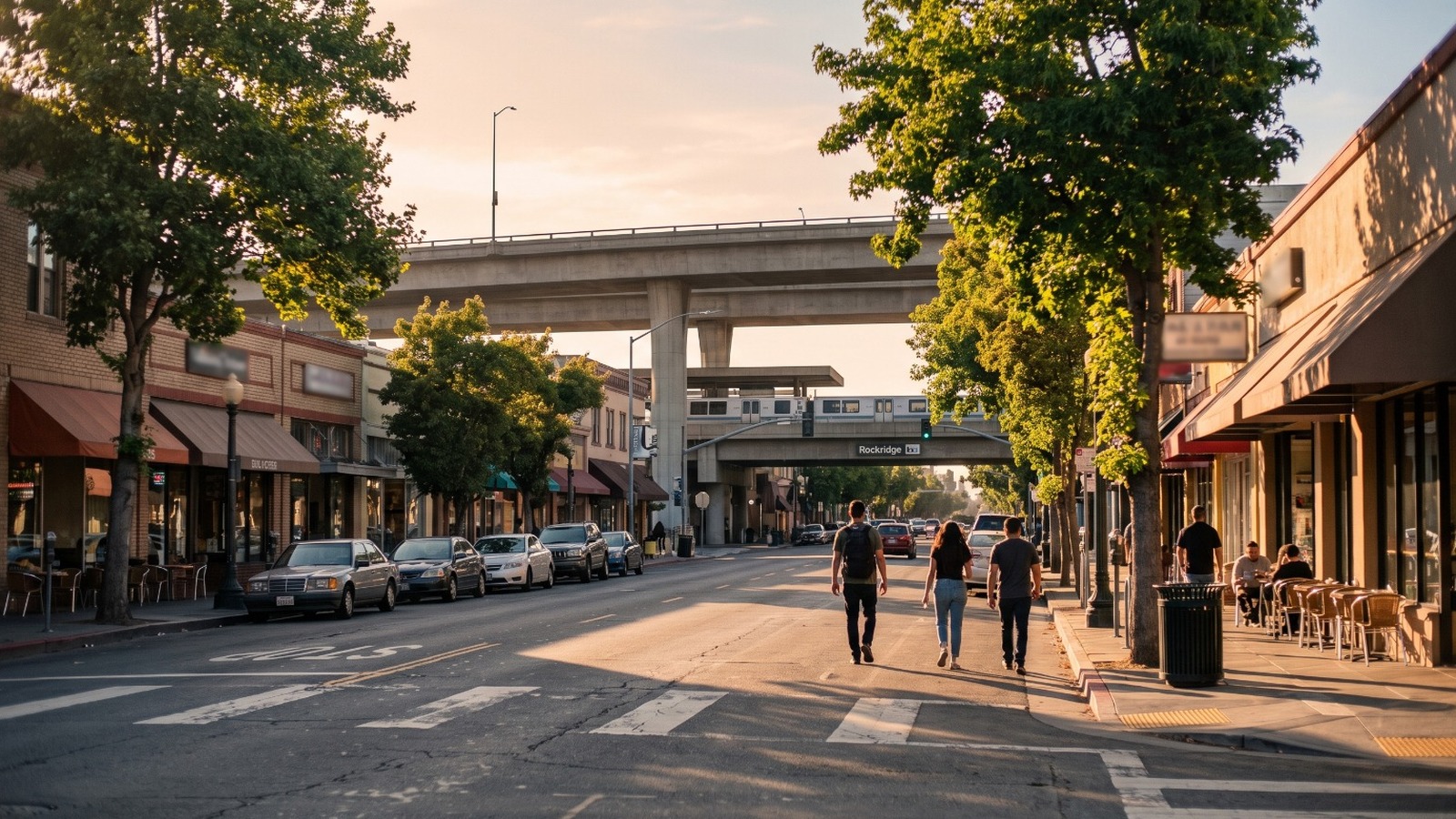
College Avenue in Oakland's Rockridge neighborhood beside the elevated BART station, near the site of the proposed 372-unit senior housing towers. Photo: Houseberry
The revised plan for 5727 College Avenue is 43 homes smaller and one entire grocery store bigger. Align Real Estate's two-tower senior housing project on the Rockridge Trader Joe's site now proposes 372 units instead of 415, and the taller tower comes down from 31 stories to 26. In return, ground-floor retail grows from 5,950 square feet to 18,800, including roughly 13,000 square feet set aside for a grocery next to Rockridge BART. That swap, not the height cut, is the story.
The short version, in five numbers:
- 372 senior housing units, down from 415 in the April 2026 filing
- Towers of 26 and 23 stories (306 and 276 feet), down from 31 and 25
- 18,800 square feet of retail, including about 13,000 square feet of BART-adjacent grocery space
- 263 car parking spaces and 60 bike spaces on a 1.5-acre site
- Filed under AB 130, SB 330, and State Density Bonus Law, the same three tools that made the first version hard to stop
What changed between April and August
Every dimension of the building got smaller except the part the neighborhood was fighting about. Here is the before and after, using the applicant's own figures as reported by San Francisco YIMBY.
| Element | April 2026 filing | August 2026 revision |
|---|---|---|
| Taller tower | 352 feet, 31 stories | 306 feet, 26 stories |
| Shorter tower | 294 feet, 25 stories | 276 feet, 23 stories |
| Total homes | 415 | 372 |
| Ground-floor retail | 5,950 sq ft | 18,800 sq ft |
| Grocery space | Not specified | About 13,000 sq ft |
Read the bottom two rows together and the trade is obvious. The applicant gave up 43 homes and about 46 feet of height, and bought back 12,850 square feet of retail. In a project designed by Solomon Cordwell Buenz on a site owned by Albertsons, that is not a rounding error. It is a deliberate purchase of goodwill, paid for in housing units.
Rockridge was never really arguing about height
The petition that got 1,000-plus signatures this spring was about losing a grocery store, not about a skyline. Read the Rockridge Community Planning Council's own writeup or the coverage of the July community meeting and the same worry shows up over and over: where does a person without a car buy groceries on College Avenue.
Height was the available weapon. Groceries were the actual grievance.
About 13,000 square feet is a normal-size Trader Joe's, which is almost certainly the point. The applicant's language, quoted in the filing, is that the project now includes space for an approximately 13,000-square-foot BART-adjacent grocery. Space for. Not a signed tenant.
And that is the honest weak spot in the revision. Nobody has committed a grocer to that floor plate, and even in the best case the current store closes years before a new one opens. A neighborhood that walks to its groceries would spend the whole construction period driving to Berkeley Bowl or the Broadway Safeway. That cost is real, and it lands on exactly the residents who have the fewest alternatives.
What 372 senior homes would do to a neighborhood that is already full
Rockridge is the North Oakland neighborhood strung along College Avenue between Temescal and the Berkeley line, and by our numbers it is the most amenity-rich place in the city. It carries a 4.6 out of 5 amenities score, the highest of Oakland's 130 ranked neighborhoods, alongside a 4.0 school score and a 3.4 safety score. Its overall score of 3.8 puts it 7th citywide. The median sale price in Rockridge was about $2.09M in July 2026, up 1.2 percent year over year.
Those two facts together explain why this site draws a tower proposal and why the proposal draws a fight. Land next to a BART station in the best-served neighborhood in Oakland is the single most valuable place in the city to put homes, and it is also the place where the people already there have the most to lose from three years of construction.
Here is the part almost nobody in this argument is saying out loud. Of the 372 units, 340 are independent living, 12 are assisted living, and 20 are memory care. Independent living is where people go when the Craftsman gets too big and the staircase stops being a feature. Most of them come from within a few miles.
Every one of those moves puts a house back on the market in a neighborhood where houses do not turn over. A built-out place like Rockridge cannot add family housing by building family housing, because there is nowhere to put it. It can add family housing by giving longtime owners somewhere to go. When we compare neighborhoods on our Rockridge page, the constraint that shows up over and over is supply, not desirability, and this is one of the few levers that touches supply without touching a single-family lot.
The trade-off worth naming: independent living at this address will not be cheap, and the applicant has published no affordable set-aside for the senior units. This is a supply argument, not an affordability one.
The parking count says more than the renderings do
263 spaces for 372 units works out to about 0.7 cars per home, on a site where the BART fare gates are a two-minute walk away and the residents are mostly over 62. For comparison, Oakland's own zoning on this block tops out around 95 feet, a limit written for an era when the assumption was that everyone drove.
If the traffic argument against this project were correct, that parking ratio would be a problem the developer had to solve. It is not, because a senior building next to heavy rail generates a fraction of the trips a market-rate apartment tower would. The cars people are picturing on College Avenue are mostly grocery customers, which is the same fight as before, wearing a different hat.
Oakland's leverage is narrower than the hearing room suggests
We walked through the legal picture in July, and the revision does not change it. Between AB 130, SB 330's protections against moving the goalposts mid-application, and the State Density Bonus Law, a compliant housing project on this parcel is very difficult for the city to simply reject. What Oakland has is conditions, timing, and negotiating leverage. What it does not have is a no button.
Which makes the retail expansion easier to understand. Align did not need to give the neighborhood a grocery store. It gave one anyway, because a project that arrives at the Planning Commission with the neighborhood's core demand already answered is a project that gets built sooner.
What happens next, and the dates worth writing down
The formal application starts the clock. Watch for the city's completeness determination, then the density bonus concession list, which is where the real negotiation happens and where the public almost never looks. After that comes environmental review and a Planning Commission hearing, neither of which has a published date yet.
Two things would tell you more than any rendering. First, whether a grocery tenant is ever named, because space for a grocery and a signed grocery lease are different assets. Second, whether the unit count holds at 372, since concessions granted under the density bonus can move it back up. If you follow Rockridge, those are the two numbers to track. Everything else is set dressing on a project the state has already made very hard to stop.
Sources
- San Francisco YIMBY: Reduced Height and Increased Retail For Rockridge Tower, Oakland
- San Francisco Chronicle: Oakland housing proposal revised after Trader Joe's backlash
- Oaklandside: Rockridge Trader Joe's could be replaced by 415-unit senior housing towers
- Oakland North: Rockridge residents urge city to stop tower development
- Rockridge Community Planning Council: Trader Joe's Senior Housing Project
- Houseberry: best neighborhoods for amenities in Oakland
The Houseberry Research Team is Houseberry's reporting team: Bay Area real estate analysts, data specialists and longtime local market watchers. Every day we check the public record: building permits, city council and planning agendas, county recorder filings, state housing bills, police incident data and school results. Then we tie each story to what it means for specific neighborhoods, using Houseberry's own neighborhood data on prices, appreciation, safety, schools and amenities. Questions or corrections: Contact us.
All information provided on this website including but not limited to - school ratings, safety, amenities, user opinions, and property data - is for general informational purposes only. We do not guarantee its reliability, accuracy, or completeness. Users should independently verify information and consult appropriate professionals as needed. By using this website, you agree Houseberry is not responsible for actions, decisions, or consequences arising from reliance on the information provided
houseberry.com - CA DRE# 01847391
 Bay East ©2025. CCAR ©2025. bridgeMLS ©2025. Information Deemed Reliable But Not Guaranteed. This information is being provided by the Bay East MLS, or CCAR MLS, or bridgeMLS. The listings presented here may or may not be listed by the Broker/Agent operating this website. This information is intended for the personal use of consumers and may not be used for any purpose other than to identify prospective properties consumers may be interested in purchasing. Data last updated at October 3, 2026 12:00 AM