The Rockridge Trader Joe's Could Become Two Towers
A developer wants to replace the Rockridge Trader Joe's with two senior-housing towers up to 31 stories across from BART. Here is what is proposed, why state law makes it hard to stop, and what to watch.

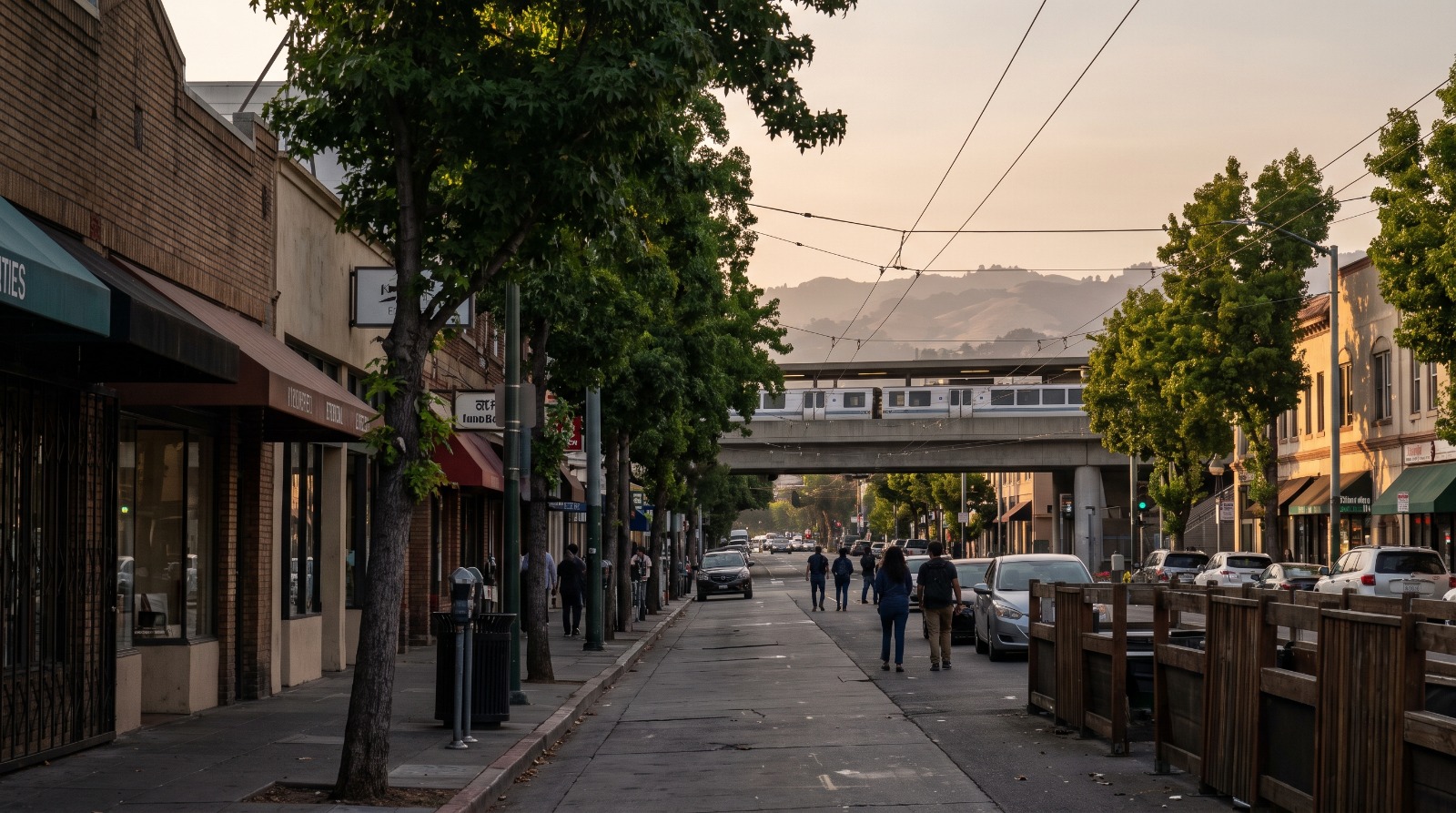
The low-rise College Avenue block by Rockridge BART in Oakland, where the Rockridge Trader Joe's could be replaced by two housing towers. Photo: Houseberry
A San Francisco developer wants to tear down the Rockridge Trader Joe's on College Avenue and put two residential towers in its place, one of them 31 stories tall. The site sits directly across the street from the Rockridge BART station, and the plan would swap a single-story grocery store for 415 senior-housing units. That is the short version of a fight that has quietly become the loudest land-use argument in North Oakland.
The proposal is early, and nothing is approved. But the Rockridge Trader Joe's towers are worth understanding now, because the reason this project is hard to stop has almost nothing to do with the towers themselves. It has to do with a stack of state housing laws that changed what Oakland is allowed to say no to.
The Trader Joe's would be demolished, though the plans have it operating for a few more years before the store closes and construction begins, as The Real Deal reported. So this is not an imminent change. It is a very early filing, a zoning worksheet and a 36-page preliminary application, with years of process still ahead.
The state laws are the real story
Here is why Rockridge residents cannot simply pack a hearing and kill this. The project leans on the State Density Bonus Law, which lets a housing developer exceed local limits on height and density in exchange for qualifying units, and on SB 330, the Housing Crisis Act, which caps how many hearings a city can hold and locks in the rules that applied when the application was filed. Add recent CEQA streamlining and the Housing Accountability Act, which can fine a city for wrongly rejecting housing, and Oakland's room to say no gets narrow.
Oakland's own city attorney told the Piedmont Exedra that it was hard to find real legal reasons to deny the project at a time when the state wants these laws applied broadly. That is the whole ballgame.
The politics have a local twist. The area is represented by Assemblymember Buffy Wicks, one of Sacramento's most prominent authors of the very housing-streamlining laws now making this project hard to block. An SF Chronicle column by Joe Garofoli framed the story as Wicks watching her own corner of Oakland test the rules she helped write. However you read the politics, the underlying point holds. The same laws that let 300 homes rise near a Peninsula Caltrain stop are the laws letting towers rise over a Rockridge grocery store.
There is also SB 79, the transit-density law that took effect on July 1, 2026, which automatically allows more height and homes near major transit. Rockridge BART is one of Oakland's highest-tier stops, which is exactly why a site across the street draws a proposal like this. We wrote about how SB 79 is now live and splitting Bay Area cities if you want the wider picture. And to be straight about where we land, 415 homes across the street from a BART station is close to a textbook case of where the region should be adding housing. The objection worth taking seriously is not the density. It is the grocery store.
The grocery fight is the neighborhood fight
Strip away the zoning acronyms and the loudest local worry is simple. Rockridge would lose its most affordable grocery store, and there is no plan to replace it. The store also happens to be the first unionized Trader Joe's in the country, with more than 120 employees. A Change.org petition to save it has gathered close to a thousand signatures.
The Rockridge Community Planning Council, which is not a reflexively anti-housing group, says it supports density near transit but objects to this project's height and form. Residents have also raised seismic concerns, since Temescal Creek runs culverted under the area, along with the picture of memory-care residents on the upper floors of a 31-story tower on that ground.
This is the part that maps onto how we look at neighborhoods. A grocery store you can walk to is not a luxury. It is a real amenity that shows up in daily life and, over time, in value. Rockridge ranks 15th of 130 Oakland neighborhoods on its Houseberry neighborhood page, and its high amenities score is built partly on this kind of walkable, everyday convenience. A version of this project that adds 415 homes and keeps a grocery on the ground floor would be a genuinely good outcome. The current version asks the neighborhood to trade one for the other.
What to watch if you follow Rockridge
For now, the honest status is early. The application is filed, not approved, and the developer itself says the store will operate for years. District Councilmember Zac Unger has said he wants real community benefits and is in no rush to let the developer cut corners. Mayor Barbara Lee has stressed the community process.
The things worth tracking are concrete. Whether the project adds any below-market units, since right now it has none. Whether a grocery replacement shows up in a later design. And how Oakland decides to steer growth toward commercial corridors like College, Broadway, and Telegraph. If you are comparing Oakland neighborhoods right now, this is a useful reminder that the map is not fixed. Zoning, a transit line, and a single grocery store can all move how a place actually lives, which is the whole reason we look at how Oakland's neighborhoods rank on schools, safety, and amenities before falling for a listing.
None of this is settled, and it will not be for a while. But the Rockridge Trader Joe's towers are a preview of a fight a lot of Bay Area neighborhoods are about to have. The state has decided the region needs more homes near transit, and it is not really asking. The open question, here and everywhere, is whether cities can get the homes and keep the things that made the neighborhood worth moving to.
Sources
- SF YIMBY: Trader Joe's could become a skyscraper in Rockridge
- The Real Deal: Senior housing coming to Oakland grocery store site
- The Daily Californian: Rockridge Trader Joe's may be replaced by two senior living towers
- Piedmont Exedra: State laws may make the Rockridge project hard to stop
- KTVU: Popular Rockridge Trader Joe's could be replaced by senior housing
- Rockridge Community Planning Council: Trader Joe's senior housing project
- SF Chronicle: Joe Garofoli on the Rockridge housing fight
- Change.org petition to save Rockridge's Trader Joe's
The Houseberry Research Team is Houseberry's reporting team: Bay Area real estate analysts, data specialists and longtime local market watchers. Every day we check the public record: building permits, city council and planning agendas, county recorder filings, state housing bills, police incident data and school results. Then we tie each story to what it means for specific neighborhoods, using Houseberry's own neighborhood data on prices, appreciation, safety, schools and amenities. Questions or corrections: Contact us.
All information provided on this website including but not limited to - school ratings, safety, amenities, user opinions, and property data - is for general informational purposes only. We do not guarantee its reliability, accuracy, or completeness. Users should independently verify information and consult appropriate professionals as needed. By using this website, you agree Houseberry is not responsible for actions, decisions, or consequences arising from reliance on the information provided
houseberry.com - CA DRE# 01847391
 Bay East ©2025. CCAR ©2025. bridgeMLS ©2025. Information Deemed Reliable But Not Guaranteed. This information is being provided by the Bay East MLS, or CCAR MLS, or bridgeMLS. The listings presented here may or may not be listed by the Broker/Agent operating this website. This information is intended for the personal use of consumers and may not be used for any purpose other than to identify prospective properties consumers may be interested in purchasing. Data last updated at October 18, 2026 12:00 AM