San Francisco's below-market condos for sale start at $222,167
Five below-market-rate condos are open on DAHLIA, from a $222,167 South Beach studio to a $442,519 two-bedroom at The Beacon. Here are the income caps, the deadlines and what each would cost a month at 7.40 percent.

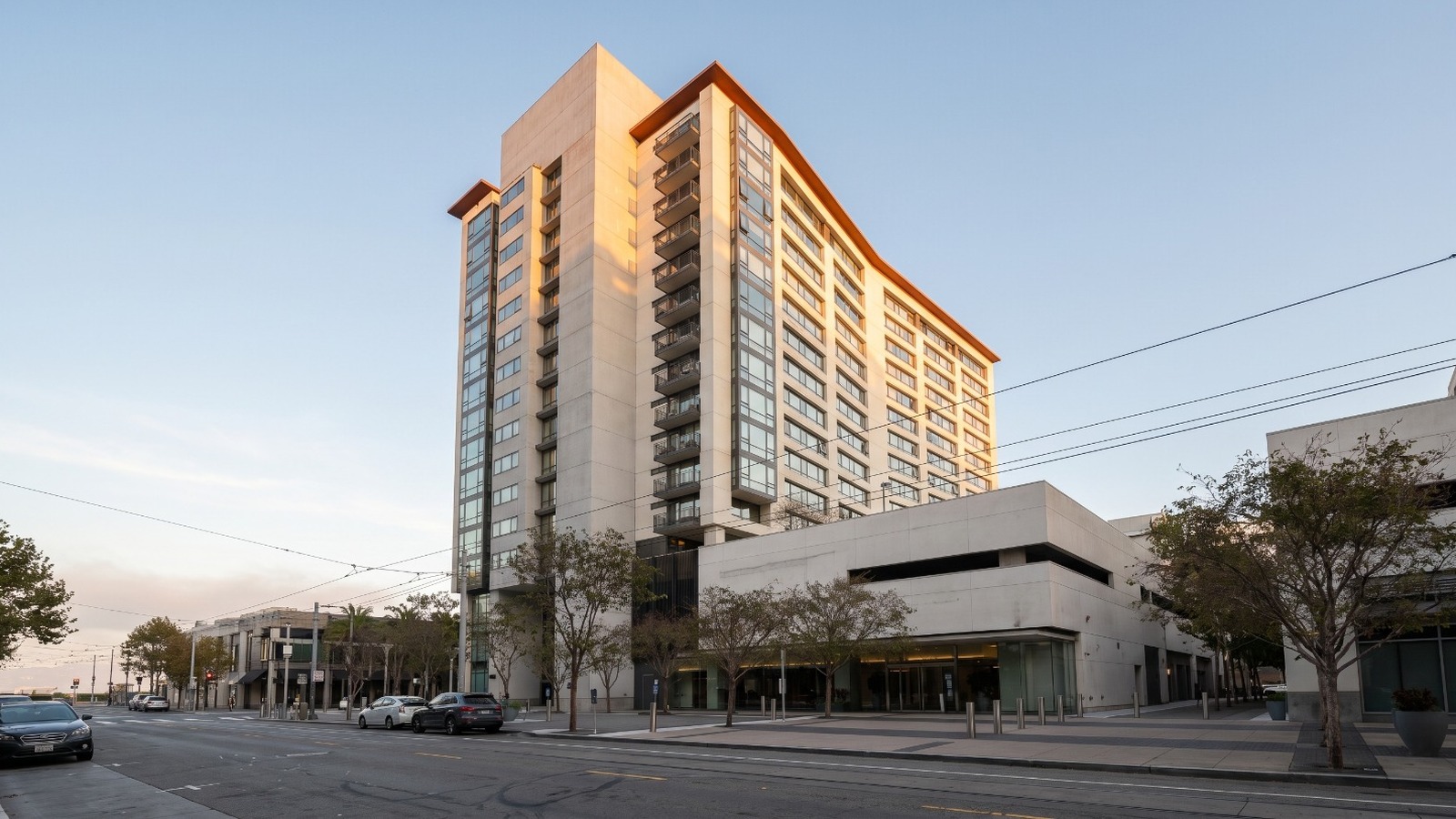
AI-rendered golden-hour view of The Beacon condominium tower at 250 King Street in San Francisco, home to one of the city's BMR condos for sale Photo: Houseberry
A two-bedroom condo in South Beach, 1,420 square feet with a parking space, for $309,624. That is the price on 200 Brannan Street #114, one of five below-market-rate condos San Francisco is selling by lottery right now. The first applications are due October 21.
All five are resales of city-restricted units listed on DAHLIA, the housing portal run by the Mayor's Office of Housing and Community Development (MOHCD). They run from a $222,167 studio at 1 Federal Street to a $442,519 two-bedroom at The Beacon, 250 King Street, across from the ballpark. For scale, the typical home in South Beach was worth about $1.23 million in September 2026, according to Houseberry data.
The catch is the deal you sign. You buy below market, and you sell below market, at a price the city sets for the next qualifying household. For a first-time buyer whose household earns from about $73,000 up to the program caps, that trade is still the cheapest way into owning in San Francisco. The payment math at a 7.40 percent mortgage rate decides which of the five actually pencil out.
The five condos open now
Three of the five sit near the ballpark, two of them in the same 2003 complex that DAHLIA lists as 200 Brannan/1 Federal. The other two are a 2016 building in Hayes Valley and Goldmine Hill, the 1975 complex on the slope between Glen Park and Diamond Heights. Every price below includes one parking space.
| Unit | Area | Size | Price | HOA a month | Income cap | Apply by | Lottery |
|---|---|---|---|---|---|---|---|
| 1 Federal St #47, studio | South Beach | 795 sq ft | $222,167 | $946 | 100% AMI | Oct. 22 | Oct. 30 |
| 60 Ora Way H101, studio | Glen Park | 489 sq ft | $289,000 | $804 | 140% AMI | Oct. 28 | Nov. 3 |
| 200 Brannan St #114, 2BR | South Beach | 1,420 sq ft | $309,624 | $1,101 | 100% AMI | Oct. 21 | Oct. 29 |
| 400 Grove St #101, 1BR | Hayes Valley | 485 sq ft | $428,000 max | $1,148 | 100% AMI | Oct. 31 | Nov. 6 |
| 250 King St #518, 2BR | Mission Bay | 1,197 sq ft | $442,519 | $1,162 | 120% AMI | Oct. 21 | Oct. 27 |
Size is where the five split apart. The Brannan two-bedroom works out to $218 a square foot. The Hayes Valley one-bedroom, listed at 485 square feet, is $882, four times as much. Its listing also sets an "affordable price" of $400,830 and lets buyers offer anything up to $428,000, but paying above $400,830 rules out the city's BMR down payment loan.
The program labels tell you where each unit came from. The King, Brannan and Federal units are overseen by OCII, the successor to the city's Redevelopment Agency. Goldmine Hill is a condo-conversion BMR. 400 Grove is an inclusionary unit, the share a private developer had to set aside. The Beacon and Brannan two-bedrooms require at least two people in the household, and results post a week after each lottery, from November 3 to November 13.
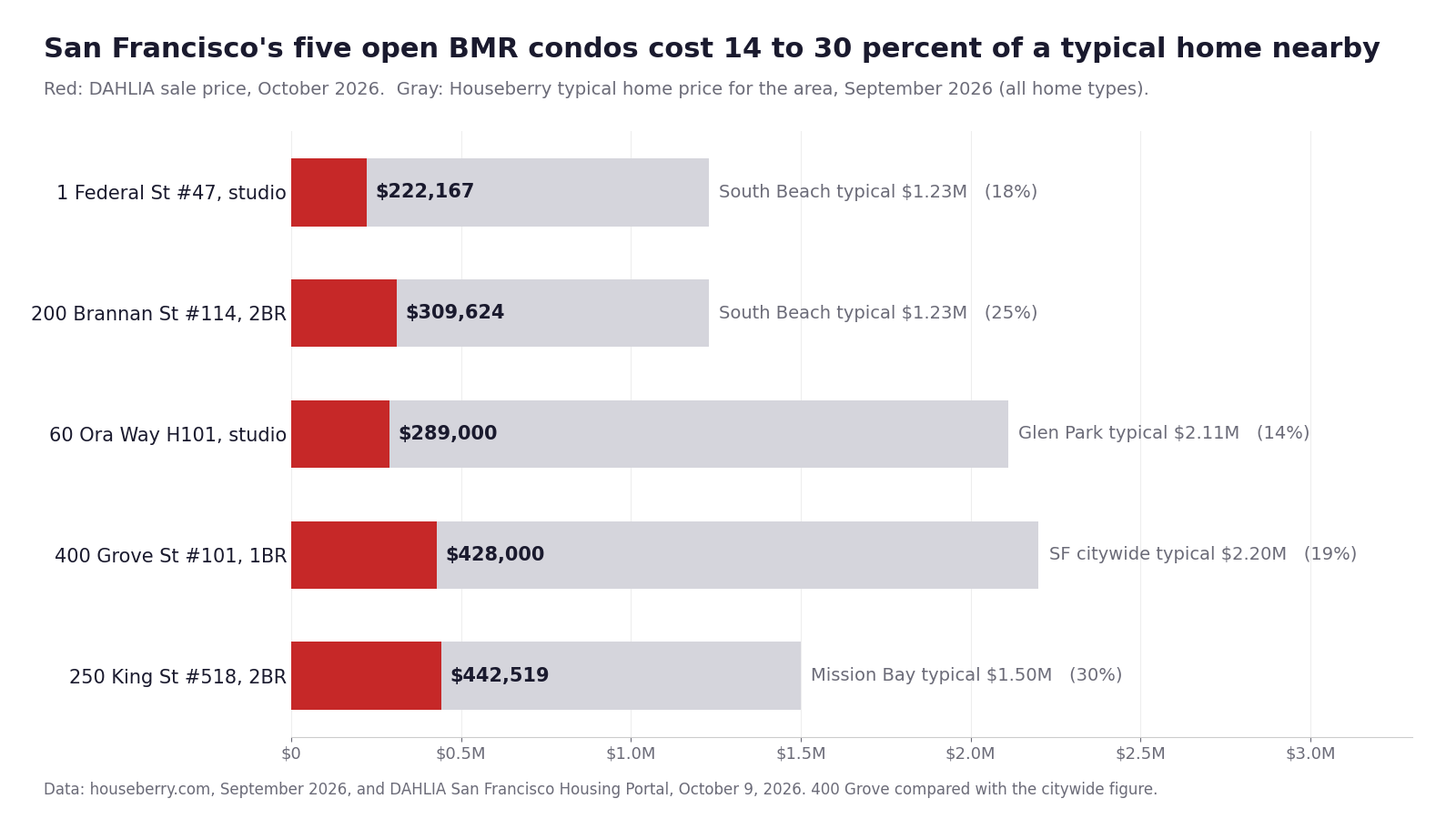
Set against the neighborhoods, the discounts are steep. The Beacon unit is about 30 percent of Mission Bay's typical home price of about $1.50 million in September 2026. Goldmine Hill's studio is about 14 percent of the $2.11 million typical price Houseberry shows for Glen Park. Those typical prices cover every kind of home, houses included, so read them as the neighborhood's going rate, not as a comp for a 489-square-foot studio.
Hayes Valley is the exception we could not measure cleanly. Houseberry's Hayes Valley median swung from $2.96 million to $9.94 million over the last 12 months on a thin run of sales, so we compared 400 Grove with the citywide typical price of $2.2 million instead.
The scores fill in what the price does not. On Houseberry, Glen Park rates 4.2 out of 5 for safety, South Beach rates 3.8 for amenities (16th of 92 San Francisco neighborhoods) and 3.5 for safety, and Mission Bay sits at 3.9 for safety and 3.6 for amenities.
What each one costs a month at 7.40 percent
This is an illustration, not a quote. We assumed 3 percent down, the figure sf.gov calls typical, and a 30-year fixed loan at the Freddie Mac average of 7.40 percent for the week of October 8. The income column adds San Francisco's 1 percent base property tax and uses the program's top housing-cost ratio of 43 percent of gross income. Homeowner's insurance and any special assessments would push the real number higher.
| Unit | Mortgage plus HOA | Income needed, about | Cap for smallest household |
|---|---|---|---|
| 1 Federal St #47 | $2,438 | $73,000 | $113,450 (1 person) |
| 60 Ora Way H101 | $2,745 | $83,000 | $158,850 (1 person) |
| 200 Brannan St #114 | $3,180 | $96,000 | $129,700 (2 people) |
| 400 Grove St #101 | $4,022 | $122,000 | $113,450 (1 person) |
| 250 King St #518 | $4,134 | $126,000 | $155,650 (2 people) |
Four of the five leave a real income window. 400 Grove does not, for a single buyer. At the $428,000 ceiling, one person at the $113,450 cap would need roughly 14 percent down, about $60,000, to keep the payment under 43 percent of income. A two-person household, capped at $129,700, clears it with the minimum down payment.
HOA dues are the other number to read slowly. On the 1 Federal studio, $946 a month is 39 percent of the payment, and sf.gov warns that HOA fees can rise every year. Goldmine Hill's listing adds a warning of its own: pooled insurance at the complex "may make financing difficult," so check with your lender before you count on it.
We think 200 Brannan #114 is the best deal on this list. It is the largest unit, the cheapest per square foot, and a two-person household earning about $96,000 to $129,700 can carry it at today's rate. The trade-off is real. You will sell it back into the program at a restricted price, so it builds far less equity than a market-rate condo down the block, and you cannot rent it out.
The rules that come with the price
San Francisco's BMR ownership rules start with the first-time buyer test: no one in the household can have owned residential property in the last three years. The home has to be your primary residence, and any refinance needs MOHCD's approval through an approved lender.
Before you apply, sf.gov's eligibility page asks for homebuyer education from a MOHCD-approved counseling agency (a 2-hour orientation, 6 hours of workshops and a one-on-one session) and a preapproval letter from a MOHCD-approved lender, dated within 120 days. The loan has to be a 30-year fixed, with no adjustable or interest-only products. You put in at least 1 percent of the price, and gift money counts. The first $80,000 of savings is ignored when the city counts your income, and 10 percent of anything above that is added in.
Four listings carry temporary waivers that loosen those rules until June 30, 2027. They raise the qualifying income level, let buyers finish homebuyer education after applying, exclude income from assets, and allow a down payment over 50 percent of the price. 400 Grove's listing shows none of them.
Income limits come from MOHCD's 2026 chart, effective June 1. At 100 percent of median, a three-person household can earn up to $145,900 and a four-person household $162,100. At 140 percent, the Goldmine Hill level, one person can earn up to $158,850. Lottery preference goes first to Certificate of Preference holders and displaced tenants, then to people who live or work in San Francisco.
If renting is the better match for your budget, our October roundup of 148 below-market rentals covers that lottery.
The Beacon and Brannan applications close first, on October 21, and the winners will own 1,197 and 1,420 square feet for less than a third of their neighborhoods' typical price. Before you apply, see how South Beach, Mission Bay and Glen Park stack up against the rest of the city on our San Francisco neighborhood ranking.
Sources
- DAHLIA San Francisco Housing Portal, for-sale listings, listings pulled October 9, 2026
- MOHCD 2026 Maximum Income by Household Size, effective June 1, 2026
- sf.gov, Below Market Rate ownership program rules
- sf.gov, Determine if you can buy in the affordable housing program
- Freddie Mac Primary Mortgage Market Survey, October 8, 2026
- Houseberry San Francisco neighborhood ranking and neighborhood price histories, September 2026
The Houseberry Research Team is Houseberry's reporting team: Bay Area real estate analysts, data specialists and longtime local market watchers. Every day we check the public record: building permits, city council and planning agendas, county recorder filings, state housing bills, police incident data and school results. Then we tie each story to what it means for specific neighborhoods, using Houseberry's own neighborhood data on prices, appreciation, safety, schools and amenities. Questions or corrections: Contact us.
Map of San Francisco Neighborhoods
Loading map...
View Full Map
Top Neighborhoods in San Francisco, CA





All information provided on this website including but not limited to - school ratings, safety, amenities, user opinions, and property data - is for general informational purposes only. We do not guarantee its reliability, accuracy, or completeness. Users should independently verify information and consult appropriate professionals as needed. By using this website, you agree Houseberry is not responsible for actions, decisions, or consequences arising from reliance on the information provided
houseberry.com - CA DRE# 01847391
 Bay East ©2025. CCAR ©2025. bridgeMLS ©2025. Information Deemed Reliable But Not Guaranteed. This information is being provided by the Bay East MLS, or CCAR MLS, or bridgeMLS. The listings presented here may or may not be listed by the Broker/Agent operating this website. This information is intended for the personal use of consumers and may not be used for any purpose other than to identify prospective properties consumers may be interested in purchasing. Data last updated at October 11, 2026 12:00 AM