SF office buildings now sell for half their 2020 prices
The old Federal Reserve Bank building at 301 Battery went back to local owners for about half its 2020 price. Six deals show that is now normal for downtown offices, while homes a few blocks away kept climbing.

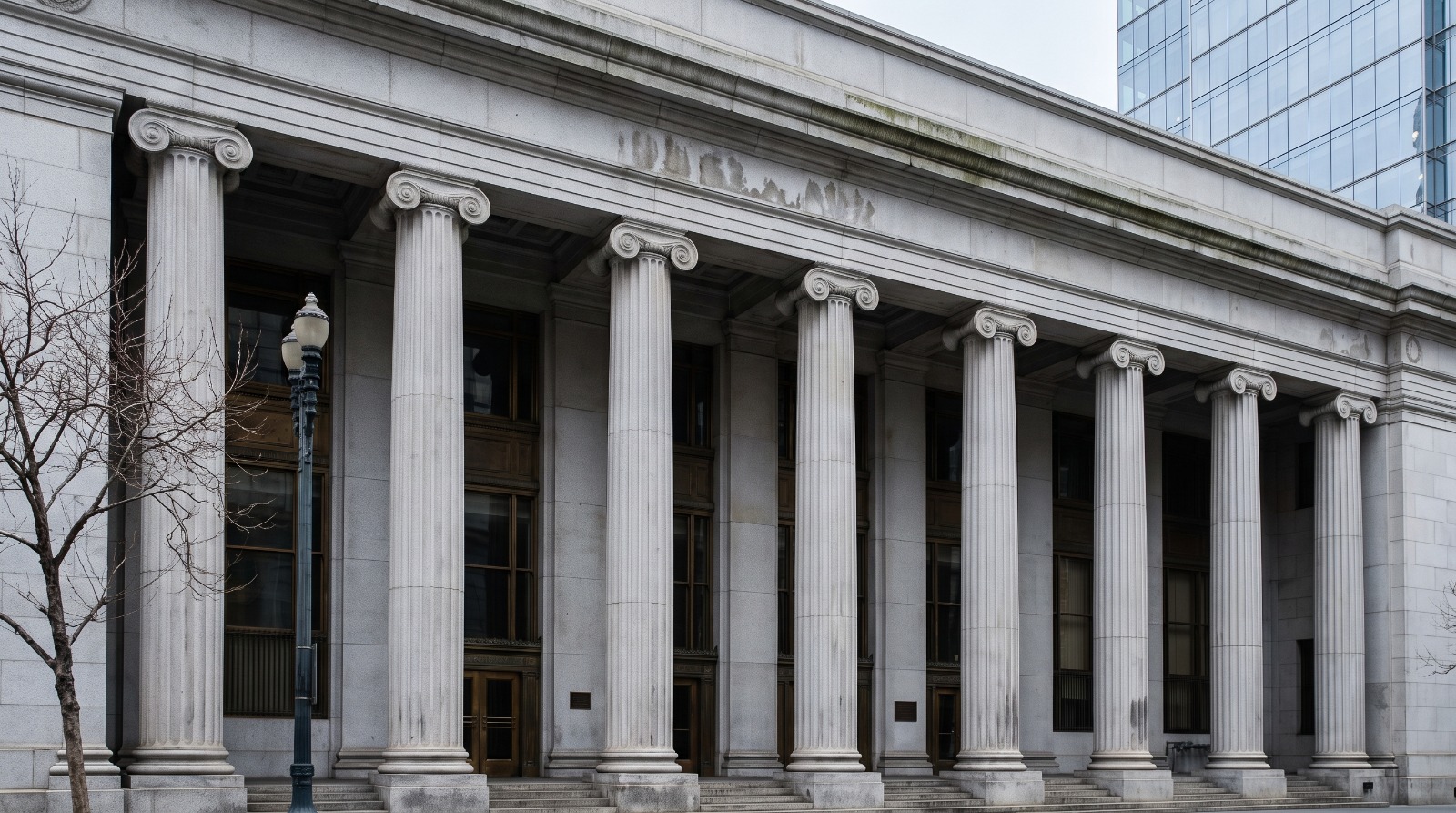
AI-rendered detail of the Ionic colonnade of the old Federal Reserve Bank building on Sansome Street in San Francisco Photo: Houseberry
In February 2020, a New York investor paid about $143 million for the old Federal Reserve Bank building at Sansome and Sacramento streets. This month the building went back to San Francisco owners for roughly half that.
The SF Standard reported on October 6 that RFR Holding, which owed about $130 million on the property, handed it over to Presidio Bay Ventures and Bridges Capital through a deed in lieu of foreclosure. The two local firms had bought the defaulted loan in July for about $70 million. On roughly 214,000 square feet, that is a drop from about $668 a square foot to about $327.
That 51 percent haircut is not unusual anymore. It is close to the going rate for a downtown San Francisco office building. Homes a few blocks away went the other way: by Houseberry's price data for the Financial District, the typical home there sold for about $1.69 million in September 2026, up 17 percent from October 2025.
The Federal Reserve Bank of San Francisco opened here in 1924. George Kelham designed it with a row of Ionic columns along Sansome and a banking hall of travertine and marble, with murals by Jules Guerin. The Fed moved to 101 Market in 1983, and the building became San Francisco Landmark No. 158 the same year. Bently Holdings bought it in 2005 for $46.8 million, about $225 a square foot, and spent about $35 million restoring it.
So the 2026 price is still above the 2005 one. What disappeared was the 2020 premium.
Presidio Bay is not turning it into housing. According to the Standard, it plans to keep it as offices and fill the lobby with a coffee and cocktail bar, a whiskey lounge, a gym and event space, the same playbook it is running at 88 Spear. A landmark with a 28,000-square-foot banking hall is easier to rent with a bar in it than to cut into apartments.
Half price is the new normal downtown
The 301 Battery deal fits a pattern that has held for three years.
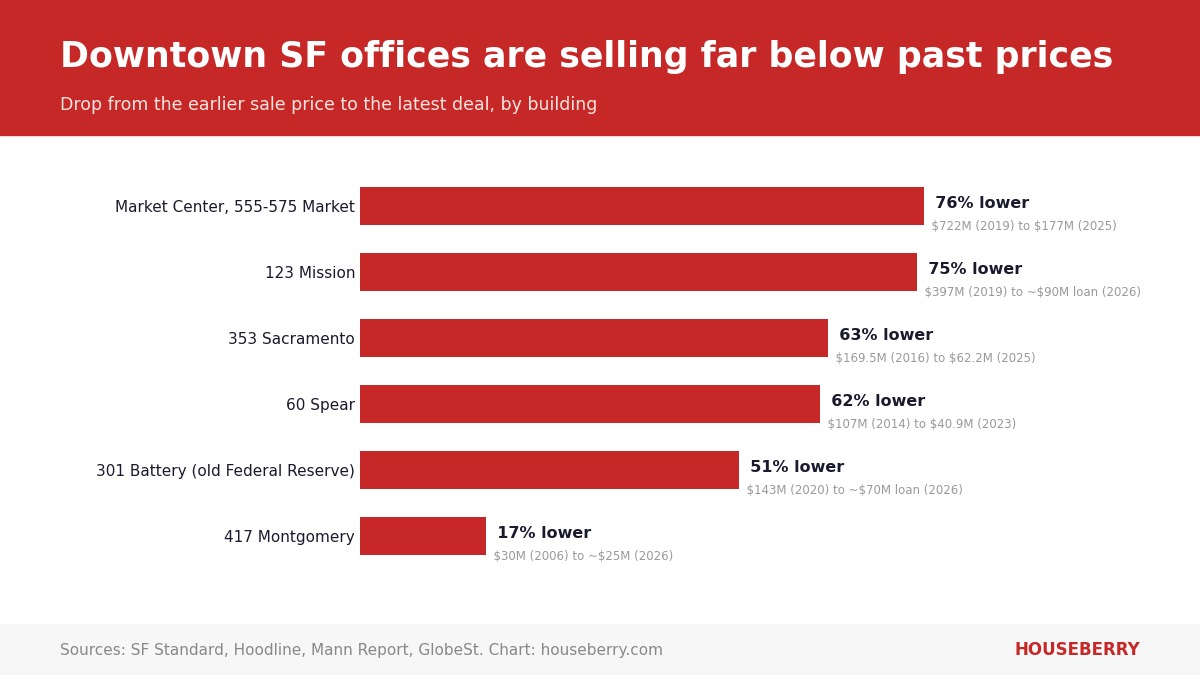
| Building | Earlier price | Latest deal | Change |
|---|---|---|---|
| Market Center, 555-575 Market | $722 million (2019) | $177 million (May 2025) | down 76% |
| 123 Mission | $397 million (2019) | about $90 million, loan purchase (March 2026) | down about 75% |
| 353 Sacramento | $169.5 million (2016) | $62.2 million (June 2025) | down 63% |
| 60 Spear | $107 million (2014) | $40.9 million (August 2023) | down 62% |
| 301 Battery | $143 million (2020) | about $70 million, loan purchase (July 2026) | down about 51% |
| 410 Townsend | $86 million (2019) | $22 million (2024), then $47 million (September 2026) | down 45% from 2019 |
Sources: SF Standard on Market Center, 353 Sacramento and 410 Townsend, Hoodline on 123 Mission and the Mann Report on 60 Spear. Two of these were loan purchases rather than ordinary sales, which is how a lot of downtown buildings change hands now.
353 Sacramento sits about a block from 301 Battery. Its buyer paid $218 a square foot last year. The old Fed came in at about $327, a premium that the landmark columns and the banking hall probably earned.
The floor may be in. The last row of that table is the hopeful one. 410 Townsend in SoMa sold for $22 million in 2024 and resold for $47 million in September 2026, more than double in two years. Leasing is back too: Savills counted 3.9 million square feet of office leases signed in the third quarter of 2026, up 77 percent from a year earlier, and the share of space on the market fell to 27 percent.
CBRE's average price per square foot climbed from $253 in 2023 to $310 in 2024, The Real Deal reported. That is still about a third of the 2018 peak.
Downtown homes held their value
People do live in the Financial District, in buildings like the Royal Insurance Building conversion at Sansome and Pine, which added 46 apartments. For them the last six years looked nothing like the office market.
| Neighborhood | Typical price, Oct 2025 | Typical price, Sept 2026 | Change |
|---|---|---|---|
| Financial District and Barbary Coast | $1.44M | $1.69M | up 17% |
| Telegraph Hill | $1.13M | $1.53M | up 35% |
| North Beach | $1.32M | $1.33M | about flat |
| San Francisco citywide | $1.89M | $2.20M | up 16% |
Source: Houseberry price histories for the Financial District, Telegraph Hill, North Beach and San Francisco.
Over the longer stretch, condos downtown did lose some ground. RealDataSF found that Financial District and Barbary Coast condos sold for about 7 percent less per square foot in early 2026 than just before the pandemic, and downtown and SoMa as a whole about 15 percent less. Put that next to office buildings that lost 50 to 76 percent, and the gap between the two kinds of property is the story of downtown since 2020.
Houseberry scores the Financial District and Barbary Coast 3.0 out of 5 overall, 67th of 92 San Francisco neighborhoods. Its merchants score is a perfect 5.0. Its safety score is 2.3.
What the cheap buildings make possible
We think the price reset is the best thing that has happened to downtown in a decade. At $700 a square foot, an office tower has one use. At $250 to $350, a buyer can try a hotel, a lab, a club-style office like Presidio Bay's, or apartments.
The city has made that last option cheaper. Voters waived the transfer tax on the first 5 million square feet of offices converted to housing in March 2024, and a downtown financing district signed in February 2026 lets converted buildings keep part of their new property taxes for up to 30 years. The city's own estimate is about 4,400 homes across about 50 buildings. We have tracked several, from 901 Market to the troubled 2300 Stockton.
The old Federal Reserve will stay an office building. Its price still tells the neighborhood something: the land under downtown is finally cheap enough to reuse. To see how the neighborhoods around it compare, start with Houseberry's San Francisco ranking.
Sources
- SF Standard: The Reserve returns to local owners, October 6, 2026
- The Registry: Presidio Bay and Bridges Capital close $70 million debt purchase, July 2026
- SF Standard: San Francisco office market rebound, September 29, 2026
- CBRE: San Francisco office figures, Q2 2026
- RealDataSF: SF condo market since COVID, August 2026
- Savills: San Francisco office market, Q3 2026
The Houseberry Research Team is Houseberry's reporting team: Bay Area real estate analysts, data specialists and longtime local market watchers. Every day we check the public record: building permits, city council and planning agendas, county recorder filings, state housing bills, police incident data and school results. Then we tie each story to what it means for specific neighborhoods, using Houseberry's own neighborhood data on prices, appreciation, safety, schools and amenities. Questions or corrections: Contact us.
Map of San Francisco Neighborhoods
Loading map...
View Full Map
Top Neighborhoods in San Francisco, CA





All information provided on this website including but not limited to - school ratings, safety, amenities, user opinions, and property data - is for general informational purposes only. We do not guarantee its reliability, accuracy, or completeness. Users should independently verify information and consult appropriate professionals as needed. By using this website, you agree Houseberry is not responsible for actions, decisions, or consequences arising from reliance on the information provided
houseberry.com - CA DRE# 01847391
 Bay East ©2025. CCAR ©2025. bridgeMLS ©2025. Information Deemed Reliable But Not Guaranteed. This information is being provided by the Bay East MLS, or CCAR MLS, or bridgeMLS. The listings presented here may or may not be listed by the Broker/Agent operating this website. This information is intended for the personal use of consumers and may not be used for any purpose other than to identify prospective properties consumers may be interested in purchasing. Data last updated at October 7, 2026 12:00 AM