Sonoma County drops its ADU ban on about 4,000 rural lots
Sonoma County supervisors erased a 1985 zoning label that blocked backyard cottages on 3,997 rural lots. About 2,550 owners can now apply, and 1,450 farms are still waiting.

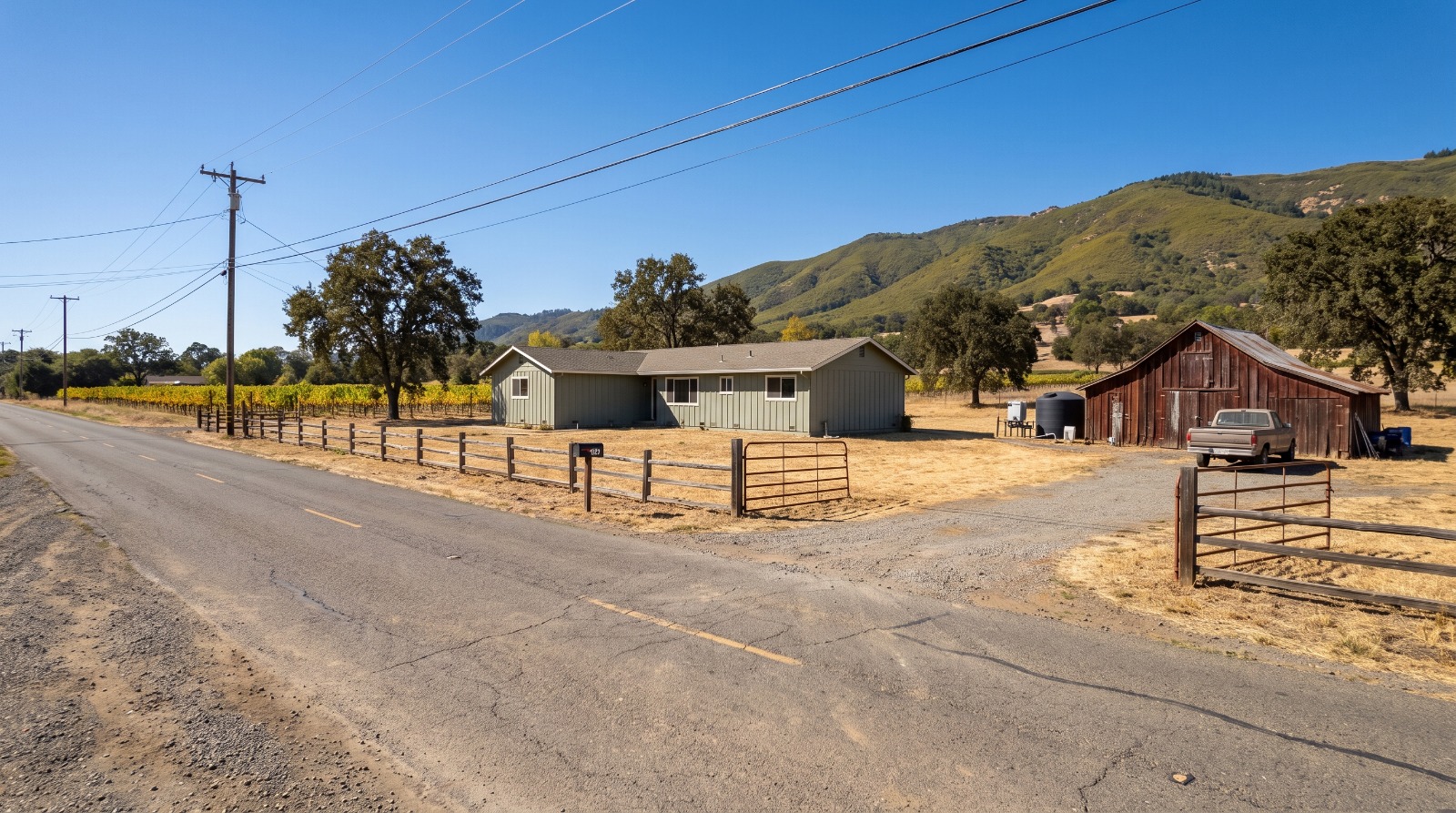
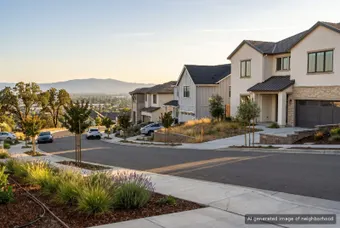
AI-rendered view of a rural ranch house, barn and open pasture on a country road in unincorporated Sonoma County Photo: Houseberry
For 41 years, one letter on Sonoma County's zoning map decided whether thousands of rural landowners could build a backyard cottage. The letter was Z. On October 6 the Board of Supervisors erased it from 3,997 lots outside the coastal zone. Supervisor David Rabbitt made the motion and Supervisor Lynda Hopkins seconded it, according to the county's vote record and the staff summary.
Fewer owners gained the right to build than that number suggests. About 1,450 of those lots are under Williamson Act farmland contracts, and the county's rules for contracted land still list an ADU as an incompatible use. That leaves roughly 2,550 lots, about 64 percent of the list, where an owner can apply for an accessory dwelling unit for the first time (our math from the county's figures).
All of them sit in unincorporated Sonoma County, where the county zoning code is the only zoning there is. Six of the 11 Sonoma County places Houseberry ranks are unincorporated: Kenwood, Larkfield-Wikiup, Fulton, Forestville, Graton and Penngrove, and every one of the six scores 4.0 or better out of 5 on Houseberry's safety measure.
A 1985 rule that spread past its purpose
The Z district dates to November 26, 1985, when the county adopted it after a string of temporary ADU moratoriums over water. Its stated purpose was narrow: keep second units out of places with thin water supply, failing septic, dangerous roads or serious fire risk.
Then it spread. The Planning Commission staff report from September 3 says the county stamped it across farm parcels after the 1989 General Plan update, attached it to subdivisions to cap density, and added it in response to public comment about community character. In the report's words, many of those records "lack documented justification."
Getting the Z off a single lot took a Planning Commission hearing and a Board vote. More than 40 owners had done it the hard way by 2019, according to Permit Sonoma's history of the district.
The state ended the argument. Two 2024 laws, SB 1211 and AB 2533, took effect on January 1, 2025, and require every county to allow a minimum number of ADUs on any lot where a house is allowed. On January 9, 2025, the state housing department wrote to Sonoma County that the Z district was out of compliance. It offered two paths: prove lot by lot why an ADU is a hazard, or delete the district. Then it clarified that even airtight findings could only block ADUs beyond the state minimum. Sonoma County allows only the minimum.
So the Z could not block anything. The county chose to delete it, and the Planning Commission recommended that unanimously on September 3.
We think the county got this right, and late. A label applied in 1989 without evidence was doing the job a well test and a septic permit already do. It did that job worse, because it said no before anyone looked at the lot.
What still stands between a lot and a cottage
Removing the Z approves nothing.
It lets an owner apply, and the checks the Z was supposed to stand in for still happen at the permit counter, per Permit Sonoma's ADU rules page.
- Water. A lot on a well in the county's Class 3 or Class 4 groundwater areas needs a dry-weather well test, run between July 15 and October 1, that shows enough yield.
- Septic. The system has to be sized for every bedroom on the property, cottage included, and the sanitation permit comes before the building permit.
- Fire. The Fire Prevention Division reviews access, water for firefighting and setbacks. State guidance says a fire hazard zone shapes how you build, not whether you can.
The size cap is generally 1,200 square feet, and a unit under 750 square feet skips the county's park and traffic impact fees. It also cannot be a vacation rental, since county rules require at least a 30-day term.
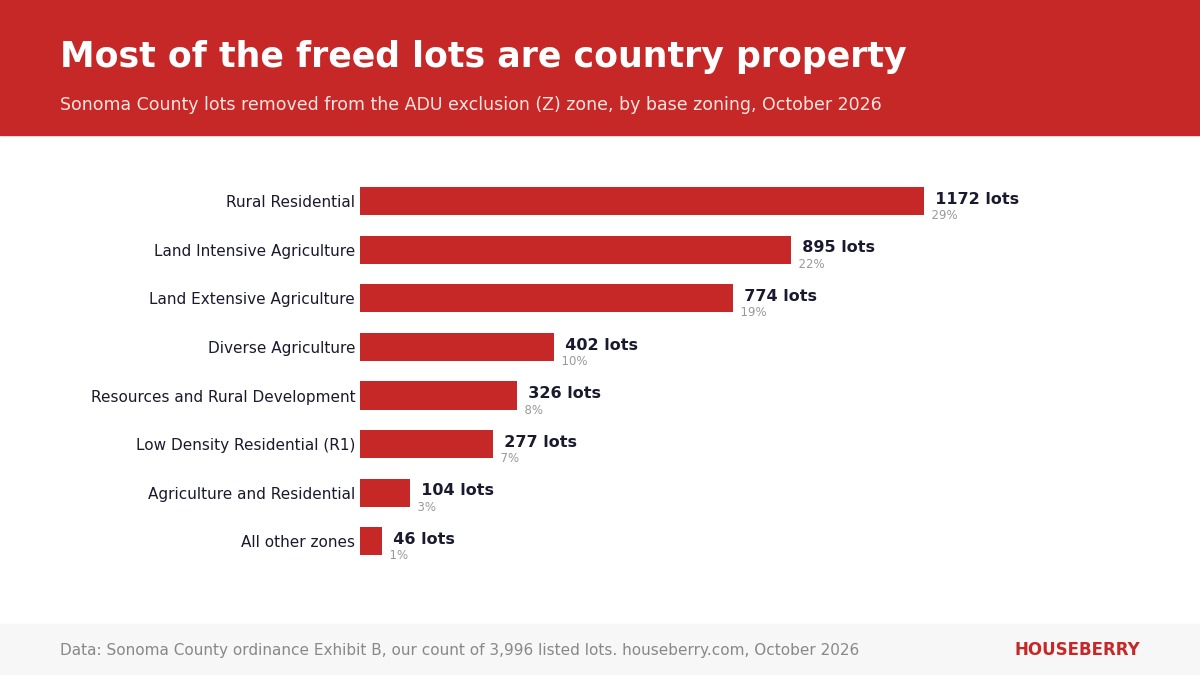
The list is mostly country property. By our count of the county's parcel list, 52 percent of the lots sit in farm zones and 29 percent are Rural Residential, the county's zone for homes on larger rural lots. Only 277 are in R1, the ordinary low-density neighborhood zone.
The farmland catch
The 1,450 contracted lots are the honest trade-off in this vote. Williamson Act contracts give farm owners a lower property tax bill in exchange for keeping the land in agriculture, and Sonoma County's Uniform Rules for those contracts decide which uses fit. Right now an ADU does not. That is a tax deal, not a safety rule.
That rule sits outside state ADU law, so Sacramento cannot override it. The September 3 staff report notes the Board of Supervisors could add ADUs as a compatible use later. Until it does, the farms that most need a place for a family member or a worker are the ones still waiting.
Does a cottage pencil out?
On a rural lot, the cost is the hard part. A statewide survey of ADU owners by UC Berkeley's Terner Center put the median build cost at $150,000, or about $250 a square foot, and that was in 2021, while a Sonoma County lot on a well and septic can add a yield test, a septic upgrade and fire access work on top.
Say a detached one-bedroom lands at $250,000, all of it borrowed at 7.28 percent, the Freddie Mac 30-year average on October 1. That is about $1,711 a month in principal and interest. HUD's fiscal 2026 fair market rent for a one-bedroom in the Sebastopol ZIP code, 95472, is $2,010. A rented cottage roughly carries its own loan before property tax and insurance. As a place for a parent or a grown kid, it is cheaper than anything on the open market.
That market is not cheap. Sonoma County's median sale price was $772,415 in August 2026, down 3.4 percent from a year earlier, according to Redfin.
The towns where county zoning is the only zoning
Cities like Santa Rosa, Petaluma and Sebastopol write their own ADU rules, so this vote changes nothing inside their limits. It applies in the unincorporated towns and the open land around them. Houseberry scores six of those towns, including Graton and Larkfield-Wikiup, and the pattern holds across all six. High safety, low amenities. Kenwood leads them at 4.1 overall, and Penngrove has the strongest amenities score of the group at 2.9.
| Place | Overall | Schools | Safety | Amenities |
|---|---|---|---|---|
| Kenwood | 4.1 | 4.2 | 4.5 | 0.4 |
| Larkfield-Wikiup | 3.7 | 3.2 | 4.5 | 0.8 |
| Fulton | 3.4 | 3.1 | 4.0 | 0.4 |
| Forestville | 3.4 | 3.0 | 4.0 | 0.4 |
| Graton | 3.4 | 3.0 | 4.0 | 0.8 |
| Penngrove | 3.3 | 3.4 | 4.0 | 2.9 |
Five of the six score under 1 out of 5 on amenities, which on Houseberry's scale means few shops, restaurants and services within an easy trip. The median amenities score across the six is 0.6, against 3.3 for Santa Rosa citywide (Houseberry analysis, October 2026). That is the rural trade. A backyard cottage does not change it.
What a cottage can change is who gets to live there. A cottage on a 3-acre lot near Penngrove is one of the few ways a teacher, a vineyard manager or a grandparent can live in these places without buying the main house.
Questions owners are asking
How does an owner check a lot? The county lists every parcel number in Exhibit B of the ordinance. The parcel number is on the property tax bill. Search the list for it, then confirm with Permit Sonoma at (707) 565-1900.
When do applications open? County ordinances generally take effect 30 days after adoption, which points to early November 2026.
Do coastal lots count? No. Z lots in the coastal zone keep the designation until the county updates its coastal zoning code with the Coastal Commission. Twenty lots that straddle the coastal line lose the Z only on their inland portion.
Can the cottage be a vacation rental? No. County rules require ADU rentals of at least 30 days.
About 2,550 rural lots can now apply for a cottage that their owners were told no to for decades, and 1,450 farms are still waiting on a rule the Board controls. If you are weighing a lot in one of those towns, start with Houseberry's safety ranking for Sonoma County and see how the towns compare before you price out the septic work.
Sources
- Sonoma County Board of Supervisors staff summary, Item 30, October 6, 2026
- Sonoma County Planning Commission staff report, September 3, 2026
- Draft ordinance with the full parcel list (Exhibit B)
- Permit Sonoma: Z district removal history
- Permit Sonoma: ADU rules
- Terner Center: California ADU owner survey, 2021
The Houseberry Research Team is Houseberry's reporting team: Bay Area real estate analysts, data specialists and longtime local market watchers. Every day we check the public record: building permits, city council and planning agendas, county recorder filings, state housing bills, police incident data and school results. Then we tie each story to what it means for specific neighborhoods, using Houseberry's own neighborhood data on prices, appreciation, safety, schools and amenities. Questions or corrections: Contact us.
Map of Santa Rosa Neighborhoods
Loading map...
View Full Map
Top Neighborhoods in Santa Rosa, CA


All information provided on this website including but not limited to - school ratings, safety, amenities, user opinions, and property data - is for general informational purposes only. We do not guarantee its reliability, accuracy, or completeness. Users should independently verify information and consult appropriate professionals as needed. By using this website, you agree Houseberry is not responsible for actions, decisions, or consequences arising from reliance on the information provided
houseberry.com - CA DRE# 01847391
 Bay East ©2025. CCAR ©2025. bridgeMLS ©2025. Information Deemed Reliable But Not Guaranteed. This information is being provided by the Bay East MLS, or CCAR MLS, or bridgeMLS. The listings presented here may or may not be listed by the Broker/Agent operating this website. This information is intended for the personal use of consumers and may not be used for any purpose other than to identify prospective properties consumers may be interested in purchasing. Data last updated at October 7, 2026 12:00 AM