The 2026 Housing Outlook, Translated for Bay Area Buyers
A new national mid-year housing outlook says rates stay near 6.5 percent and inventory keeps improving. Here is what that actually changes for a Bay Area buyer, county by county.

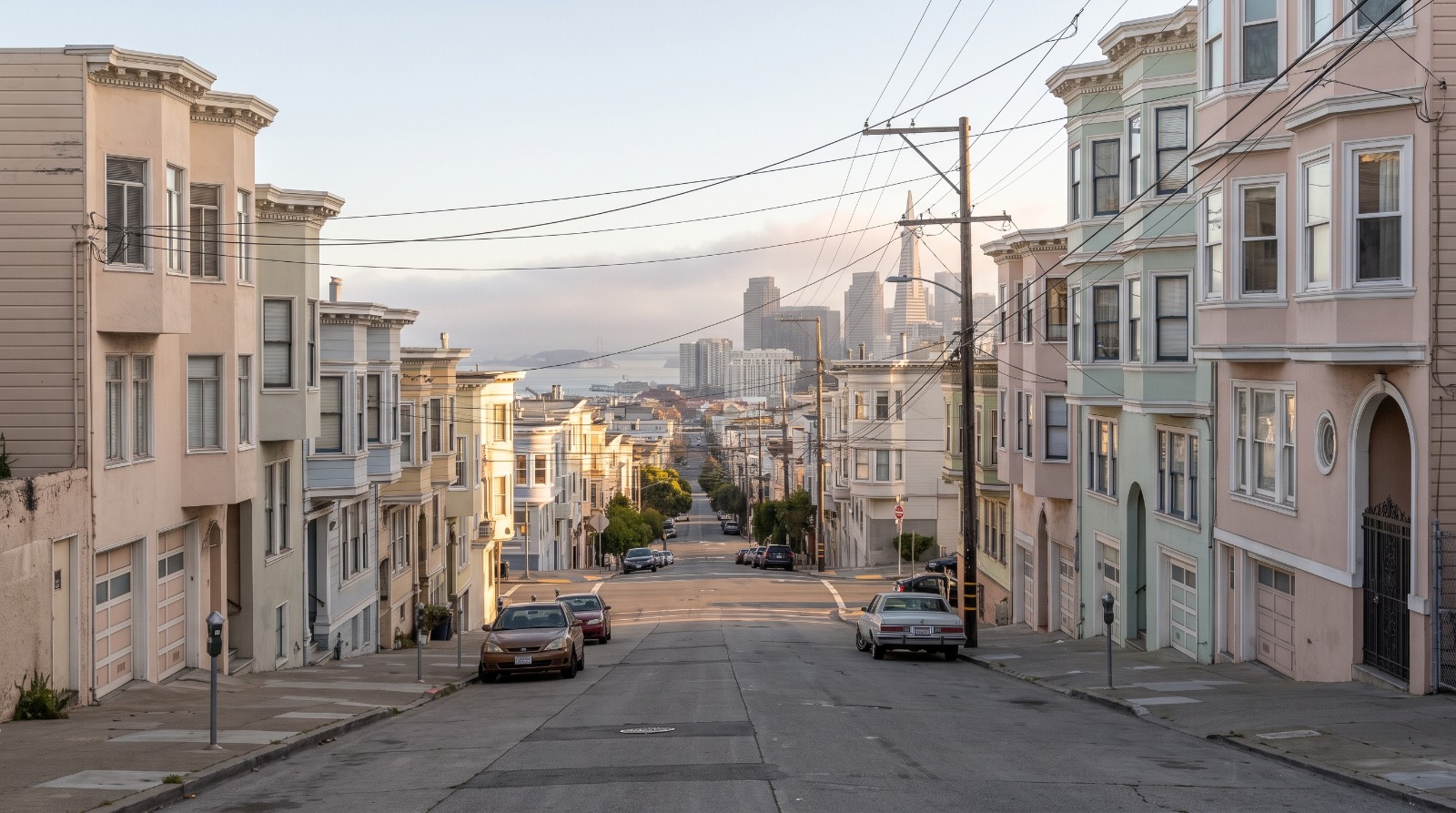
A San Francisco residential hillside stepping down toward the bay, illustrating what the 2026 housing outlook means for Bay Area buyers. Photo: Houseberry
Stop waiting for a 5 percent mortgage. It is not coming, at least not this year, and the people who forecast this for a living just said so out loud.
On July 22, HomeServices of America put out its 2026 mid-year housing outlook, and the headline number is the one buyers keep hoping will move. Most economists in the report expect the 30-year fixed rate to hold in the 6.0 to 6.5 percent range through the end of the year. As of last week the Freddie Mac average sat at 6.55 percent, so the forecast is basically saying today is roughly what the rest of 2026 looks like. Inman summed the report up bluntly as telling agents to stop waiting for a rate that is not coming.
That sounds like bad news. For a Bay Area buyer, it is mostly just clarity. Here is what the national outlook actually says, and then the part that matters more, which is how little of it applies evenly across the Bay.
What the 2026 housing outlook actually says
Three things, stripped of the spin.
Rates hold near 6.5 percent. The report frames the market’s problems as macroeconomic, not structural. HomeServices CEO Chris Kelly put it plainly, saying the challenges are driven more by macroeconomic conditions than by housing fundamentals. Translation: rates are stuck because of the 10-year Treasury and inflation, not because housing itself is broken. The 10-year sat around 4.64 percent last week, and mortgage rates track it closely.
Inventory keeps improving. Nationally, buyers are slowly getting more choice and more time to decide. Existing-home inventory was about 1.56 million units in June, roughly a 4.6-month supply. That is still under the six months that usually signals a balanced market, but it is the loosest it has been in years.
Prices grind up, not down. HomeServices projects national home prices rising about 1.7 percent in 2026 and 2.0 percent in 2027. Redfin’s June index had U.S. prices up 3 percent year over year, the fastest in ten months. Nobody credible is forecasting a national price drop. The story is slow appreciation, not a correction.
So the national picture is a rate-stuck, slowly loosening, slowly appreciating market where buyers gain a little leverage each month. Fine. Now throw most of that out when you cross into the Bay Area.
The national averages barely describe the Bay
This is where a national outlook gets dangerous if you read it too literally. The Bay Area is not one market, and in mid-2026 it is barely even two.
Redfin pegged the San Francisco metro median sale price at about 1.72 million dollars in June, up 9.2 percent year over year, the biggest jump of any major U.S. metro. That is the AI-wealth wave landing on the city and the close-in Peninsula. At the same time, the California Association of Realtors put the broader nine-county Bay Area median at 1.4 million dollars, essentially flat from a year earlier. One region, and depending on which slice you measure, prices are either climbing hard or going nowhere.
The line about improving inventory works the same way. It is largely true in the East Bay, where homes are sitting a little longer and listings are building. It is not really true in San Mateo County, where the typical home still closes above asking in under two weeks. A single national inventory number cannot tell you which of those two you are walking into.
The way we look at it when we compare neighborhoods, the national forecast is a backdrop, not a plan. It tells you the cost of money for the rest of the year. It does not tell you whether the specific blocks you are shopping are a seller’s market or finally a buyer’s one.
Where the national read is useful anyway
The outlook is not useless locally. It is useful in exactly one way. It kills the wait-for-rates strategy.
If rates are going to sit near 6.5 percent through year-end, then a buyer who can afford the payment today gains nothing by waiting for a number that is not coming, and in a market like San Francisco or San Mateo they risk paying 9 percent more for the house while they wait. That is the real math. The rate you are frustrated about is roughly the rate you will get in December too, so the decision comes down to the home and the neighborhood, not the calendar.
Where waiting can still pay off is the softer pockets. In parts of the East Bay and the cooling South Bay, more inventory and longer days on market are quietly handing buyers negotiating room that did not exist a year ago. If you are shopping East Bay neighborhoods, the national story about buyers gaining leverage is closest to true right where you are standing.
How to actually use this
Read the national outlook for the cost of money, then ignore its averages and go county by county.
Pull the actual median and days on market for the specific area you are shopping, not the regional or national figure. Compare neighborhoods on schools, safety, amenities, and value before you fall for a listing, because in a two-speed market the difference between overpaying and finding room is a few miles, not a few months. That habit, looking hard at the area before the address, is the whole reason we built Houseberry, and it matters more in a year when one national number hides two completely different local markets. If you want a starting point, our San Francisco neighborhood rankings and best-value San Jose neighborhoods are built for exactly this kind of side-by-side.
The rate is set. The neighborhood is still your move.
Bay Area 2026 housing questions, answered
Will Bay Area home prices drop in 2026?
No major forecast expects a national or Bay Area price drop this year. HomeServices projects U.S. prices up about 1.7 percent in 2026, and the San Francisco metro was actually up 9.2 percent year over year in June. Some softer pockets in the East Bay and South Bay are flat or slightly down, but region-wide the story is slow appreciation, not a correction.
Should I wait for mortgage rates to fall before buying?
The 2026 mid-year outlook expects the 30-year rate to hold in the 6.0 to 6.5 percent range through year-end, which is about where it is now. Waiting for a materially lower rate this year is a bet against the consensus, and in the hotter Bay Area counties you could easily pay more for the home while you wait for a rate that may not arrive.
Which Bay Area areas give buyers the most room right now?
The East Bay and the cooling South Bay are where inventory is building and homes sit longer, which is where negotiating room is showing up. San Francisco and San Mateo County remain fast and competitive. Check the specific area’s days on market before you assume the national trend applies to your street.
Sources
- HomeServices of America 2026 Mid-Year Housing Outlook (Business Wire)
- HomeServices tells agents to stop waiting for a rate that is not coming (Inman)
- Mortgage Rates Today, July 22, 2026 (The Mortgage Reports)
- U.S. Home Prices Hit All-Time High, Driven by San Francisco (Redfin)
- Existing-Home Sales, June 2026 (National Association of Realtors)
- June 2026 California Home Sales and Price Report (C.A.R.)
The Houseberry Research Team is Houseberry's reporting team: Bay Area real estate analysts, data specialists and longtime local market watchers. Every day we check the public record: building permits, city council and planning agendas, county recorder filings, state housing bills, police incident data and school results. Then we tie each story to what it means for specific neighborhoods, using Houseberry's own neighborhood data on prices, appreciation, safety, schools and amenities. Questions or corrections: Contact us.
All information provided on this website including but not limited to - school ratings, safety, amenities, user opinions, and property data - is for general informational purposes only. We do not guarantee its reliability, accuracy, or completeness. Users should independently verify information and consult appropriate professionals as needed. By using this website, you agree Houseberry is not responsible for actions, decisions, or consequences arising from reliance on the information provided
houseberry.com - CA DRE# 01847391
 Bay East ©2025. CCAR ©2025. bridgeMLS ©2025. Information Deemed Reliable But Not Guaranteed. This information is being provided by the Bay East MLS, or CCAR MLS, or bridgeMLS. The listings presented here may or may not be listed by the Broker/Agent operating this website. This information is intended for the personal use of consumers and may not be used for any purpose other than to identify prospective properties consumers may be interested in purchasing. Data last updated at October 21, 2026 12:00 AM