3945 Judah Street: 20 Homes, 12 Years, One Outer Sunset Permit
A 20-home building at Judah and 45th Avenue just got its final sign-off from San Francisco, 11.7 years after the permit was filed. We walked the permit record phase by phase and counted how rare a finish like this is in the Sunset.
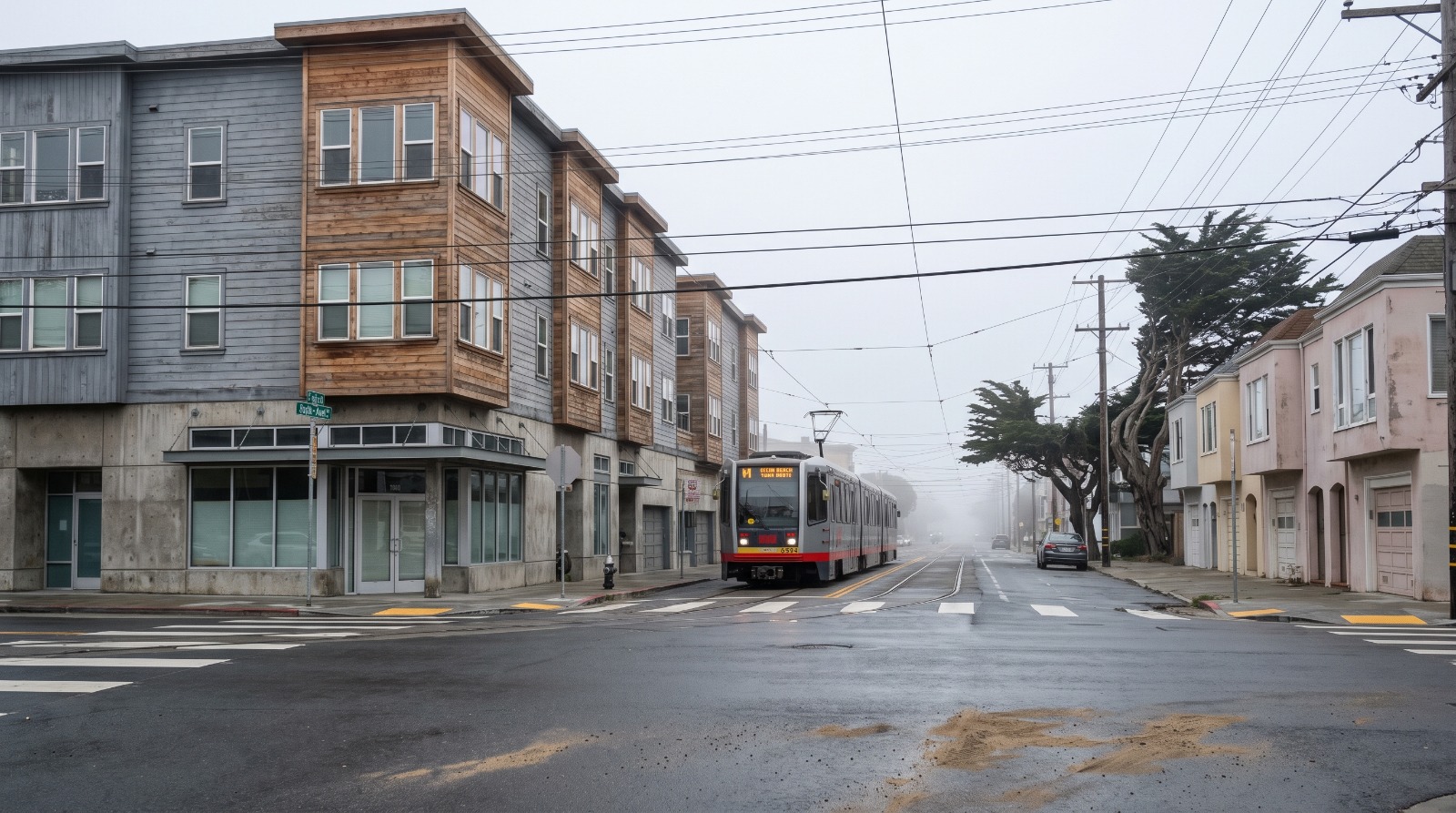
New five-story apartment building at 3945 Judah Street in the Outer Sunset with an N-Judah train passing in the fog Photo: Houseberry
11.7 years. That is how long it took a 20-home building at 3945 Judah Street, on the corner of 45th Avenue in San Francisco's Outer Sunset, to go from a filed building permit to a finished one. The city's Department of Building Inspection marked permit 201412314770 complete on September 28, 2026, almost twelve years after it was filed on December 31, 2014.
Construction itself took about 3.4 years. The rest was paperwork, a redesign, an appeal, and a cleanup of old gas station tanks. And in a neighborhood where new apartment buildings of this size barely happen, the finish is rarer than the delay.
Where the 11.7 years went, phase by phase
Most of the wait happened before anyone could legally build. DBI's own record for the permit shows four dates that split the timeline cleanly: filed December 31, 2014, approved April 13, 2021, issued October 27, 2021, and first construction document May 11, 2023.
Put another way, it took longer to get the plans approved than it took to demolish the old building, pour the podium, frame five stories, and pass final inspection combined.
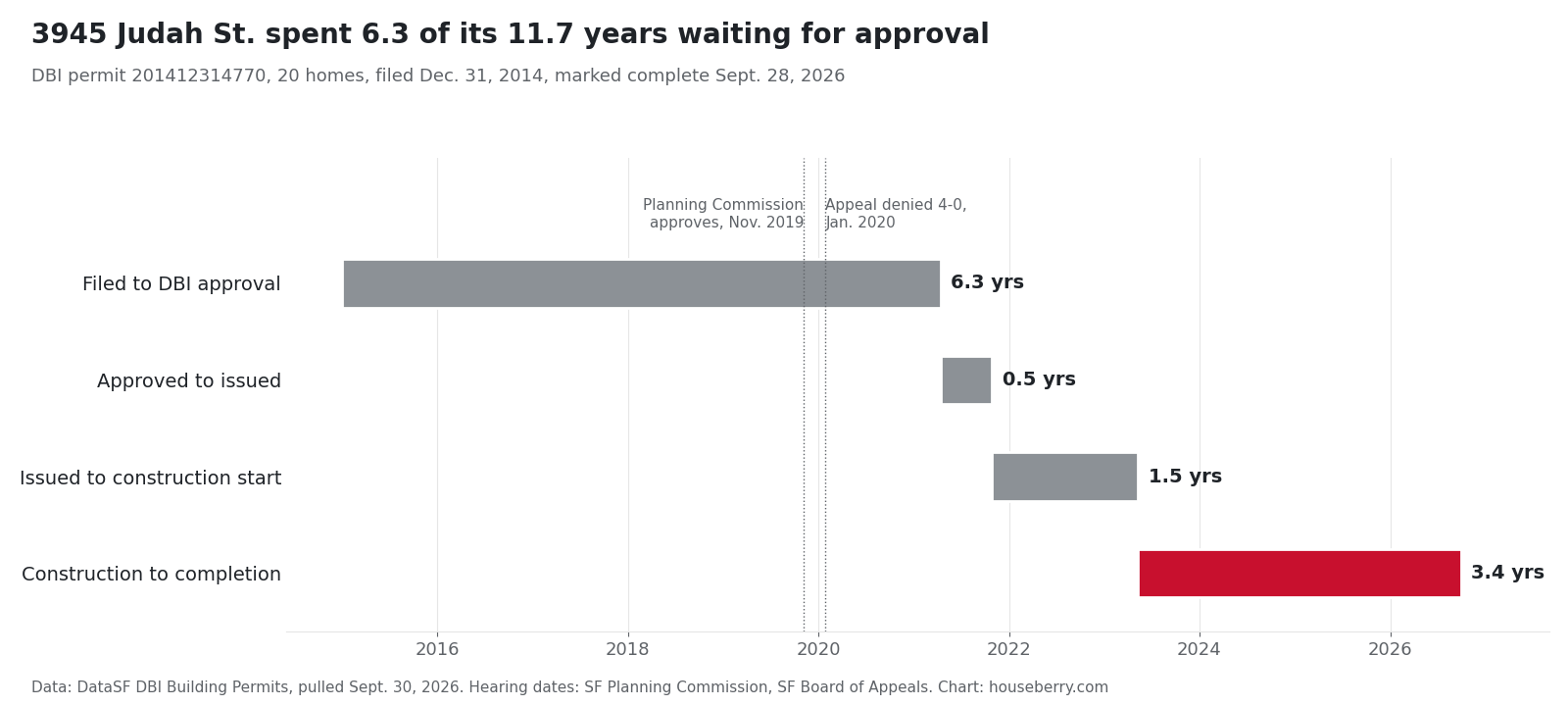
The gap between issuance and construction (1.5 years) is the part people outside the business tend to miss. A separate demolition permit for the auto shop was filed in January 2021 and not issued until December 2021, and SF YIMBY reported the single-story shop came down in 2022. Shoring permits followed. Only then could the concrete podium go in.
The building filed in 2014 was not the one that got built
The permit number is from 2014, but the 20-home design is from 2018. According to SF YIMBY's reporting, owner Brendan Quinlan bought the parcel in 2013 for $900,000 and first proposed a four-story building with ground-floor retail and six apartments. The application was resubmitted in 2015 and later closed.
What changed was HOME-SF, the density bonus program former District 4 Supervisor Katy Tang championed and the city adopted in 2017. It let the project add a floor and more than triple its home count in exchange for making 25 percent of the units affordable. Hoodline reported it was only the third HOME-SF project approved anywhere in the city when the Planning Commission voted 6-0 for it on November 7, 2019.
That is the honest downside of this story. Some of the delay was the price of a better project. Six apartments became 20. Two affordable units became five.
The appeal, and the two old tanks under the lot
Neighbors appealed within days. Hoodline covered the filing in November 2019, with opponents citing groundwater, parking, height, and density, and floating a 16-unit alternative.
The San Francisco Board of Appeals denied the appeal 4-0 on January 29, 2020, according to a meeting summary. The substance was real, though. Two closed underground storage tanks sat under the former gas station, and the board made clear that the Department of Public Health, through its Maher soil and groundwater program, had to sign off on a site mitigation plan before building permits could issue. DBI's plan approval came about 15 months later.
Cleaning up a gas station site before stacking homes on it is a good rule. It is also, on a lot this size, a year-plus of consultants and lab work that a 20-unit budget has to carry.
How rare is a 20-unit finish in the Sunset?
Very. We pulled every new-construction permit marked complete in the Sunset/Parkside planning area from DataSF and found five buildings of 10 or more homes finished since 2015, totaling 233 homes. Everything else finished in that stretch was small, mostly one- and two-home buildings.
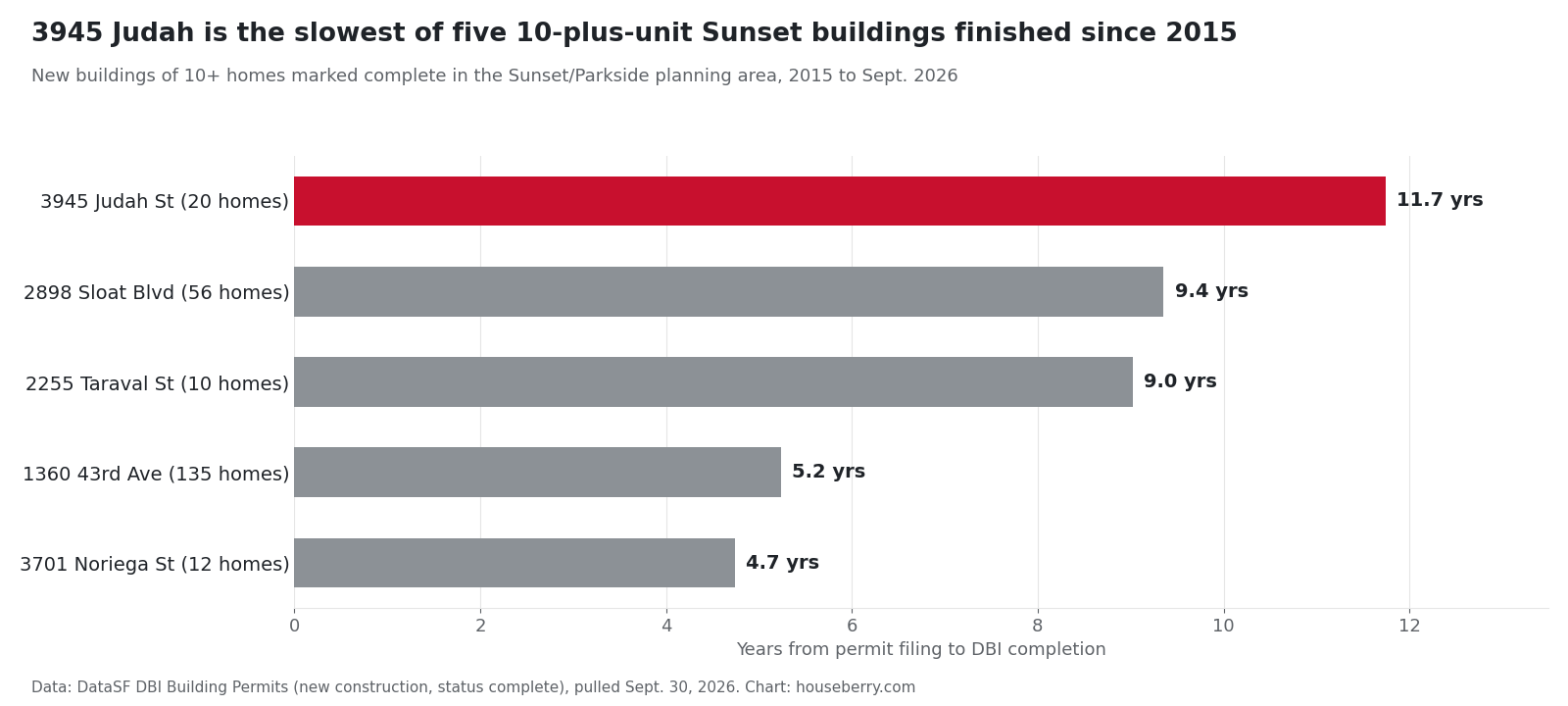
The fastest two tell you what speeds things up. 1360 43rd Avenue, the 135-home educator building two blocks east on the same N-Judah line, was filed as a mayoral priority project and finished in 5.2 years. 3701 Noriega, 12 condos, took 4.7. The two slowest besides Judah, 2898 Sloat and 2255 Taraval, both ran past nine years.
Five buildings in roughly eleven years, across a planning area that takes in most of the Sunset and Parkside. That is the supply picture behind every Sunset price chart. It is also why our earlier look at the 199-home proposal at 1234 Great Highway and the 45 homes planned for the church at 4114 Judah matter more than their unit counts suggest.
What 20 homes do and do not do to Outer Sunset prices
Twenty homes will not move the Outer Sunset median. What they add is a kind of housing the neighborhood almost never gets: new rentals with an elevator, a block from an N-Judah stop and about four blocks from Ocean Beach. The building is leasing as Seadrift, and a Corcoran listing advertised a one-bedroom at $3,600 a month.
Meanwhile, ownership prices kept climbing without much help from new supply. On Houseberry's Outer Sunset page, the neighborhood median rose from $1.47 million in September 2025 to $1.69 million in August 2026.
| Median home price | Sept. 2025 | Aug. 2026 | Change |
|---|---|---|---|
| Outer Sunset | $1.47M | $1.69M | +15% |
| San Francisco citywide | $1.89M | $2.20M | +16% |
So the Outer Sunset is tracking the city almost exactly, at about $510,000 below the citywide median. It also ranks second of 92 neighborhoods on our San Francisco overall ranking, with a 4.2 out of 5, which helps explain why demand keeps pace with the rest of the city even out by the beach.
What this does not mean: a finished building is not a sign the pipeline is speeding up. Our piece on San Francisco housing filings hitting their lowest September since 2012 found just 30 net new homes proposed citywide that month. And the deal this building took is already gone. After a July 2026 Board of Supervisors vote, SF Planning's HOME-SF page now lists affordability requirements of 7 to 10 percent, a fraction of the 25 percent 3945 Judah committed to in 2019.
Questions people are asking about 3945 Judah
When did 3945 Judah Street finish?
DBI marked the building permit complete on September 28, 2026. Follow-up permits for emergency radio coverage, evacuation signage, and a final inspection closed out in August and September 2026. Ground-floor retail build-outs are still working through permits.
Does the building have affordable units?
Yes. Five of the 20 homes are below market rate. SF YIMBY listed two at about 50 percent of area median income, two at 80 percent, and one at 110 percent. San Francisco lists these units through its DAHLIA housing portal under the name Seadrift.
What is the unit mix?
Ten one-bedrooms, nine two-bedrooms, and one three-bedroom, over about 2,400 square feet of ground-floor retail, with seven car spaces and 20 bike spaces.
What was on the site before?
A single-story auto repair shop on the site of a former gas station, which is why the underground tank cleanup had to happen before construction permits could issue.
If you are weighing the Outer Sunset against the rest of the west side, the new-construction count is the number to keep in mind. We keep score on schools, safety, and prices for every San Francisco neighborhood, and the Sunset's scores are strong. The part no score captures is how few new homes get built here, and how long the ones that do take.
Sources
- DataSF, DBI Building Permits, permit 201412314770
- DataSF, DBI Building Permits dataset
- SF YIMBY, Construction Underway for 3945 Judah Street, January 2024
- SF YIMBY, Construction Tops Out for 3945 Judah Street, August 2024
- Hoodline, 20 apartments to rise on the site of former gas station in Outer Sunset, November 2019
- Hoodline, Outer Sunset residents file appeal over 20-unit apartment building, November 2019
- Citizen Portal, Board of Appeals upholds HOME-SF authorization for 3945 Judah
- SF Planning, HOME-SF program page
- Corcoran, 3945 Judah Street rental listing
- Houseberry, Outer Sunset neighborhood page
Map of San Francisco Neighborhoods
Loading map...
View Full Map
Top Neighborhoods in San Francisco, CA





All information provided on this website including but not limited to - school ratings, safety, amenities, user opinions, and property data - is for general informational purposes only. We do not guarantee its reliability, accuracy, or completeness. Users should independently verify information and consult appropriate professionals as needed. By using this website, you agree Houseberry is not responsible for actions, decisions, or consequences arising from reliance on the information provided
houseberry.com - CA DRE# 01847391
 Bay East ©2025. CCAR ©2025. bridgeMLS ©2025. Information Deemed Reliable But Not Guaranteed. This information is being provided by the Bay East MLS, or CCAR MLS, or bridgeMLS. The listings presented here may or may not be listed by the Broker/Agent operating this website. This information is intended for the personal use of consumers and may not be used for any purpose other than to identify prospective properties consumers may be interested in purchasing. Data last updated at October 1, 2026 12:00 AM