860 West San Carlos: 272 Affordable Homes Get Their Permit
San Jose issued the building permit for Block A at 860 West San Carlos Street on Sept. 4, 2026. Here is what the permit and state filings say, who qualifies for the 272 affordable homes, and what the nearby neighborhood data shows.
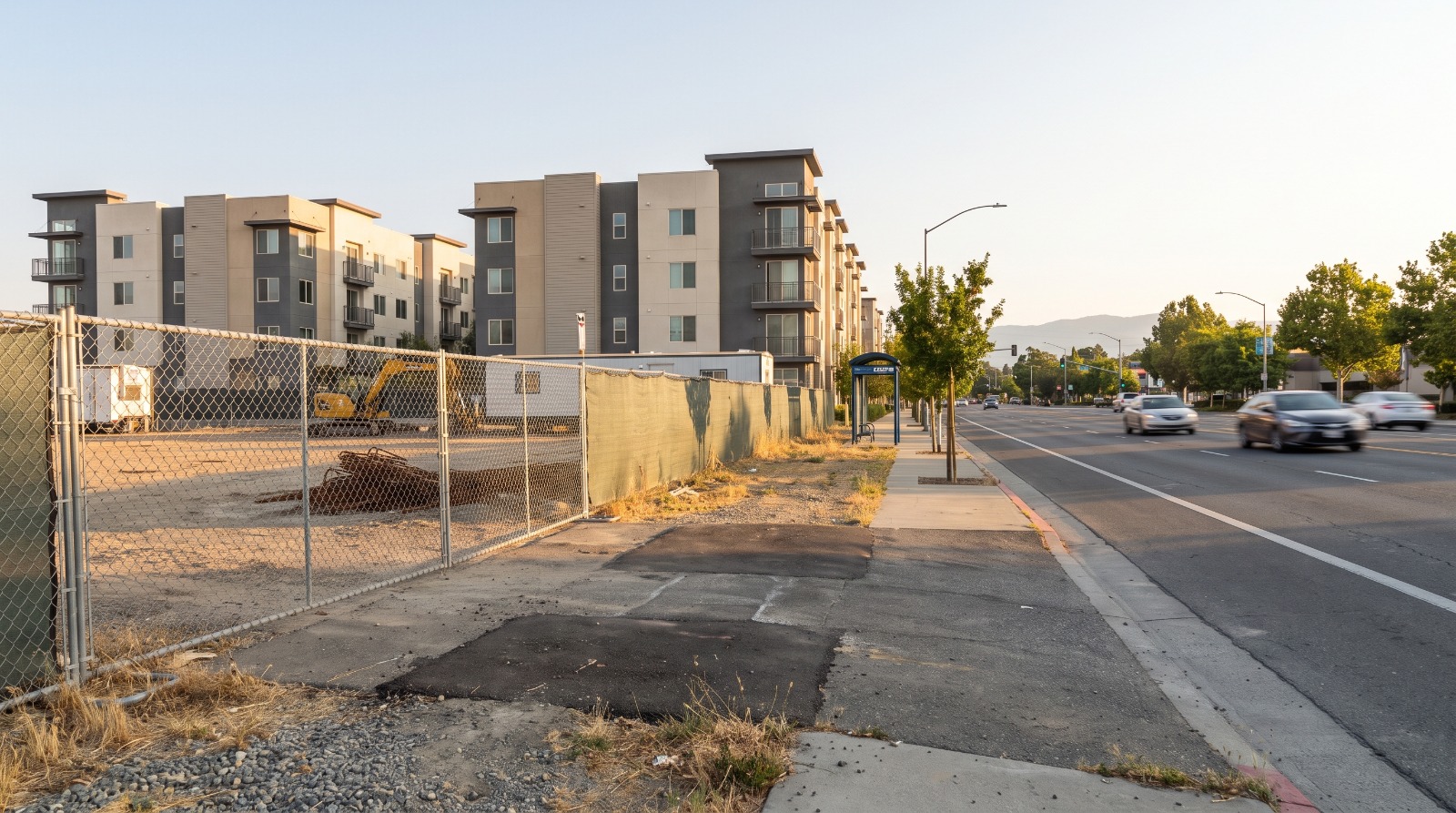
Construction site at 860 West San Carlos Street in San Jose, where 272 affordable homes are planned beside existing apartments Photo: Houseberry
The last empty block of Swenson's Ohlone project finally has its building permit. San Jose issued permit 2026-132634-MF on September 4, 2026, for 272 apartments at 860 West San Carlos Street, and every one of them will be income-restricted affordable housing.
The city's own permit record lists the job as "Block A Family Affordable Apts," with a declared construction value of $80.8 million and 512,400 square feet of floor area. That is the largest valuation on any new apartment permit San Jose has issued this year, and it lands on a corridor where the headline projects around Diridon Station have mostly stalled.
What the 860 West San Carlos permit actually says
The permit is what turns an approval into a construction site. Here is what the city recorded on September 4:
- Permit number: 2026-132634-MF, new construction, multiple attached dwellings
- Owner: GR Block A LLC. Applicant and contractor: Swenson and Swenson Builders
- Homes: 272. Declared valuation: $80,819,610. Floor area: 512,400 square feet
- Plan review signoffs: building, electrical, plumbing and mechanical all marked complete
The design behind it went through a Planning Director hearing on May 20 as file H25-045, a Site Development Permit for a seven-story building on about 2.17 gross acres at the southwest corner of West San Carlos and Sunol streets. The city used State Density Bonus Law to grant three concessions and two waivers, including a waiver on floor area ratio, and cleared the environmental review as an addendum to the original Ohlone EIR.
That works out to about 125 homes per acre, dense by San Jose standards and ordinary for a site this close to a regional rail hub.
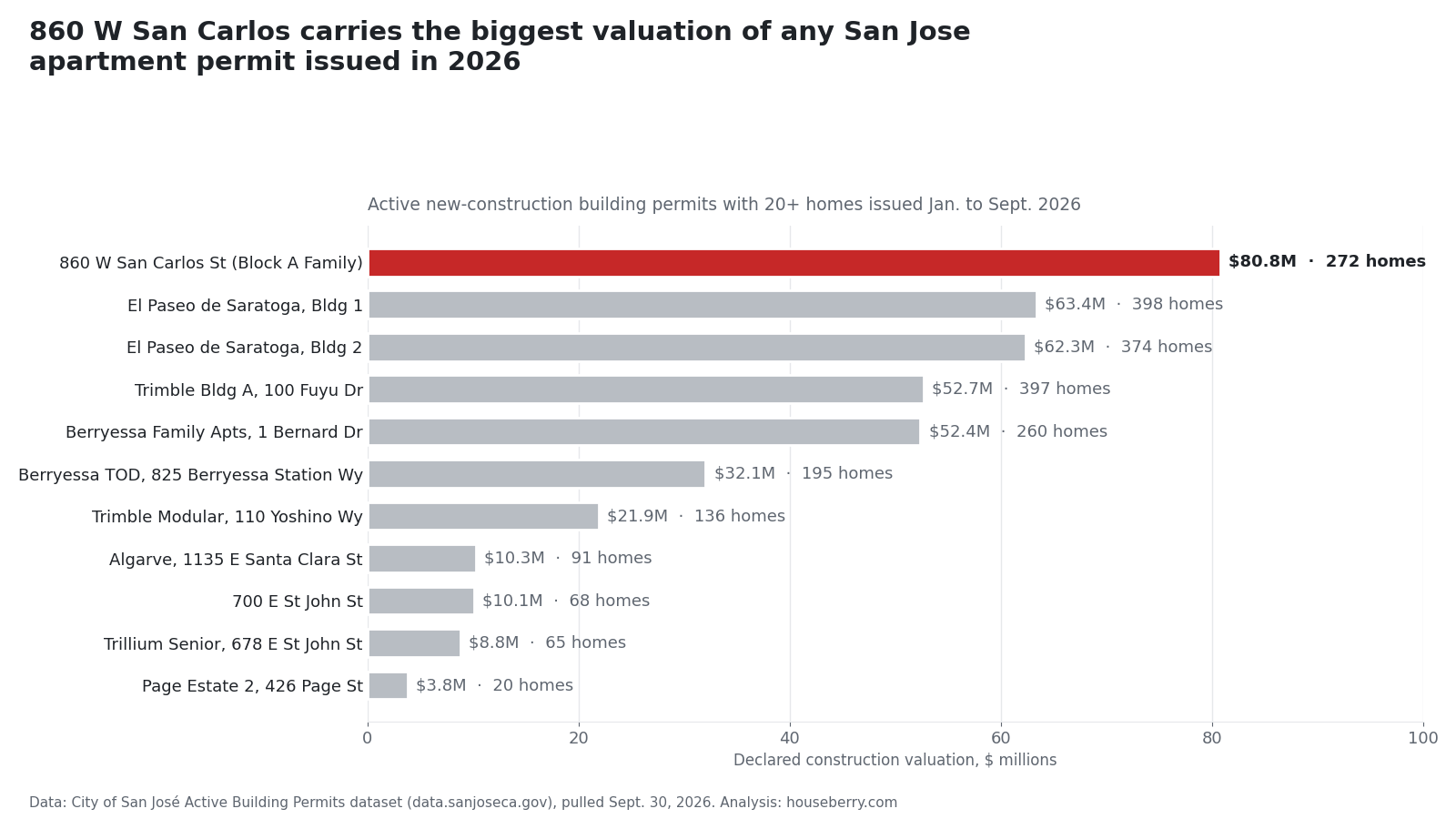
Divide by the number of homes and Block A still leads, at about $297,000 of construction value per home. The next highest in the chart, the Berryessa Family Apartments on Bernard Drive, works out to about $201,500. Big family-size units and a two-level concrete garage are not cheap to build.
From a 12-story market-rate tower to a seven-story affordable building
This site has been promised a building for a long time. The Ohlone Mixed-Use Project started environmental review in 2009 as up to 800 homes and 30,000 square feet of retail on about 8.25 acres of mostly paved former industrial land at West San Carlos and Sunol.
Swenson and its partner Republic Urban Properties built it in phases. Silver at Ohlone, with 268 apartments, broke ground in 2016. Patina@Midtown added 269 more in an eight-story building. The deal also set aside four acres to expand Del Monte Park.
Block A was always the tall one. San Jose approved a 12-story, 263-unit market-rate design in 2022, and Swenson later told reporters that version proved financially infeasible. A 13-story all-affordable version followed in 2024. The March 2026 filing cut it to seven stories, 79 feet, with five wood floors over a two-level concrete podium. The mix is 107 one-bedrooms, 96 two-bedrooms and 69 three-bedrooms, over a 242-space garage.
Shorter, same unit count, much cheaper to build. I will take a seven-story building that gets built over a 13-story rendering that does not, every time.
Who can live at Block A, and what the rent looks like
Block A will house working households earning roughly 30 to 70 percent of area median income, with most homes aimed at the 60 and 70 percent tiers.
There are two versions of that mix floating around, and they are both right. The city's hearing notice uses broad legal ceilings: 55 very-low-income homes at or below 50 percent of AMI and 217 low-income homes at or below 80 percent. The state tax-credit application reviewed in December 2025 sets the actual rent tiers, which are deeper. Some coverage described the 217 as moderate-income. The state filing does not.
Here is the tax-credit mix, with 2026 income ceilings. We derived those from HUD's FY2026 limits for Santa Clara County, where the four-person median family income is $205,500 and the 50 percent limit for a family of four is $102,750.
| Rent tier (share of AMI) | Homes | Approx. 2026 income cap, 1 person | Approx. 2026 income cap, family of 4 |
|---|---|---|---|
| 30 percent | 27 | $43,170 | $61,650 |
| 50 percent | 27 | $71,950 | $102,750 |
| 60 percent | 109 | $86,340 | $123,300 |
| 70 percent | 106 | $100,730 | $143,850 |
| Manager units | 3 | Not restricted | Not restricted |
The state filing's 2025 rent schedule, utilities included, runs from $1,130 for a one-bedroom at the deepest tier to $2,638 at the top tier. Three-bedrooms run $1,567 to $3,656. So the 70 percent homes are not cheap. They are priced for a household with two steady paychecks that still cannot touch a $1.08 million condo near the station.
The 69 three-bedrooms matter more than they look. Large affordable units are the hardest kind to finance here, and many downtown projects skip them.
Leasing will run through the city's affordable housing portal once the building nears completion. Nothing is open for applications yet.
$80.8 million on the permit, $149.8 million all in
The permit valuation covers construction only. The real cost of the building is almost twice that.
The state tax-credit staff report puts the total development cost at $149.8 million, or about $550,900 per home. The permit's $80.8 million works out to roughly $297,000 per home. The gap is land, fees, financing and design. The financing stack includes about $5.7 million a year in federal tax credits and a $38 million tax-exempt bond allocation, according to the CTCAC report.
Here is the honest downside. Half a million dollars per affordable apartment is a hard number to defend to taxpayers, and it is still roughly what subsidized housing costs in the Bay Area right now. The building also trades the old plan's ground-floor retail for ground-floor apartments facing the street, one of the three density bonus concessions. Fine for residents, but a quieter frontage than West San Carlos deserves.
What 272 affordable homes do to the West San Carlos corridor
The corridor between Diridon Station and Bascom Avenue is where San Jose's housing is actually going up, and Block A is the biggest affordable piece of it.
A few blocks east, Urban Catalyst's Aquino at 486 West San Carlos is nearly topped out with 278 apartments, 14 of them affordable. Meanwhile Google's 80-acre Downtown West, approved in 2021, is still flattened lots and parking, which we dug into in our look at how much approved Diridon housing is actually getting built.
So the pattern on this side of downtown is clear. The mega-plan waits. The mid-rise, tax-credit-financed blocks keep coming, like the moderate-income plan for the Arena Hotel lot on The Alameda and the 18 townhomes proposed on a long-vacant Alameda lot. Together they are most of what this side of downtown will actually get this decade.
On prices, the best research I know is a Stanford study by Rebecca Diamond and Tim McQuade. It found that tax-credit developments in lower-income neighborhoods pushed nearby home prices up about 6.5 percent, while ones in higher-income areas led to declines of about 2.5 percent. The Buena Vista and Diridon medians sit well below San Jose's, which puts this site closer to the first case.
The neighborhoods around 860 West San Carlos, by the numbers
The site sits between two of our San Jose neighborhoods: Buena Vista, the older residential grid that stretches west from here toward Bascom, and Diridon, the station district to the northeast. This stretch of West San Carlos is often called Midtown. Both score in the bottom quarter of the city on our San Jose neighborhood rankings.
| Neighborhood | Overall score | Schools | Safety | Rank of 112 | Typical price, Aug. 2026 |
|---|---|---|---|---|---|
| Buena Vista | 2.9 | 2.8 | 2.8 | 87th | $941,500 |
| Diridon | 2.0 | 2.0 | 1.9 | 110th | $1.08M |
| Burbank | 2.9 | 2.9 | 2.6 | 88th | $1.39M |
| Gardner | 3.1 | 2.8 | 3.1 | 74th | $1.42M |
| Rose Garden | 3.5 | 2.8 | 3.9 | 61st | $2.04M |
| Downtown San Jose | 1.9 | 2.2 | 1.3 | 112th | $805,000 |
| San Jose citywide | $1.63M |
Buena Vista's typical home price was about $941,500 in August 2026, down from roughly $1.02 million in September 2025. Diridon's slipped from about $1.11 million to $1.08 million. Over the same 12 months, the San Jose citywide figure rose about 1 percent to roughly $1.63 million.
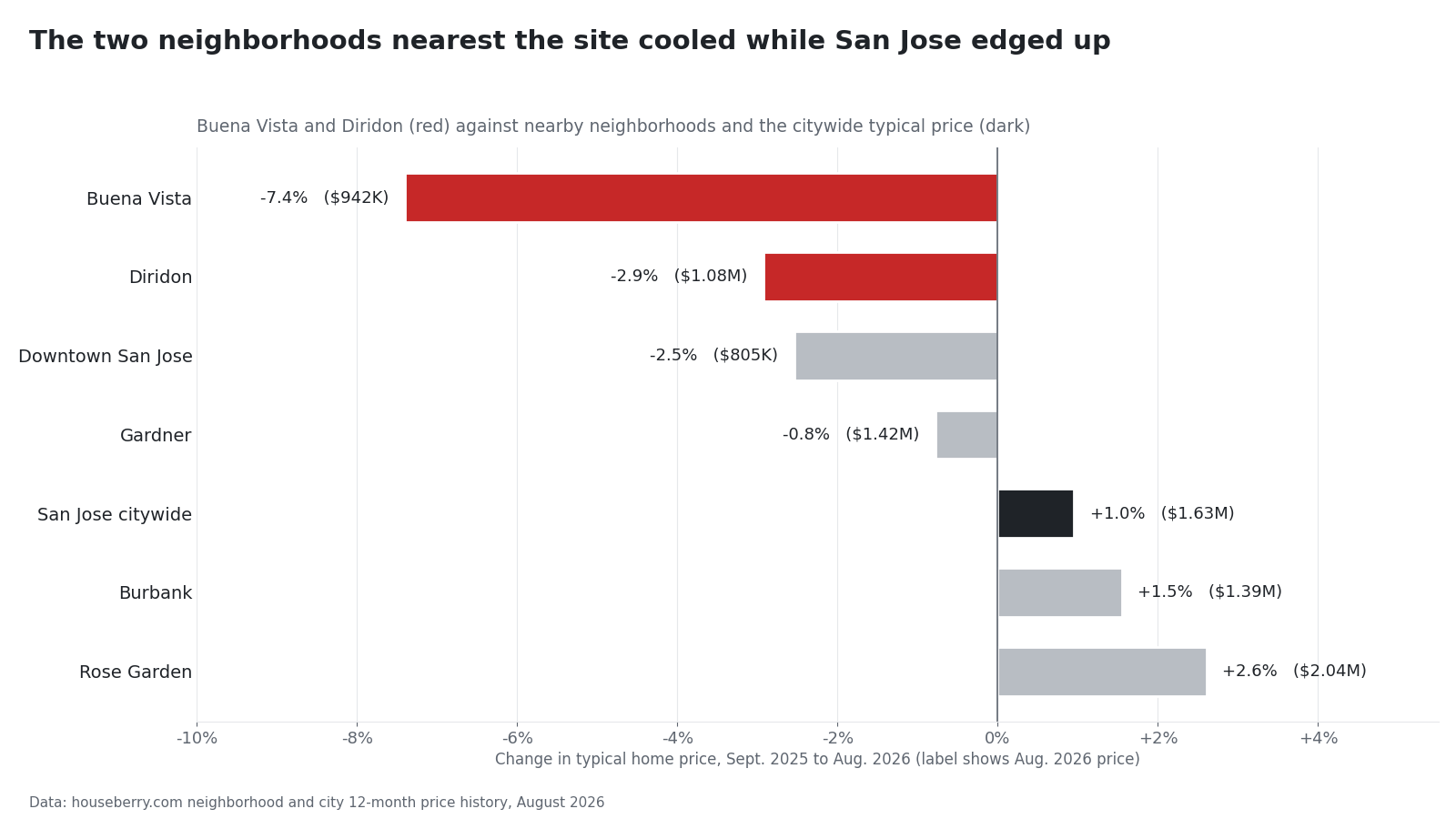
That softness predates the building and tracks the stalled Google campus and a housing stock heavy on older, smaller homes. For a buyer, the practical read is that this is one of the few parts of central San Jose where the entry price is still under $1 million, and the 0.9-point safety gap between Diridon and Buena Vista is the difference to research street by street.
When Block A could open, and what to watch next
The state filing assumed construction from May 2026 to July 2028. The building permit came four months after that start date, so treat mid-to-late 2028 as the realistic window for move-ins.
Three things are worth watching from here:
- Construction activity on the fenced lot at Sunol and West San Carlos, which tells you the financing actually closed.
- A listing on the city's affordable housing portal, usually months before first move-ins.
- Whether market-rate projects on the corridor, like the Gifford at 470 West San Carlos, reach a building permit.
Seventeen years after this land first went into environmental review, the last block of Ohlone is going to be 272 homes for households earning roughly $43,000 to $144,000 a year. If you are weighing Buena Vista or the streets around Diridon, look at the block first, and let the Houseberry scores tell you what the listing photos will not.
Sources
- City of San José, Active Building Permits dataset, permit 2026-132634-MF, accessed Sept. 30, 2026
- City of San José, Planning Director Hearing agenda, May 20, 2026, file H25-045 and ER26-016
- California Tax Credit Allocation Committee, staff report CA-25-715, Block A Family Apartments, December 2025
- HUD, FY2026 Income Limits, San Jose-Sunnyvale-Santa Clara HUD Metro FMR Area
- CEQAnet, Ohlone Mixed-Use Project, SCH 2009042075
- San Francisco YIMBY, Updated affordable housing plans filed for 860 West San Carlos Street, March 2026
- San Francisco YIMBY, Plans shift to affordable housing at 860 West San Carlos Street, September 2024
- The Real Deal, Swenson switches to affordable apartments at downtown San Jose site, May 20, 2026
- First American, The Ohlone revived
- San Francisco YIMBY, Construction nearly topped out for 486 West San Carlos Street, September 2026
- Planetizen, Google razed 80 acres in downtown San Jose, March 2026
- Stanford GSB, Diamond and McQuade, Who Wants Affordable Housing in Their Backyard?
- Houseberry, San Jose neighborhood rankings and neighborhood price history, August 2026
Map of San Jose Neighborhoods
Loading map...
View Full Map
Top Neighborhoods in San Jose, CA


All information provided on this website including but not limited to - school ratings, safety, amenities, user opinions, and property data - is for general informational purposes only. We do not guarantee its reliability, accuracy, or completeness. Users should independently verify information and consult appropriate professionals as needed. By using this website, you agree Houseberry is not responsible for actions, decisions, or consequences arising from reliance on the information provided
houseberry.com - CA DRE# 01847391
 Bay East ©2025. CCAR ©2025. bridgeMLS ©2025. Information Deemed Reliable But Not Guaranteed. This information is being provided by the Bay East MLS, or CCAR MLS, or bridgeMLS. The listings presented here may or may not be listed by the Broker/Agent operating this website. This information is intended for the personal use of consumers and may not be used for any purpose other than to identify prospective properties consumers may be interested in purchasing. Data last updated at October 1, 2026 12:00 AM