Arena Hotel San Jose: Developer Pick and Parking Lot Homes
San Jose staff want Episcopal Community Services to take over the city-owned Arena Hotel on The Alameda and plan moderate-income homes on its parking lot. Here is what the Oct. 6 council item does, what 120 percent of AMI means in dollars, and what it means for nearby buyers.
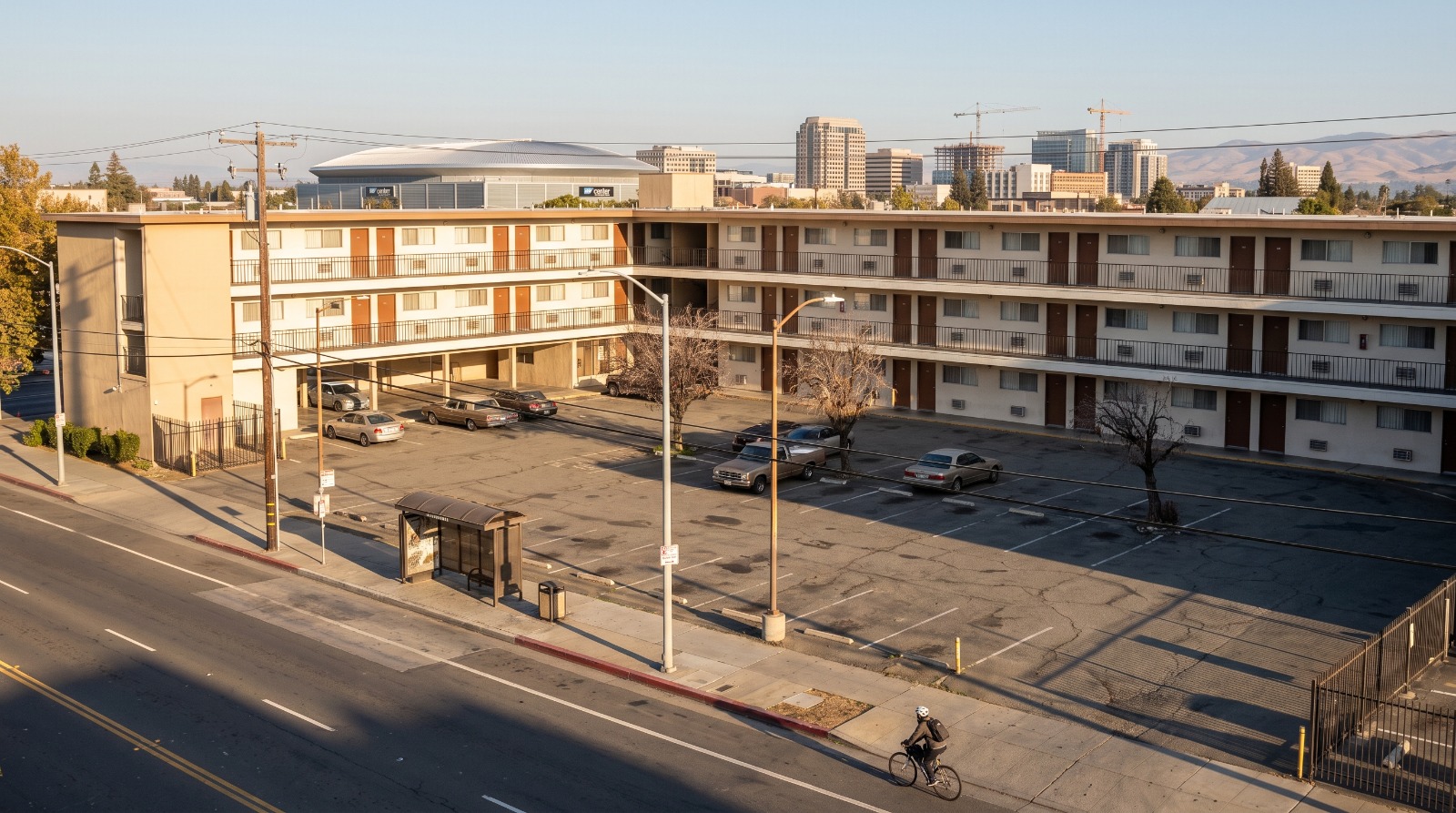
The Arena Hotel on The Alameda in San Jose, a three-story motor hotel beside the parking lot slated for new homes. Photo: Houseberry
The most interesting piece of land on The Alameda right now might be a motel parking lot. It sits beside the Arena Hotel at 817 The Alameda, a short walk from SAP Center, and San Jose housing staff want it to become new homes for moderate-income households.
That is the quiet headline inside Item 8.2 on the Oct. 6, 2026 San Jose City Council agenda (File 26-1035). Staff recommend a three-year exclusive negotiating agreement with Episcopal Community Services of San Francisco to take over the city-owned Arena Hotel, keep the building as housing under its state Homekey rent limits, and explore building mixed-income housing on the parking lot for households at or below 120 percent of area median income. Propertyworx LLC, the second-highest scorer, is the backup. No unit counts or dollar figures appear in the legislation text, and I could not get the attached staff memo, so those numbers are not public in anything we have read yet.
From budget motel to city-owned Homekey site
The Arena Hotel has been public housing infrastructure for three years, and it has not been a smooth three years. San Jose first lined it up in 2021 as an 89-unit Homekey project with developer Urban Housing Communities and operator HomeFirst. The state awarded $25.2 million in Homekey money for it in May 2022.
It opened as interim housing with a grand opening on Sept. 28, 2023: 90 rooms (80 singles and 10 doubles) at a total cost of $45.2 million, $25.2 million from Homekey and $20.8 million from the city's Measure E property transfer tax. That is roughly $502,000 per room, which is what hotel conversions cost when the building needs real work.
Then the problems. By late 2025, residents were describing broken elevators, food-poisoning incidents and uneven case management, and the city replaced HomeFirst with WeHope on Dec. 1, 2025, under a $2.7 million contract. To be fair to HomeFirst, it moved 52 residents into permanent housing in just over two years. In May 2026, the site switched again, becoming a waiting room for people who already hold federal housing vouchers, with the county Housing Authority paying up to $2.3 million over three years.
What Item 8.2 would actually set in motion
The resolution does two jobs at once: it picks the next team, and it cleans up the old one. On the first, it authorizes the Housing Director to negotiate with Episcopal Community Services on two pieces.
- The hotel. Convert the existing Arena Hotel into housing units with rents consistent with the project's Homekey agreement.
- The parking lot. The potential future construction of mixed-income housing on the parking lot portion of the site, serving households at or below 120 percent of AMI.
A right-of-entry agreement lets the nonprofit onto the property for due diligence. If Episcopal Community Services cannot sign or misses a material obligation, the same authority passes to Propertyworx LLC.
On the second job, the city would amend its Homekey standard agreement with the California Department of Housing and Community Development to remove A0729 San José L.P., Urban Housing Communities LLC and HomeFirst Services of Santa Clara County, and name the city as sole grantee. It would also unwind the ground lease, the acquisition and rehabilitation grant agreement and the operating agreements with the original partners. That is a lot of paperwork, and it is the paperwork that has to happen before anyone new can finance anything.
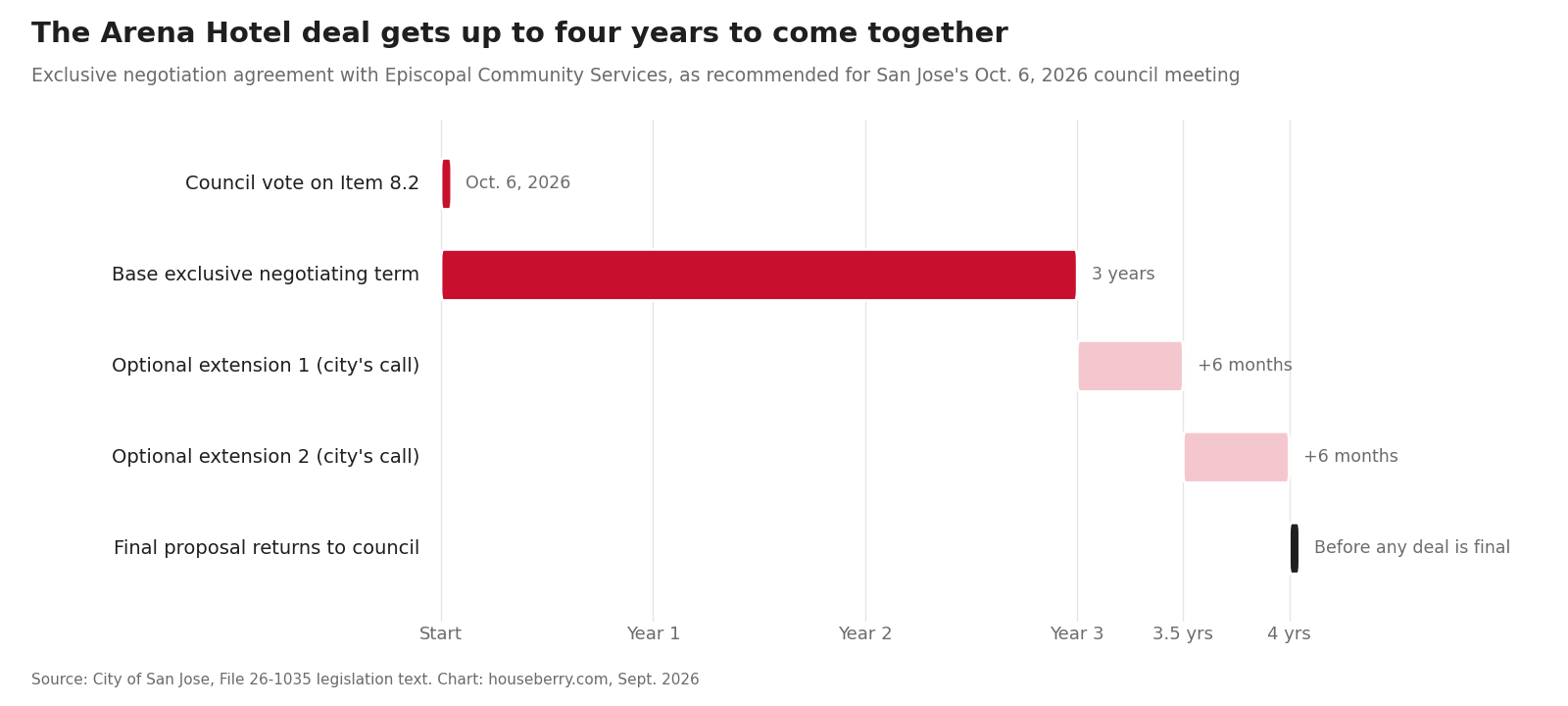
One shift is worth flagging. As recently as April 2026, the long-term plan reported for this site was to demolish the building for up to 200 permanent affordable apartments. The new recommendation talks about converting the existing hotel and adding housing on the lot instead. Keeping 90 occupied rooms while building next door is less disruptive for the people living there. It may also mean fewer total homes than a full rebuild, and we will not know until the proposal has numbers.
Why this nonprofit, and why the parking lot matters
Episcopal Community Services has done exactly this kind of project before. In San Francisco it acquired two hotels through Homekey, the 232-room Granada and the 130-room Diva, and it owns and operates 1064 Mission Street, a 256-studio supportive housing building. This would be a move south of its home turf, which is worth watching, but the hotel-to-housing playbook is familiar to it.
The parking lot is where I get genuinely optimistic. The hotel's rooms are deeply affordable by design. The lot is different: 120 percent of AMI is moderate income, the teachers, nurses, bus drivers and city staff who earn too much for most affordable housing and not nearly enough for a $1.6 million San Jose house. Almost nobody builds for them, because the rents do not cover construction costs without help. A city-owned parcel, where land cost is already paid for, is one of the few places it can pencil.
And this is a good spot for it. The site is a few blocks from SAP Center and walking distance to Diridon Station, where Caltrain, VTA light rail and the future BART extension meet. Putting homes on surface parking next to a regional transit hub is the most basic pro-housing move there is. I would rather see a four-story building on that asphalt than another decade of parked cars.
What 120 percent of AMI means in dollars in 2026
For a family of four in Santa Clara County, the moderate-income ceiling is $246,600 a year. That comes from the 2026 state income limits published by HCD, which put the county's four-person area median income at $205,500, up from $195,200 a year earlier. Here is the full ladder, with our own math on what 30 percent of that income works out to per month.
| Household size | 2026 moderate-income limit (120% AMI) | 30% of that income, per month |
|---|---|---|
| 1 person | $172,600 | $4,315 |
| 2 people | $197,300 | $4,933 |
| 3 people | $221,950 | $5,549 |
| 4 people | $246,600 | $6,165 |
Read the table carefully. These are income caps, not rents. The right column is the most a household at the very top of the band would pay at the standard 30 percent affordability line. Actual rents on a 120 percent AMI building are set in the regulatory agreement and are usually calculated below the cap, so most tenants would pay less. The point is who qualifies: a two-earner household making just under $250,000 is still in.
What it means if you are buying near The Alameda
For nearby buyers, the practical takeaway is that the Arena Hotel is becoming more stable, not less. A city-owned site with a named nonprofit, a clear contract and a moderate-income building planned next door is a better neighbor than a troubled interim shelter whose operator and mission both changed within six months.
The Alameda also sits on a real price seam. Rose Garden, the older residential neighborhood around the Municipal Rose Garden off The Alameda, had a median of about $1.96 million in August 2026 on our data. College Park, between The Alameda and Highway 880, was at about $1.32 million. Buena Vista, the older flat grid stretching from the Bascom area toward downtown, was at about $941,500. The San Jose citywide median was about $1.63 million the same month.
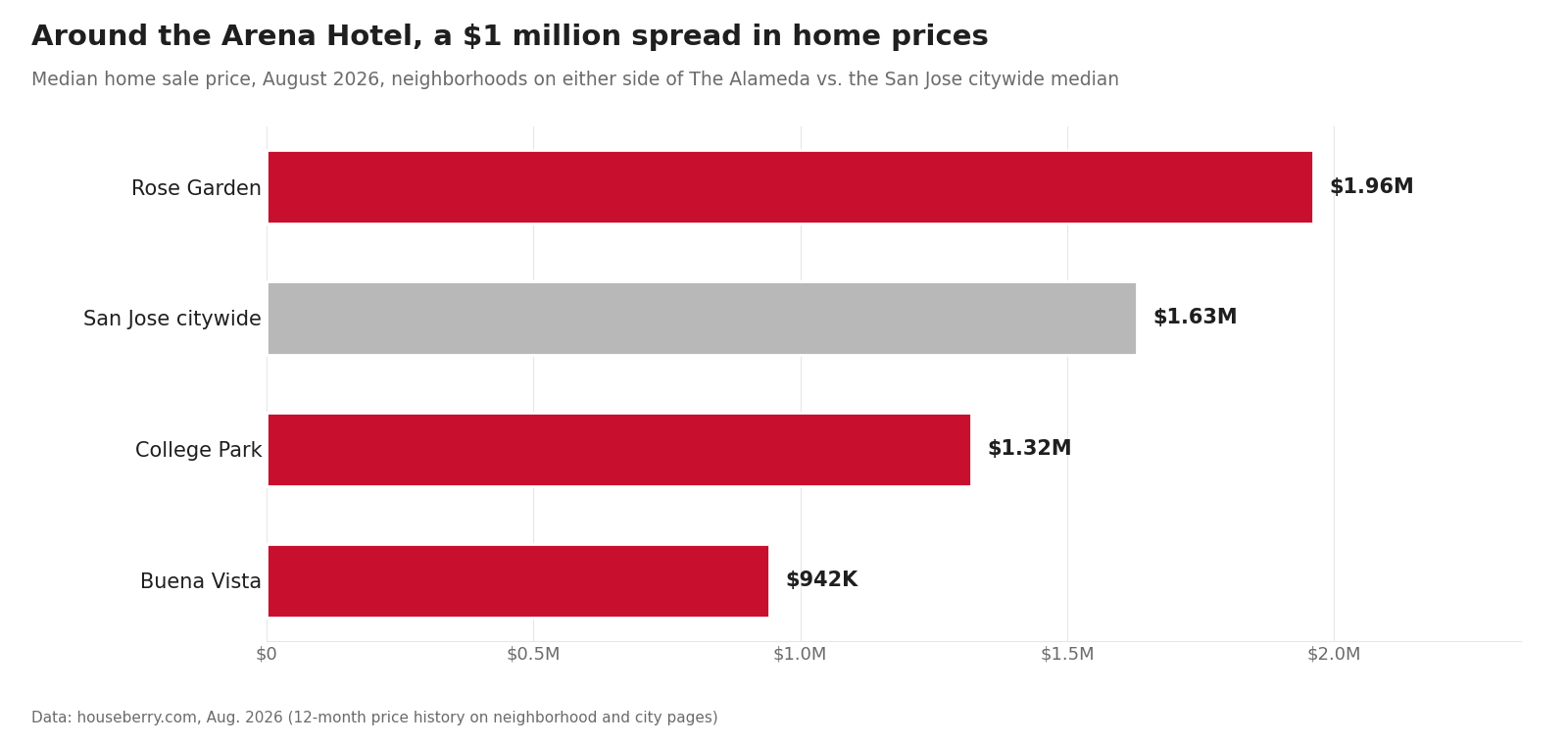
That spread is the story of The Alameda as a whole. It is the seam between some of San Jose's priciest older blocks and some of its most attainable ones, and it is where the city keeps putting new housing, like the 18 townhomes proposed for a long-vacant Emory Street lot. Rose Garden scores 3.5 overall and 3.9 on safety in our San Jose neighborhood rankings, and nothing in this item changes that.
The honest caveat is time. This is a negotiating agreement, not a building permit. We have watched the Diridon area stay stuck between approved and actually built for years, and a four-year negotiating window plus CEQA review means shovels on the parking lot are realistically years out. If you are buying near The Alameda, price in what is there today.
When the next decision lands
Council takes up Item 8.2 on Oct. 6, 2026. The item sits in Council District 6, and the city has deemed the agreements themselves not a project under CEQA, since no physical change happens yet. The real test comes later, when Episcopal Community Services returns with a final proposal that has unit counts, a budget and a construction plan for the lot.
That is when we will know whether this becomes 60 homes or 200, and what the moderate-income rents look like. We will be reading that staff report when it lands. Until then, if you are weighing a home on either side of The Alameda, start with how the surrounding neighborhoods actually compare, then look at the house.
Sources
- City of San Jose, File 26-1035, Item 8.2 legislation text (Oct. 6, 2026 agenda)
- City of San Jose, File 26-1035 staff memorandum (attachment)
- Office of Mayor Matt Mahan, Arena Hotel grand opening (Sept. 28, 2023)
- San Jose Spotlight, San Jose pushes ahead to convert hotels to housing (Oct. 2021)
- San Jose Inside, San Jose to receive $25.2 million Homekey grant to buy Arena Hotel (May 2022)
- San Jose Spotlight, San Jose homeless hotel gets new management (Nov. 2025)
- San Jose Spotlight, San Jose shelter is a stop on the way to permanent housing (April 2026)
- California HCD, 2026 State Income Limits
- Episcopal Community Services of San Francisco, Supportive Housing Expansion
- Houseberry, Rose Garden, Buena Vista and College Park neighborhood pages and San Jose city page, price history through August 2026
Map of San Jose Neighborhoods
Loading map...
View Full Map
Top Neighborhoods in San Jose, CA


All information provided on this website including but not limited to - school ratings, safety, amenities, user opinions, and property data - is for general informational purposes only. We do not guarantee its reliability, accuracy, or completeness. Users should independently verify information and consult appropriate professionals as needed. By using this website, you agree Houseberry is not responsible for actions, decisions, or consequences arising from reliance on the information provided
houseberry.com - CA DRE# 01847391
 Bay East ©2025. CCAR ©2025. bridgeMLS ©2025. Information Deemed Reliable But Not Guaranteed. This information is being provided by the Bay East MLS, or CCAR MLS, or bridgeMLS. The listings presented here may or may not be listed by the Broker/Agent operating this website. This information is intended for the personal use of consumers and may not be used for any purpose other than to identify prospective properties consumers may be interested in purchasing. Data last updated at September 29, 2026 12:00 AM