MiTAC's $76.8M San Jose AI Server Lab Permit, Explained
MiTAC just pulled a $76.8 million permit for a 40,042-square-foot lab at 1750 Automation Parkway. Here is what the permit says, why it points to AI server work, and what it does and does not mean for homes in Berryessa and Milpitas.
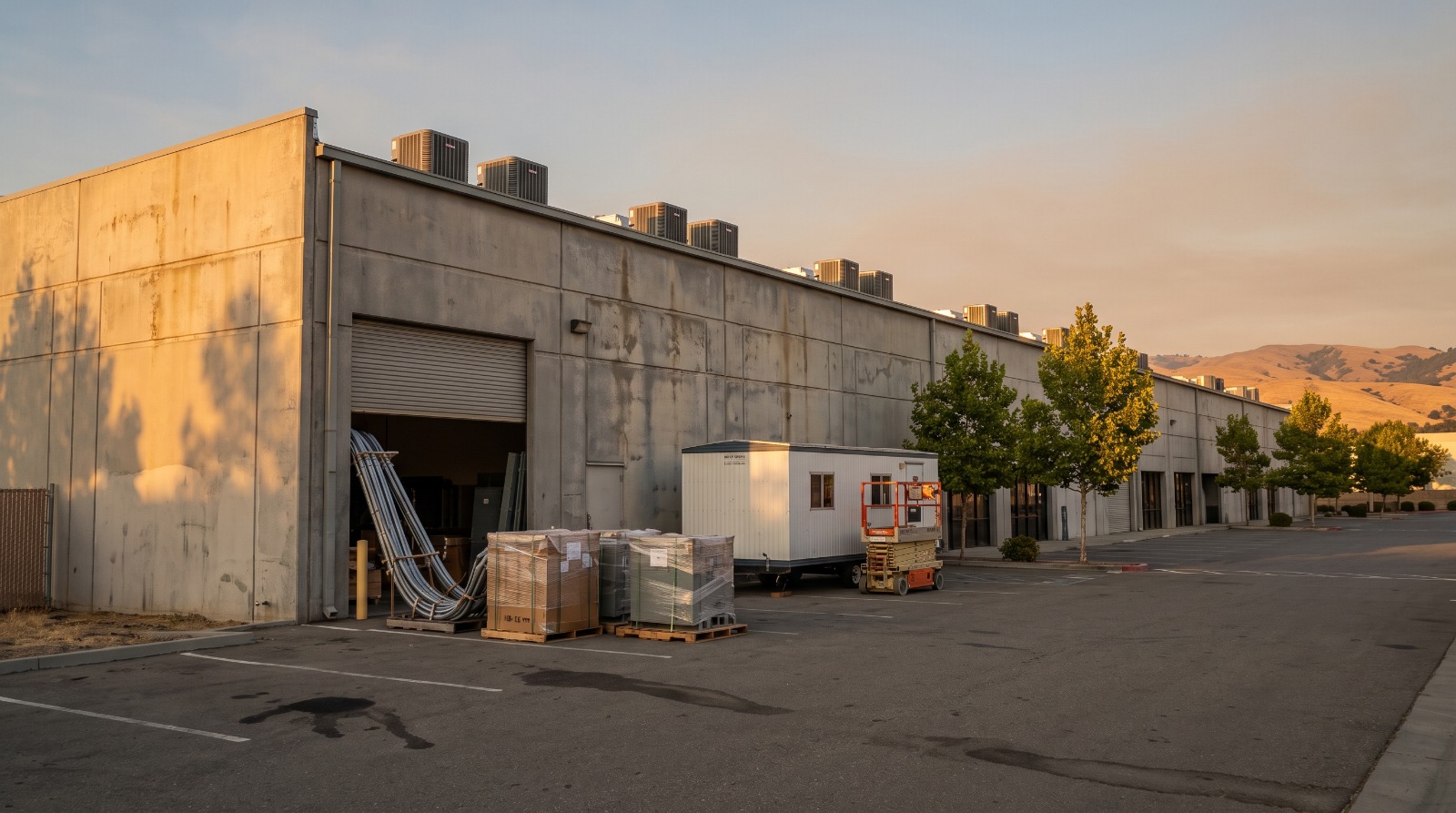
A single-story North San Jose R&D building mid build-out at dusk, the kind of site where MiTAC's San Jose AI server lab is going in. Photo: Houseberry
$1,917 a square foot. That is the construction value San Jose recorded on September 22, 2026, for a 40,042-square-foot research lab MiTAC is building inside an existing industrial building at 1750 Automation Parkway in North San Jose. The total is $76,756,558, the second-largest building permit the city issued in the past 30 days, behind only a 512,400-square-foot affordable apartment complex.
MiTAC is the Taiwanese group whose computing arm builds servers for AI and cloud data centers. The permit does not say what the lab will design or test. But the company, the address and the price per foot all point the same way. MiTAC San Jose is shaping up as a serious AI server engineering site, and for anyone house hunting on the Berryessa side of town it is a jobs signal, not a housing story on its own.
What the MiTAC permit actually says
The permit is specific about scale and cost and silent about purpose. We pulled it straight from the city's Last 30 Days Building Permits dataset on September 29. It is listed as a tenant improvement, subtype "R & D Lab," with building, electrical, plumbing and mechanical reviews all marked complete. The contractor is Megawatt Construction. The owner of record is MLC V SC Automation LLC.
It is the second MiTAC permit at the address this month. A $500,000 demolition-only permit was issued on September 3, which is the usual order of things: clear the old interior, then build the new one.
The building has a recent history. 1750 Automation Parkway is one of four single-story buildings, about 340,900 square feet in all, in a campus zoned for industrial park use. Battery maker QuantumScape leased the 80,641-square-foot building in 2021 on a term running to September 2032, and in December 2025 it subleased the neighboring 1762 building to space company Momentus as it trimmed its footprint. The permit does not say whether MiTAC's space is a sublease or a direct deal. Either way, MiTAC's lab covers roughly half of the 1750 building.
Why $1,917 a foot reads as a serious lab
The per-foot number is the tell. Ordinary office build-outs in the same feed ran $329 to $396 a square foot, and even the two jobs that are explicitly about servers came in under $1,000.
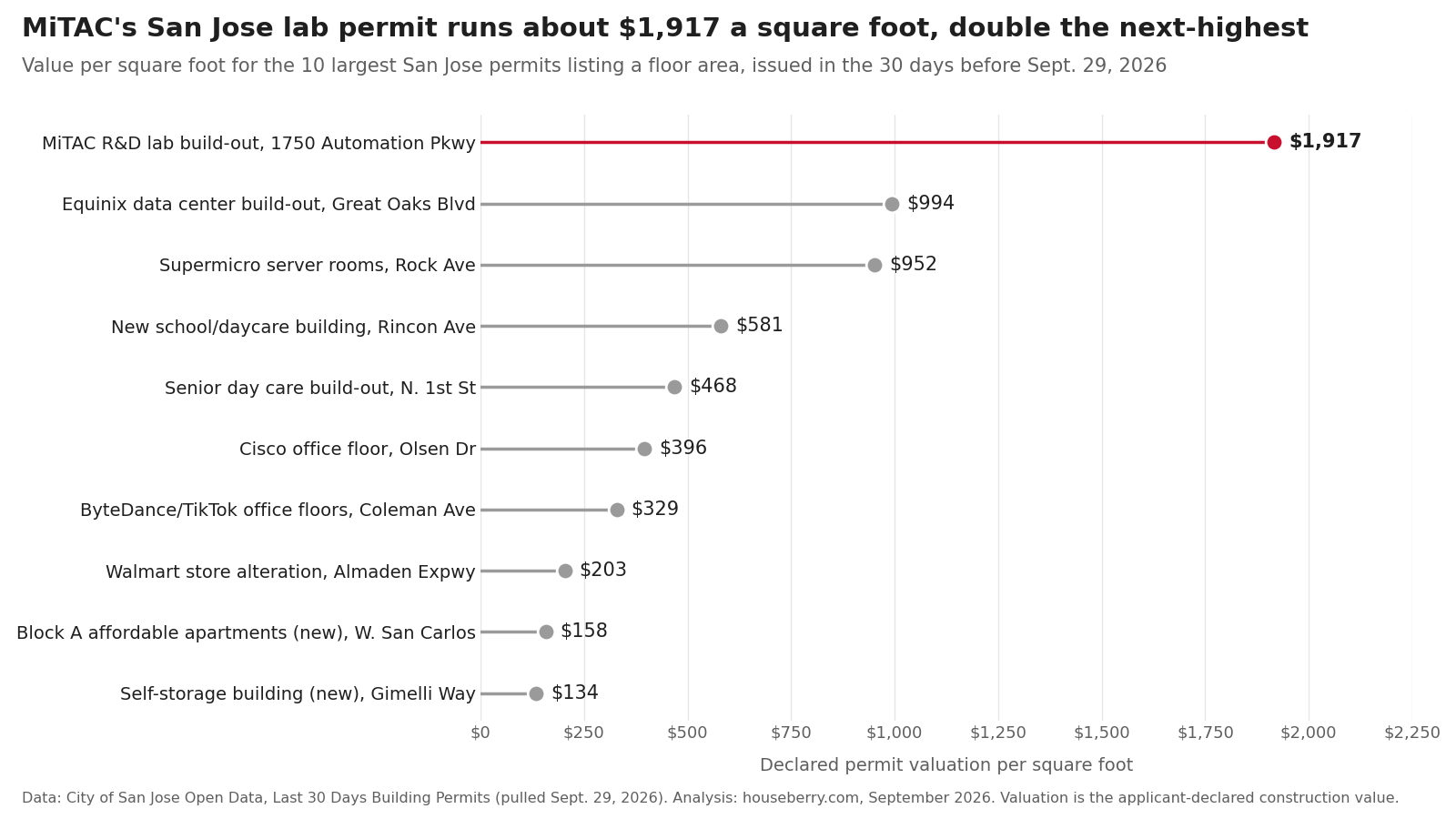
Equinix's data center build-out on Great Oaks Boulevard in south San Jose works out to $994 a foot. Supermicro's server-room job on Rock Avenue, a short drive from Automation Parkway, is $952. MiTAC's lab is about twice either one.
A few caveats keep this honest. Permit valuation is what the applicant declares for construction. It is not a sale price, and it typically does not cover the servers and test gear that roll in later. So the $76.8 million is mostly walls, power, cooling and plumbing. That is exactly why it is interesting. You do not spend that per foot on desks.
MiTAC's newly expanded Newark office offers a clue about what this kind of space does. The company said in August that it houses a new product introduction unit for advanced cooling and an engineering lab for validating AI and cloud workloads. A San Jose lab doing similar work would need heavy electrical service and liquid-cooling plumbing. That is a reasonable read of the number, not something the permit states.
Who MiTAC is, and why it keeps adding Bay Area space
MiTAC has spent the last three years turning itself into a serious AI server maker. In April 2023 Intel sold its Data Center Solutions Group server business to MiTAC, handing it the right to build and sell Intel-designed servers. MiTAC Computing now sells AI and GPU servers built on AMD and Intel platforms, and NVIDIA named it in August 2025 among the system makers bringing its RTX PRO Blackwell servers to market.
The Bay Area footprint has grown fast. MiTAC Information Systems took about 348,000 square feet at Fremont Technology Center in mid-2025, then committed in August 2026 to essentially all of the roughly 470,000-square-foot Campus at Bayside in Fremont. We looked at what that means for the neighborhoods across I-880 in our piece on the Fremont Bayside campus. San Jose is the new piece.
The backdrop is a push to build AI hardware in the United States. In April 2025 NVIDIA said it would work with partners to produce up to $500 billion of AI infrastructure in the U.S. over four years, with supercomputer assembly in Texas. And North San Jose already has the region's biggest homegrown example. Supermicro in April 2026 added a 32.8-acre, 714,000-square-foot campus on Qume Drive and Commerce Drive, which it calls its largest in the country. MiTAC's lab sits in the same North San Jose industrial belt.
A lab is not a data center
This is a lab permit, and the difference matters to neighbors. San Jose's own permit feed files the Equinix job as "Data Center" and MiTAC's as "R & D Lab." A lab is people at benches testing machines during work hours. A data center is racks running around the clock with chillers and backup generators out back, which is where the noise fights in San Jose come from.
Nothing in this permit points to that kind of equipment yard, and the site sits inside a business park zoned for industrial use. For Berryessa residents, a lab like this is not the kind of building that tends to produce noise complaints.
Where the people working here are likely to live
The practical commute shed is northeast San Jose and Milpitas. The site is about 0.9 mile from the Hostetter light rail station on Capitol Avenue, roughly 1.8 miles from Berryessa BART, and about 2.4 miles from Milpitas BART. Here is how the nearby neighborhoods compare on our scores and September 2026 typical prices.
| Neighborhood | Overall score | Schools | Safety | Typical price, Sept 2026 |
|---|---|---|---|---|
| Berryessa Station, San Jose | 4.0 | 3.7 | 4.3 | $1,126,830 |
| Midtown, Milpitas | 3.3 | 4.2 | 2.2 | $1,125,460 |
| Berryessa, San Jose | 3.6 | 3.4 | 3.7 | $1,219,290 |
| Wayne, San Jose | 3.5 | 3.1 | 3.9 | $1,221,970 |
| Berryessa North, San Jose | 4.0 | 3.7 | 4.3 | $1,294,180 |
| Northwestern Milpitas | 4.1 | 4.6 | 3.7 | $1,367,540 |
| Lundy, San Jose | 3.7 | 3.7 | 3.6 | $1,424,810 |
| Morrill, San Jose | 4.2 | 4.2 | 4.3 | $1,455,340 |
Two things jump out. Berryessa Station posts the same 4.0 overall and 4.3 safety scores as Berryessa North for about $167,000 less. The catch is the name. Berryessa BART actually sits in Lundy, not in Berryessa Station, so do not buy there for a walk to the train.
The other is the school gap across the city line. Northwestern Milpitas scores 4.6 on schools for about $1.37 million, against 3.7 in the Berryessa pair. For a household that plans to stay a decade, that 0.9-point school gap may matter more than a shorter drive to Automation Parkway. Morrill is the San Jose answer, with a 4.2 school score and the highest overall score in the table, at the top of the price range.
Midtown Milpitas is the cheapest line, and its 2.2 safety score is the lowest. That is a trade to research street by street, not a verdict on the neighborhood.
What this does and does not mean for nearby home prices
It does add jobs that cannot go remote. You cannot validate a liquid-cooled GPU server from a laptop in another state. Engineers and technicians have to be in the room, and those rooms are clustering in North San Jose, around Supermicro's campuses and now MiTAC's lab.
It does not, on its own, move a neighborhood median. A 40,042-square-foot lab is a modest headcount compared with a manufacturing floor, and MiTAC has not said how many people will work there. Plenty of the people who fill these jobs already live somewhere in the South Bay and will simply change their commute. One permit is a data point, not a trend line.
The cumulative story is the one to watch. North San Jose keeps adding hardware jobs, and the housing math only works if the city keeps adding homes near Berryessa BART and along the Capitol Avenue light rail line to match. More jobs with no new homes is how a commute shed turns into a bidding war.
Next, watch for MiTAC to say what the lab is for and how many people it will hold, and for the permit's final inspection date, which is still blank in the city's data. When we compare neighborhoods for a buyer weighing a job in this corridor, we start with the commute shed and then let the school and safety scores do the sorting, and the full San Jose neighborhood rankings on Houseberry are the fastest way to run that same screen yourself.
Sources
- City of San Jose Open Data, Last 30 Days Building Permits (permits 2026-139041-CI and 2026-135876-CI)
- QuantumScape lease for 1750 Automation Parkway, SEC exhibit 10.1 (November 2021)
- QuantumScape Form 8-K on the 1762 Automation Parkway sublease (December 2025)
- Peninsula Land and Capital, 1750-1762 Automation Parkway property page
- DatacenterDynamics, Intel to sell dedicated server business to MiTAC (April 2023)
- NVIDIA, RTX PRO Servers with Blackwell partner announcement (August 2025)
- MiTAC Computing Technology product site
- MiTAC Computing Technology USA, Newark office grand opening (August 2026)
- GlobeSt, MiTAC Information takes 348K SF at Fremont industrial center (July 2025)
- ConnectCRE, MiTAC leases entirety of 470K-SF Fremont campus (August 2026)
- Nextgov, NVIDIA plans for U.S.-manufactured AI supercomputers (April 2025)
- Supermicro, adds largest Silicon Valley campus (April 2026)
- Hoodline, Supermicro North San Jose campus (April 2026)
- Hostetter station, VTA light rail
- Houseberry, San Jose and Milpitas neighborhood rankings (September 2026)
Map of San Jose Neighborhoods
Loading map...
View Full Map
Top Neighborhoods in San Jose, CA


All information provided on this website including but not limited to - school ratings, safety, amenities, user opinions, and property data - is for general informational purposes only. We do not guarantee its reliability, accuracy, or completeness. Users should independently verify information and consult appropriate professionals as needed. By using this website, you agree Houseberry is not responsible for actions, decisions, or consequences arising from reliance on the information provided
houseberry.com - CA DRE# 01847391
 Bay East ©2025. CCAR ©2025. bridgeMLS ©2025. Information Deemed Reliable But Not Guaranteed. This information is being provided by the Bay East MLS, or CCAR MLS, or bridgeMLS. The listings presented here may or may not be listed by the Broker/Agent operating this website. This information is intended for the personal use of consumers and may not be used for any purpose other than to identify prospective properties consumers may be interested in purchasing. Data last updated at September 29, 2026 12:00 AM