Living Near a San Jose Data Center: The 55-Decibel Rule
South San Jose residents want a pause on new data centers. No councilmember has proposed one. The number that will actually decide this sits in the city's own noise code, and almost nobody has quoted it.

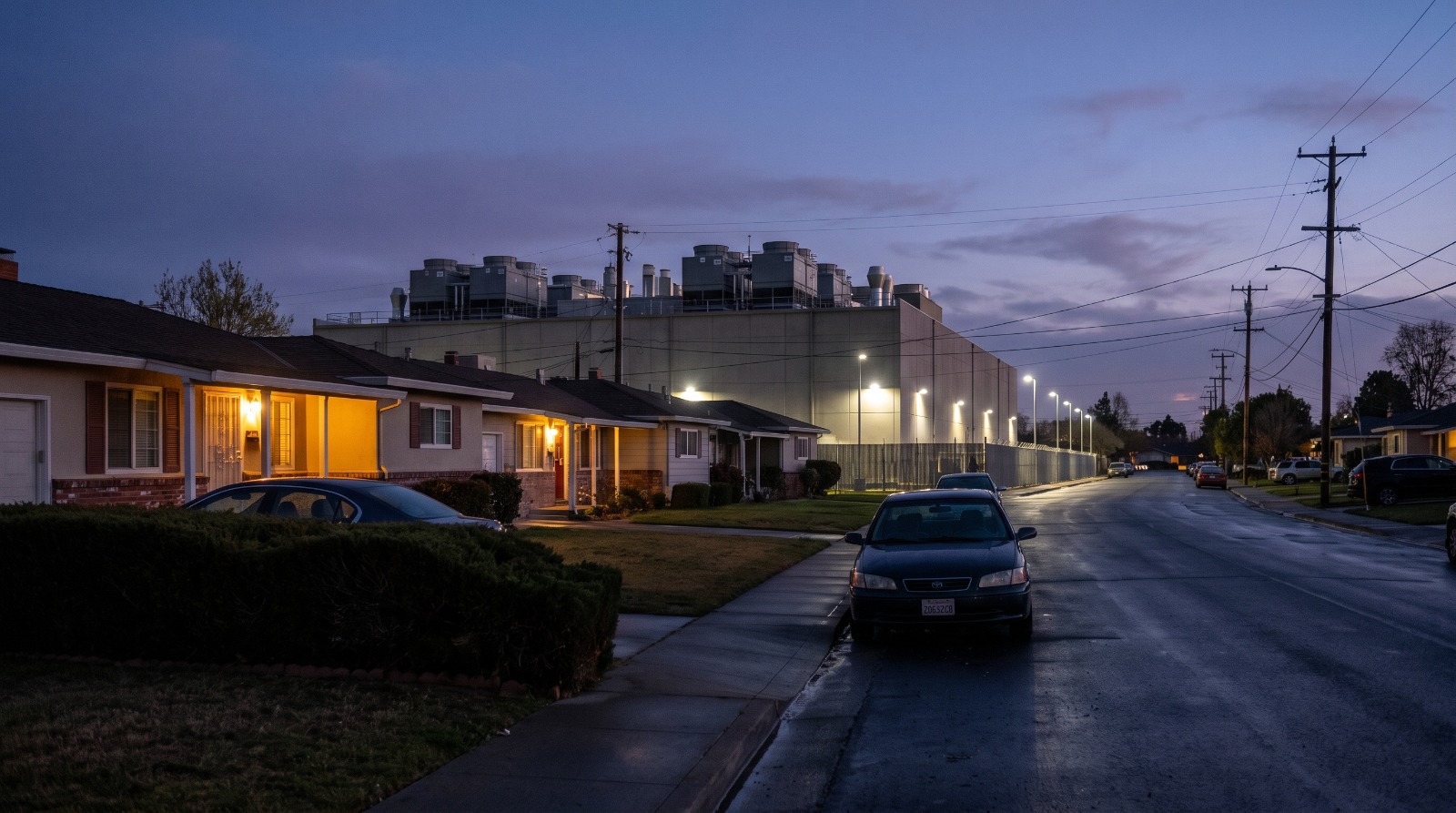
A quiet South San Jose residential street at dusk with a long windowless data center building visible past the last houses, the proximity at the center of the city's data center debate Photo: Houseberry
The question people in Edenvale and Blossom Valley are actually asking is not whether data centers are good for San Jose. It is narrower and more domestic than that. Will I be able to sleep with the window open in August.
There is a real answer, and it is a number San Jose already wrote down. The city's own municipal code caps noise from a commercial use at 55 dBA at a shared property line with homes, and the General Plan sets the same 55 dBA standard for new nonresidential development next to residential neighbors. Continuous noise at a data center property line commonly runs 60 to 80 dBA. That gap, roughly 5 to 25 decibels, is the entire fight, and it is going to be settled by a standards document rather than by a moratorium.
Which brings up the first thing worth correcting. Residents and two environmental groups are asking the council to pause new data center applications, and San José Spotlight reported that push on August 15. But no councilmember has introduced a moratorium. Nothing is pending. Mayor Matt Mahan and Councilmember David Cohen have both said publicly they do not want a pause. What is actually moving is a package of citywide uniform standards, directed by a Mahan memo that the Rules Committee adopted 5-0 in June, covering energy, water, air quality, backup generators and noise.
That package goes to the full council, tentatively, on December 1, 2026. For anyone in South San Jose, the date that matters more is a District 2 townhall in early October. That is where the noise number gets argued in front of the people who live with it.
How far the sound actually carries
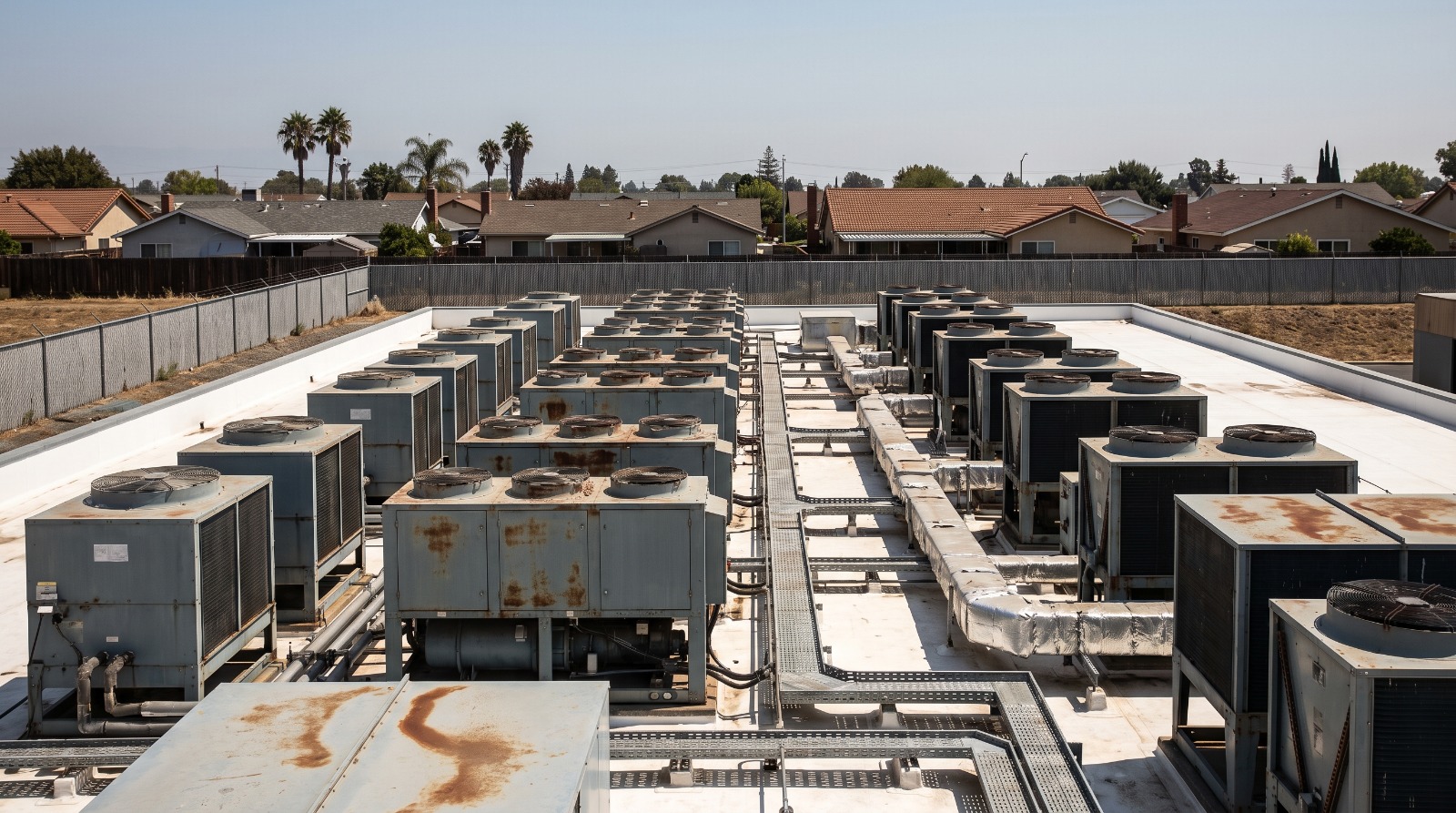
Data center noise is not a machine sound so much as a weather sound. It comes from cooling fans, chillers and transformers, and it does not stop. Here is roughly how it decays across open ground, starting from a typical 70 dBA reading at 50 feet.
| Distance from the property line | Typical continuous level | About as loud as |
|---|---|---|
| 50 feet | 70 dBA | a vacuum cleaner in the next room |
| 200 feet | 60 dBA | a normal conversation |
| 800 feet | 50 dBA | a quiet office |
| Half a mile | 40 dBA | a library |
Read that as a rough ladder, not a promise. Terrain, walls and wind all move it. And there is a wrinkle that explains why complaints in Chandler, Arizona and Prince William County, Virginia keep outrunning the measurements: much of the energy sits below 100 hertz. Low frequencies travel further than high ones and they pass through walls and windows better, so a reading that looks acceptable on a meter outside can still be the thing you notice at 2 a.m. inside. Sixty-five decibels is the level where researchers start measuring stress responses. Nobody near Great Oaks is being exposed to hearing damage. They are being exposed to something quieter and more persistent than that, which is a different kind of problem and a harder one to win an argument about.
Where San Jose's data centers actually are
The Great Oaks cluster is not new and it is not one project. It is mostly Equinix, and it has been operating off Santa Teresa Boulevard for years: SV1, SV5, SV10 and SV11 at 5 through 11 Great Oaks Boulevard, plus a group at 123 Great Oaks, roughly a thousand feet northwest of Highway 85. A rezoning to expand that campus, raising allowable floor area from 260,000 to 400,000 square feet across two two-story buildings, is working through an environmental review that includes a noise assessment and a separate acoustical study. Those two appendices are public documents and they are the single most useful thing a nearby homeowner can read.
What is new is the pace. In the first ten days of August, San Jose took in two more filings: a 444,436-square-foot data center with its own substation at 5601 Great Oaks Parkway on August 10, and a 152,676-square-foot, 18-megawatt building at 865 Embedded Way on August 3, both in the Edenvale industrial park. The city keeps a running list of these applications with file numbers and dates, and that page is the first place to look if a proposal lands near you.
One pattern in that list deserves more attention than it has gotten. Several San Jose approvals are capped at exactly 99 megawatts: the 2017 campus at 127 Great Oaks, the 2025 approval at 4160 Zanker Road, and the Prologis proposal at 5977 Silver Creek Valley Road we wrote about in July. Ninety-nine is not an engineering number. It is one megawatt under the threshold that would pull a project into state-level review. When three separate projects stop at the same inch of a line, that is a design choice, and it tells you which regulator everyone is actually managing.
The fears that are right, and the one that has aged
At the August listening session the loudest worry was water, and it is the one that has moved fastest underneath the debate. Nationally the concern is earned: a large facility can evaporate millions of gallons a day, and Loudoun County's roughly two hundred data centers used around 900 million gallons in 2023, much of it drinking water.
San Jose's recent record is better than that reputation. The 127 Great Oaks campus is air-cooled. The North San Jose campus approved in 2023 is air-cooled. The 2025 approval at Zanker Road uses recycled water. The counterexample is real and worth naming, a December 2025 approval at 5853 Rue Ferrari running on about 26,360 gallons of potable water a day, which is exactly the sort of thing a written standard would stop. But if you are picturing a cooling tower boiling off the county's drinking supply behind your fence, that is mostly a picture of somewhere else.
The generator worry lands differently. Backup diesel engines are permitted by the Bay Area Air Quality Management District to run 50 hours a year for testing and maintenance, with unlimited hours only in an actual emergency. Fifty hours is about an hour a week, usually mid-morning. That is a genuine intrusion and a bounded one, and it is a separate thing from the cooling noise that never stops. The scale is what makes people uneasy: the North San Jose campus carries 39 diesel generators, and a proposal at 350 West Trimble Boulevard lists 21 generators and 224 trees removed.
And then there is the electric bill, which is the fear I would rank highest and the one a moratorium cannot touch at all. The South Bay is projected to add 2.5 gigawatts of concentrated data center and electrification load between 2026 and 2039, and grid operators approved more than $2 billion in regional transmission upgrades last year. Who pays for that is not a San Jose question. It is a California Public Utilities Commission question, and the commission opened a rulemaking on exactly it in April 2026, expected to run about two years.
What a pause would and would not do
A moratorium would not quiet the roughly twenty facilities already running. It would not lower anyone's PG&E bill. It probably would not stop the eight applications already filed, since the standard practice is to grandfather what is in the queue, and one of the advocates' sharper points is that the long runway to December is itself an incentive to file early.
What it would buy is time, and the honest case for it is that the standards are not written yet while the applications keep arriving. That is a fair complaint even if the council never acts on it.
The tools that have actually changed outcomes elsewhere are narrower and duller than a ban. Chandler, Arizona requires a pre-construction baseline sound study shared with residents plus annual noise studies for five years after a facility opens, with no fixed decibel cap at all, measuring instead against what the neighborhood sounded like before. Birmingham, Alabama adopted a 500-foot residential setback in June. Loudoun County did the highest-leverage thing of all in 2025 and moved data centers from a by-right use to one needing a special exception, which turns a staff signature into a public hearing. Any of the three could land in the December package.
An outright ban is not fantasy either. Monterey Park voted one in citywide in June with more than 86 percent support, and the developer withdrew. But Monterey Park had one project and no existing industry. San Jose has twenty-odd facilities and a utility tax stream the city estimates at about $5.6 million a year from a single 99-megawatt building. Cities do not usually ban their own revenue.
Which is the trade-off residents are actually being asked to weigh, and it deserves to be said without spin. That money is real and it funds real things. It also buys very few jobs. Research on roughly 1,500 US facilities found a county's first large data center adds something like 100 to 200 jobs over a decade, with no measurable wage effect, and colocation campuses like the Equinix cluster are the thinnest staffed of all. A data center is a good tenant for a tax base and a poor one for a job market.
What this means for the neighborhoods
Edenvale is the closest residential neighborhood to the Great Oaks cluster. Its median sale price was about $1.35 million in July 2026, down from roughly $1.45 million a year earlier, and it scores 4.1 for safety and 3.2 for schools in our neighborhood data. Next door, Blossom Valley sits at about $1.54 million and Santa Teresa Foothills West at about $1.55 million, both up slightly over the same twelve months.
Do not read Edenvale's dip as a data center effect. Twelve months of one neighborhood's median is a noisy series, and when we looked hard at whether these buildings move nearby home values, the best available evidence said they do not. That is the part people get backwards. The reason we build Houseberry around neighborhood scores rather than one headline is that livability and value answer to different things, and this is a textbook case of the two coming apart.
If you live near one of these sites, or you are considering a house that does, there is a short list worth doing before you form an opinion. Find the file number on the city's data center project page. Ask the planner for the environmental noise assessment, and look for the modeled level at the residential property line rather than the average across the site. Check whether the project is asking for a conditional use permit, because that is the code's own escape hatch from the 55 dBA cap and it is where the exception would be granted. Then go stand on the sidewalk nearest the fence line at ten at night, which no document replaces.
And put the early-October townhall on the calendar. The standards being drafted right now will govern every one of these buildings for the next decade, and the 55 in the municipal code is either going to be enforced at the property line or quietly permitted around. That single decision will matter more to South San Jose than any moratorium vote that is never going to happen.
Sources
San José Spotlight: San Jose residents push for data center moratorium
City of San José: Data center and other large energy-use projects, the running application list
City of San José: Data center uniform standards timeline and revenue estimates
City of San José: Equinix data centers environmental review, Great Oaks Boulevard
Bay Area Air Quality Management District: permit evaluation for emergency standby engines
CPUC Public Advocates Office: how data center growth will impact California ratepayers
EESI: Communities are raising noise pollution concerns about data centers
The Houseberry Research Team is Houseberry's reporting team: Bay Area real estate analysts, data specialists and longtime local market watchers. Every day we check the public record: building permits, city council and planning agendas, county recorder filings, state housing bills, police incident data and school results. Then we tie each story to what it means for specific neighborhoods, using Houseberry's own neighborhood data on prices, appreciation, safety, schools and amenities. Questions or corrections: Contact us.
All information provided on this website including but not limited to - school ratings, safety, amenities, user opinions, and property data - is for general informational purposes only. We do not guarantee its reliability, accuracy, or completeness. Users should independently verify information and consult appropriate professionals as needed. By using this website, you agree Houseberry is not responsible for actions, decisions, or consequences arising from reliance on the information provided
houseberry.com - CA DRE# 01847391
 Bay East ©2025. CCAR ©2025. bridgeMLS ©2025. Information Deemed Reliable But Not Guaranteed. This information is being provided by the Bay East MLS, or CCAR MLS, or bridgeMLS. The listings presented here may or may not be listed by the Broker/Agent operating this website. This information is intended for the personal use of consumers and may not be used for any purpose other than to identify prospective properties consumers may be interested in purchasing. Data last updated at October 9, 2026 12:00 AM