Fremont Bayside AI Campus: The Neighborhoods Next Door
A server maker just took roughly 470,000 square feet on the Bayside flats. The Fremont neighborhoods closest to it are the middle of the market, not Mission San Jose, and that gap is the useful part.
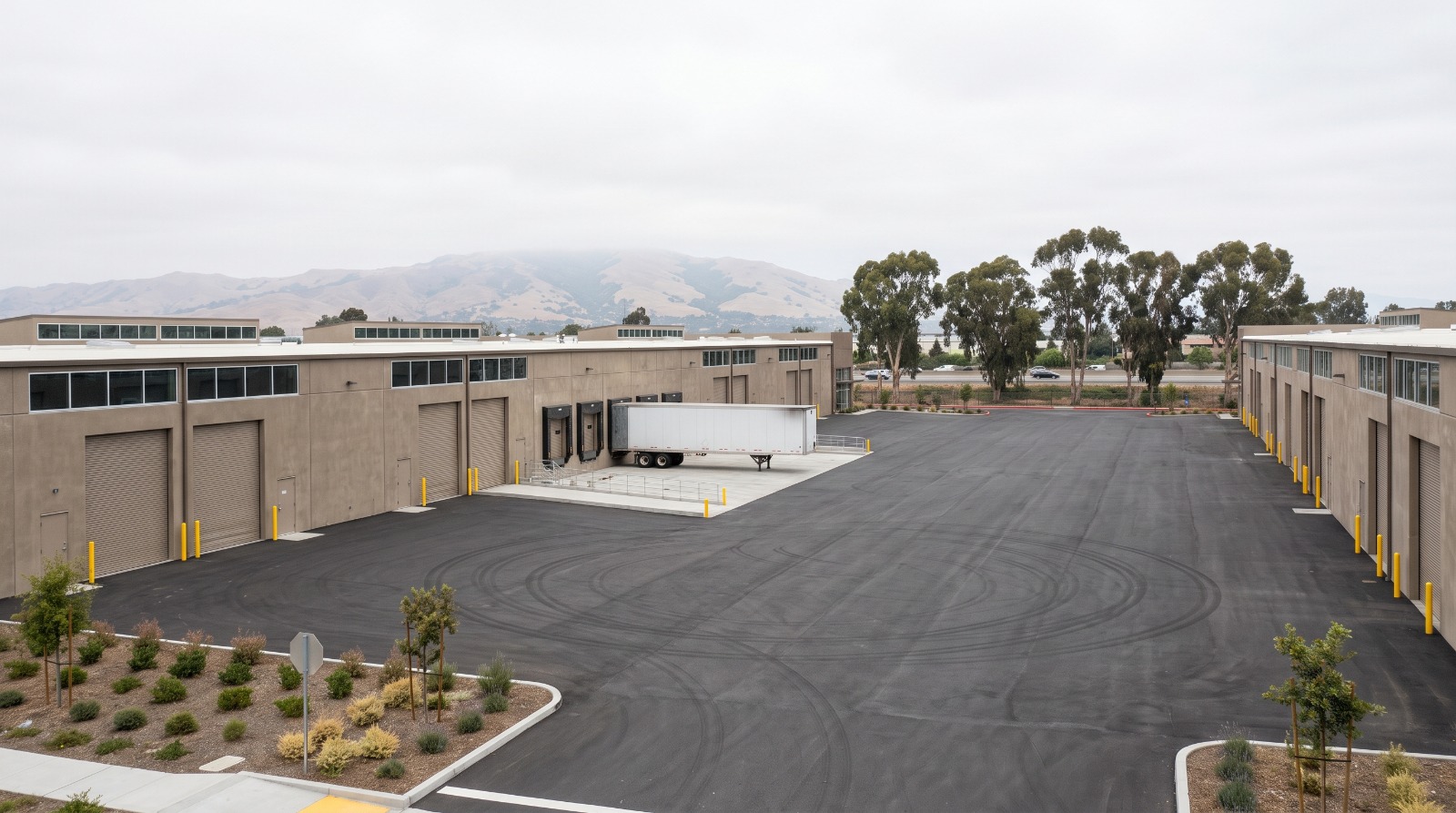
Low concrete advanced-manufacturing buildings on the Bayside industrial flats west of Interstate 880 in Fremont, California. Photo: Houseberry
The question I get about Fremont is almost always some version of the same one. If all the jobs are landing here, which neighborhood should I be looking in? The newest lease is worth roughly 470,000 square feet, and the honest answer is that the housing nearest it is not any of the three names people type into a search bar.
MiTac, a Taiwanese server maker building hardware for AI and cloud infrastructure, has committed to Campus at Bayside, the six-building manufacturing park at Lakeview and Gateway boulevards. Bayside is Fremont's industrial west side, out past I-880. The residential Fremont closest to that belt is the city's older central spine, Centerville and Irvington, with Niles tucked behind them against the canyon. All three sit below Fremont's citywide median price, not above it. In a city where job proximity usually carries a premium, that inversion is the whole story, and it deserves a look before you let a lease announcement move your search.
What MiTac actually signed for
The deal is big and the details are thin, which is normal this early. ConnectCRE reported that MiTac committed to roughly 470,000 square feet at Campus at Bayside. The park itself is 466,767 square feet across six freestanding buildings, developed by 9th St. Partners with Clarion Partners, which broke ground on July 22, 2025. Reports differ on exactly how the commitment splits between the finished phase and the one still unbuilt. The total is the number that matters, and the total is essentially the whole park.
No headcount has been announced. No move-in date has been announced. Anyone telling you how many jobs this brings to Fremont is guessing.
What we do know is that this is a repeat, not a debut. MiTac already leases about 348,300 square feet at Fremont Technology Center, which delivered in early 2025. A company that fills one Fremont building and then takes an entire second park is behaving like a company that expects to keep growing here. The market backs that up: Fremont's industrial submarket posted a 1.1 percent direct vacancy rate and $2.78 per square foot NNN asking rents in the second quarter of 2026. At that vacancy level there is effectively nothing to lease, which is why pre-leasing an unbuilt phase makes sense to a tenant. We covered the shape of this boom back in July, when Campus at Bayside was still just square footage on a construction schedule. Now it has a tenant.
Bayside is a real place, and it is not where you shop for a house
Bayside is the strip of Fremont west of I-880, and the city's economic development office describes it as holding more than two-thirds of Fremont's roughly 50 million square feet of industrial space. It is truck courts, tilt-up concrete, and eucalyptus windbreaks. Nobody lives there, and that is the point of the zoning.
Which means the practical question for a buyer is not "can I live in Bayside" but "what is a reasonable commute to it," and the answer runs through a car. BART's Fremont and Warm Springs stations both sit on the east side of the freeway. There is no station on the Bayside side. If you are buying with this job cluster in mind, you are buying a driving commute, and you should weigh the freeway crossing the way you would weigh a school assignment.
The neighborhoods across the freeway are Fremont's middle
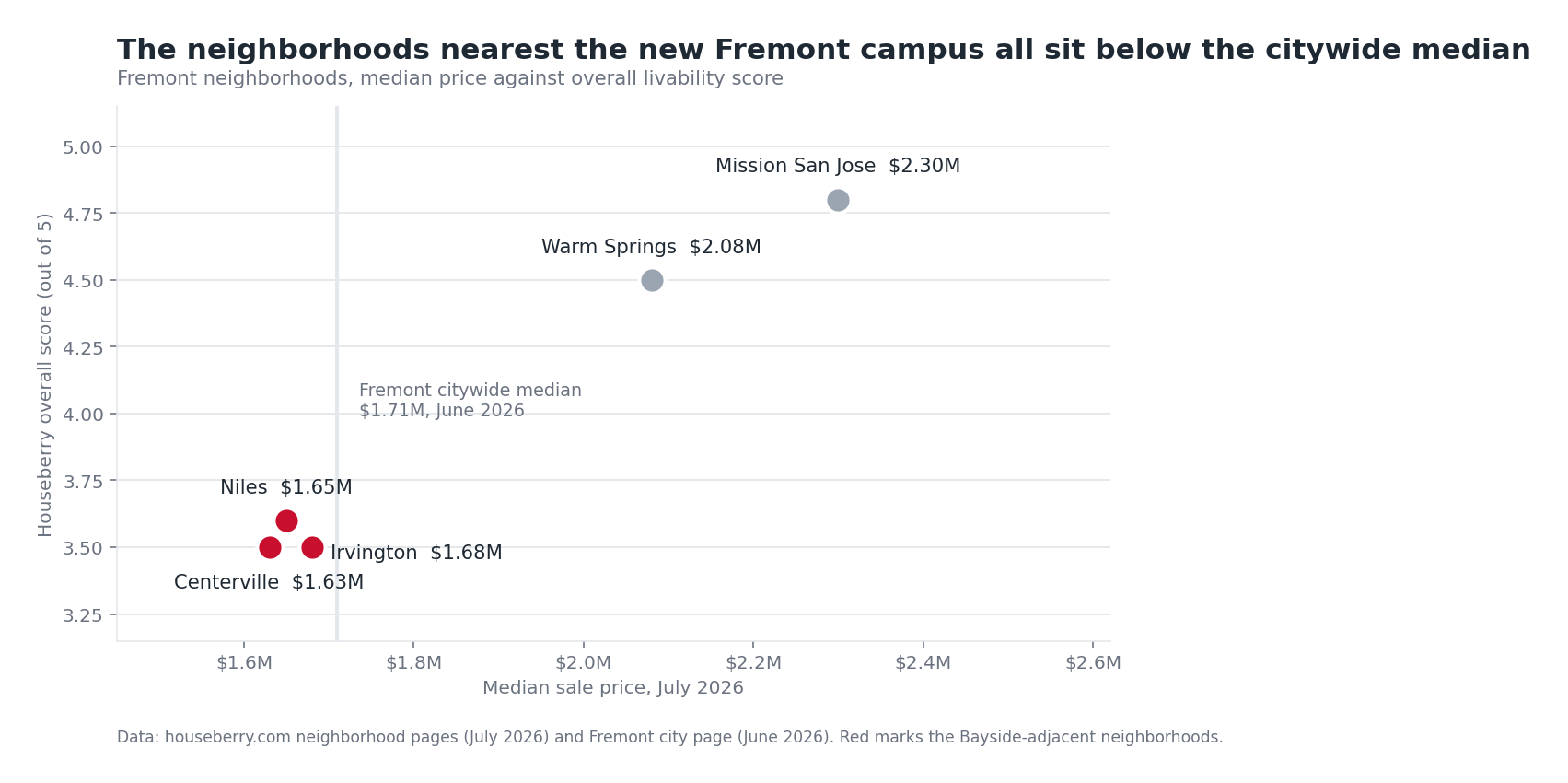
Here is the same picture in numbers, using July 2026 medians from our neighborhood pages.
| Fremont neighborhood | Median price, July 2026 | Overall | School | Safety |
|---|---|---|---|---|
| Mission San Jose | $2.30M | 4.8 | 5.0 | 4.8 |
| Warm Springs | $2.08M | 4.5 | 5.0 | 4.5 |
| Irvington | $1.68M | 3.5 | 4.5 | 2.6 |
| Niles | $1.65M | 3.6 | 4.6 | 2.6 |
| Centerville | $1.63M | 3.5 | 4.1 | 2.9 |
Mission San Jose costs about $670,000 more than Centerville, or roughly 41 percent. For that money a buyer gets 0.9 more points of school score and 1.9 more points of safety score. Whether that trade is worth it depends entirely on which of those two numbers is doing the work for your family, and most people I talk to have not separated them.
The thing I find genuinely interesting is the direction. In most of the Bay Area, being near a large employer pushes prices up. In Fremont it currently does the opposite, because the neighborhoods closest to the industrial belt are the older, denser, more commercial parts of the city, and the neighborhoods with the highest scores sit as far from the freeway as Fremont geography allows, up against the hills. Proximity to the jobs and proximity to the top scores pull in opposite directions here. A single lease does not change that.
What the safety scores are actually telling you
A 2.6 out of 5 looks alarming next to a 4.8, so let me say plainly what these numbers are and are not. Our safety scores are regionally comparative, which means a Fremont neighborhood is being measured against the rest of the Bay Area, not against a national baseline. Fremont as a whole scores 3.7, above the regional middle.
The lower scores in Centerville, Irvington and Niles track something specific and fairly mundane: these districts carry Fremont's commercial corridors. Fremont Boulevard, Mowry Avenue and Niles Boulevard run through them, with the retail, the through traffic and the incident counts that come with any commercial strip. Mission San Jose and Warm Springs are close to purely residential. Comparing them is partly comparing a main street to a cul-de-sac.
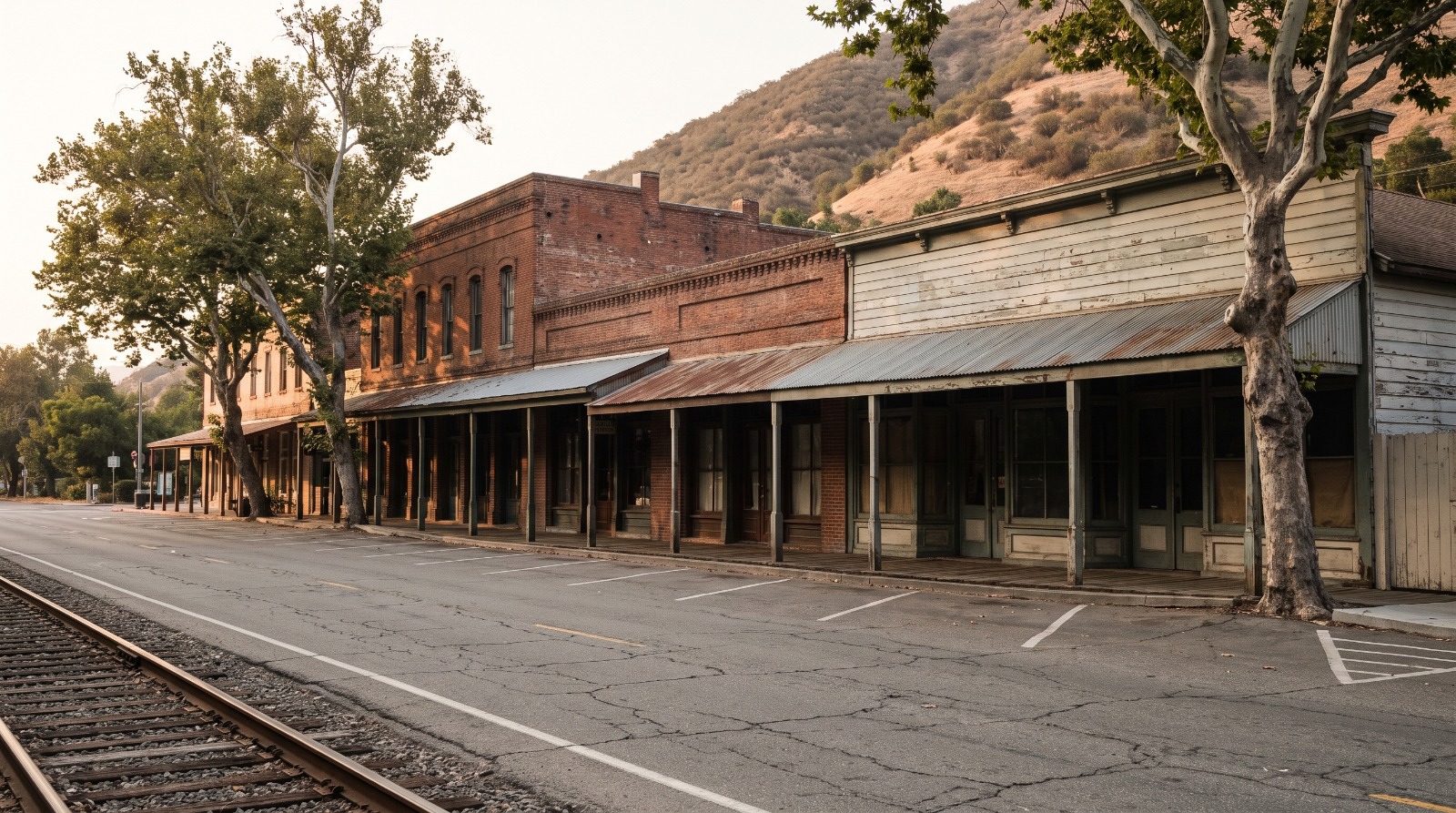
That does not make the score wrong or ignorable. It means the useful move is to look at the specific blocks you are considering rather than the district average, and to visit at 6pm on a weekday rather than at 11am on a Sunday. A district-level number is a starting question, not a verdict.
Schools do not move because a lease gets signed
This is the part people most often get backwards. Nothing about MiTac taking 470,000 square feet changes an attendance boundary, a teacher, or a test score. Irvington's 4.5 and Niles's 4.6 school scores are already strong, and Centerville at 4.1 is the weakest of the three by a visible margin. Those numbers will move when district results move, on a timeline measured in years, not when a tenant signs a lease.
Keep the price context straight too. Fremont's citywide median was $1.71 million in June 2026, down from a peak of $1.82 million last September and October. The city is off about 6 percent from that high. Reading a single industrial lease as a price signal in a market that has been drifting down all year is how people end up overpaying in the fall.
How I would actually use this
If your household income is coming from the Bayside job cluster, the reasonable framing is not "where will prices go up" but "where does the daily reality work." Centerville and Irvington buy you a shorter drive and about $650,000 of headroom against Mission San Jose, with school scores that are good rather than extraordinary and a main-street environment you should see for yourself. Mission San Jose buys you the top of our Fremont schools ranking and a longer commute across the city. Both are defensible. Neither is what a headline about an AI campus is really telling you.
The habit worth keeping is the one that has nothing to do with this lease at all. Look at how Fremont's 28 neighborhoods actually compare before you narrow to a listing, because the area you land in shapes the next decade a lot more than the address does. That is the whole idea behind Houseberry, and a 470,000-square-foot lease is a good reminder of why the order matters.
Sources
- ConnectCRE, Server manufacturer MiTac leases entirety of 470K sf Fremont campus, August 11, 2026
- The Real Deal, Taiwanese tech company pre-leases multi-building Fremont complex, August 10, 2026
- Campus at Bayside project site, CBRE
- REBusinessOnline, 9th St. and Clarion break ground at Bayside Technology Park, Fremont
- City of Fremont, Bayside employment hub
- Kidder Mathews, Silicon Valley industrial market report, Q2 2026
- The Registry, Fremont Technology Center fully leased with MiTac taking 348,300 square feet, July 2025
- Houseberry price history and scores for Fremont, Mission San Jose, Warm Springs, Irvington, Niles and Centerville, June and July 2026
All information provided on this website including but not limited to - school ratings, safety, amenities, user opinions, and property data - is for general informational purposes only. We do not guarantee its reliability, accuracy, or completeness. Users should independently verify information and consult appropriate professionals as needed. By using this website, you agree Houseberry is not responsible for actions, decisions, or consequences arising from reliance on the information provided
houseberry.com - CA DRE# 01847391
 Bay East ©2025. CCAR ©2025. bridgeMLS ©2025. Information Deemed Reliable But Not Guaranteed. This information is being provided by the Bay East MLS, or CCAR MLS, or bridgeMLS. The listings presented here may or may not be listed by the Broker/Agent operating this website. This information is intended for the personal use of consumers and may not be used for any purpose other than to identify prospective properties consumers may be interested in purchasing. Data last updated at September 26, 2026 12:00 AM