Fremont’s AI Factory Boom and the Neighborhoods It Lifts
Fremont now captures most of Silicon Valley’s advanced manufacturing. Here is how the AI factory boom is reshaping demand across Fremont’s neighborhoods and home prices.

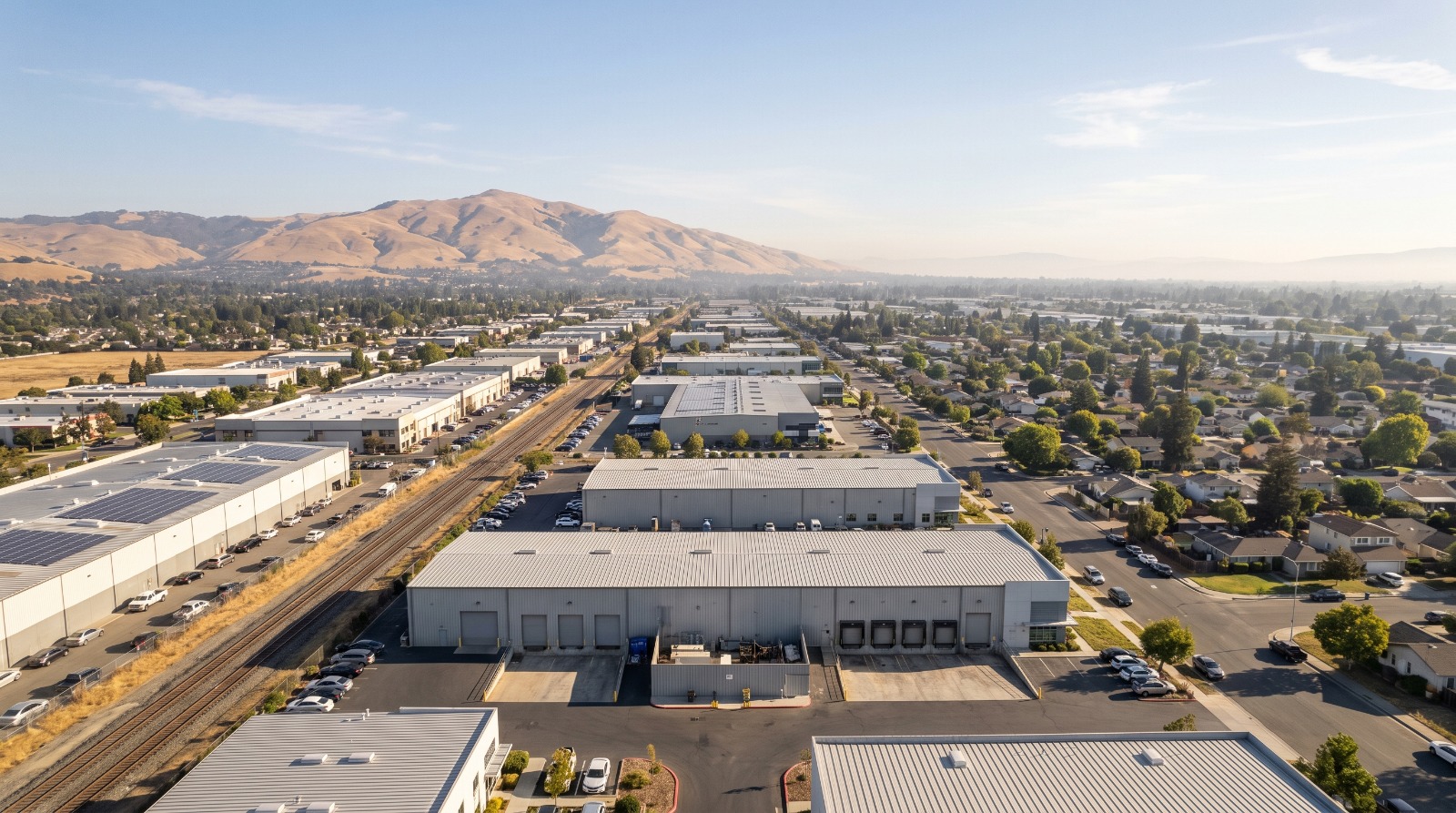
Advanced manufacturing buildings in the Warm Springs district of Fremont, the center of the city’s AI factory boom, with homes and Mission Peak beyond. Photo: Houseberry
Start with one number. Seventy-five percent. That is Fremont’s share of every square foot of advanced manufacturing space leased across Silicon Valley in the past year, according to CBRE data. Not the East Bay’s share. The whole valley’s. The city people still picture as the place with the Tesla plant has quietly become where the region actually builds things, and more and more of what it builds is AI hardware and robots.
The tell this month was a hotel. The 357-room Fremont Marriott on Landing Parkway sold for $53 million to SRE Acquisitions. That price looks ordinary until you notice most Bay Area hotels have been trading for a fraction of it. A nearby Hyatt Place changed hands for $13.2 million. When money moves toward Fremont even in a battered hotel market, it is fair to ask what is drawing it, and what that means for anyone buying a home nearby.
What an AI manufacturing hub actually looks like
This is not abstract. In June, Clarion Partners paid $132.3 million, about $495 a square foot, for a 267,000-square-foot plant on Milmont Drive in the Warm Springs district. Tesla leases it and is using it to ramp AI applications and humanoid robots, its Optimus line, next to the plant that already builds the Model 3 and Model Y. A few blocks away, a new six-building, 473,000-square-foot campus called The Campus at Bayside is opening its first phase this year, aimed squarely at AI and advanced manufacturing tenants, with Zoox, Bloom Energy, and Seagate already in the area. Fremont’s mayor, Raj Salwan, called the AI wave the future for the city.
Here is why that matters for housing in a way a software boom does not. You cannot build a robot from a laptop in another state. Hardware and manufacturing engineers have to be near the line. That ties a large, well-paid workforce to a specific place, and that place is south Fremont. Job demand that cannot go fully remote is exactly the kind that shows up in local home demand.
Where the jobs are pulls demand toward these neighborhoods
The gravity centers on Warm Springs and south Fremont, which has its own BART station and a wave of new housing, including roughly 500 homes planned near the station. For buyers, the practical question is what each nearby neighborhood costs and what the price is actually buying. Here is how Fremont’s main areas stack up, using spring 2026 sale data.
| Neighborhood | Median price (2026) | vs. Fremont overall | What you are paying for |
|---|---|---|---|
| Mission San Jose | About $2.3M | Roughly +50% | Top-ranked schools and steady, commute-proof demand |
| Warm Springs | About $2.0M | Roughly +35% | Closest to the AI and robotics jobs, plus BART |
| Ardenwood | About $1.6M | Roughly +7% | Newer homes and a quick Dumbarton hop to the Peninsula |
| Centerville and Irvington | About $1.5M | Near the citywide median | Central location and relative value |
| Niles | About $1.4M | Roughly -7% | Older character, small-town feel, lowest entry point |
Citywide, Fremont’s median sits near $1.5 million as of spring 2026, down about 8 percent from a year earlier, with homes selling in about 13 days and roughly five offers per listing. Zillow’s broader home-value index for the city runs a touch higher, around $1.6 million. Treat the neighborhood figures above as levels, not to-the-dollar quotes, since a single neighborhood’s median swings a lot on low sale volume.
Why Mission San Jose still holds the premium
The gap between Mission San Jose and Warm Springs is roughly $650,000, and it is almost entirely a school story. Mission San Jose’s schools are among the strongest in California, and Houseberry’s own Fremont school ranking puts the neighborhood first in the city at a 5.0 out of 5. For a two-income robotics or engineering household planning to stay a decade, that rating often outweighs shaving ten minutes off a commute. It is why the priciest corner of Fremont is not the one closest to the factories.
What this does and does not mean
It does mean Fremont’s home values have a real, physical anchor under them. Jobs tied to a factory floor do not evaporate when office rent in another city gets cheaper, and the neighborhoods with BART access and a short drive to Warm Springs are best positioned to benefit.
It does not mean a guaranteed run-up. Fremont prices are actually down about 8 percent year over year right now, and an advanced-manufacturing boom is a slow tailwind, not a 2021-style bidding frenzy. AI hardware cycles can cool, and a single factory lease does not lift every street equally.
If you are shopping here, the move is the same one we would make comparing any neighborhoods: weigh commute, schools, safety, and price together rather than chasing the headline. Houseberry’s overall ranking of Fremont neighborhoods is built for exactly that kind of side-by-side.
Fremont AI manufacturing FAQs
Is Fremont a good place to buy a home in 2026?
It can be, with eyes open. Prices are down about 8 percent from a year ago, yet demand is brisk, with homes selling in roughly 13 days. The advanced-manufacturing boom gives local values a steadier floor than a purely remote-work economy would. The right neighborhood depends on your budget and whether schools or commute matters more, and our look at the safest neighborhoods in Fremont is a useful place to start that comparison.
Which Fremont neighborhood is closest to the AI and robotics jobs?
Warm Springs and south Fremont. That is where Tesla’s AI and Optimus operations, the new Bayside campus, and neighbors like Zoox and Bloom Energy sit, and the area has its own BART station. Expect a median near $2 million there.
Why is Mission San Jose so much more expensive?
Schools. Mission San Jose posts some of California’s top public-school scores, and that pulls a median above $2.3 million, roughly $650,000 over Warm Springs for comparable homes. Buyers there are paying for the school assignment as much as the house.
Will the AI factory boom push Fremont home prices up?
It is a tailwind, not a switch. Place-bound manufacturing jobs support demand and give values a firmer base, especially near BART and Warm Springs. But prices are still down year over year, so expect gradual support rather than a sudden spike.
Sources
The Real Deal: Fremont Marriott sells for $53 million
The Real Deal: Clarion buys Tesla-leased Fremont plant, with CBRE leasing data
GovTech: Fremont high-tech campus aimed at the AI boom
The Real Deal: 500 homes planned near a Fremont BART station
The Houseberry Research Team is Houseberry's reporting team: Bay Area real estate analysts, data specialists and longtime local market watchers. Every day we check the public record: building permits, city council and planning agendas, county recorder filings, state housing bills, police incident data and school results. Then we tie each story to what it means for specific neighborhoods, using Houseberry's own neighborhood data on prices, appreciation, safety, schools and amenities. Questions or corrections: Contact us.
All information provided on this website including but not limited to - school ratings, safety, amenities, user opinions, and property data - is for general informational purposes only. We do not guarantee its reliability, accuracy, or completeness. Users should independently verify information and consult appropriate professionals as needed. By using this website, you agree Houseberry is not responsible for actions, decisions, or consequences arising from reliance on the information provided
houseberry.com - CA DRE# 01847391
 Bay East ©2025. CCAR ©2025. bridgeMLS ©2025. Information Deemed Reliable But Not Guaranteed. This information is being provided by the Bay East MLS, or CCAR MLS, or bridgeMLS. The listings presented here may or may not be listed by the Broker/Agent operating this website. This information is intended for the personal use of consumers and may not be used for any purpose other than to identify prospective properties consumers may be interested in purchasing. Data last updated at October 18, 2026 12:00 AM