A $560K-Per-Door San Jose Deal and the Rent It Needs
Bell Partners paid $140 million for 250 apartments on Stockton Avenue, about 79 percent above the Bay Area's average price per unit. Running that price backward shows the rent it requires, and how thin the cushion is.

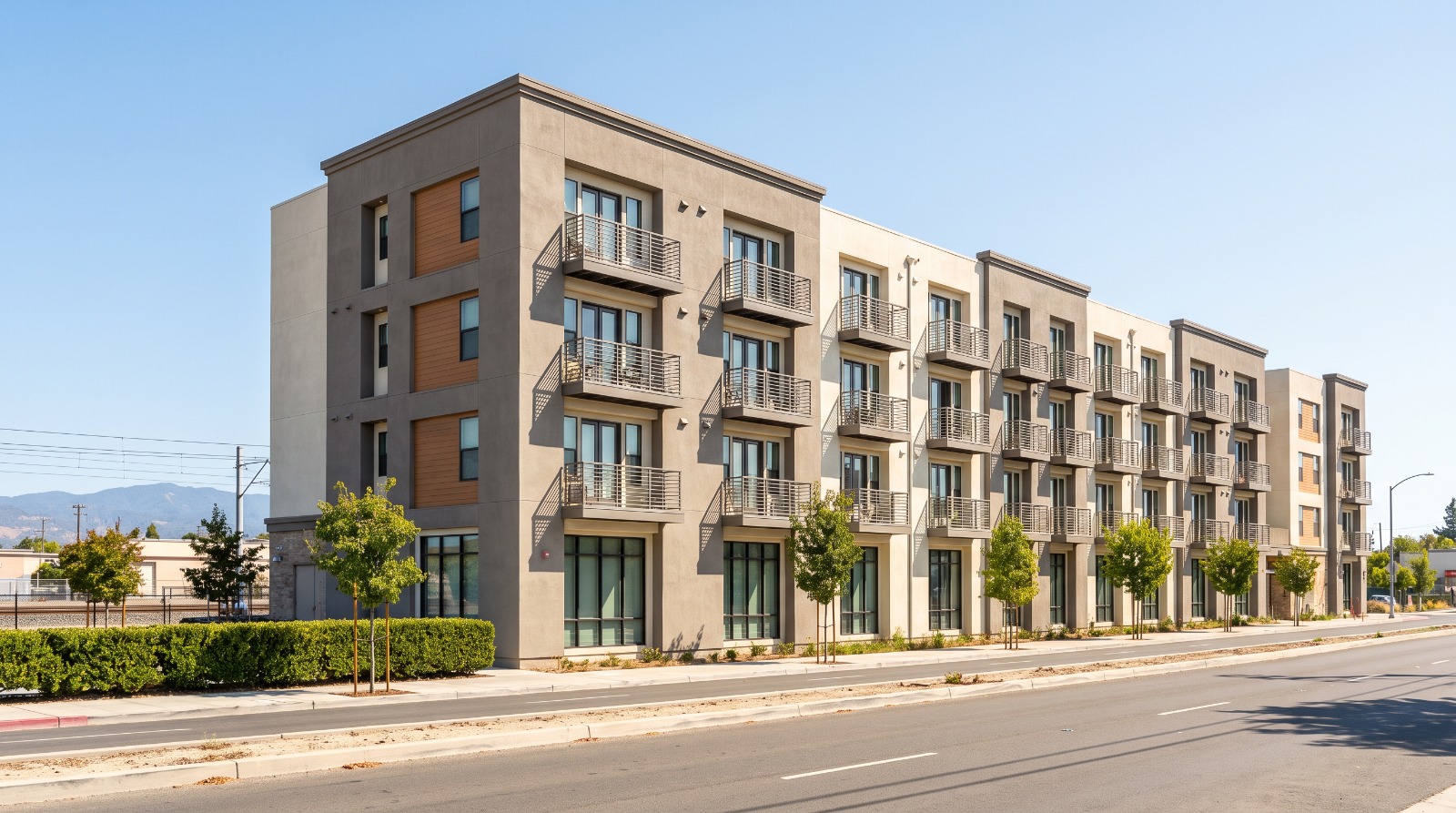
A modern mid-rise apartment building on Stockton Avenue near The Alameda in San Jose, where a 250-unit complex sold for $140 million. Photo: Houseberry
Bell Partners paid $560,000 per apartment for a 250-unit building on Stockton Avenue in San Jose. The Bay Area average this year is $313,445 per unit. That is 79 percent above the market, and the price only works if San Jose rents hold roughly where they are today. Run it backward and the building needs about $3,330 a month per unit. The city's median rent is $3,418. That gap is the entire story.
Working the price backward
Nobody publishes the rent roll on a deal like this, but the price itself tells you what the buyer has to collect. Here is the chain, using the middle of the quoted South Bay cap rate range and a standard operating expense ratio.
| Step | Figure |
|---|---|
| Price paid per apartment | $560,000 |
| Cap rate assumed, San Jose Class A midpoint | 4.45% |
| Net operating income required per unit | $24,920 a year, or $2,077 a month |
| Operating costs at 35% of collected rent | adds about $1,118 a month |
| Rent collected per occupied unit | about $3,195 a month |
| Grossed up for 4% vacancy | about $3,330 a month |
| San Jose median rent, September 1, 2026 | $3,418 a month |
About $90 a month of daylight, or roughly 3 percent. That is not a comfortable margin. It is a bet that rents at this building beat the citywide median, that expenses run leaner than 35 percent, or that both are true.
Fair warning on the arithmetic: the cap rate and the expense ratio are my assumptions, not disclosed terms. Shift the cap rate to 4.25 percent and the required rent falls near $3,180. Shift it to 4.65 and it climbs past $3,480, which is above what the median San Jose apartment rents for today. The conclusion holds across that whole range, which is why it is worth writing down.
What this means if you rent in San Jose
It is not a rent-increase forecast, and anyone selling it as one is overreaching. What it does say is that a large, well-capitalized owner just committed $140 million on the view that current rents are a floor rather than a peak. Buyers at $560,000 a door have no room to discount their way to occupancy.
The counterweight is supply, and it is real. Coyote Creek Village in north San Jose is the largest project under construction in the Bay Area at 1,140 units, and it delivers in the third quarter of 2027. That is a lot of new competition arriving in one place.
The market is also splitting by unit size in a way the median hides. San Jose studio rents are down 4 percent year over year at about $2,122, while two-bedrooms are up 9 percent at roughly $3,577. If you are renting alone, your negotiating position is better than the headline suggests. If you need a second bedroom, it is worse.
What this means if you are buying instead
$560,000 per apartment is about 34 percent of San Jose's citywide median home price, which stood at $1.63 million in August 2026. An institutional investor just paid roughly a third of a median San Jose house for one unit in a rental building.
The neighborhood next door tells you why. Rose Garden, the pocket along The Alameda, scores 3.5 out of 5 overall with amenities at 4.5 and curb appeal at 4.8, and its median price was $1.96 million in August 2026. Schools are the soft spot there at 2.8. A mile east, Japantown scores 2.7 overall with a median of about $932,600 in the same month.
That spread is the practical point. Central San Jose has walkable, amenity-rich neighborhoods trading anywhere from under $1 million to near $2 million depending mostly on school scores, and the way we look at it when comparing neighborhoods, that is a school-data question before it is a price question. The full San Jose ranking makes the trade-off visible in one screen.
Questions people are actually asking
Does an investor paying more mean my rent goes up?
Not directly. Rents are set by what tenants will pay, not by what the owner paid. What a high purchase price does is remove the owner's flexibility to cut rent during a soft stretch, because the debt service was underwritten at today's numbers.
Is $560,000 per unit a record for San Jose?
I could not confirm a record, and I would not claim one. It is clearly well above the Bay Area's $313,445 average for the second quarter of 2026, and above the roughly $334,700 per unit paid for the 262-unit Almaden Terrace in the same period.
What neighborhood is 383 Stockton Avenue in?
Garden Alameda, the residential pocket between The Alameda and the Diridon rail corridor, roughly a mile west of downtown San Jose. It sits next to Rose Garden and within walking distance of the Diridon station area.
What this does and does not mean
It means one sophisticated buyer thinks San Jose rents are durable enough to underwrite at a price 79 percent above the regional average. It does not mean rents are about to jump, that the building is worth $140 million, or that San Jose is suddenly a landlord's market. Bay Area multifamily vacancy sat at 4.0 percent in the second quarter, which is tight but not desperate.
The number to watch is not this sale. It is what happens to San Jose asking rents in late 2027, when 1,140 units in north San Jose finish leasing up.
Sources
- The Registry, Bell Partners buys 250-unit San Jose apartment complex for $140MM at $560K per unit, September 1, 2026
- Kidder Mathews, Bay Area Multifamily Market Report, Q2 2026
- JM Henderson CRE, Bay Area Multifamily Cap Rate Outlook Q2 2026
- Zumper, Average rent in San Jose, CA, data as of September 1, 2026
- Houseberry price history and neighborhood scores for San Jose, accessed September 2, 2026
The Houseberry Research Team is Houseberry's reporting team: Bay Area real estate analysts, data specialists and longtime local market watchers. Every day we check the public record: building permits, city council and planning agendas, county recorder filings, state housing bills, police incident data and school results. Then we tie each story to what it means for specific neighborhoods, using Houseberry's own neighborhood data on prices, appreciation, safety, schools and amenities. Questions or corrections: Contact us.
All information provided on this website including but not limited to - school ratings, safety, amenities, user opinions, and property data - is for general informational purposes only. We do not guarantee its reliability, accuracy, or completeness. Users should independently verify information and consult appropriate professionals as needed. By using this website, you agree Houseberry is not responsible for actions, decisions, or consequences arising from reliance on the information provided
houseberry.com - CA DRE# 01847391
 Bay East ©2025. CCAR ©2025. bridgeMLS ©2025. Information Deemed Reliable But Not Guaranteed. This information is being provided by the Bay East MLS, or CCAR MLS, or bridgeMLS. The listings presented here may or may not be listed by the Broker/Agent operating this website. This information is intended for the personal use of consumers and may not be used for any purpose other than to identify prospective properties consumers may be interested in purchasing. Data last updated at October 13, 2026 12:00 AM