Coyote Valley Open Space: 417 More Acres Headed for Protection
The state just cleared the way for the Open Space Authority to buy about 417 more acres of Coyote Valley farmland. Here is what that means for South San Jose neighborhoods, and what it costs the region.
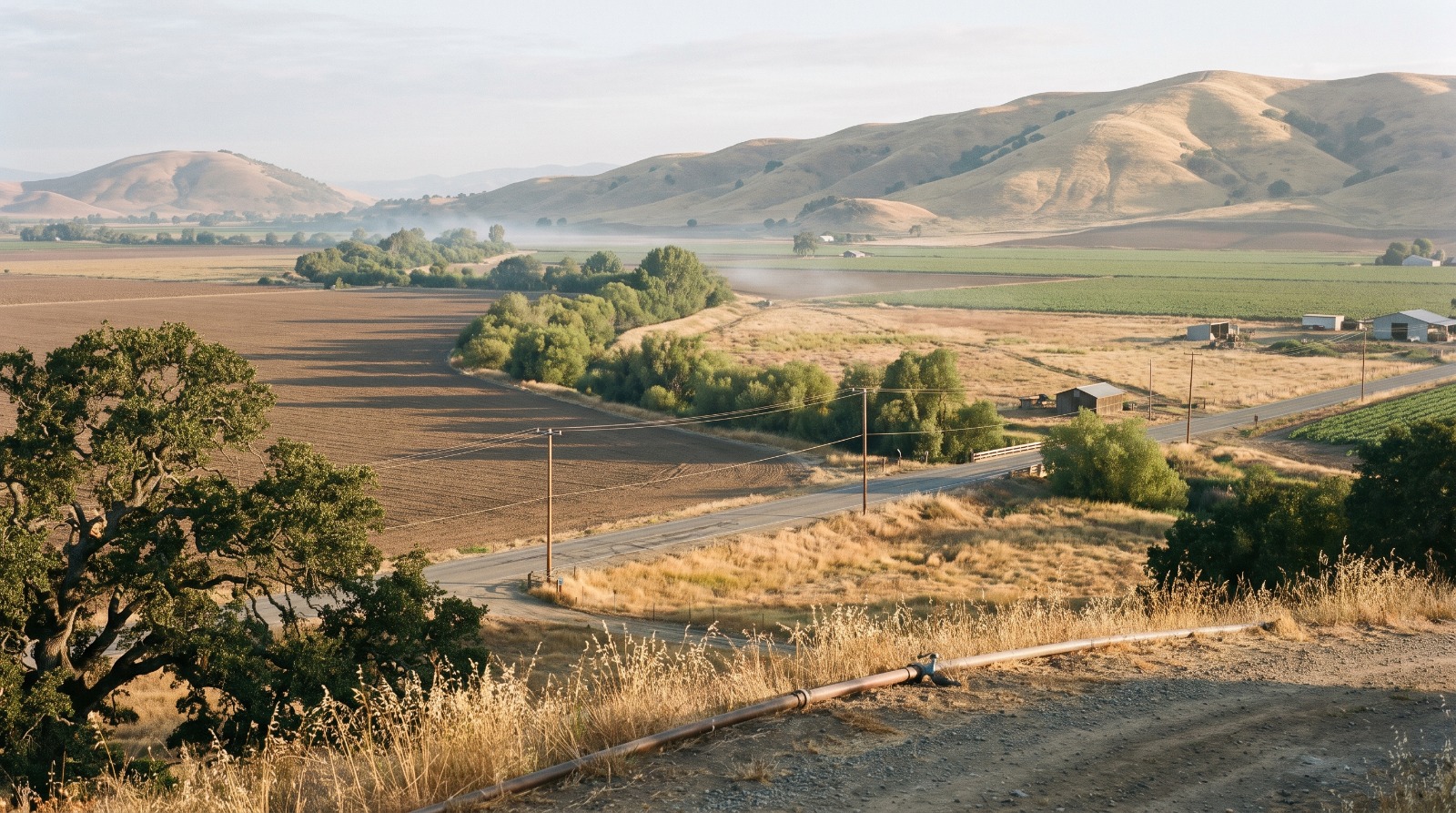
Coyote Valley open space farmland south of San Jose, with Fisher Creek willows and Coyote Ridge behind. Photo: Houseberry
If you live in the Santa Teresa foothills, you have probably stood at the top of your street and looked south at all that flat farmland and wondered the same thing your neighbors do. Will somebody eventually build out there?
For another big piece of Coyote Valley, the answer just got closer to a permanent no. On September 28, 2026, the State Coastal Conservancy filed a notice of exemption for the Santa Clara Valley Open Space Authority to buy about 417 acres of Coyote Valley open space, to keep it farmed, keep wildlife moving between two mountain ranges, and later let Fisher Creek spread back into its floodplain. The Conservancy board approved $14.5 million for the purchase on September 17. We could not find anyone who has reported the filing yet.
What the September 28 filing actually says
The document is short, and most of it is legal plumbing. The project is called the Coyote Valley Landscape Linkage Acquisition, and it relies on the state's categorical exemption for land transfers that keep property in its natural condition. That exemption only works because nothing is being built.
The stated purpose has three parts: let agriculture continue, protect the landscape linkage wildlife use to cross the valley, and set up a future restoration of the Fisher Creek floodplain and its streamside habitat. Fisher Creek is the small creek that runs north up the middle of the valley, straightened into a drainage ditch for farming in the early 1900s, according to the Open Space Authority.
What it does not say is just as useful. No seller, no sale price, no parcel numbers. The $14.5 million grant works out to roughly $34,800 per acre, but the grant may not cover the full price, so treat that as a ceiling on what the state is putting in, not the land's value. Until a deed records, this is a funded plan, not a finished purchase.
Coyote Valley, deal by deal
This is the latest step in a run of purchases that started in earnest in 2019, and the pattern matters more than any single deal.
| When | What happened | Size and money |
|---|---|---|
| November 2018 | San Jose voters pass Measure T, which sets aside public money for Coyote Valley land | $50 million for Coyote Valley |
| November 2019 | San Jose, POST and the Open Space Authority buy North Coyote Valley land once zoned for industry | 937 acres, $93.46 million |
| November 2021 | City Council votes unanimously to replace industrial designations with agriculture and open space | Drops a vision the city once sized at 35,000 jobs |
| April 2026 | POST buys Coyote Fields, a working farm on Santa Teresa Boulevard | 71 acres, $5.3 million |
| September 2026 | Conservancy funds the Open Space Authority's latest purchase, filing on September 28 | About 417 acres, $14.5 million grant |
Sources for the rows: the Protect Coyote Valley timeline on Measure T, POST on the 2019 deal, which used $46.3 million in Measure T money, San Jose Spotlight on the 2021 vote, and POST on Coyote Fields.
Read the table top to bottom and the direction is not subtle. The city stopped planning for Coyote Valley as a job center in 2021, and ever since, the buyers have been conservation agencies, not developers.
What it means if you live on the Santa Teresa side
For the neighborhoods that look down on the valley, this purchase mostly protects the view and the quiet you already have. It does not add anything overnight.
Santa Teresa Foothills East, the hillside streets on the slope of the Santa Teresa Hills with Santa Teresa County Park behind them, scores 4.2 out of 5 on schools and 4.5 on safety in our data. Its median sale price was about $1.53 million in July 2026, a little under the San Jose citywide median of about $1.63 million in August 2026.
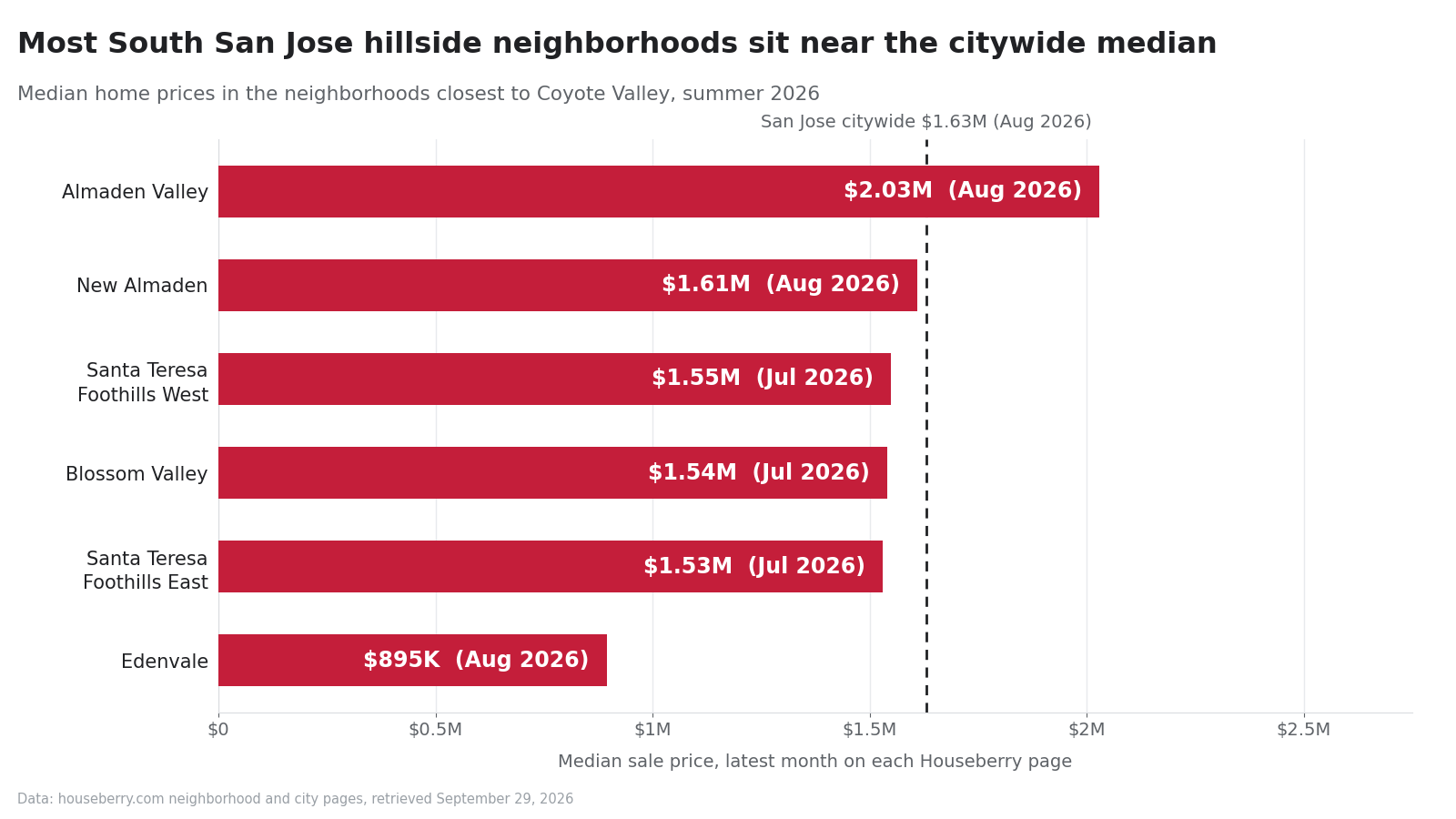
That is the part we find most useful when we compare neighborhoods on Houseberry. You get foothill streets, a county park at the back fence and farmland in the view for roughly the city median, sometimes less. Almaden Valley, boxed in between the Santa Cruz Mountains and the Santa Teresa Hills, is the pricier outlier at about $2.03 million in August 2026. Edenvale, down on the flats near Hayes Mansion, sold at about $894,600.
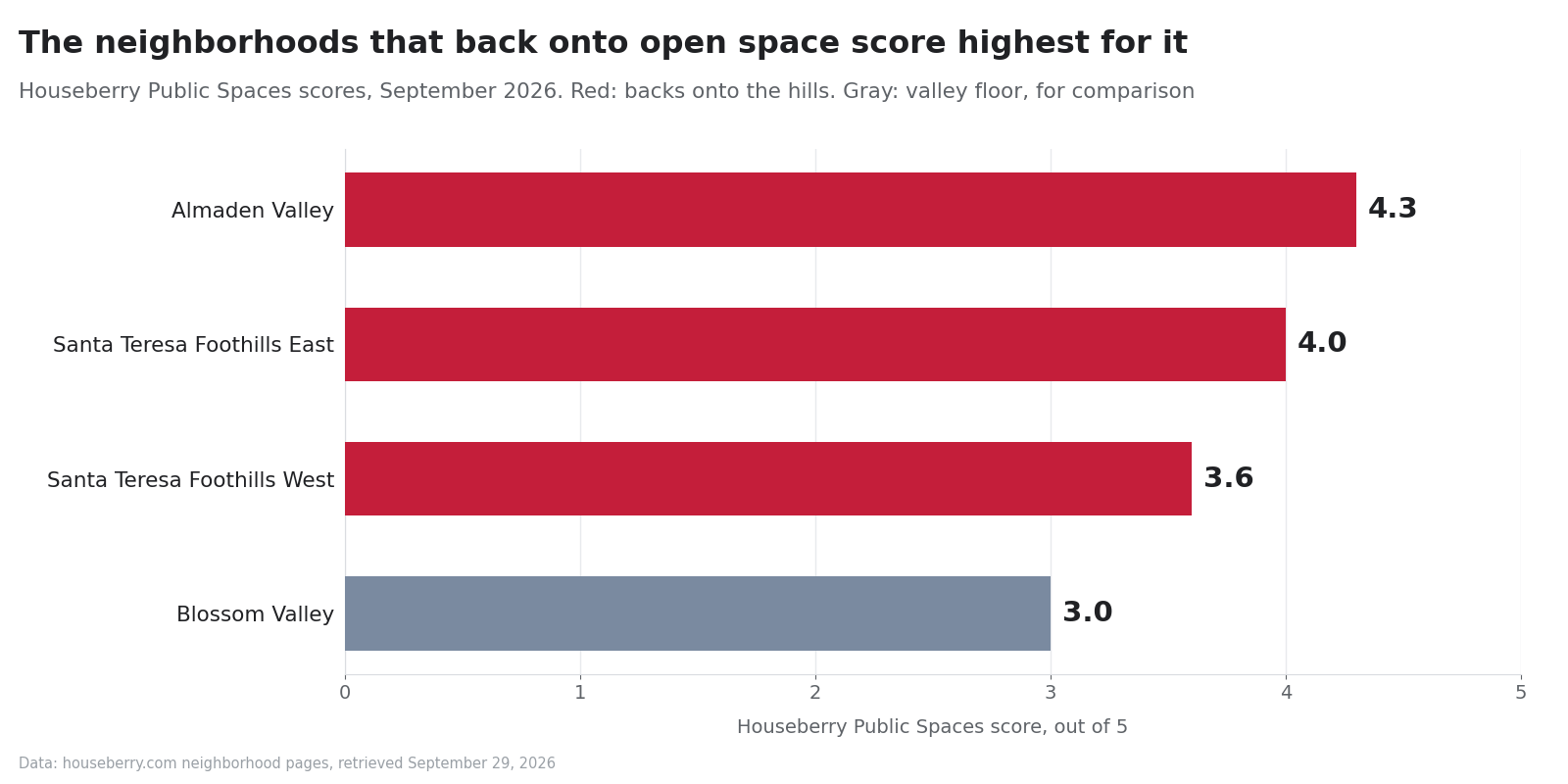
Our Public Spaces score, which measures parks and open land close to home, follows the hills. Almaden Valley scores 4.3 and Santa Teresa Foothills East 4.0, while Blossom Valley, the flatter middle of South San Jose around Oakridge mall, sits at 3.0.
Does this raise nearby home values? Probably not in a way you could measure. The valley was already off the table for big development after 2021, so buyers were not pricing in a warehouse district next door. What the purchase does is lower the odds that a future council reopens the question on these particular acres.
Will it add trails? Not right away. POST said in March 2026 that it is looking at two possible public access options, near the Laguna Seca wetland and in the mid-valley farm area, without mileage or dates. The trail you can use today is the Coyote Creek Parkway, 15 paved miles along the creek from Hellyer County Park south to Anderson Lake County Park.
What about flooding? This is the benefit most people underrate. POST describes the plan as reconnecting Fisher Creek to its natural floodplain and restoring Laguna Seca, to hold water in the valley and ease downstream flood risk for San Jose. Anyone who remembers the 2017 Coyote Creek flood will understand why the agencies care about spare room for water upstream. Just do not expect a number, since no one has published how much risk this particular parcel reduces.
And the wildlife? Coyote Valley is the shortest workable route between the Santa Cruz Mountains and the Diablo Range. That means bobcats and mountain lions crossing, and it also means the wild pigs that tear up foothill lawns are not leaving. The Santa Clara Valley Transportation Authority board approved a design contract in January 2026 for wildlife crossings at Highway 101 and Monterey Road, Local News Matters reported.
The trade-off: land that will not hold homes
I am pro-housing, and I am not going to pretend a 417-acre purchase is free. Every acre set aside is an acre that will never hold a home in a region that badly needs them.
San Jose has to plan for 62,200 homes between 2023 and 2031 under its state housing target. That is the real pressure, and open space purchases do not relieve it.
But Coyote Valley is a bad place to meet it. Caltrain's Gilroy trains run through the valley without a stop between Blossom Hill and Morgan Hill, and homes out there would mean new roads, new sewers and long car commutes. The better answer is the one San Jose is already fumbling toward, which is more homes along corridors and in urban villages near jobs and transit. Our look at San Jose's general plan reset walks through where 4 to 10 homes could replace one. If you support protecting Coyote Valley, the honest follow-through is supporting those infill projects too, including the ones near you.
The deed is the next document to watch
The next thing to look for is a recorded deed at the Santa Clara County recorder with the Open Space Authority as buyer. That will finally name the seller, the price and the parcels. Until then, the September 28 filing is a strong signal, not a closing.
If you are shopping the southern edge of San Jose, open our San Jose neighborhood rankings and compare the foothill neighborhoods side by side. The Coyote neighborhood page covers the rural ranches around the valley itself, where a thin run of sales put the median near $2.45 million in August 2026. That figure describes a handful of big properties, not a trend. The view south is looking more settled every year. The housing math, sadly, is not.
Sources
- CEQAnet, Coyote Valley Landscape Linkage Acquisition, SCH 2026091176
- State Coastal Conservancy, September 17, 2026 grant awards
- Peninsula Open Space Trust, 937 acres in North Coyote Valley (2019)
- Peninsula Open Space Trust, Protecting What Protects Us (March 2026)
- Peninsula Open Space Trust, Coyote Fields acquisition (April 2026)
- Local News Matters, 71-acre Coyote Valley farm deal (April 2026)
- Santa Clara Valley Open Space Authority, public ownership of Coyote Valley (2025)
- San Jose Spotlight, council keeps Coyote Valley as open space (2021)
- Protect Coyote Valley, timeline
- Protect Coyote Valley, flooding and Coyote Valley
- Santa Clara County Parks, Coyote Creek Parkway
- San Jose Spotlight, San Jose's 62,200 housing unit question
- Houseberry, San Jose neighborhood rankings and neighborhood pages, September 2026
Map of San Jose Neighborhoods
Loading map...
View Full Map
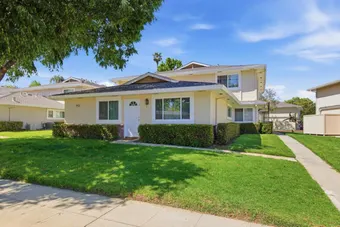
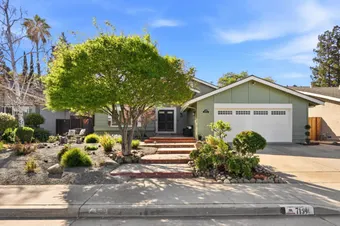
Top Neighborhoods in San Jose, CA


All information provided on this website including but not limited to - school ratings, safety, amenities, user opinions, and property data - is for general informational purposes only. We do not guarantee its reliability, accuracy, or completeness. Users should independently verify information and consult appropriate professionals as needed. By using this website, you agree Houseberry is not responsible for actions, decisions, or consequences arising from reliance on the information provided
houseberry.com - CA DRE# 01847391
 Bay East ©2025. CCAR ©2025. bridgeMLS ©2025. Information Deemed Reliable But Not Guaranteed. This information is being provided by the Bay East MLS, or CCAR MLS, or bridgeMLS. The listings presented here may or may not be listed by the Broker/Agent operating this website. This information is intended for the personal use of consumers and may not be used for any purpose other than to identify prospective properties consumers may be interested in purchasing. Data last updated at September 29, 2026 12:00 AM