San Jose's Wild Pigs Are Redecorating Your Lawn
A deadpan field guide to San Jose's wild pigs, the foothill neighborhoods they actually raid, and what buying next to open space really signs you up for.

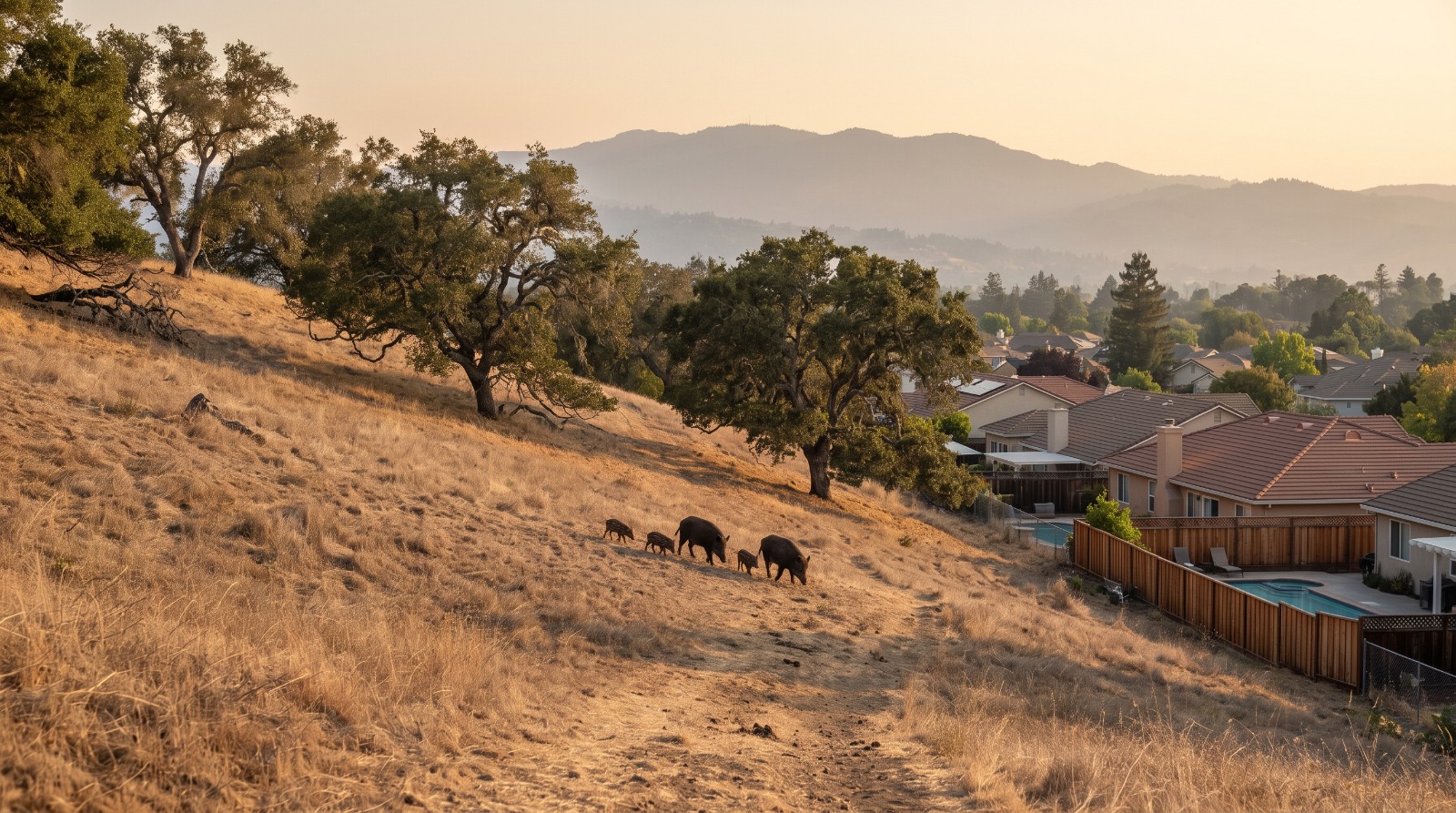
Feral pigs on the golden foothills above an Almaden Valley neighborhood in San Jose, where wild pigs raid backyard lawns. Photo: Houseberry
There is a video going around r/SanJose this week that appears to show a herd of wild pigs methodically dismantling the landscaping at a for-lease office campus. No people, no drama, just pigs, calmly rearranging the lawn like they hold the lease. We could not independently confirm exactly where it was filmed, so treat the clip as one more entry in a very long series. Because the wild pigs of San Jose are not new. They were here before the office park, and they were not impressed by it.
If you are shopping for a home along the San Jose foothills, consider this your fair warning and, honestly, a bit of local color. Feral pigs have been rooting up South Bay lawns, golf courses, and school fields for well over a decade. They are very good at it. Here is the deadpan truth about who they are, why nobody can stop them, and which neighborhoods keep finding hoofprints in the yard.
The pigs have a track record
This is a rerun, not a premiere. Back in 2013, a herd of up to 40 pigs, some pushing 300 pounds, dug up roughly ten lawns and chewed through the greens at the Almaden Golf and Country Club during a dry spell, per CBS Bay Area. One resident described it, accurately, as like Africa.
Golf courses have it worst. The general manager of Coyote Creek Golf Club once told KRON4 the course spends probably 50,000 dollars a month fixing pig damage, and had caught exactly zero pigs in two months of trying. Over in the East Foothills, a homeowner watched a dozen pigs peel his entire lawn up overnight, and a trapper hauled off a 240-pound boar that had jumped a five-foot-tall trap, according to KTVU. A county parks staffer summed up the method for the Smithsonian. They are basically rototilling the land.
Why nobody can stop them
You are not going to outsmart these animals, and it helps to know why. California's wild pigs are hybrids, descendants of domestic pigs the Spanish brought in the 1700s crossed with European wild boar that a rancher released near Carmel Valley in the 1920s. The mix produced an animal that eats anything and breeds constantly, as Lookout Santa Cruz laid out.
The math is grim in a funny way. A sow can be a mother by about four months old and can have more than one litter a year, often a dozen or so piglets at a time. Adults run 150 to 500 pounds. No local predator, not a coyote and not even a mountain lion, is taking down a full-grown boar. And they learn. They see a trap once, escape, and you do not get a second try, which is why San Jose Public Works has admitted some of the city's pigs are simply trap-wise, per ABC7.
Control is slow and legally fussy. You cannot relocate them, because they are invasive. You cannot shoot them inside city limits, which is why San Jose once seriously debated letting licensed trappers use a crossbow, as San Jose Inside reported. What is left is a property owner getting a depredation permit from the state, hiring a licensed trapper, and adding fencing, secure trash, and a motion-sensor sprinkler or two, which Santa Clara County Parks recommends. It works about as fast as you would expect against an animal that reproduces this quickly.
The neighborhoods with a standing reservation
Here is where it gets specific, and where it matters if you are actually house hunting. The pigs come down out of the open space, so the neighborhoods that catch them are the ones that back onto it. That is most of the pretty foothill areas, which is not a coincidence.
Almaden Valley, on the southern edge of the city, sits right under Almaden Quicksilver County Park and the Sierra Azul beyond it. It is one of the highest-ranked neighborhoods in San Jose, and its open-space backyard comes with deer, bobcats, coyotes, and, yes, those golf-course pigs. You can see the tradeoffs on the Almaden Valley neighborhood page. Just east, Santa Teresa learned this the hard way after a 2005 hillside fire pushed pigs down into the streets below the park, where they dug up yards and even the field at Bernal Middle School, per a local park history.
Evergreen and Silver Creek, tucked into the southeast foothills toward Mount Hamilton, get regular visits, with herds of a dozen to twenty hitting lawns in 2016 and 2020 and the Silver Creek Valley Country Club taking its lumps. The Evergreen neighborhood page gives a sense of the area. The Alum Rock and East Foothills stretch, below Alum Rock Park and the Sierra Vista Open Space Preserve, shares its hills with mountain lions, bobcats, and golden eagles, so a few pigs are almost polite by comparison. And out in Coyote Valley, on the rural southern end, the land is a genuine wildlife corridor linking two mountain ranges, as San Jose Spotlight has covered, which is wonderful for biodiversity and rough on the local golf course.
A San Jose councilmember once told residents near open space to simply expect deer, bobcats, coyotes, and turkeys, per CBS Bay Area. He left the pigs off the list. The pigs RSVP'd anyway.
What buying near the hills actually signs you up for
None of this is a reason to avoid the foothills. These are some of the best neighborhoods in San Jose, and you can see how San Jose neighborhoods rank on schools, safety, and amenities to confirm it. The views, the trails, the quiet, and the strong scores are all real. The pigs are just the comedic edge of a reasonable idea, which is that living next to wildland means living with wildland. That is the same package that brings the deer into your roses and the higher wildfire-insurance quote into your inbox.
So, a few practical notes for the foothill house hunter. Are the pigs dangerous. Mostly to your sod. Give them room, do not feed or corner them, and they move on. What do you do if they show up. Call a licensed trapper, look into a state depredation permit, fence the soft ground they love, and lock down anything that smells like food. And which San Jose neighborhoods get them. The ones that border open space, which happen to be the ones people pay a premium to live in. It is exactly the kind of lived-in detail that never shows up in a listing photo, and exactly the kind of thing we think you should know before you fall for the view. Budget for a good fence, keep a sense of humor, and you will be fine. You are going to need both.
Sources
- CBS Bay Area: Wild pigs digging up yards and a golf course in Almaden Valley
- KRON4: Wild pigs causing trouble in San Jose
- KTVU: Neighbors say wild boars are ransacking yards
- Smithsonian: Wild pigs are causing big problems in the Bay Area
- Lookout: Feral pigs are biological time bombs
- ABC7: San Jose's feral pig problem
- San Jose Inside: San Jose sticks to trapping feral pigs
- Santa Clara County Parks: Feral pigs
- Santa Teresa park history: pigs after the 2005 fire
- San Jose Spotlight: Wildlife corridors in Coyote Valley
The Houseberry Research Team is Houseberry's reporting team: Bay Area real estate analysts, data specialists and longtime local market watchers. Every day we check the public record: building permits, city council and planning agendas, county recorder filings, state housing bills, police incident data and school results. Then we tie each story to what it means for specific neighborhoods, using Houseberry's own neighborhood data on prices, appreciation, safety, schools and amenities. Questions or corrections: Contact us.
All information provided on this website including but not limited to - school ratings, safety, amenities, user opinions, and property data - is for general informational purposes only. We do not guarantee its reliability, accuracy, or completeness. Users should independently verify information and consult appropriate professionals as needed. By using this website, you agree Houseberry is not responsible for actions, decisions, or consequences arising from reliance on the information provided
houseberry.com - CA DRE# 01847391
 Bay East ©2025. CCAR ©2025. bridgeMLS ©2025. Information Deemed Reliable But Not Guaranteed. This information is being provided by the Bay East MLS, or CCAR MLS, or bridgeMLS. The listings presented here may or may not be listed by the Broker/Agent operating this website. This information is intended for the personal use of consumers and may not be used for any purpose other than to identify prospective properties consumers may be interested in purchasing. Data last updated at October 18, 2026 12:00 AM