AB 2074: What 450-Foot Downtown Towers Would Change
A bill on the California Senate floor this week would force San Francisco, San Jose and Oakland to zone downtown districts for 450-foot housing by July 2027. What the statute actually says, and why height was never the binding problem.

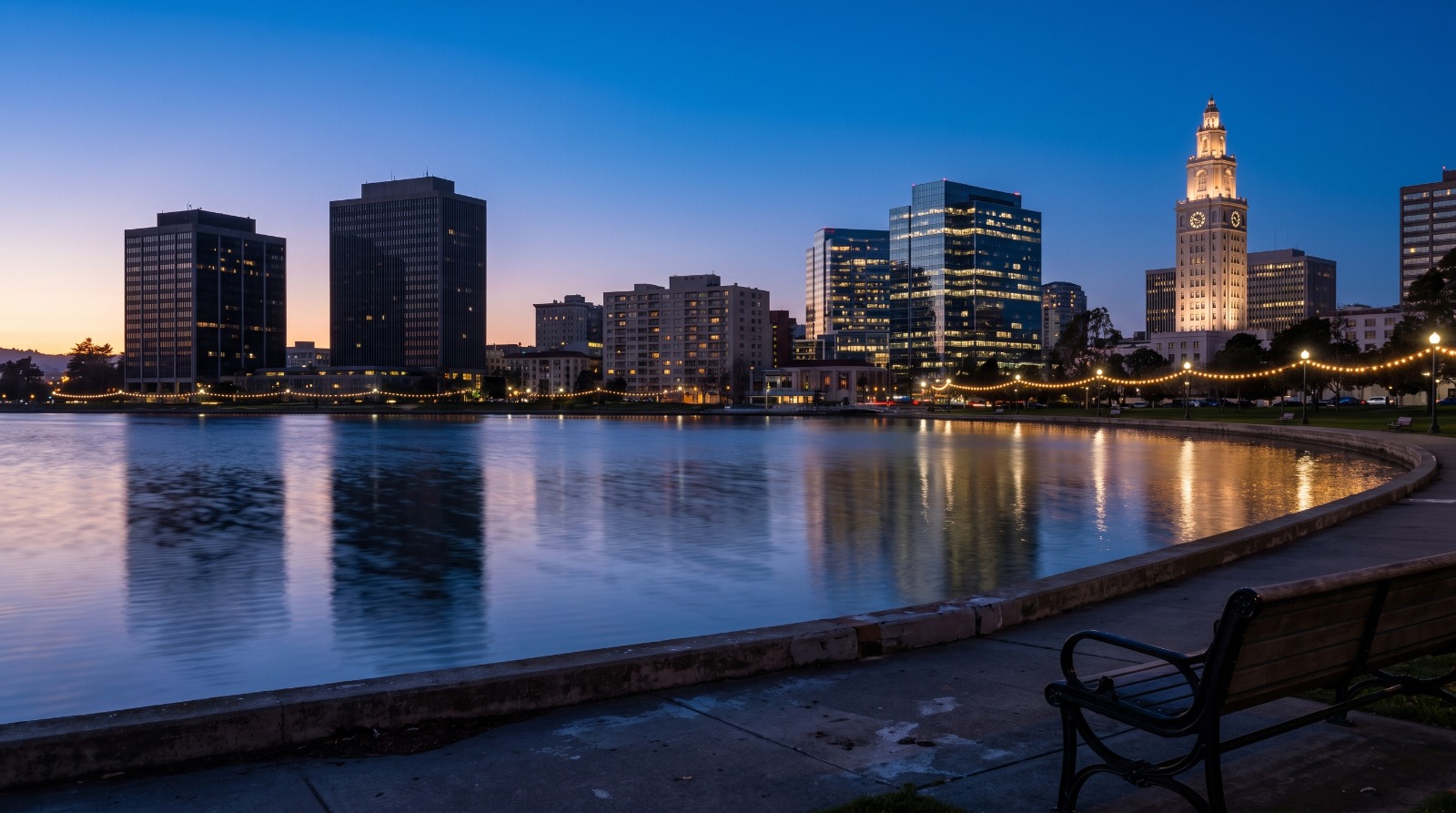
The downtown Oakland skyline reflected in Lake Merritt at dusk, the district AB 2074 would require the city to zone for 450-foot housing towers. Photo: Houseberry
On August 21 the California Senate pulled AB 2074 off the floor mid-vote, amended it, and sent it back to second reading. Three days later it was ordered to third reading again. As of this morning it has not passed, and the Legislature's deadline to pass anything is August 31. If it clears, San Francisco, San Jose and Oakland each have until July 1, 2027 to draw a downtown district where housing towers are allowed by right, with at least a quarter of that district zoned for buildings of 450 feet or more.
Here is the finding that no coverage of this bill has printed: in two of those three cities, the height was never the problem. San Francisco already permits 550 to 1,000 feet in its downtown core and has no residential density limit there at all. Oakland's own downtown plan already maps a tier at 450 feet and another with no height limit whatsoever. And San Jose cannot reach 450 feet, because the bill defers to the airport plan that stops it.
On the affordable set-aside, the bill points at Section 65912.157, which offers a menu rather than a percentage: 7 percent of units at extremely low income, or 10 percent at very low, or 13 percent at lower income, for 55 years on rentals. Where a city's own inclusionary ordinance demands more, the local rule wins. That matters here, because San Francisco and Oakland both have inclusionary rules that would keep governing.
Seven cities qualify, and Oakland clears the bar by 40,646 people
Nine California cities had 400,000 residents in the 2020 census. Only seven qualify, because Fresno and Bakersfield sit in counties that contain no transit-oriented development stops under the SB 79 definition the bill borrows. That leaves Los Angeles, San Diego, San Jose, San Francisco, Sacramento, Long Beach and Oakland.
Three of them are ours, and the sizes are worth noting because they set the homework. San Jose counted 1,013,240 in 2020, which puts it over the one-million line and doubles its obligation to a full square mile. San Francisco at 873,965 and Oakland at 440,646 each owe half a square mile.
Oakland is the interesting one. It qualifies by 40,646 people, a cushion of about 10 percent, and the statute keys off the most recent decennial census, so Oakland is locked in through 2030 no matter what happens to its population in the meantime. Current Census Bureau estimates put the city around 438,000 and drifting down. If Oakland comes in under 400,000 in the 2030 count, this law simply stops applying to it in 2032. Nobody has written that sentence, and Oakland's planning department should probably have it on a slide.
In San Francisco, almost none of this is new
San Francisco's downtown commercial districts already meet most of AB 2074's floors, and one of them by a mile. Planning Code Section 210.2 says the C-3 districts have no residential density limit, full stop, with density instead governed by height, bulk and open space. The 200-unit floor and the no-density-cap carve-out are satisfied the day the bill is signed.
Height is not close either. The Transit Center District Plan runs a tiered set of limits from 250 feet up through 550, 700, 850 and 1,000 feet at the Transit Tower site. A 450-foot mandate in that context is a floor several hundred feet below the ceiling. Base floor area ratios in the C-3 districts run 6.0 to 9.0, so only the C-3-S district at 5.0 falls short of the FAR-6 requirement.
What San Francisco actually gets from this bill is the ministerial approval, and that is not nothing. The city has more than 20,000 entitled housing units sitting unbuilt and completed 1,453 homes in 2024. Approval was never what stopped them. But removing the discretionary hearing removes the delay, and delay is priced into every pro forma in the city.
San Jose cannot build to 450 feet, and the bill says so itself
This is the contradiction at the center of AB 2074 and I have not seen anyone name it. Among the conditions a qualifying project must meet, subparagraph (F) requires that it be consistent with the height, noise and safety standards of an adopted airport land use compatibility plan. Mineta San Jose sits at the north end of downtown, and its approach surfaces are the reason the practical downtown ceiling is roughly 24 stories at the south end and about 18 nearer the airport.
The tallest building in San Jose is 200 Park Avenue, finished in 2023 at 300 feet and 21 floors. The city fought hard for that. In March 2019 the council raised downtown core heights by up to 35 feet and Diridon Station area heights by up to 150, against airline objections quantified down to the passenger, and that increase is what made 200 Park possible.
So AB 2074 would order San Jose to zone a quarter of a full square mile for 450 feet, while its own eligibility rules make any 450-foot project in that zone ineligible. The statute does not resolve this. Either San Jose zones for a height nothing can use, or it draws its district away from the airport surfaces, which means away from downtown, which defeats the purpose of a bill named for downtown revitalization. Somebody in Sacramento is going to have to answer that, and the August 21 floor amendments did not.
Oakland already zones for this and has never built it
The Downtown Oakland Specific Plan, adopted by the City Council in July 2024, plans for 29,100 new homes and already maps intensity areas that exceed what AB 2074 demands. Intensity Area 17 allows 450 feet at a floor area ratio of 20. Intensity Area 18 has no height limit at all, also at FAR 20. Those tiers sit around the 12th Street and 19th Street BART stations, which is precisely where a regional transit hub district would go.
And the tallest building in Oakland is the Ordway, at 404 feet, finished in 1970. Nothing in the city has ever reached 450. Hines halted its 622-foot tower at 415 20th Street in August 2023. The 513-foot Town Tower at Two Kaiser Plaza filed permits in February 2023 and has not moved. Oakland is not short of permission. It is short of financing, in a downtown carrying 37.8 percent office vacancy.
The three downtowns, side by side
Put the requirement next to what each city allows today and the pattern is hard to miss.
| AB 2074 requirement | San Francisco | San Jose | Oakland |
|---|---|---|---|
| Height limit floor of 150 feet | Already 550 to 1,000 feet in the C-3 core | Practical ceiling about 300 feet | Downtown plan already allows 450 feet |
| 25 percent of district at 450 feet | Already exceeded | Blocked by the airport plan the bill defers to | Already mapped in Intensity Area 17 |
| District area to draw by July 1, 2027 | 0.5 square miles | 1 square mile | 0.5 square miles |
| Tallest building standing today | 1,070 feet, Salesforce Tower | 300 feet, 200 Park Avenue | 404 feet, the Ordway Building |
| Downtown office vacancy, Q1 2026 | 31.1 percent | 30.8 percent | 37.8 percent |
Read the last two rows together. Every one of these downtowns is sitting on roughly a third empty office space, which is the condition that makes lenders decline residential high-rise construction regardless of what the zoning map says. California YIMBY's own fact sheet, arguing for the bill, concedes that fewer than 5 percent of planned multifamily projects in major California cities can currently secure financing.
The loan fund everyone wrote about is gone
Every article you can find on AB 2074 describes a Downtown Revitalization Loan Fund at CalHFA, continuously appropriated, lending up to 30 percent of a project's cost. It was the feature that made the bill interesting, because cheap construction debt is the actual constraint.
It was struck by the July 2 Senate amendments and replaced with a study. CalHFA would analyze gaps in construction lending and report to the Legislature by March 1, 2028, a date the August 21 amendments pushed back from December 1, 2027. Read the current text and the fund appears only as a stricken definition. The Legislative Analyst had projected an $18 billion deficit for 2026-27, the bill went to the Appropriations suspense file on August 3, and it came off on August 13 with a 7-0 do-pass. The money did not survive the trip. The mandate did.
That is the honest summary of AB 2074 as it stands today: a bill that lost its money and kept its zoning requirement. Which is a real thing, just a smaller thing than the one that got written up in April. We covered the bill in its earlier form in our roundup of the housing bills facing the August 31 deadline, when it was still sitting on suspense with the fund attached.
The parts that do have teeth
Two provisions make this more than an advisory rezoning, and both are new to the amended text.
First, the default district. If a city misses the July 2027 deadline, the statute deems a district into existence anyway, drawn as a uniform radius around the city's highest-ridership transit stop. A city that stalls does not get to stall. It gets a district somebody else drew. The amendments also added the constraint that this automatic district must sit entirely inside the city and may not occupy any portion of the San Francisco Bay or the Pacific Ocean, which tells you exactly how a coastal city's attorney was reading the earlier draft.
Second, enforcement. The bill amends Section 65585 to add a violation of this section to the list of things the Department of Housing and Community Development may refer to the Attorney General. And it includes findings that this is a matter of statewide concern, which makes it binding on charter cities. San Francisco, San Jose and Oakland are all charter cities. That clause is not decoration.
What it would mean for anyone shopping a downtown condo
Not much in the next three years, and possibly quite a lot after that. Nothing in this bill produces a home before 2029, and the financing problem it no longer addresses is the reason.
The more useful thing to notice is what these districts already look like as places to live. Downtown San Jose scores 2.0 out of 5 on Houseberry and ranks 111th of 112 San Jose neighborhoods, with a median sale price of $997,630 in July 2026, roughly 39 percent below the citywide median and down 16 percent over twelve months. It also ranks 13th of 112 for amenities. That combination of the best merchant access in the city and the worst safety score in the city is the defining feature of every American downtown, and it is the thing more housing actually fixes, because the fastest way to make a commercial district safer at night is to put residents in it.
The pattern repeats in Downtown Oakland, at 2.1 overall with a perfect 5.0 for nearby merchants and a 1.2 for safety, and in San Francisco, where the citywide median reached $2.16 million in July 2026. If you are weighing a downtown purchase in any of the three, the question worth asking is not whether a tower gets approved next to you. It is whether the blocks around it fill in, and that is a question about how the whole city's neighborhoods compare rather than about any one parcel. We built Houseberry around looking at the area first for exactly this reason.
The fair objection to all of this comes from the affordable housing side rather than from neighborhood groups, and it is a good one. The California Housing Consortium and Housing California both opposed the bill on the grounds that high-rise construction is the most expensive housing there is, and a policy aimed only at towers subsidizes the units least likely to be affordable. With the loan fund deleted, that objection got stronger, not weaker.
August 31
AB 2074 passed the Assembly 64 to 6 on May 28 and has cleared every Senate committee it has touched, including a 7-0 vote out of Appropriations on August 13. It is on the third reading file now. If the Senate passes it, the Assembly still has to concur in the August 21 amendments, which means two floor votes in five days.
If it makes it, watch what each city does by July 1, 2027, and watch San Jose in particular, because it has to solve a problem the statute created and did not answer. If it dies on the file, it comes back in January, and the version that comes back will be the one without the money.
Sources
California Legislature, AB 2074 bill text as amended August 21, 2026
California Legislature, AB 2074 bill history
Government Code Section 65912.157, affordability and site eligibility standards
California YIMBY, AB 2074 legislation page and fact sheet
U.S. Census Bureau QuickFacts, Oakland city 2020 population
San Francisco Planning Code, Section 210.2, C-3 district standards
San Francisco General Plan, Transit Center District subarea plan
City of Oakland, Downtown Oakland Specific Plan height and intensity maps
Mineta San Jose International Airport, downtown height limits
San Jose Spotlight, council vote raising downtown height limits, March 2019
SF YIMBY, Hines halts 415 20th Street in downtown Oakland, August 2023
Cushman and Wakefield, San Francisco office marketbeat
The Houseberry Research Team is Houseberry's reporting team: Bay Area real estate analysts, data specialists and longtime local market watchers. Every day we check the public record: building permits, city council and planning agendas, county recorder filings, state housing bills, police incident data and school results. Then we tie each story to what it means for specific neighborhoods, using Houseberry's own neighborhood data on prices, appreciation, safety, schools and amenities. Questions or corrections: Contact us.
All information provided on this website including but not limited to - school ratings, safety, amenities, user opinions, and property data - is for general informational purposes only. We do not guarantee its reliability, accuracy, or completeness. Users should independently verify information and consult appropriate professionals as needed. By using this website, you agree Houseberry is not responsible for actions, decisions, or consequences arising from reliance on the information provided
houseberry.com - CA DRE# 01847391
 Bay East ©2025. CCAR ©2025. bridgeMLS ©2025. Information Deemed Reliable But Not Guaranteed. This information is being provided by the Bay East MLS, or CCAR MLS, or bridgeMLS. The listings presented here may or may not be listed by the Broker/Agent operating this website. This information is intended for the personal use of consumers and may not be used for any purpose other than to identify prospective properties consumers may be interested in purchasing. Data last updated at October 11, 2026 12:00 AM