California Housing Bills: What Passes by August 31
The Legislature has until August 31 to pass this year's housing and insurance bills, and most of them will live or die in a single committee hearing on August 13. Here is what is still alive and what it would change in the Bay Area.
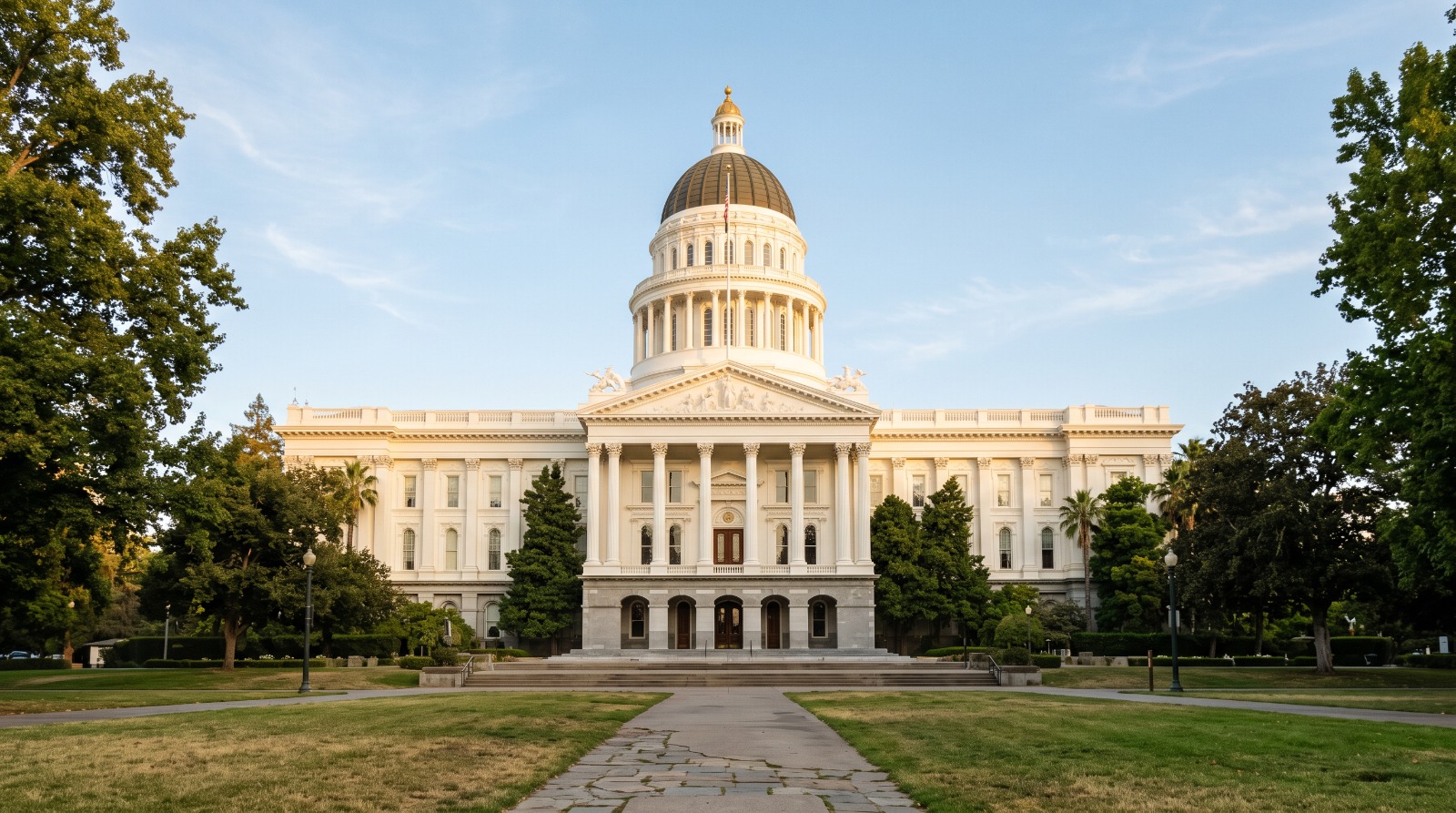
The California State Capitol in Sacramento seen across the lawn of Capitol Park in late afternoon light. Photo: Houseberry
Most California housing bills do not die on the floor. They die on the suspense file, in an Appropriations hearing where a chair reads a list of bill numbers and the ones that are not read are simply over. For the Senate this year that hearing is August 13, 2026, and it will decide more about Bay Area housing than the August 31 deadline everyone is watching.
The Legislature came back from summer recess on August 3 and has until August 31 to pass bills. The Governor then has until September 30 to sign or veto. Below is what is still alive, where each bill actually stands as of today, and what it would change here.
The calendar, and one thing people get wrong
The dates that matter are close together. Fiscal committees must report bills to the floor by August 14. From August 17 to 31 it is floor sessions only, with no committees except conference and rules. Floor amendments close August 21. Each house must pass bills by August 31.
The common error is calling August 31 the constitutional end of session. It is not. This is the second year of a two-year biennium, and the Legislature formally adjourns sine die on November 30, 2026. August 31 is the deadline to pass bills, which is what matters in practice but is a different thing.
AB 2074 is the big one for San Francisco, San Jose and Oakland
AB 2074, by Assemblymember Matt Haney of San Francisco, would require California's seven cities with more than 400,000 residents to create regional transit hub districts around their downtown transit hubs by July 1, 2027, where high-rise housing is an allowed use with ministerial approval for projects meeting labor standards. Three of the seven cities are ours: San Francisco, San Jose and Oakland.
It passed the Assembly 64 to 6 on May 28, 2026 and was placed on the Senate Appropriations suspense file on August 3. The bill also carries a state revolving loan fund aimed at closing financing gaps on downtown high-rises, which is the part that put it on suspense in the first place, because suspense is about cost rather than merit.
Ministerial approval near a downtown transit hub is the single most useful thing the state can do for a city like Oakland, where the constraint has never been demand for housing near 12th Street. It has been the years between filing and breaking ground. Whether the loan fund survives the August 13 hearing intact is the thing to watch.
The for-sale bills are the quieter story
Nearly everything built in the Bay Area in the last decade has been rental, and three bills still moving would change the math on the ownership side.
AB 1903, by Buffy Wicks, rewrites construction defect litigation for condos and townhomes. That sounds like a lawyers' bill and it is the closest thing on the list to a fix for why almost nobody builds for-sale condos here: defect liability makes the insurance impossible, so the same parcel gets built as apartments instead. It passed the Assembly 70 to 0 and was re-referred to Senate Housing on August 4, which means it still needs a policy committee after the deadline for those. Treat it as live but genuinely uncertain.
AB 1751, the Missing Middle Townhome Ownership Act, gives ministerial approval and a CEQA exemption to townhome projects meeting objective standards. It passed the Assembly 47 to 0 and was amended in Senate Appropriations on August 4. SB 1116 strengthens the Starter Home Revitalization Act by measuring height limits in feet rather than floors and allowing subdivided parcels as small as 480 square feet.
Where every live bill stands as of August 5
Statuses move fast in August. This is where each bill sits today.
| Bill | Author | What it does | Status as of Aug 5, 2026 |
|---|---|---|---|
| AB 2074 | Haney | Transit hub districts with ministerial high-rise approval in cities over 400,000 | Senate Approps, suspense file (Aug 3) |
| AB 1751 | Quirk-Silva | Ministerial approval and CEQA exemption for qualifying townhomes | Senate Approps, amended Aug 4 |
| AB 1903 | Wicks | Rewrites condo and townhome construction defect litigation | Senate Housing, re-referred Aug 4 |
| SB 1116 | Caballero | Strengthens the Starter Home Revitalization Act | Assembly Approps |
| SB 1117 | Cervantes | Impact fees on ADUs charged only above 750 sq ft | Assembly Approps, heard Aug 5 |
| SB 1014 | Grayson | 30-day written estimate of required infrastructure improvements | Assembly Approps, heard Aug 5 |
| AB 748 | Harabedian | Preapproved plans with 30-day ministerial review, up to ~10 units | Senate Approps |
| AB 1680 | Calderon | Make It FAIR Act: comprehensive FAIR Plan coverage and governance | Senate Approps, heard Aug 3 |
| SB 1301 | Allen | Expands nonrenewal protections on residential property insurance | Assembly Approps, heard Aug 5 |
Two useful patterns in that table. Almost every one of these passed its house with a lopsided bipartisan vote, several of them unanimously, which tells you the fight is about money rather than ideology. And almost all of them are sitting in an Appropriations committee this week, which is why August 13 and 14 decide the year.
The insurance track runs on the same clock
For most Bay Area homeowners the insurance bills will matter more than the zoning ones, because they change a bill that arrives every year.
AB 1680, the Make It FAIR Act, would require the California FAIR Plan to offer comprehensive homeowners coverage including water damage and liability, which would end the need to buy a separate wrap policy alongside it. It would also open the plan's governing committee meetings to the public and require climate risk assessments. It follows a Department of Insurance market conduct exam that found the FAIR Plan had not started or fully implemented recommendations in more than half of 32 areas examined.
The scale problem behind it: the FAIR Plan held 668,609 policies and $724 billion in exposure as of December 2025, a 146% increase in policies since September 2022. The state's insurer of last resort has become a large primary insurer by accident.
Meanwhile the prices are already set. Regulators approved a 29.1% overall FAIR Plan rate increase taking effect for new and renewal policies on October 15, 2026. State Farm General's 17% homeowners increase stood under a March 6, 2026 settlement, though its condominium increase was cut from 15% to about 5.8% with refunds back to June 2025. Farmers received 1.5% in May 2026 for roughly 915,000 policyholders, effective at renewals after September 15.
This is no longer only a Napa and Santa Cruz Mountains story, though the newest Bay Area specific figure is now dated: a November 2024 study found 4,200 FAIR Plan homeowner policies across Santa Clara and San Mateo counties as of mid-2024, a 300% rise over five years, at premiums averaging about $2,100 a year above comparable private coverage.
Does any of this actually build anything?
The fair question about streamlining bills is whether they produce houses or press releases. There is now one month of real evidence.
SB 79, the transit density law, took effect July 1, 2026. In its first month builders filed proposals for at least several hundred homes across 15 projects in five cities, including Palo Alto, San Mateo and Atherton. We wrote up the seven projects filed in Palo Alto when they landed, and the Palo Alto pipeline alone is more multifamily housing than the city has approved since 1999.
Several hundred homes is not a housing supply. But it is a month, from one law, in a region that has spent years producing almost nothing.
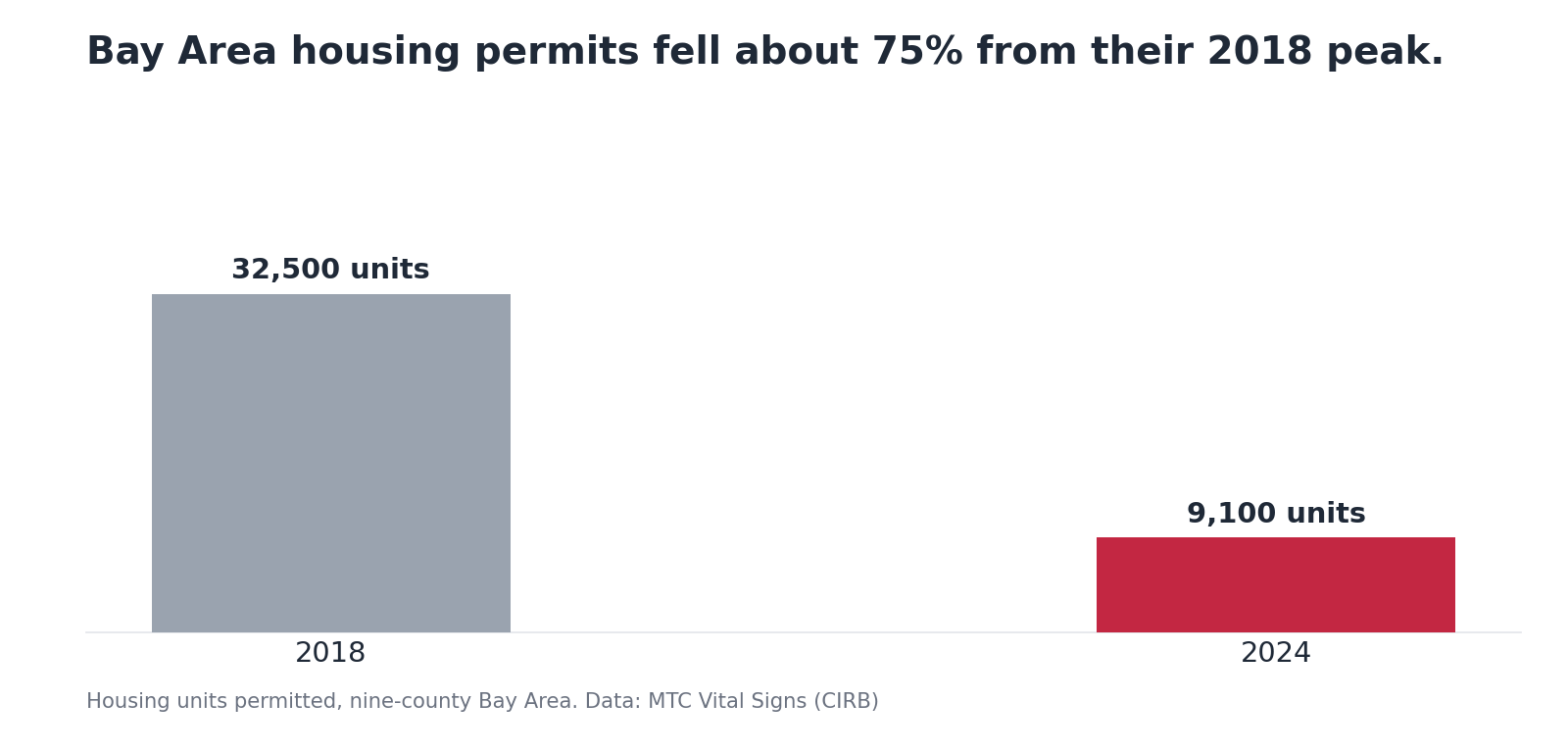
Here is the hole all of this is trying to fill. The nine-county Bay Area permitted 9,100 housing units in 2024, roughly 75% below the 2018 peak of 32,500. Statewide, California permitted 49,400 units in the first half of 2025, the lowest first half since 2014 outside the pandemic.
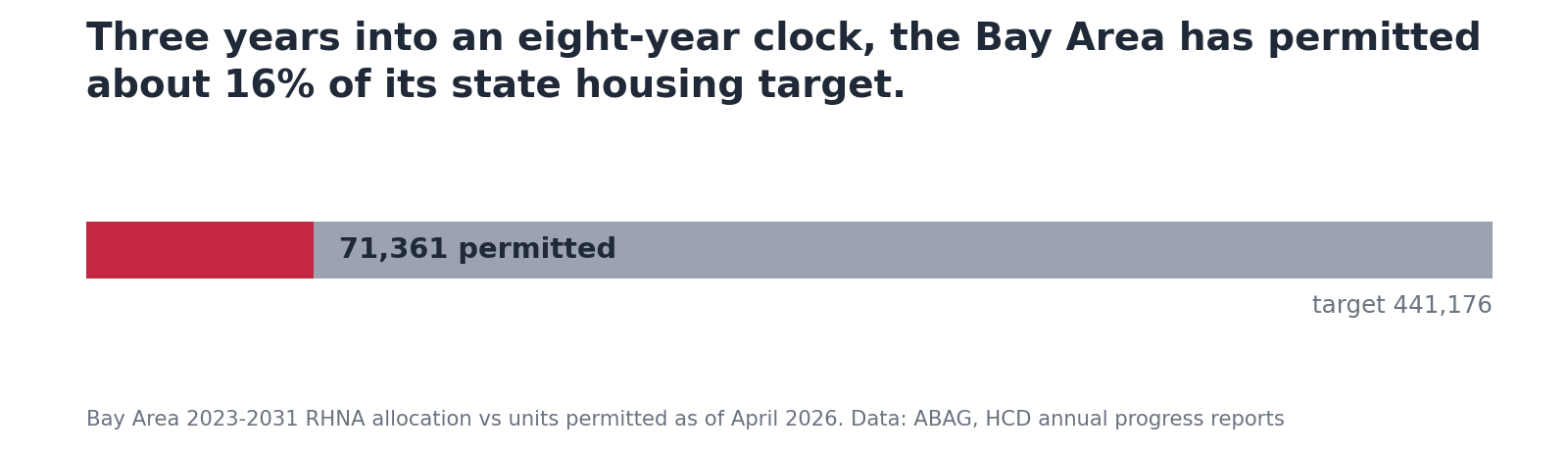
Against the state target the gap is starker. The Bay Area's 2023 to 2031 allocation is 441,176 units, and a tracker built on the state's annual progress reports put the region at roughly 71,000 permitted as of April 2026, about 16%. Three years into eight, on pace for well under half.
What it means if you own here, or are trying to
If you own, the insurance bills are the ones to follow, and the FAIR Plan increase on October 15 is already decided regardless of what passes. If you are shopping for a condo or townhome, AB 1903 and AB 1751 are the two that could change what gets built in the next five years, though nothing they do shows up as inventory before 2028.
If you are buying near a transit stop on the Peninsula or in the South Bay, the practical effect of SB 79 and AB 2074 is that some quiet blocks will not stay quiet, and some corridors will get real housing. That is not a warning. It is the point, and mostly it is good. But it does mean the thing worth checking before you commit to an address is what the area around it is zoned to become. What it looks like today is the easy part. That is the sort of question we built Houseberry to answer, and it is a better use of an afternoon than another open house. Start with how a city's neighborhoods actually compare and work down from there.
The next real checkpoint is August 13. Most of the bills in the table above will not survive it, and the ones that do will be on the Governor's desk within a month.
Sources
California State Senate, 2026 Tentative Legislative Calendar
California Legislative Information, AB 2074
California Legislative Information, AB 1903
California Legislative Information, AB 1680
Assembly Insurance Committee, FAIR Plan oversight background paper (January 2026)
California Department of Insurance, State Farm General settlement (March 2026)
MTC Vital Signs, Bay Area housing permits
ABAG, Regional Housing Needs Allocation
California YIMBY, SB 79 one month in (August 2026)
Joint Venture Silicon Valley, FAIR Plan shift (November 2024)
All information provided on this website including but not limited to - school ratings, safety, amenities, user opinions, and property data - is for general informational purposes only. We do not guarantee its reliability, accuracy, or completeness. Users should independently verify information and consult appropriate professionals as needed. By using this website, you agree Houseberry is not responsible for actions, decisions, or consequences arising from reliance on the information provided
houseberry.com - CA DRE# 01847391
 Bay East ©2025. CCAR ©2025. bridgeMLS ©2025. Information Deemed Reliable But Not Guaranteed. This information is being provided by the Bay East MLS, or CCAR MLS, or bridgeMLS. The listings presented here may or may not be listed by the Broker/Agent operating this website. This information is intended for the personal use of consumers and may not be used for any purpose other than to identify prospective properties consumers may be interested in purchasing. Data last updated at September 18, 2026 12:00 AM