Candlestick Point Finally Breaks Ground on 7,200 Homes
Infrastructure for the first 675 homes starts in September 2026. The full 7,200 run to 2048, the money is not the city's, and the neighborhoods around the site are the cheapest in San Francisco right now.
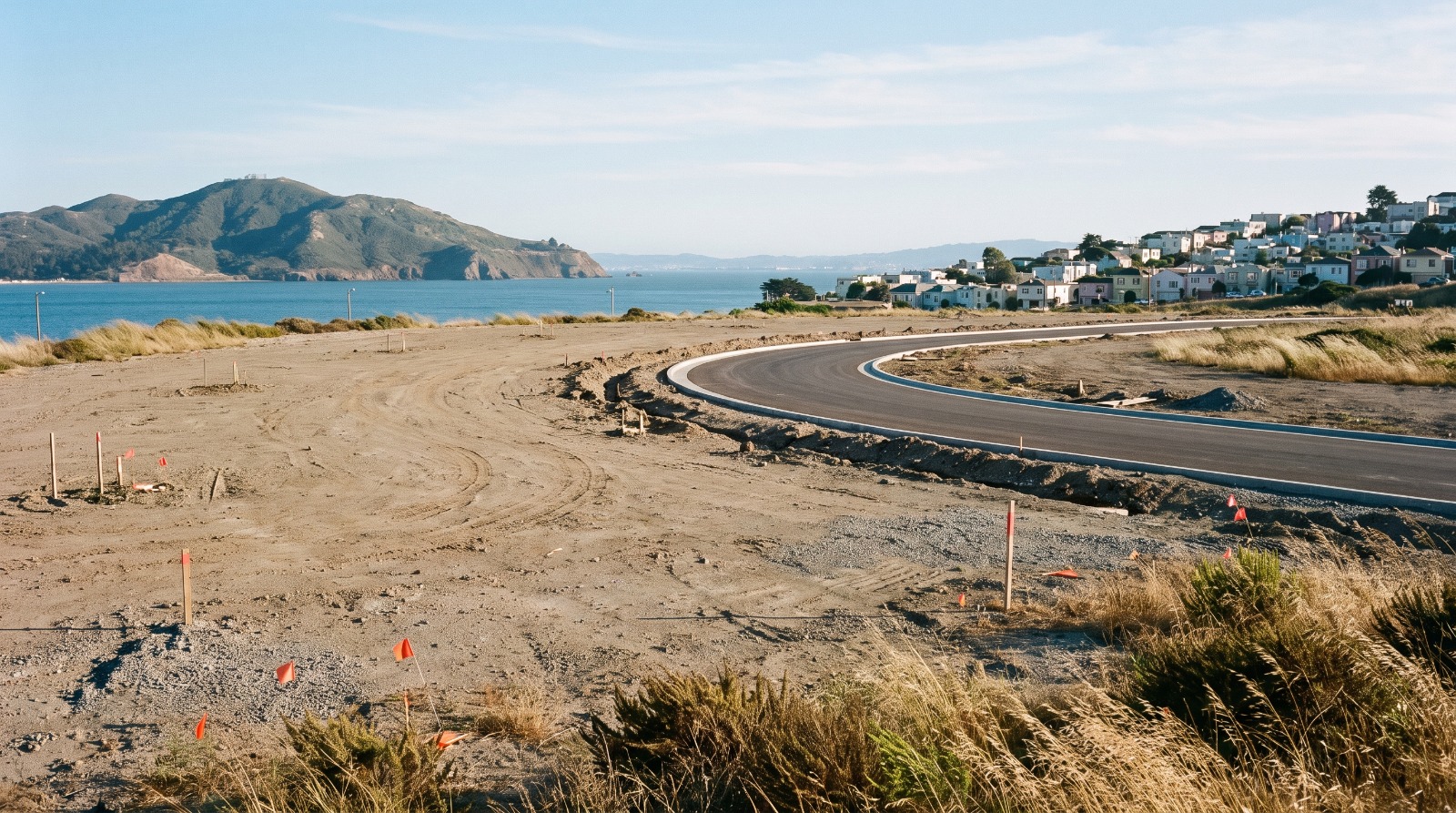
The graded, empty former Candlestick Park site in San Francisco with a new roadbed and the Bayview hillside behind it before construction begins. Photo: Houseberry
San Francisco is not putting $130 million into Candlestick Point. That headline has been traveling all week and it has the money backwards. FivePoint is spending the $130 million, and the city repays most of it later out of the property taxes the project itself generates.
What is true is the important part. After 18 years, dirt finally moves. Roads and utilities for the first seven blocks, enough for about 675 homes, are scheduled to start in September 2026 on the roughly 270-acre site where Candlestick Park stood until 2015. The full entitlement is 7,218 homes.
Phase one, in the least glamorous terms possible:
- About $130 million of horizontal infrastructure, spent by the developer and reimbursed through tax-increment financing administered by the city's Office of Community Investment and Infrastructure.
- Seven blocks of streets, sidewalks and utilities, including extensions of Harney Way and Arelious Walker Drive.
- Roughly 675 homes worth of capacity, and about two years of work before any of it is finished.
- Zero vertical construction. No building goes up in this phase.
Whose $130 million this actually is
The financing structure is the whole reason this project sat still for a decade, so it is worth getting right. FivePoint fronts the infrastructure cost. As property tax revenue from the finished development comes in, the city returns most of that money to the developer. About $20 million is reported to come from a Federal Highway Administration grant, though that piece traces back to a single paywalled report and I have not found it in an OCII or federal document.
Tax-increment financing is not a subsidy in the usual sense. It is a bet that the finished neighborhood generates enough new tax base to pay for the streets that made it possible. When the Board of Supervisors restructured the deal in October 2024, it raised the project's bond debt ceiling from $800 million to $3.3 billion and pushed the tax-increment deadline from 2036 all the way to 2070.
Those two numbers tell you how long the city expects to be repaying this, and how much risk it was willing to move onto its own future revenue to get shovels in the ground. Reasonable people disagree about that trade. Nobody should pretend it is a $130 million check from City Hall.
What the June 16 final map actually unlocked
The legal milestone was the Board of Supervisors approving the final subdivision map on June 16, 2026. A final map is the document that turns an entitlement into legally recordable parcels. Until it exists, there is nothing to build streets to.
The quieter signal came six weeks earlier. On May 5, 2026, the Board passed Resolution 261-26, which names 11 public and 13 private streets at Candlestick Point and renames Bill Walsh Way as Giants Drive. Cities do not name streets for projects they expect to cancel. If you want a single piece of paper that says this one is real, that is the one.
Eighteen years, one ballot measure, and a stadium that left
Voters approved this in 2008, not 2010. Proposition G passed on June 3, 2008 with 62.5% of the vote, authorizing redevelopment across Candlestick Point and the Hunters Point Shipyard. The Lennar entitlements followed in July 2010, when the Board approved the environmental impact report 8 to 3.
Then the plan lost its pieces one at a time. Santa Clara voters approved a stadium in June 2010 and the 49ers left. The team played its last game at Candlestick in December 2013, Paul McCartney closed the building in August 2014, and demolition finished on September 24, 2015. The urban outlet mall that was supposed to anchor the retail was scrapped around 2018. The 2024 restructuring replaced it with 2 million square feet of offices branded the Candlestick Center Innovation District, which is now being marketed to an unnamed AI tenant.
What survived is a smaller, denser, more housing-heavy plan than the one voters approved. From a supply standpoint that is an improvement. Here is the before and after.
| 2010 entitlement | 2026 plan | |
|---|---|---|
| Homes at Candlestick Point | About 7,000 | 7,218 |
| Affordable share | About 32% project-wide | About 32%, roughly 2,472 units |
| Commercial space | About 1M sq ft | About 2M sq ft, shifted from Hunters Point |
| Open space | Promised by 2026 | 105 acres, main park now slated for 2042 |
| Completion | 2036 | 2048 |
Read the bottom two rows together. The park residents were promised for this year is now scheduled for 2042, and completion slipped 12 years. That is the honest cost of the deal that got construction moving.
The contamination question, answered precisely
Candlestick Point is not part of the Hunters Point Naval Shipyard Superfund site, and Tetra Tech never tested it. The falsified soil-sampling scandal that made national news, and that ended in a $97 million federal settlement in January 2025, concerns the shipyard's parcels, not this parcel.
The connection was contractual, not environmental. Candlestick Point and the shipyard shared one development agreement, one financing structure and one master developer. When the Navy's cleanup collapsed and the shipyard's land transfers froze, Candlestick froze with it because the paperwork tied them together. The October 2024 amendment decoupled the two so Candlestick could proceed on its own. That single administrative act is why anything is happening in September.
One more distinction, since it trips people up. The neighboring Candlestick Point State Recreation Area sits on a former wartime landfill and municipal dump, remediated by California State Parks decades ago. That is a separate and far more ordinary history than radiological waste, and the two should not be blurred together in either direction.
First homes around 2030, not 2027
Anyone reading a September groundbreaking as a signal to start watching listings should reset the clock. Phase one infrastructure runs about two years. Vertical construction follows that. Realistically the first residents move in around 2030, and the final phase is scheduled for 2048.
The track record supports the caution. As of October 2024, 337 homes had been built on this project in 18 years, all of them the Alice Griffith replacement units. That is about 4.5% of what was promised.
I am firmly in favor of this getting built, and 7,218 homes on a vacant 270-acre site next to a freeway and the bay is close to the best-case use of land in this city. It is also a project that has missed every deadline it has ever set. Both of those are true.
What this does to the blocks around it
The neighborhoods absorbing this project are, right now, the cheapest in San Francisco. That is the part none of the coverage touches.
Bayview, the flat industrial and residential district along Third Street south of Islais Creek, had a median sale price of about $869,480 in July 2026, its lowest in a year and down from a $1.05 million peak in November 2025. That is roughly 65% of the $1.33 million citywide median from June 2026.
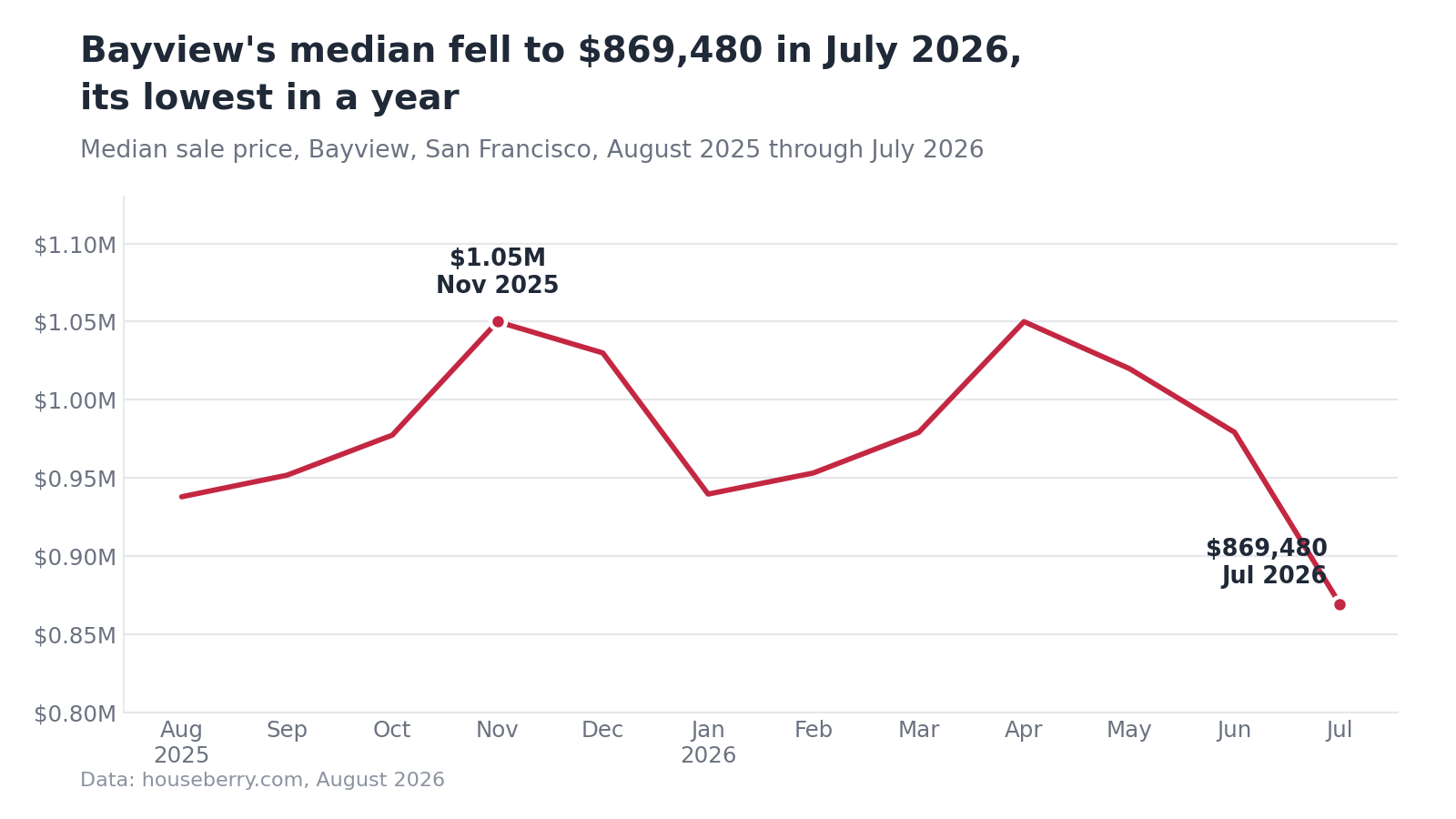
Candlestick Point itself sits at about $900,000 as of July 2026, down from $1.02 million a year earlier. Whatever the market thinks of 7,200 new homes arriving, it has not priced it in.
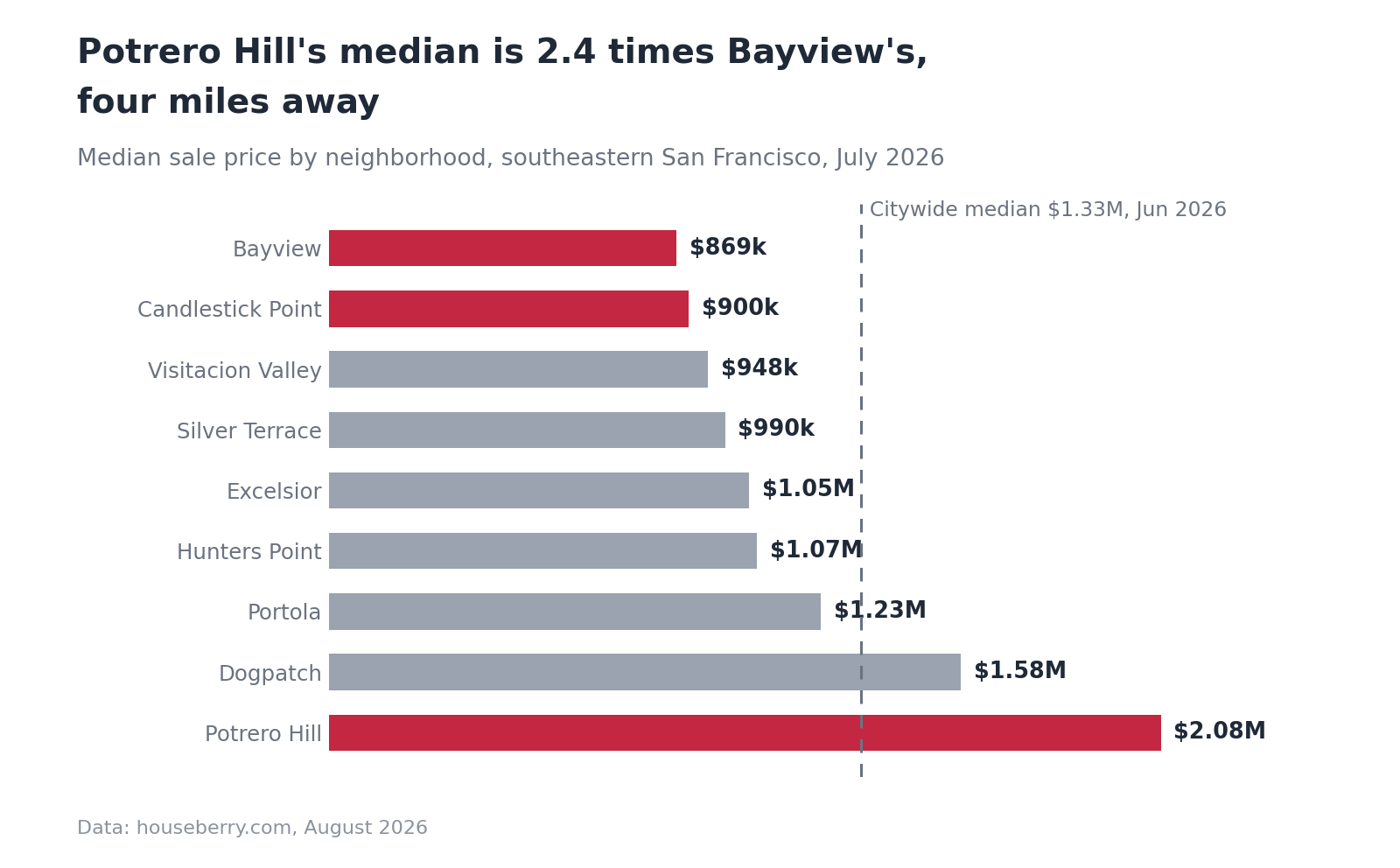
Here is the fuller picture, with the scores that usually explain a price gap.
| Neighborhood | Median (July 2026) | Overall | Schools | Safety |
|---|---|---|---|---|
| Bayview | $869,480 | 2.3 | 2.2 | 2.4 |
| Candlestick Point | $900,000 | 2.4 | 1.6 | 3.6 |
| Visitacion Valley | $947,670 | 2.9 | 2.4 | 3.7 |
| Hunters Point | $1.07M | 2.4 | 2.5 | 2.6 |
| Portola | $1.23M | 2.8 | 2.2 | 3.7 |
| Potrero Hill | $2.08M | 3.1 | 3.0 | 3.4 |
Look at the safety column before you assume you know this story. Candlestick Point scores 3.6 on safety, higher than Potrero Hill's 3.4, at 43% of the price. The number holding it down is schools, at 1.6 out of 5, near the bottom of all 92 San Francisco neighborhoods we score. That is the binding constraint on this side of the city, and it is the one a 7,200-home project does the least to fix on its own.
For buyers, the practical question cuts both ways. A hundred acres of new parks, 2 million square feet of offices and a rebuilt street grid are real amenity gains for Hunters Point and Bayview. But 7,218 new homes is also 7,218 units of competing supply landing in the same submarket, and the first of them arrive right around the time a 2026 buyer would be thinking about selling. Anyone telling you this is a straightforward appreciation play is only reading one half of it.
What to watch, and when
September 2026 is the groundbreaking. The thing worth actually tracking is whether phase one infrastructure finishes near its two-year estimate, because that is the first deadline this project will have hit in its history. Late 2028 is the real test.
After that, watch for a named anchor tenant on the 2.8 million square foot innovation district campus. An office commitment is what turns a housing site into a neighborhood with daytime population, and it is the piece the 2024 restructuring bet the retail plan on.
Between now and then, the way we look at it when we compare neighborhoods is unchanged: a project that delivers its first homes in 2030 should not move your decision in 2026. What should move it is the 1.6 school score, the 3.6 safety score, and a median 35% below the rest of the city. Those are measurable today.
Sources
OCII affordable housing plan for Candlestick Point and Hunters Point Shipyard
FivePoint, Candlestick project FAQ
The San Francisco Standard on the stalled Candlestick development (October 29, 2024)
The San Francisco Standard on the Tetra Tech settlement (January 17, 2025)
Connect CRE on the Board of Supervisors final map approval (June 17, 2026)
Propmodo on the phase one infrastructure financing (July 28, 2026)
SPUR voter guide, Proposition G, June 2008
California State Parks, Candlestick Point State Recreation Area
All information provided on this website including but not limited to - school ratings, safety, amenities, user opinions, and property data - is for general informational purposes only. We do not guarantee its reliability, accuracy, or completeness. Users should independently verify information and consult appropriate professionals as needed. By using this website, you agree Houseberry is not responsible for actions, decisions, or consequences arising from reliance on the information provided
houseberry.com - CA DRE# 01847391
 Bay East ©2025. CCAR ©2025. bridgeMLS ©2025. Information Deemed Reliable But Not Guaranteed. This information is being provided by the Bay East MLS, or CCAR MLS, or bridgeMLS. The listings presented here may or may not be listed by the Broker/Agent operating this website. This information is intended for the personal use of consumers and may not be used for any purpose other than to identify prospective properties consumers may be interested in purchasing. Data last updated at September 18, 2026 12:00 AM