Contra Costa Lands $28.8M for 82 Senior Homes
Contra Costa took the largest slice of a $109.6 million state Homekey+ round. Here is the per-home math on 82 senior homes in Pleasant Hill, and what it does and does not change for buyers nearby.
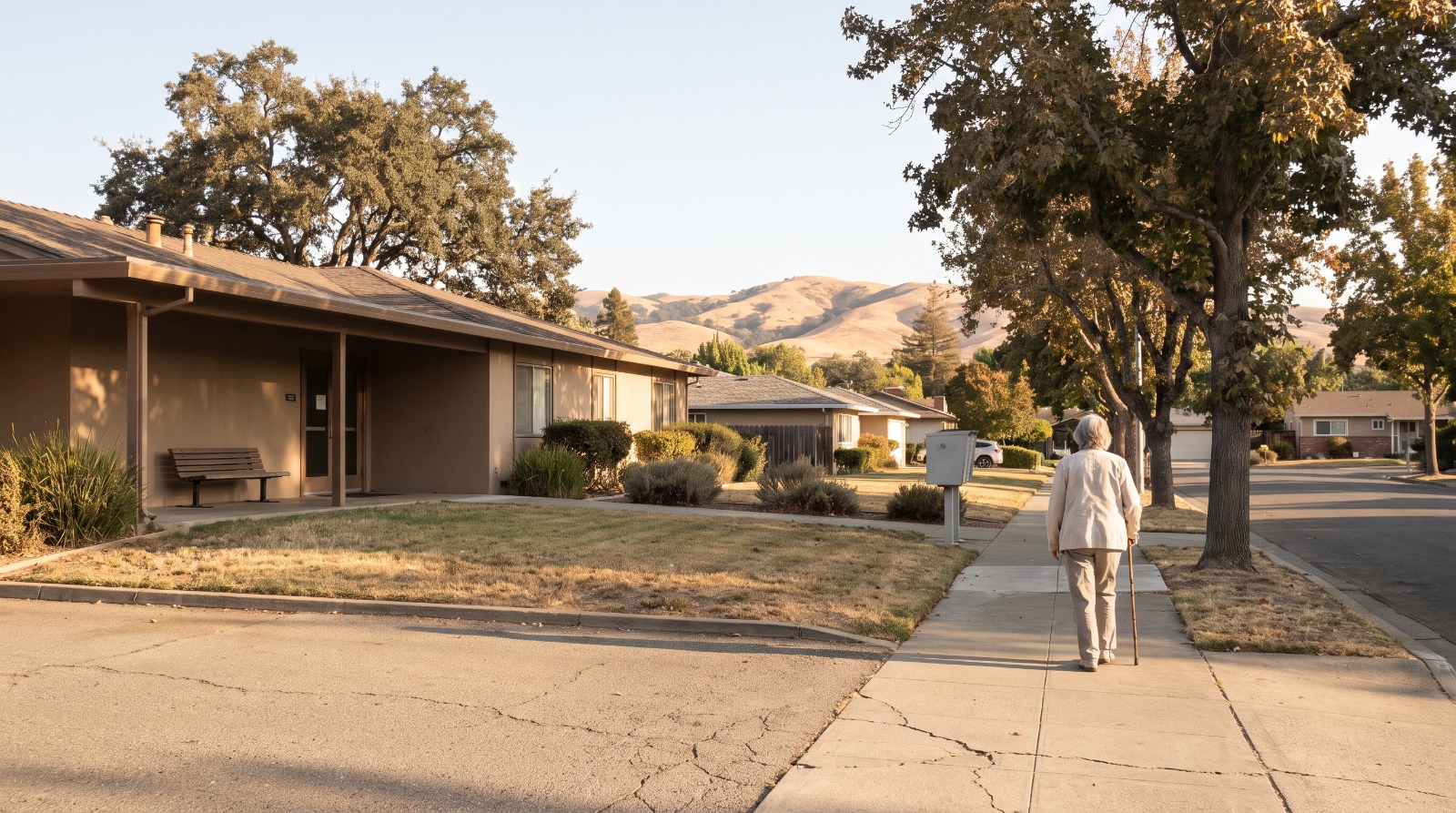
A quiet stretch of Golf Club Road in Pleasant Hill, Contra Costa County, near the site of 82 new affordable senior housing units funded by the state. Photo: Houseberry
Contra Costa County took $28.8 million out of a $109.6 million state round announced July 23, the single largest award in the batch. It funds 82 senior homes off Golf Club Road in Pleasant Hill, 62 of them reserved for older adults at risk of homelessness and 30 of those set aside for veterans.
Divide it out and the state is putting in about $351,200 per home. For Contra Costa senior housing, in a county where Pleasant Hill's median sat at $1.04 million in June 2026, that ratio is better than most people expect from a state housing program. It is also more complicated than a single division suggests, which we will get to.
What $28.8 million actually bought
The Governor's office announcement covered four projects producing 278 supportive homes. Lined up side by side, the state money per home looks like this:
| Where | Sponsor | State award | Homes | State $ per home |
|---|---|---|---|---|
| Sacramento | Urban Capital LLC | $31.9M | 100 | about $319,000 |
| Contra Costa County | Satellite Affordable Housing Associates | $28.8M | 82 | about $351,200 |
| Fresno | Parkway Prime LLC | $32.6M | 84 | about $388,100 |
| Bakersfield | Community Action Partnership of Kern | $14.1M | 30 | about $470,000 |
The interesting line is the Bay Area one. Statewide, Homekey+ has committed $968.4 million across 54 projects producing 2,749 homes, which averages roughly $352,000 each. Contra Costa came in at essentially that number. A Bay Area project landing at the statewide average is not the usual result when a state program crosses into the nine counties, and it is the most quietly encouraging thing in the announcement.
One important caveat before anyone runs with that figure. This is state money per home, not total development cost. Homekey+ is gap financing that stacks on top of tax credits, county contributions and other sources, and this same project already collected more than $6 million from the state's Veterans Housing and Homelessness Prevention Program back in 2021. Nobody builds an 82-unit building in Contra Costa for $351,000 a door. The number tells you what California is putting in, not what the building costs.
Where it lands, and what else is on the site
The address is 490 Golf Club Road in Pleasant Hill, near Diablo Valley College. It is not a standalone apartment building dropped onto a parcel. It is the housing piece of Choice in Aging's Aging in Place Campus, a four-acre site being subdivided into three parcels, with Satellite Affordable Housing Associates as developer and Perkins Eastman as architect.
The 82 units are 81 one-bedrooms plus a manager's unit, aimed at seniors earning 30 to 60 percent of area median income. Around them the campus rebuilds the Mt. Diablo adult day health center, which Choice in Aging has run in Pleasant Hill for decades, and a Montessori preschool that shares the site on purpose so the two ends of the age range run into each other. Completion is scheduled for February 2029.
For scale on the need: Contra Costa's point-in-time count on January 29, 2026 found 2,260 people experiencing homelessness countywide, up 7 percent from the year before. Sixty-two supportive homes does not solve that. It is sixty-two homes, and they are real.
What this does and does not mean if you are buying nearby
It does not move prices. Eighty-two deed-restricted senior units in a city whose median was $1.04 million is not a supply event, and anyone telling you otherwise in either direction is guessing. Pleasant Hill as a city scores 3.5 out of 5 overall on Houseberry, with safety its strongest factor at 3.9 and schools and amenities both at 3.4. Inside the city the spread is wide, from Boyd at 4.1 down to Sherman Acres at 2.3 across the Pleasant Hill neighborhood rankings. None of that shifts because of this award.
Two things it does mean. First, state money for senior and supportive housing is visibly pointed at Contra Costa right now. This is the second such project in the county to hit a deadline in a week, after the Walnut Creek senior housing measure that lands by August 7, and it follows the state's consolidation of housing funding under its new housing and homelessness agency on July 1. If you are tracking where the county's next few hundred units come from, that is the pipeline.
Second, February 2029 is a long time. Anyone buying within a few blocks of Golf Club Road is buying next to an active construction site for roughly the next two and a half years. That is a knowable, checkable thing, and it belongs in the same column as the commute and the roof age rather than being discovered after the offer.
For what it is worth, a health center, a preschool and 82 affordable senior apartments sharing four acres is a better use of that ground than nearly anything else that could go there.
Four quick answers
Is this supportive housing or regular affordable senior housing?
Both. Sixty-two of the 82 units are Homekey+ units for seniors at risk of homelessness with behavioral health needs, and 30 of those are reserved for veterans. The rest is affordable senior housing at 30 to 60 percent of area median income.
Where does the money come from?
Proposition 1, the $6.4 billion behavioral health bond California voters approved in 2024. Homekey+ is the housing arm of it, administered by the state Department of Housing and Community Development.
When could someone actually apply to live there?
Not for a while. Completion is scheduled for February 2029, and the developer currently lists the waitlist as closed. Affordable senior lotteries typically open closer to a year before move-in.
Does affordable housing nearby change what a home is worth?
The research on this is mixed and no single blog paragraph settles it, so we will not pretend to. The more useful question for a buyer is narrower and answerable: what is the site like during construction, and what does the finished thing put on the block? Here that is a health center, a preschool and homes for people who already live in this county.
Sources
- Office of the Governor: $109.6 million in Prop 1 funding for 278 supportive homes
- California HCD: Homekey+ July 2026 awards
- Satellite Affordable Housing Associates: Choice in Aging Redevelopment
- Choice in Aging: Aging in Place Campus
- Local News Matters: Contra Costa homeless count rises 7% to 2,260 people
- Houseberry: Pleasant Hill city guide and median price
All information provided on this website including but not limited to - school ratings, safety, amenities, user opinions, and property data - is for general informational purposes only. We do not guarantee its reliability, accuracy, or completeness. Users should independently verify information and consult appropriate professionals as needed. By using this website, you agree Houseberry is not responsible for actions, decisions, or consequences arising from reliance on the information provided
houseberry.com - CA DRE# 01847391
 Bay East ©2025. CCAR ©2025. bridgeMLS ©2025. Information Deemed Reliable But Not Guaranteed. This information is being provided by the Bay East MLS, or CCAR MLS, or bridgeMLS. The listings presented here may or may not be listed by the Broker/Agent operating this website. This information is intended for the personal use of consumers and may not be used for any purpose other than to identify prospective properties consumers may be interested in purchasing. Data last updated at September 14, 2026 12:00 AM