Walnut Creek's Senior Housing Vote Lands by August 7
A developer-backed initiative would rezone 2.4 acres across from Walnut Creek BART for 200-plus senior homes. The council either adopts it or sends it to November, and the deadline is August 7.
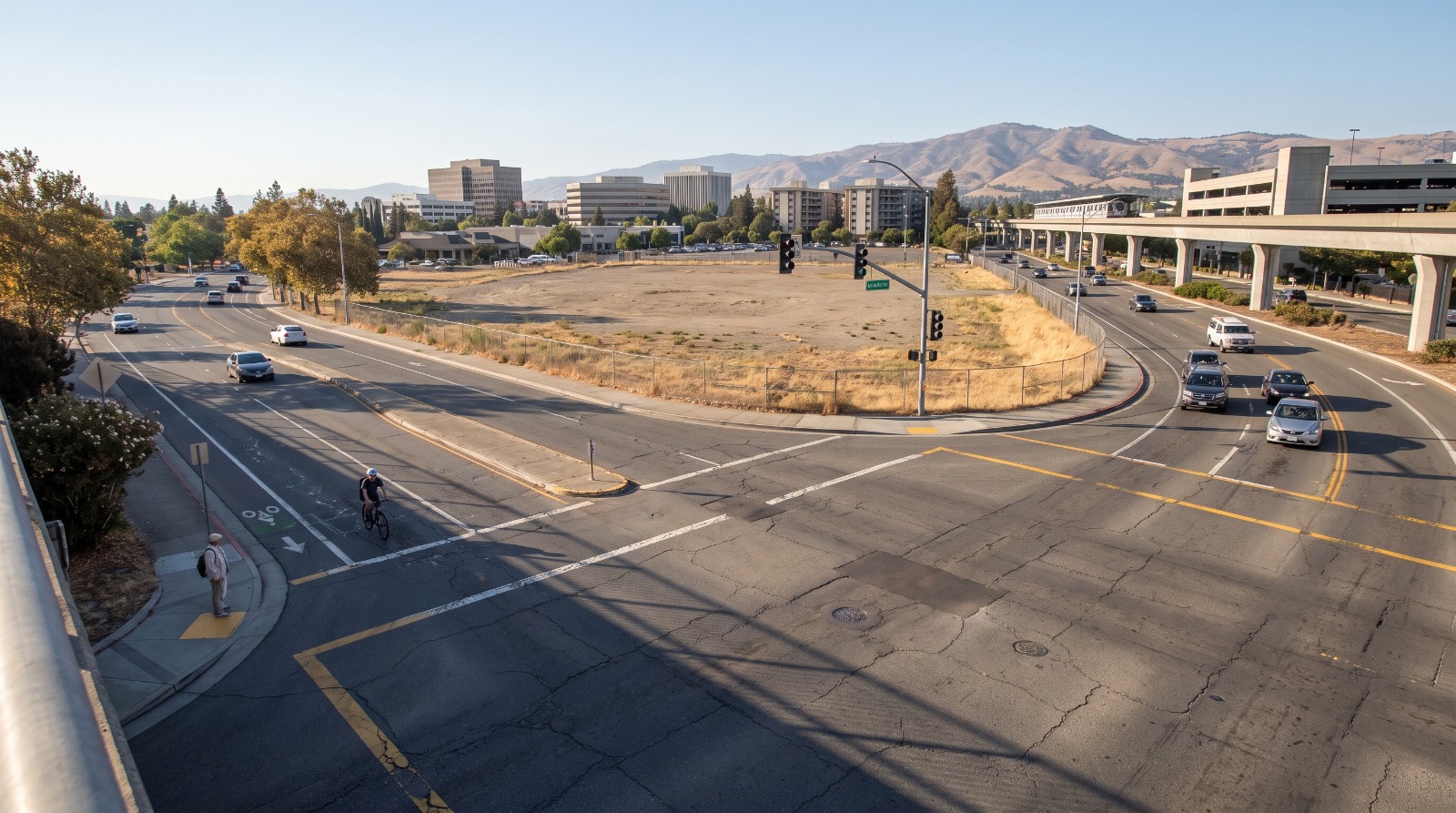
The North California Boulevard and Ygnacio Valley Road area across from Walnut Creek BART, the site proposed for senior housing under a rezoning initiative. Photo: Houseberry
Walnut Creek has until August 7 to decide whether its voters get a say on 2.4 acres.
That is the real deadline buried in the Senior Housing Transit Village Initiative, which qualified for the ballot in June and came to the city council on July 21. The council has exactly two legal options. Adopt the initiative as written, in which case the rezoning simply becomes law. Or pass a resolution by August 7 placing it on the November 3 ballot and let the campaign happen. There is no third door, no amending it, no sending it back to staff for a study session.
Read that last line again. The measure qualified by thirteen signatures, which is about as thin as a citizen initiative gets, on the fastest signature drive in the city's history. Both of those things are true at once and they say something about how this campaign was run.
City staff put the fiscal picture at $257,000 to $552,000 a year in new municipal revenue if it gets built, against $66,000 to $83,000 a year in costs, plus a one-time $6.4 million to $7.7 million in affordable housing in-lieu fees.
Ballot-box zoning, pointed the other direction
Here is what makes this worth writing about beyond Contra Costa County.
For thirty years in California, the citizen initiative has mostly been a tool for stopping buildings. Urban limit lines, height caps, growth-control measures, voter-approval requirements for anything over three stories. Walnut Creek has its own history with that instrument. What is happening here is the same machinery aimed the opposite way: a developer-funded signature campaign to zone a parcel for housing, going around a discretionary approval process rather than into it.
I am not going to pretend that is a pure exercise in civics. Hall Equities is the largest funder and the parcel is the point. But I also cannot pretend the alternative was working. Two hundred homes on a hard corner across from a BART station is the single most obviously correct place to put housing in central Contra Costa County, and the fact that getting there required 7,248 signatures in 25 days rather than a planning commission hearing is a comment on the entitlement process, not on the signature gatherers.
Why this specific corner is the one that matters
Our own scoring makes the case better than the campaign literature does.
Downtown Walnut Creek scores 4.5 out of 5 on amenities, the highest of the 30 Walnut Creek neighborhoods we rank. It also lands 24th of 30 on overall score at 3.4, dragged by a 2.3 safety score, with schools at 4.3 and a median around $1.07 million as of May 2026. So the tradeoff downtown is real and it is not hidden.
Now compare it to how Walnut Creek actually houses older residents today. Rossmoor, the 1,800-acre gated 55-plus community on the other side of town, scores 3.4 on amenities. It is a lovely place with golf and a shuttle, and it is also a car trip from everything, which is why it launched an autonomous shuttle pilot a couple of years back. That is the existing model: age-restricted housing in the part of town with the fewest walkable destinations.
The initiative proposes the inverse. Homes in the one district where you can reach a pharmacy, a grocery store, a movie theater, and a BART platform without driving, on a parcel where somebody would otherwise eventually build another office building nobody needs. When we talk about researching the neighborhood before the address, this is the kind of distinction we mean. The unit count is the least interesting number in the file. The walk radius is the whole thing.
What happens next
Watch for the resolution on the council's agenda between now and August 7. If it lands, Walnut Creek spends the fall arguing about 2.4 acres, and Contra Costa County voters will see the measure on November 3 alongside the regional transit measure that decides whether the BART station across the street keeps its current service, which we covered when the state wrote a $590 million emergency loan to buy the agencies time. If no resolution appears, the council took the shorter path and adopted it, and the rezoning is done without a campaign.
Either way this is the second transit-adjacent fight in central Contra Costa in a month. Lafayette broke ground on a seven-story building next to its own BART station in July, in a city that spent decades insisting it did not do buildings like that. Something is moving in the 680 corridor, and it is moving faster than the entitlement calendars were built for. If you are comparing East Bay neighborhoods right now, the downtowns next to the stations are the ones to watch, and how Walnut Creek's neighborhoods rank is a reasonable place to start.
Sources
- Contra Costa News: Walnut Creek City Council set to talk transit village initiative
- Contra Costa News: Walnut Creek senior housing initiative moves forward following record signature effort
- Friends of Walnut Creek Senior Housing
- Houseberry: Downtown Walnut Creek neighborhood guide
- Houseberry: Top Walnut Creek neighborhoods by amenities
All information provided on this website including but not limited to - school ratings, safety, amenities, user opinions, and property data - is for general informational purposes only. We do not guarantee its reliability, accuracy, or completeness. Users should independently verify information and consult appropriate professionals as needed. By using this website, you agree Houseberry is not responsible for actions, decisions, or consequences arising from reliance on the information provided
houseberry.com - CA DRE# 01847391
 Bay East ©2025. CCAR ©2025. bridgeMLS ©2025. Information Deemed Reliable But Not Guaranteed. This information is being provided by the Bay East MLS, or CCAR MLS, or bridgeMLS. The listings presented here may or may not be listed by the Broker/Agent operating this website. This information is intended for the personal use of consumers and may not be used for any purpose other than to identify prospective properties consumers may be interested in purchasing. Data last updated at September 13, 2026 12:00 AM