Do Data Centers Hurt Home Values? What Host Towns Say
A new national study found no meaningful effect on home values near data centers. The more useful finding is who is hosting them now, and what those communities are actually paying.

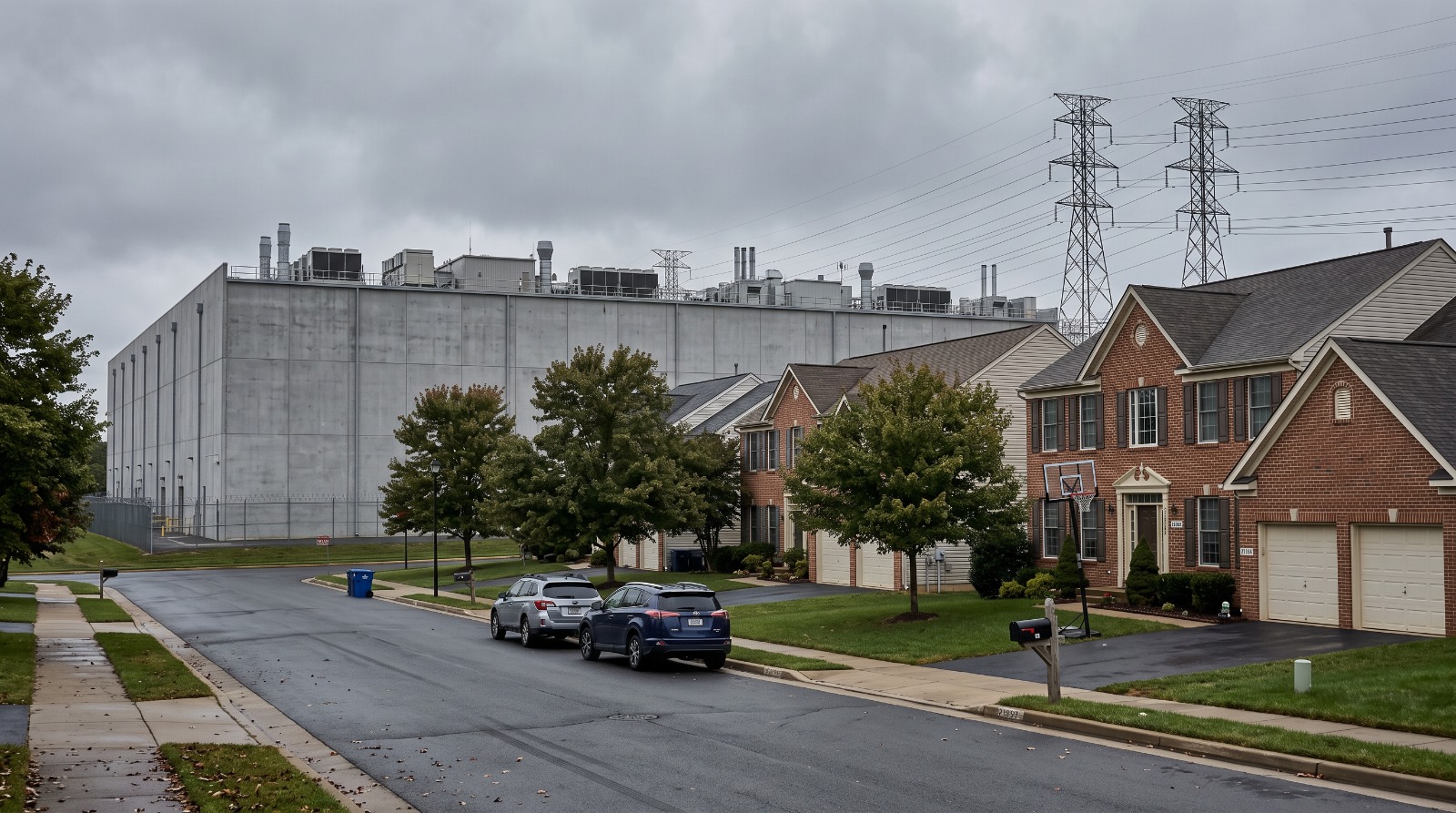
Suburban houses in Ashburn, Virginia with a data center building and high-voltage transmission towers rising directly behind them, the setting for the question of whether data centers hurt home values. Photo: Houseberry
Do data centers hurt home values? The best evidence available says no, and the study that says so is a week old. On August 11, Realtor.com's economics team published an event study of 43 ZIP codes that received a large data center between 2019 and 2025, matched against comparable ZIP codes. Home values in them moved in line with the comparisons. Chief economist Danielle Hale's line was that "a new data center wasn't associated with higher or lower home values."
That is the answer to the question most people are typing into Google. It is also the least interesting number in the report.
The one that matters is who lives near these things now. In 2023, the typical ZIP code getting a large data center had household income 24.7 percent above the national median. In 2026 it is 2.1 percent below it. The 2027 pipeline sits 5.7 percent below.
Read those together. The facilities are getting bigger, moving farther out, and landing in places with fewer households and less money. Hale's co-author Glen Morgenstern said it plainly in the release: "New neighbors are farther from the city, tend to be lower-income, and usually have fewer resources on hand."
That is a siting strategy, and it is why the home-value question turns out to be close to the wrong one. Nobody in Coweta County, Georgia is arguing about resale comps. They are arguing about wells, transmission lines and the power bill.
Loudoun County is the version that worked, and it is still fighting
Loudoun County, Virginia, the county along the Dulles corridor west of Washington that hosts the densest data center cluster on earth, is the case the industry cites, and it is a good case. Data centers there generate 38 percent of general fund revenue while sitting on about 4 percent of commercial parcels, and the county's real property tax rate for 2026, 80.5 cents per $100 of assessed value, is the lowest in Northern Virginia after a decade of annual cuts.
Residents there are still unhappy. After a power failure on July 16, 2026, a Vantage campus in Ashburn ran its diesel generators and neighbors reported throat and lung irritation. Virginia's own legislative watchdog, JLARC, found in December 2024 that data centers emit low-frequency noise that "rarely violates ordinances but affects nearby residents' well-being," and projected a typical Dominion residential customer paying $14 to $37 more a month by 2040 because of data center load. In July 2026 Loudoun homeowners lost their fight at the State Corporation Commission over transmission lines routed past their houses.
Twenty miles south, Prince William County's Digital Gateway is dead. Thirty-seven buildings, fourteen substations, up to nine gigawatts, alongside the Manassas battlefield. The Virginia Court of Appeals voided the rezonings on March 31, 2026, the Board of Supervisors withdrew its defense two weeks later, and the developer dropped its final appeal on July 2. Elena Schlossberg of the Coalition to Protect Prince William County gave the fight its best line: "You don't see the cost until the wires arrive."
Abilene is the version San Francisco should read twice
Abilene, Texas, a West Texas city of roughly 130,000, got Stargate, the flagship OpenAI-linked AI campus, and became the closest thing America has to a controlled experiment in what an AI boom does to a housing market that does not also get the payroll.
KUT reported on August 12, 2026 that average rent in Abilene has reached about $2,600 a month, up nearly 50 percent in a year, against a HUD fair market rent of $1,020 for a one-bedroom with bills paid. The local homeless services agency says moving someone into housing has gone from about a month to as long as six. The campus brought 9,000 construction jobs and will leave about 1,000 permanent ones, on an 85 percent tax abatement, for an estimated $30 million a year to the city.
The quotes are the part worth sitting with. Lexi Smith, a teacher who had paid her house off: "Our house has no more residential value. If we were ever able to sell, it would be purely commercial." Diana Luna, running for local office: "If we're supposed to be in this economic boom, where is the money?"
Anyone who has watched a Bay Area neighborhood get repriced by a nearby employer knows that shape. The difference is that here the wages land on roughly the same ZIP codes they displace. In Abilene they do not.
The power bill is what actually turned the country
PJM Interconnection runs the capacity market for 13 states and the District of Columbia. Its capacity price went from $28.92 per megawatt-day for the 2024/2025 delivery year to $269.92, then $329.17, then $333.44, then $325.00 for 2028/2029, three consecutive auctions clearing at the regulatory cap. PJM's own independent market monitor, Joe Bowring, calculated in July 2026 that data centers drove $6.3 billion of the latest $16.4 billion auction, and $29.4 billion of $63.6 billion across the last four. His comment was that PJM "is continuing to act like it's business as usual" when "it is really a paradigm shift."
Households feel that arithmetic. NRDC's analysis puts a typical PJM family at roughly $70 a month more by 2028. Virginia's State Corporation Commission approved a Dominion increase of about $16 a month for 2026 while cutting $350 million from the request for speculative data center projects, and created a separate rate class for customers above 25 megawatts starting January 1, 2027.
The honest counterweight is real. EPRI found that where grids had slack capacity, large new customers spread fixed costs across more sales and pushed rates down, and that average residential rates in the average state would have been about 6 percent higher without the data centers built between 2019 and 2024. Brattle Group's Ryan Hledik drew the line cleanly, noting that the states that saw decreases "already had room on their power grid." PJM did not have room. That is the entire difference.
What five host communities actually got
Put the deals side by side and the pattern is about leverage rather than luck.
| Community | What arrived | What it brought in | What residents are living with |
|---|---|---|---|
| Loudoun County, Virginia | 200-plus operating facilities, 100-plus in the pipeline | 38 percent of general fund revenue, the lowest property tax rate in Northern Virginia | Diesel generator fumes, low-frequency noise, and a lost transmission line fight in July 2026 |
| Abilene, Texas | The Stargate AI campus | About $30 million a year, on an 85 percent abatement, for 1,000 permanent jobs | Average rent near $2,600, up almost 50 percent in a year |
| Coweta County, Georgia | Project Sail, about 830 acres, $17 billion | Approved on a 3 to 2 county vote in July 2025 | A county moratorium in May 2026 and a lawsuit from 19 residents over wetlands and groundwater |
| Southaven, Mississippi | Gas turbines powering xAI's Colossus 2 | Power for a Memphis-area AI cluster | An NAACP Clean Air Act lawsuit filed April 14, 2026 over unpermitted turbines |
| Santa Clara, California | 55 operating data centers | About $40.9 million a year, the city's third-largest general fund source | A municipal grid at capacity, and a median home price around $1.97 million |
The last row is the outlier, and it is the one Bay Area readers should look hardest at. Santa Clara owns its own electric utility, set its own terms, and stopped when the grid filled. Coweta County had none of that.
Public opinion moved faster than the buildout
Four pollsters, four methodologies, one direction. Gallup in March 2026 found 71 percent of Americans opposed to a data center in their area. Heatmap and Embold Research in May, surveying 4,118 registered voters, also found 71 percent opposed, including 63 percent of Republicans and 78 percent of Democrats. Reuters and Ipsos in June found only 14 percent comfortable with one nearby. Penn's Annenberg center measured opposition at 61 percent in July, up 12 points in four months.
Heatmap's own trend line is the striking part. September 2025: 43 percent support against 42 percent opposed. May 2026: 71 percent opposed. Penn's Matt Levendusky called it "almost the antithesis of a partisan issue."
It is showing up in decisions, not just surveys. Data Center Watch counted 75 projects worth about $130 billion blocked or delayed in the first quarter of 2026 alone, with opposition groups active in 49 states and their number growing from 396 to 833 in three months. New York became the first state with a hyperscale moratorium on July 14, 2026. Monterey Park, in Los Angeles County, became the first American city to ban data centers permanently, by popular vote. Roughly a third of Indiana's 92 counties now restrict them.
Why almost none of this is happening in the Bay Area
Because the grid here is full and the land is expensive.
Silicon Valley added 25.2 megawatts of data center capacity in the year to June 2025 and sits at 484.4 megawatts total. Atlanta added 969 megawatts in the same window, and Northern Virginia has roughly seven times Silicon Valley's capacity. CBRE's Bill Dougherty put it bluntly: "There's lots of reasons not to put data centers in California, from a cost perspective and an energy supply perspective." Finished buildings near San Jose airport sit empty waiting on power that may be years out.
Santa Clara is the exception, and it is instructive. Silicon Valley Power, the city-owned utility, states on its own site that 53 percent of its power use and sales go to data centers. Fifty-five facilities operate there, the peak sits around 720 megawatts, and the utility holds requests for 500 more it cannot serve until upgrades finish in 2028.
And the neighborhoods are fine. Santa Clara's median home price was about $1.97 million in July 2026, and on Houseberry the city scores 3.5 overall with a 3.4 for safety, ahead of most of the East Bay, with its strongest neighborhoods past 4.0. Hosting the densest data center concentration in California has not cost Santa Clara anything a buyer would notice.
What Bay Area readers should take from this
Our housing market sits downstream of this buildout in a way most people here have not priced in. CBRE counts $578 billion of AI venture capital raised since 2019, with roughly 80 percent of it landing in the Bay Area. That money is why San Francisco rents are climbing faster than any other large American city's and why the top of the market keeps clearing over asking. The megawatts that make it possible are being installed in Loudoun, Abilene, Coweta County and Southaven.
Which makes those fights our business, and worth reading as something other than noise. Almost none of the objections are about the buildings being ugly. They are about a $70 monthly bill increase, unpermitted gas turbines outside Memphis, 29 million gallons of unauthorized water use in Fayette County, Georgia, and abatements worth more than a million dollars per permanent job. Those are pricing arguments, and most of them are correct.
We think more of this infrastructure should get built, for the same reason we think more housing should get built. But the deals have been bad in a fixable way. Developers have not been made to carry the full cost of the power they need, and small counties have handed over abatements far out of proportion to the jobs. Ohio and Virginia started fixing that with large-load tariffs and minimum-take contracts, and the result is telling: once Ohio made data centers commit, roughly 30 gigawatts of stated interest turned into 5.6 gigawatts of signed contracts. Most of the demand was never real.
The honest downside is that stricter terms push some projects toward states with weaker rules and cheaper power, which is worse for everyone including the climate. That trade is real. It still beats the current arrangement, where the cheapest place to build is wherever residents have the least ability to say no.
What people ask us about data centers and home values
Will a data center lower my home value?
On average, the current evidence says no. Realtor.com's August 2026 study of 43 ZIP codes found values moving with matched comparisons, and county-level work from NBER and Brookings finds small increases in the 2 to 5 percent range. The evidence is thinner for the very largest facilities at close range, so treat "no effect" as an average rather than a promise about the house across the fence line.
What should I check before buying near a proposed one?
The megawatt figure and the cooling design, both of which are in the planning file. Megawatts drive the backup generator count and the transmission needs. Cooling drives water use and noise. A 20-megawatt building in an existing industrial corridor is a different animal from a 500-megawatt campus on farmland.
Are data centers loud, and do they lower my property taxes?
The recurring complaint is low-frequency noise from cooling equipment, which JLARC found "rarely violates ordinances" while still affecting residents. Indianapolis's proposed rules use a 400-foot buffer and a 65-decibel cap at the property line, a fair benchmark to hold your own city to. On taxes, Loudoun is the one county in America that has demonstrably cut its rate on data center revenue. Most host communities granted abatements instead, so the revenue arrives years after the traffic and the transmission lines do.
The meeting that matters here is on Wednesday
San Jose is where this lands closest to home. The city has 20 data centers operating, 6 under construction and 5 working through approvals, and residents pushed the Rules and Open Government Committee this month for an emergency moratorium. Mayor Matt Mahan pushed back, saying the city cannot "just bury our heads in the sand, say 'no' and push the jobs and industries of the future to states with fewer environmental safeguards," and also cannot "allow unfettered growth without protecting the people and places that will be impacted." That is roughly the right frame.
The first community listening session is August 19 at City Hall, and the new standards, which would attach community benefits like affordable housing funding to approvals, reach the City Council in December. If you own in San Jose, that December meeting is the one to watch. We looked at one specific version of this question in July when Prologis filed for a 500,000 square foot facility next to Silver Creek, and the same two numbers still decide it: megawatts and who pays for them.
Sources
- Realtor.com Economic Research data center report, August 11, 2026, via PR Newswire and RISMedia
- Virginia JLARC, Data Centers in Virginia, December 2024: jlarc.virginia.gov
- Loudoun County data center tax revenue FAQ: loudoun.gov
- American Battlefield Trust on the Prince William Digital Gateway, July 2026: battlefields.org
- KUT, Abilene and the Stargate data center, August 12, 2026: kut.org
- Utility Dive on PJM's independent market monitor, July 2026: utilitydive.com
- Marketplace on the EPRI findings, July 10, 2026: marketplace.org
- Gallup, Americans Oppose Data Centers in Their Area, March 2026: gallup.com
- Heatmap and Embold Research polling, May 2026: heatmap.news
- Data Center Watch, Q1 2026 report: datacenterwatch.org
- TIME on Coweta County's Project Sail, July 22, 2026: time.com
- NAACP lawsuit against xAI, April 2026: naacp.org
- Silicon Valley Power data center page: siliconvalleypower.com
- San Jose Spotlight on the moratorium push, August 15, 2026: sanjosespotlight.com
- CBRE on AI office leasing and venture capital, May 12, 2026: cbre.com
- Houseberry city and neighborhood price histories and scores, retrieved August 18, 2026.
The Houseberry Research Team is Houseberry's reporting team: Bay Area real estate analysts, data specialists and longtime local market watchers. Every day we check the public record: building permits, city council and planning agendas, county recorder filings, state housing bills, police incident data and school results. Then we tie each story to what it means for specific neighborhoods, using Houseberry's own neighborhood data on prices, appreciation, safety, schools and amenities. Questions or corrections: Contact us.
All information provided on this website including but not limited to - school ratings, safety, amenities, user opinions, and property data - is for general informational purposes only. We do not guarantee its reliability, accuracy, or completeness. Users should independently verify information and consult appropriate professionals as needed. By using this website, you agree Houseberry is not responsible for actions, decisions, or consequences arising from reliance on the information provided
houseberry.com - CA DRE# 01847391
 Bay East ©2025. CCAR ©2025. bridgeMLS ©2025. Information Deemed Reliable But Not Guaranteed. This information is being provided by the Bay East MLS, or CCAR MLS, or bridgeMLS. The listings presented here may or may not be listed by the Broker/Agent operating this website. This information is intended for the personal use of consumers and may not be used for any purpose other than to identify prospective properties consumers may be interested in purchasing. Data last updated at October 23, 2026 12:00 AM