Fed Holds Rates. What Bay Area Buyers Actually Pay
The Fed left rates alone on July 29 with three officials dissenting in favor of a hike. Here is what that does, and does not do, to a Bay Area mortgage payment.
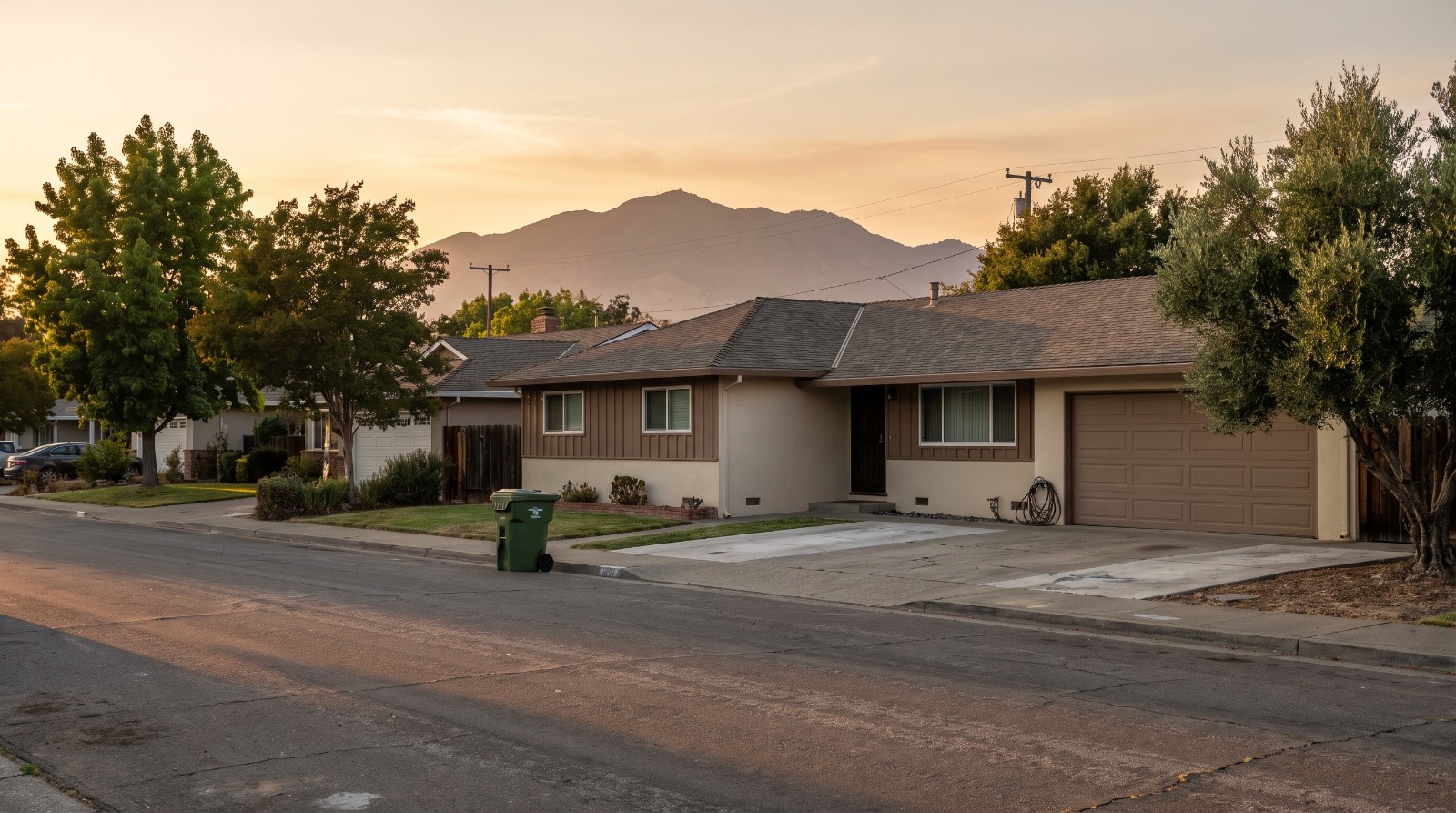
A Concord ranch house at golden hour with Mount Diablo behind, in the East Bay market where Bay Area mortgage payment math after the Fed rate decision plays out. Photo: Houseberry
Three Fed officials voted to raise interest rates on Wednesday. They lost, nine to three, and the federal funds rate stayed right where it was at 3.50 to 3.75 percent. If you are shopping for a house here, the useful thing to know about the Fed rate decision is that it did not move your Bay Area mortgage payment, and it was never going to.
Those are two different numbers that happen to share a news cycle. The 30-year fixed averaged 6.58 percent last week. It was 6.55 percent the week before and 6.74 percent a year ago. Rates ticked up in a week the Fed did nothing at all. That is a fair summary of the entire relationship.
The 9-3 split is the actual story
The FOMC statement says economic activity is expanding at a solid pace, job gains have kept pace with the workforce, and inflation is still elevated relative to the Committee's 2 percent goal, partly because of supply shocks in energy. Beth Hammack, Neel Kashkari, and Lorie Logan all voted against the hold. All three wanted a quarter-point increase.
Three dissents on the hawkish side is unusual, and it is the part worth filing away. It says a meaningful minority of the committee thinks the next move is up rather than down.
The other change is procedural and matters more than it sounds. Chair Kevin Warsh has stripped forward guidance out of the post-meeting statement entirely. No signal about the path. No hints about the next few meetings. If your house-buying plan was built around a date the Fed was going to hand you, you are not getting one anymore.
The Fed does not set your mortgage rate
The federal funds rate is what banks charge each other overnight. Your 30-year fixed tracks the 10-year Treasury and the market for mortgage-backed securities, which respond to inflation expectations and to whatever is happening in the world that week. Right now that includes Brent crude spiking on Middle East escalation, which pushed Treasury yields up and dragged mortgage rates along with them, Fed hold or not.
Jay Lessard of Sonoran Lending put the buyer side of it plainly in Mortgage Professional America: "Clients aren't necessarily calling about the Fed decision. What we're seeing is a growing number of buyers reaching out to prepare for homeownership." That is the correct instinct.
What a quarter point actually costs at three Bay Area price points
Here is the math nobody runs for you. Principal and interest only, 20 percent down, 30-year fixed, using our own current median prices for three very different markets. Concord's median was about $794,790 in June 2026, and you can see the full Concord price picture alongside its scores.
| Market (Houseberry median) | At 6.50% | At 6.75% | At 7.00% | Quarter point costs |
|---|---|---|---|---|
| Concord, $794,790 (Jun 2026) | $4,019 | $4,124 | $4,230 | about $105 a month |
| San Francisco, $1.33M (Jun 2026) | $6,725 | $6,901 | $7,079 | about $176 a month |
| San Mateo, $2.21M (Jun 2026) | $11,175 | $11,467 | $11,763 | about $292 a month |
Now look at the table sideways instead of across. Moving from 6.50 percent to 7.00 percent costs a Concord buyer about $211 a month. Moving from Concord to San Mateo at the same rate costs about $7,156 a month. The interest rate is the small number on that grid. The place is the enormous one.
Those figures are principal and interest only, which is the number lenders quote and the number that flatters everybody. Add property tax and insurance and the San Francisco median at 6.58 percent carries closer to $8,477 a month, and San Mateo lands around $14,031. Run your own numbers with taxes in them before you fall for a quoted payment.
Waiting has a price too, and it is bigger than the rate
The reasonable case for patience is that rates drift down. Lessard allows for it: "If inflation continues to trend lower and the economy slows without a significant resurgence in price pressures, we could see mortgage rates ease somewhat before year-end." He allows for the opposite in the same breath, which is honest of him. Our read of the 2026 mid-year housing outlook landed in the same place, with forecasts clustered in the 6.0 to 6.5 percent range through December.
So call it a quarter point of upside. On the San Francisco median that is $176 a month. Meanwhile a 3 percent move in the price of that same house is roughly $40,000. In a region where the medians swing by six figures between one city and the next, rate timing is the smallest lever you are pulling.
And Sam Khater of Freddie Mac keeps making the boring point that actually pays: "Shopping around for a mortgage rate can make a meaningful difference, potentially saving them thousands over the loan's lifetime." Three quotes instead of one is worth more than a Fed meeting.
Where the rate genuinely decides something
Rate sensitivity scales with the size of the loan, so the buyers most exposed to a quarter point are the ones already writing the biggest checks. At the affordable end of the East Bay's ranked neighborhoods by price, where Elmhurst Park in Oakland sits near $198,693 and Ralph Bunche near $249,999, a quarter point moves the payment by roughly $26 to $33 a month. That is not what is keeping those buyers out. The down payment is.
Which is the whole reason we look at neighborhoods before addresses. The rate is set in Washington and traded in New York. The number that actually determines what you pay every month for thirty years gets decided when you pick a zip code, and unlike the Fed, that one is yours.
Sources
All information provided on this website including but not limited to - school ratings, safety, amenities, user opinions, and property data - is for general informational purposes only. We do not guarantee its reliability, accuracy, or completeness. Users should independently verify information and consult appropriate professionals as needed. By using this website, you agree Houseberry is not responsible for actions, decisions, or consequences arising from reliance on the information provided
houseberry.com - CA DRE# 01847391
 Bay East ©2025. CCAR ©2025. bridgeMLS ©2025. Information Deemed Reliable But Not Guaranteed. This information is being provided by the Bay East MLS, or CCAR MLS, or bridgeMLS. The listings presented here may or may not be listed by the Broker/Agent operating this website. This information is intended for the personal use of consumers and may not be used for any purpose other than to identify prospective properties consumers may be interested in purchasing. Data last updated at September 13, 2026 12:00 AM