Hunters Point Homeowners Lose Their Property Value Claim
A federal judge ruled that a nuclear liability statute bars more than 300 Parcel A homeowners from suing over their property values. What the ruling changes, and what it does not, for anyone looking at Bayview.
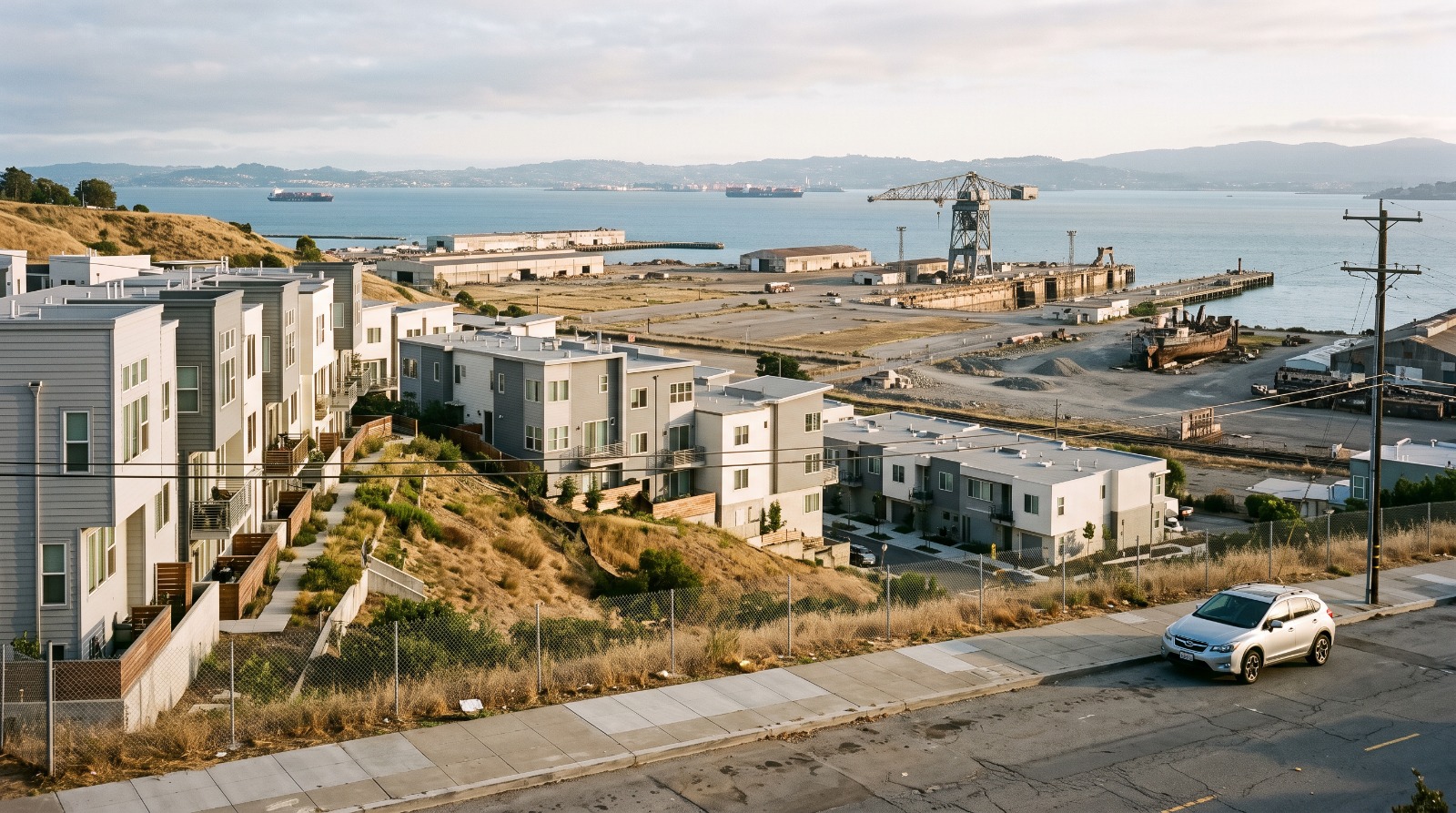
Townhomes on Parcel A of the Hunters Point shipyard in San Francisco, with the old naval shipyard flats and the bay behind them. Photo: Houseberry
The federal law that just ended more than 300 Bayview homeowners' case against a Navy cleanup contractor was written for reactor accidents. On Tuesday, August 5, 2026, U.S. District Judge James Donato ruled that the Price-Anderson Act, the statute Congress passed to channel liability from nuclear incidents, bars the Parcel A homeowners at the San Francisco Shipyard from suing Tetra Tech EC over what their homes are worth.
Their lawyers argued the law was built for a Three Mile Island, not for a contractor accused of faking soil samples on a hillside where the city then let people buy condos. The judge went with the statute.
Three things to hold onto before the rest of this.
- The ruling is about a legal remedy, not a health finding. Nothing in it says Parcel A is contaminated. The EPA reaffirmed in a November 2020 memorandum that Parcel A is suitable for residential use.
- Every federal route to money has now closed, each by a different doctrine. Sovereign immunity closed one, a settlement closed another, and this week a nuclear liability statute closed the third.
- The redevelopment keeps moving anyway. Infrastructure work on the Candlestick Point half of the project starts next month.
The law that closed the door was built for reactor accidents
Price-Anderson channels claims arising from a nuclear incident into a single federal cause of action, and that action compensates bodily injury caused by radiation. Economic loss is not the kind of harm the statute was built to pay for. The argument that your house is worth less because the cleanup behind it was falsified, however reasonable it sounds standing on Innes Avenue, is an economic loss argument.
Plaintiffs' attorney Anne Marie Murphy called the outcome "tragic," saying there are "300-plus families that have been injured very concretely by the Tetra Tech fraud as alleged in the complaint," SFist reported.
One caution on reading this. The reporting covers the property value claims. It does not say the case is over in every form, and Price-Anderson leaves a bodily injury lane open in principle. What died this week is the money-for-your-equity theory.
Four cases, four different federal doors, all shut
It is worth laying the litigation out side by side, because the shipyard story gets told as one lawsuit and it has never been one lawsuit.
| Case | Who brought it | Where it landed |
|---|---|---|
| Parcel A homeowners v. Tetra Tech EC | More than 300 homeowners, property value and economic loss | Aug 5, 2026: Price-Anderson bars the economic claims |
| Bayview residents' injury class v. Tetra Tech EC | About 6,500 opt-in plaintiffs | Settled for $1.5 million, approved Feb 17, 2026, a minimum of roughly $230 each, down from an original $27 billion demand |
| Abbey v. United States | San Francisco police officers who worked at the shipyard | Ninth Circuit affirmed dismissal Aug 20, 2024 under the FTCA misrepresentation exception |
| Greenaction v. U.S. Navy and EPA | Environmental justice group, CERCLA claims | July 2, 2025: two of three claims dismissed. The surviving claim is that the government missed mandatory five-year review deadlines |
Read down that right-hand column and the pattern is hard to miss. Nobody has lost on the facts. The fraud is not in dispute. What keeps happening is that a different piece of federal law turns out to stand between the people who live there and a check.
What the fraud actually was, and what it was not
The falsified paperwork is established, and it is not a gray area. Two former Tetra Tech supervisors, Stephen Rolfe and Justin Hubbard, were each sentenced to eight months in prison on May 2, 2018 for falsifying soil sample records at the shipyard, by the same judge who issued this week's ruling. In January 2025 the company agreed to pay the United States $97 million, $57 million under the False Claims Act and $40 million under CERCLA, without admitting liability.
The scale of the data problem is genuinely large. A Navy review across the 900-acre site found that about 48 percent of Tetra Tech's radiological data contained inconsistencies, and the EPA identified specific portions of the shipyard where between 90 and 97 percent of the data appeared suspect or manipulated.
Here is the part that gets flattened in every retelling. Falsified data is not the same thing as proven contamination. The 90 to 97 percent figure describes survey units where the records look wrong, not soil that has been shown to be hot. Parcel A, the piece with houses on it, was transferred to the City of San Francisco in December 2004 and was never used to handle radiological materials the way the working parcels were. Both of those things can be true at once, and the homeowners' claim was about fraud and disclosure rather than a finding under their foundations.
The 2024 plutonium episode fits the same shape. The Navy measured airborne plutonium-239 at roughly double the action level in November 2024 and did not tell San Francisco officials for 11 months. A UC Berkeley nuclear physics professor told SFist that concentrations around 1,000 times that level would be needed to cause cancer or radiation poisoning. The dose was not the story. The 11 months were.
Bayview trades at 53 cents on the citywide dollar
Bayview's median sale price was about $869,500 in July 2026, against a San Francisco citywide median of about $1.64 million the same month. That is roughly 53 percent of the city, a gap near $770,000 on the median house.
| Place | Median, July 2026 | Overall | Safety | Amenities | Rank of 92 |
|---|---|---|---|---|---|
| Bayview | $869,480 | 2.3 / 5 | 2.4 / 5 | 1.9 / 5 | 87th |
| Candlestick Point | $900,000 | 2.4 / 5 | 3.6 / 5 | 3.0 / 5 | 85th |
| Bayview Heights | $1.06M | 2.4 / 5 | 2.7 / 5 | 2.6 / 5 | 84th |
| San Francisco citywide | $1.64M | 3.4 / 5 | 3.9 / 5 | 3.3 / 5 | n/a |
Two warnings on that table before anyone builds a thesis on it. These are single-month medians on small transaction counts, and they bounce. Bayview Heights printed $445,840 in January 2026 and $1.32 million in May. Read the direction, not the decimal. And nothing in the court record or the safety scores across San Francisco establishes that the shipyard is what produces the discount.
Look at the amenities column instead. Bayview scores 1.9 out of 5 on amenities, near the bottom of all 92 neighborhoods we rank in the city. When the SF Standard visited Parcel A in March 2024 it found just over 500 people living there and the nearest grocery store 1.5 miles away. A neighborhood with no grocery store, thin transit and an unfinished superfund site on three sides is going to trade at a discount whether or not a contractor faked a soil log. The radiation story is the loudest explanation, not the largest one.
What a buyer out here should actually be reading
The useful documents are not the ones in the headlines.
- The disclosure packet, closely. The $6.3 million Lennar and FivePoint paid homeowners in 2022 settled claims about what buyers were told. Disclosure is the live issue here, and it is the one thing a buyer still has leverage over.
- The five-year reviews. Greenaction's surviving claim is that the government blew statutory deadlines on them. Those reviews are the periodic public check on whether a remedy is still working.
- Which parcel. Parcel A is a different legal and physical animal from the parcels still under Navy control. Anyone selling you on "the shipyard" as one place is not being precise enough to be useful.
This is the kind of question we built Houseberry around, and it is why we push people to look at the area before the address. A listing photo tells you nothing about whether the grocery store is a mile and a half away or whether the parcel across the fence has a cleanup schedule. Those answers live at the neighborhood level, and in Bayview's case they are more decisive than anything in the ruling.
September is the next date that matters
The redevelopment is not waiting for the litigation. Infrastructure work at Candlestick Point begins in September 2026, starting a first phase of roughly 700 homes. The full entitlement across Candlestick Point and Hunters Point Shipyard Phase 2 is 10,672 units on 693 acres, 3,348 of them affordable, with 337.7 acres of parks. Shipyard Phase 2 itself is not slated to start until 2038.
Set that against what exists. Fewer than 1,000 of those 10,672 entitled homes have been built, more than twenty years after the first parcel changed hands. In a city that finished 405 homes in the first half of this year, a 10,000-unit entitlement sitting mostly idle on the largest piece of developable land in San Francisco is its own kind of scandal, and a quieter one than the soil.
The next real markers are the September groundbreaking, the overdue five-year review, and whether Greenaction's deadline claim forces the Navy back onto a schedule. None of those will put money in a Parcel A homeowner's pocket. All three will do more to set what a home out there is worth in 2030 than this week's order did.
Sources
Courthouse News, Judge clears Navy contractor's $1.5 million settlement with Hunters Point residents
Courthouse News, Ninth Circuit upholds dismissal of police lawsuit over Hunters Point contamination
Courthouse News, Judge pares claims over Navy radioactive waste cleanup in San Francisco
San Francisco Standard, Tetra Tech $97 million shipyard settlement (Jan 17, 2025)
NBC Bay Area, Former Tetra Tech workers sentenced for falsifying records
City and County of San Francisco, Hunters Point Naval Shipyard Parcel A cleanup
SFist, Navy found high levels of airborne plutonium at Hunters Point (Oct 31, 2025)
San Francisco Standard, Who lives in this SF neighborhood with no grocery store (Mar 17, 2024)
GrowSF, Only 405 homes built in the first half of 2026 (Jul 31, 2026)
All information provided on this website including but not limited to - school ratings, safety, amenities, user opinions, and property data - is for general informational purposes only. We do not guarantee its reliability, accuracy, or completeness. Users should independently verify information and consult appropriate professionals as needed. By using this website, you agree Houseberry is not responsible for actions, decisions, or consequences arising from reliance on the information provided
houseberry.com - CA DRE# 01847391
 Bay East ©2025. CCAR ©2025. bridgeMLS ©2025. Information Deemed Reliable But Not Guaranteed. This information is being provided by the Bay East MLS, or CCAR MLS, or bridgeMLS. The listings presented here may or may not be listed by the Broker/Agent operating this website. This information is intended for the personal use of consumers and may not be used for any purpose other than to identify prospective properties consumers may be interested in purchasing. Data last updated at September 18, 2026 12:00 AM