Living Near Golden Gate Park During Outside Lands
JFK Drive closed to cars on August 3 for a festival that starts August 7. What living beside Golden Gate Park is actually like, festival weekend and the other 362 days of the year.
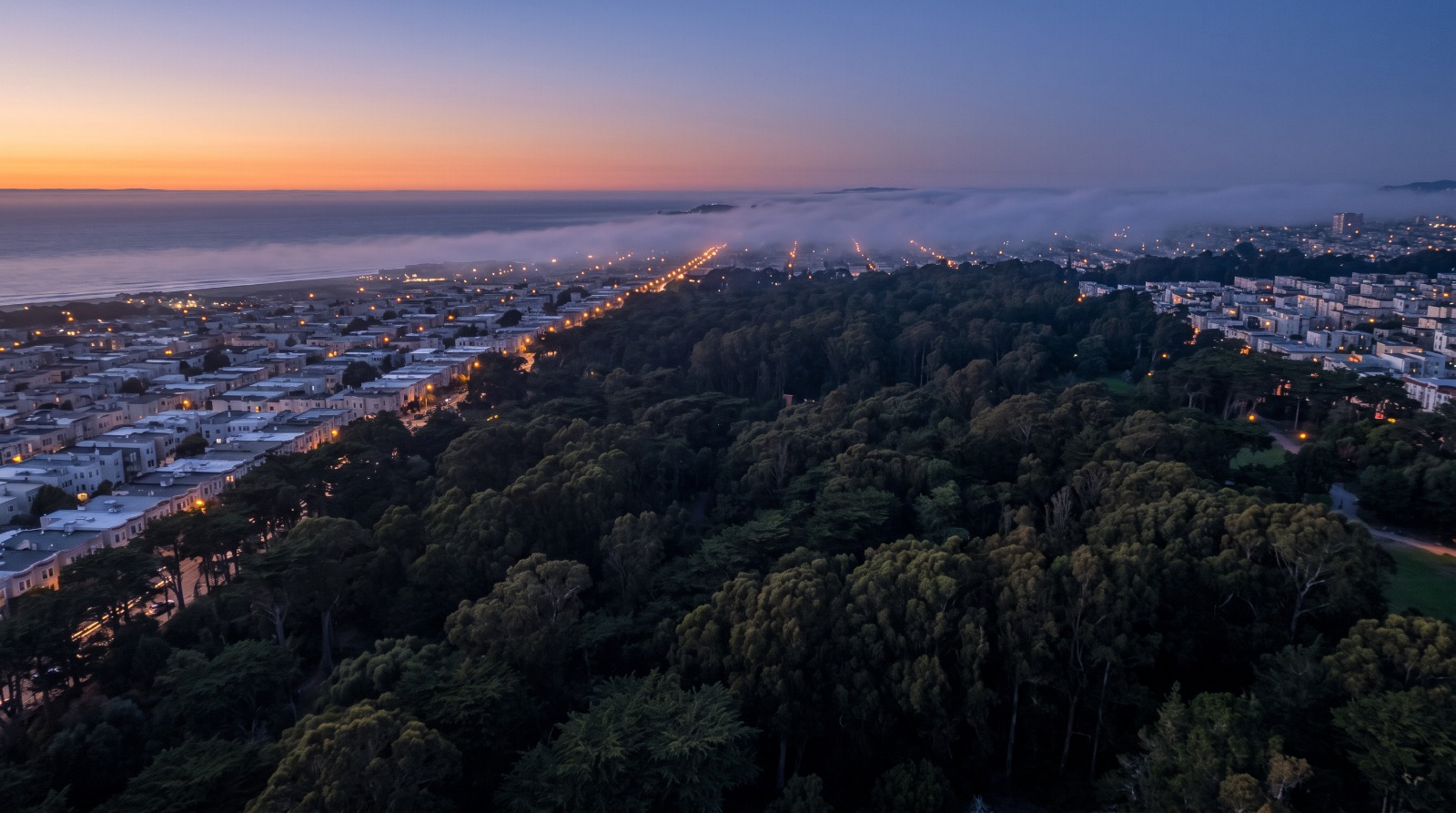
Dusk view over the Golden Gate Park tree canopy toward the Outer Sunset row houses with marine fog rolling in over the western avenues. Photo: Houseberry
The barricades went up on JFK Drive on Monday morning. The first note of Outside Lands does not sound until Friday afternoon. If you live on 30th and Fulton, that four-day gap is the part of the festival nobody outside the neighborhood ever hears about.
The short version, for anyone weighing a west-side address: Outside Lands closes a stretch of the park for roughly ten days to stage a three-day event, brings about 75,000 people a day into your neighborhood, and is audible from a mile away with no decibel cap in its permit. It has also paid the city's park system more than $49 million since 2008. The park it inconveniences you with for one week is the same park that makes these the highest-scoring neighborhoods in San Francisco on safety the other 51 weeks, and the reason a Sunset house costs what it does.
Both of those things are worth understanding before you sign anything within earshot of a main stage.
The road closures start four days early and end four days late
JFK Drive between Transverse and 36th Avenue closed to cars on Monday, August 3, and stays closed through the Wednesday after the festival. That is roughly ten days of closure for a three-day event, because load-in and load-out for a festival this size takes longer than the festival.
Every street inside the park footprint closes Friday at 11 a.m. and reopens Sunday at 11:59 p.m. On top of that there are blackout zones where no pick-ups or drop-offs are allowed at all, which is the rule most residents run into without knowing it exists.
| What | When | Where |
|---|---|---|
| JFK Drive car closure | Monday August 3 through the Wednesday after | Transverse to 36th Avenue |
| Park street closures | Friday 11 a.m. to Sunday 11:59 p.m. | All streets inside the festival footprint |
| No pick-up or drop-off zones | Friday and Saturday 9 to 11:30 p.m., Sunday 8:30 to 11 p.m. | Lincoln Way 25th to 41st, Fulton 26th to 37th, cross streets between |
| Extra N Judah trains | 3 p.m. to midnight, all three days | Full route |
| 5X Fulton Express | 9 p.m. to midnight | Golden Gate Park to Civic Center BART |
The transit response is genuinely good, and it is the reason the neighborhood is passable at all. SFMTA runs extra N Judah trains from 3 p.m. to midnight, adds 5R Fulton Rapid service in the afternoon, and runs a 5X Fulton Express from 9 p.m. to midnight for the post-show surge. A festival wristband works as an all-day Muni fare, which pushes a large share of that 75,000 onto trains rather than into your block.
Yes, you can hear it, and there is no decibel cap
Music from Outside Lands is audible about a mile from the venue, and the Board of Supervisors set no maximum volume when it extended the festival's permit through 2031. Instead, the operator places at least three sound monitors in surrounding neighborhoods and relays readings to production in real time.
What that means in practice depends almost entirely on where you are relative to a stage and which way the wind is running. Bass carries hardest north across Fulton into the Richmond and into the 20s and 30s avenues. One neighbor near 30th and Fulton described the house shaking. Three blocks south, in the numbered streets off Lincoln, people report a distant thump they stop noticing by Saturday.
The complaint record has actually improved over time. Noise complaints peaked at 384 in 2011 and were down to 212 by 2018. The 2025 run of Golden Gate Park concerts, four weekends of them, drew close to 100 calls to 311 in total. And a caveat worth stating: reporting on the 2026 permit debate noted at least one person filing the same complaint repeatedly, so raw counts overstate how many distinct households are actually bothered.
Where residents park, which is the real complaint
There is no official general parking for Outside Lands, and there never has been. SFMTA's own guidance is that parking will be extremely limited. Residents compete with 75,000 daily visitors for the same curb.
Blocked driveways are enforced on a complaint basis, meaning nobody tows the car in front of your garage unless you call it in. The festival historically staffs two tow trucks and a parking control officer on each side of the park, and there is a neighborhood hotline at (415) 965-8001 staffed during event days. Use 311 for towing. Residents in 2025 reported hunting for a spot for two hours or leaving the car most of a mile away.
This is the honest downside of the address, and it is not a small one. If you own a car and depend on street parking, three days a year are simply miserable, and starting in 2027 there will be more of them.
What the festival pays the park
Outside Lands has contributed more than $49 million to the San Francisco Recreation and Parks Department since 2008, which makes it the largest private funder of the park system in the city. That money does not go into a stage. It goes into the park maintenance budget that keeps the Botanical Garden, the playgrounds and the meadows in the condition west-side residents actually use.
There is also a Community Benefits Fund specifically for the Richmond and Sunset districts, funding school projects, rec center improvements and neighborhood cultural events, plus more than $1 million donated to local music and arts education over the past decade.
Now the part residents are less happy about. In July 2026, Rec and Park approved a permit for a second major festival in Golden Gate Park starting in 2027, scheduled for the weekend before or after Outside Lands, at $1.53 million to $2.295 million a year or 5% of gross revenue, whichever is greater. Stack that against the marathon and Outside Lands and some households are looking at three consecutive weekends of closures. That is a real change to the deal, and anyone buying near the park this year should price it in rather than discover it next August.
The other 362 days
Golden Gate Park is 1,017 acres and draws roughly 24 million visitors a year, making it the third most-visited urban park in the country. It is about 20% larger than Central Park. For the neighborhoods wrapped around it, that is not a nice amenity, it is the yard.
Two changes in the last few years matter more to a buyer than the festival does. The JFK Promenade has been permanently car-free since 2022, and Rec and Park counts nearly 7 million visits to that stretch since, with daily park visits up 36% over pre-closure levels. It is still car-free in 2026.
The bigger one is Sunset Dunes, the park built on the former Upper Great Highway after voters passed Proposition K with 54% in November 2024. It opened in April 2025 and logged more than 1.7 million visits in its first year. It has also been politically brutal: District 4 Supervisor Joel Engardio was recalled in September 2025 with 63% voting to remove him, largely over his support for it, and a judge upheld Prop K in January 2026.
A reversal measure qualified for the November 2026 ballot with more than 15,000 signatures. If it passes, about two miles of road reopen to cars on weekdays. If you are buying in the Outer Sunset this fall, that vote changes what is at the end of your street, and it is the single most consequential local measure on the ballot for that neighborhood.
How the park-adjacent neighborhoods actually score
Every neighborhood around Golden Gate Park except one beats the citywide safety score. That is the finding that surprised me most when I pulled our numbers for this piece.
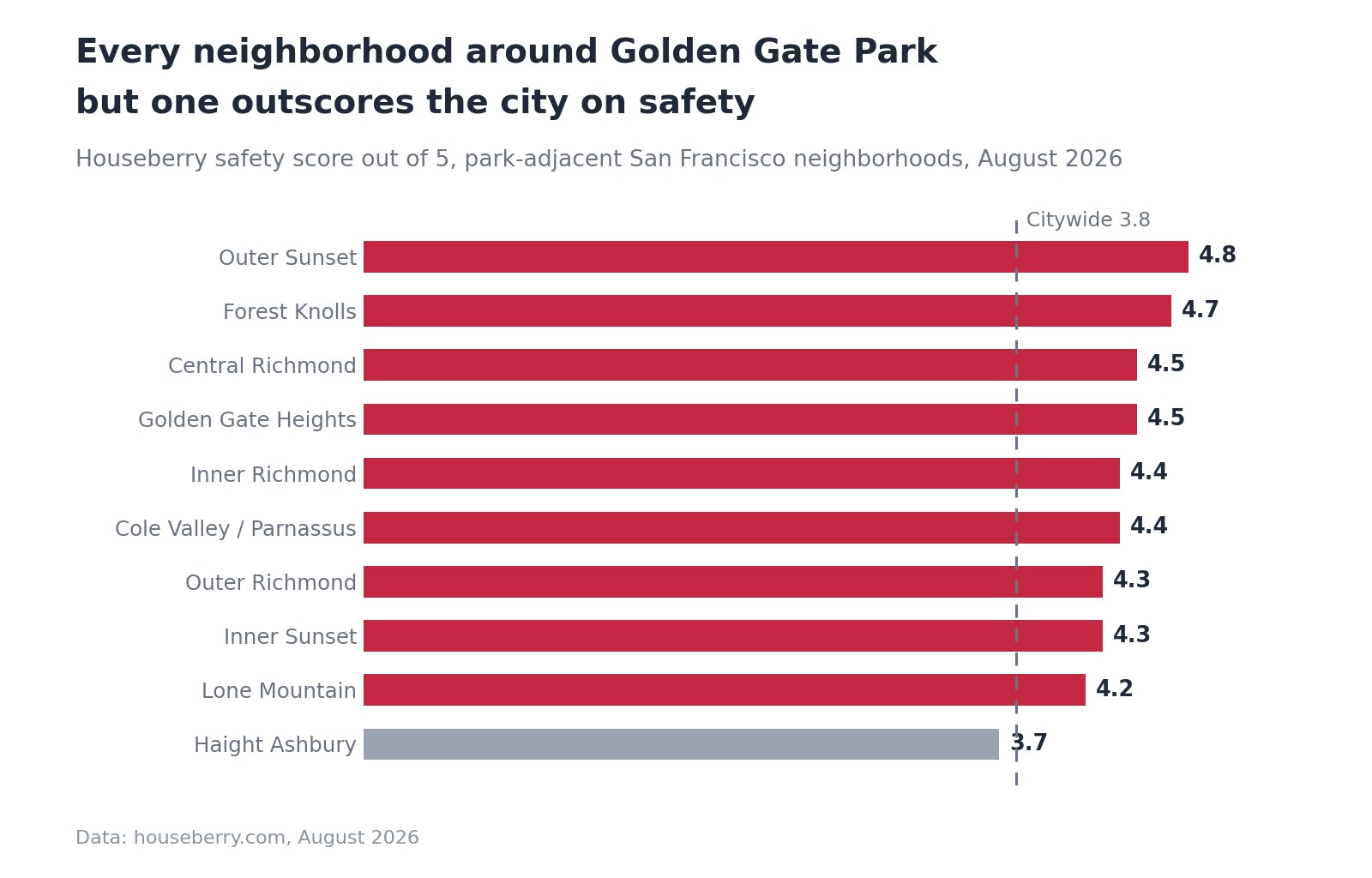
San Francisco as a whole scores 3.8 on safety. Outer Sunset scores 4.8, Forest Knolls 4.7, Central Richmond and Golden Gate Heights 4.5 each. Only Haight Ashbury, at 3.7, sits below the city line, and that has more to do with the Haight Street corridor than with the residential blocks above it.
Amenities are the mirror image. On our San Francisco amenities ranking, the best park-adjacent neighborhood is Outer Sunset at 11th of 92. Most of the rest land in the middle of the pack. These are quiet residential grids with a handful of good commercial strips, not dense walkable retail districts, and no amount of park acreage changes that.
| Neighborhood | Median sale price | Overall | Schools | Safety | Amenities |
|---|---|---|---|---|---|
| Outer Sunset | $1.50M (June 2026) | 4.5 | 4.5 | 4.8 | 3.9 |
| Inner Sunset | $1.81M (July 2026) | 3.9 | 4.2 | 4.3 | 3.6 |
| Central Richmond | $1.83M (July 2026) | 4.0 | 4.0 | 4.5 | 3.8 |
| Outer Richmond | $2.01M (July 2026) | 3.9 | 4.1 | 4.3 | 3.3 |
| Golden Gate Heights | $2.07M (July 2026) | 3.9 | 4.0 | 4.5 | 3.1 |
| Inner Richmond | $2.61M (July 2026) | 4.1 | 4.4 | 4.4 | 3.4 |
| Cole Valley / Parnassus | $4.04M (July 2026) | 4.1 | 4.2 | 4.4 | 3.6 |
| Haight Ashbury | $4.60M (June 2026) | 3.5 | 3.8 | 3.7 | 3.6 |
Outer Sunset is first of all 92 San Francisco neighborhoods on our overall score, at the lowest median on this list. That combination does not appear anywhere else in the city.
The price ladder around the park
The park is free. Everything around it is not, and the range is wider than most buyers expect.
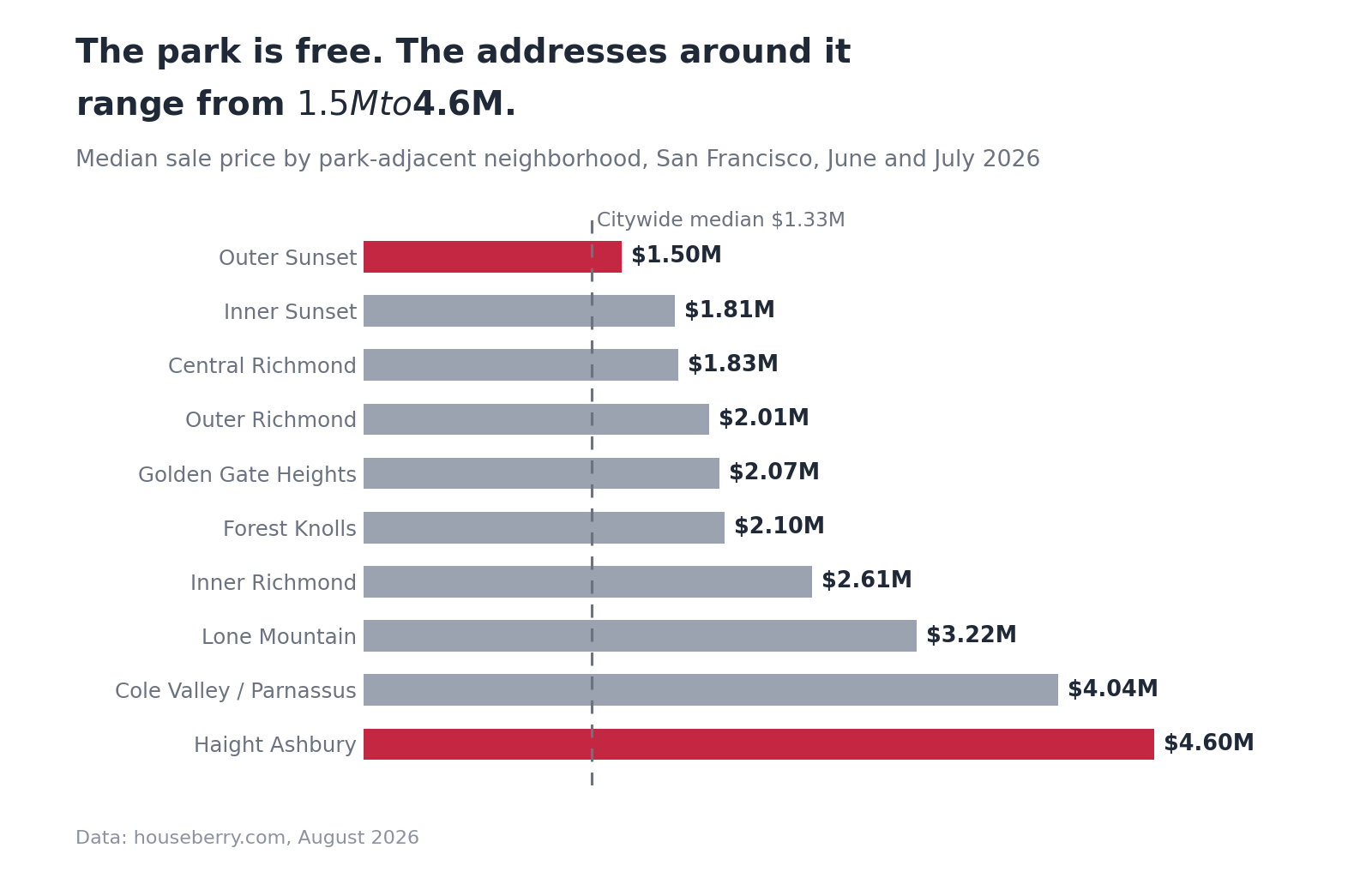
Roughly a threefold spread, all within walking distance of the same 1,017 acres. What separates them is not park access. It is sunlight, commute distance and housing stock. Haight Ashbury and Cole Valley are close to the center of the city and their medians swing hard on low sale volume, so treat single-month numbers there with more caution than the Sunset figures.
The fog is a real variable and it is measurable. The Outer Sunset runs 10 to 20 degrees cooler than the Mission on a typical summer afternoon, routinely sitting between 55 and 62 degrees in August. Some people find that unbearable. Others discover after one summer that they never want to live anywhere else. It is worth spending a July afternoon on the block before deciding which kind of person you are.
Richmond or Sunset, if you are choosing
They are more different than the map suggests. The Inner Richmond, north of the park along Clement and Geary, has the denser commercial life of the two, an easier ride downtown on the 38 Geary, and prices to match at a $2.61 million median in July 2026. The Inner Sunset, south of the park around 9th and Irving, is smaller and quieter, sits on the N Judah, and comes in at $1.81 million.
Go further west and both sides get cheaper, foggier and more garage-dependent. The Outer Sunset at $1.50 million is the value end of the whole west side on our numbers, and Sunset Dunes has given it a second park at the other end of the avenues, at least until November.
Cole Valley and Parnassus Heights are the sunny exception on the south side, sitting above the fog line at a $4.04 million median and fifth overall in the city. You pay about $2.2 million over the Inner Sunset for maybe 15 minutes of extra afternoon sun and a shorter walk to a smaller commercial strip. Whether that is worth it is not a data question.
What to actually check before you buy near the park
Walk the block on a Friday evening in August, not a Sunday morning in April. The festival is the loudest weekend of the year and it is the one that tells you what the worst case sounds like from that specific address.
Find out whether the street is inside a blackout zone or a closure footprint. Lincoln between 25th and 41st and Fulton between 26th and 37th are the tightest, and that detail never appears in a listing.
Then check the November ballot if you are looking west of 30th Avenue, because the Great Highway measure changes what is at the end of the street either way.
And do the boring part: compare the neighborhood before you fall for the house. A 1.1-point safety gap between two addresses fifteen blocks apart is the kind of thing that decides whether your kid bikes to practice, and it is not visible from a listing photo. That habit is the whole reason we built Houseberry, and festival week is a good reminder of why the area matters more than the address.
Sources
SFMTA travel update, Outside Lands August 7 to 9, 2026
Outside Lands community impact and contributions to Recreation and Parks
Outside Lands neighborhood hotline and 311 information
KQED, San Francisco sets no maximum volume and extends the permit through 2031
The San Francisco Standard on the second Golden Gate Park festival (July 21, 2026)
The San Francisco Standard on the 2025 Golden Gate Park concert run (August 15, 2025)
San Francisco Recreation and Parks, JFK Promenade
San Francisco Recreation and Parks on Sunset Dunes first-year visits
CBS News Bay Area on the November 2026 Great Highway ballot measure (July 24, 2026)
All information provided on this website including but not limited to - school ratings, safety, amenities, user opinions, and property data - is for general informational purposes only. We do not guarantee its reliability, accuracy, or completeness. Users should independently verify information and consult appropriate professionals as needed. By using this website, you agree Houseberry is not responsible for actions, decisions, or consequences arising from reliance on the information provided
houseberry.com - CA DRE# 01847391
 Bay East ©2025. CCAR ©2025. bridgeMLS ©2025. Information Deemed Reliable But Not Guaranteed. This information is being provided by the Bay East MLS, or CCAR MLS, or bridgeMLS. The listings presented here may or may not be listed by the Broker/Agent operating this website. This information is intended for the personal use of consumers and may not be used for any purpose other than to identify prospective properties consumers may be interested in purchasing. Data last updated at September 18, 2026 12:00 AM