Oakland Sells Its Half of the Coliseum for $110 Million
The City Council approved the sale of Oakland's 50 percent stake in the Coliseum complex for $110 million. Here is what is actually in the deal, and what it does and does not change for the East Oakland neighborhoods that ring the site.
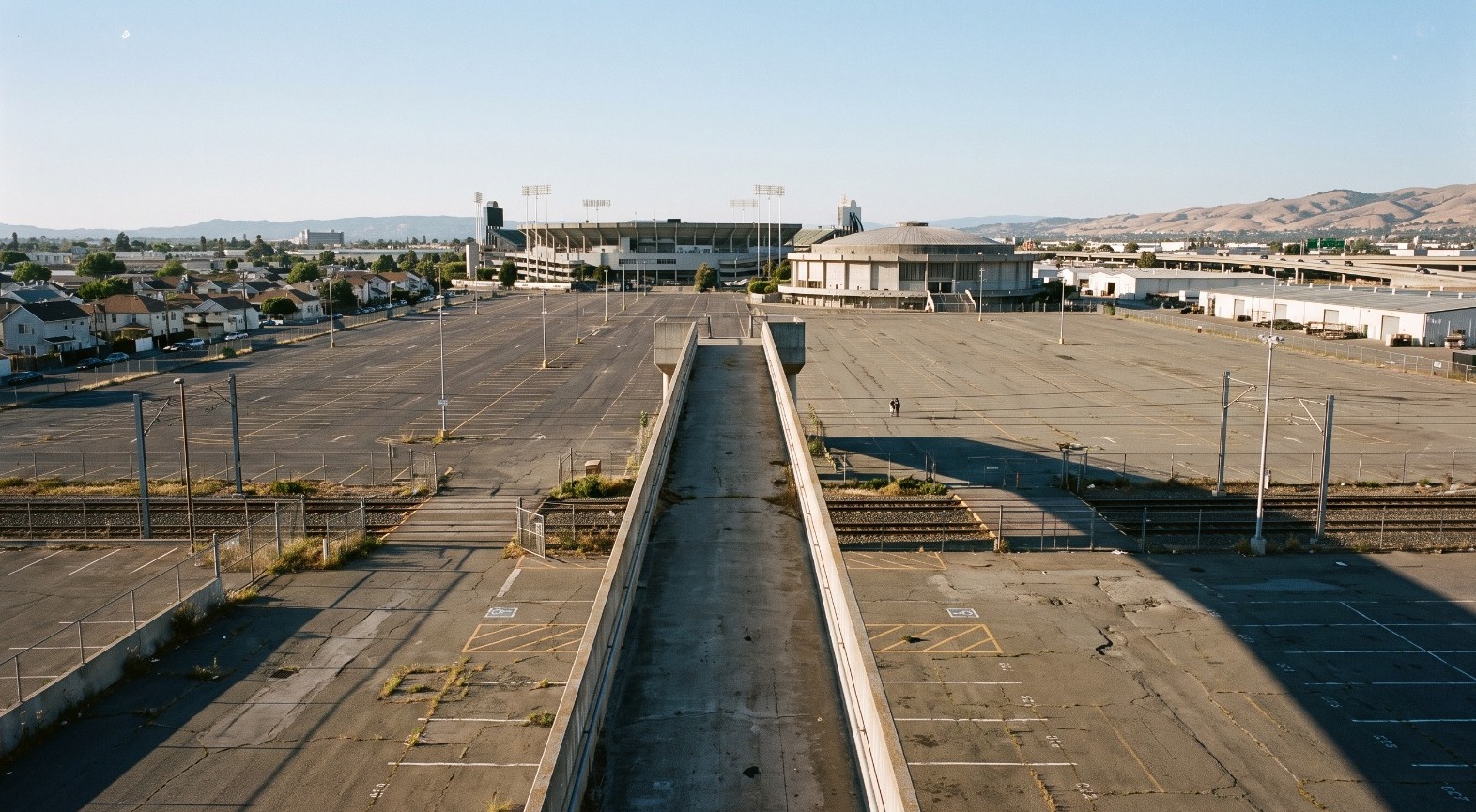
The Oakland Coliseum and its empty parking lots seen from the BART pedestrian bridge, the 112-acre site at the center of the Oakland Coliseum sale. Photo: Houseberry
The number everyone will repeat is $110 million. The number that actually decides anything is 112.
That is the acreage of the Coliseum complex, and on Monday morning the Oakland City Council voted to sell the city's 50 percent stake in it to the Oakland Acquisition Company, the entity formed by Loop Capital and the Black-led African American Sports and Entertainment Group. One hundred and twelve acres of flat, transit-served, freeway-adjacent land in a part of the city that has been promised things before. The Oakland Coliseum sale is now, at long last, done on the city's side.
Whether it becomes housing is a different question, and nobody voted on that yesterday.
Oak View Group, the arena operator co-founded by Irving Azoff, is lined up to run the arena side. Alameda County already cleared its half of the puzzle, voting unanimously last summer to reassign its interest in the property to the same buyer. The lawsuit over environmental cleanup and affordable housing has been dropped. For the first time since the A's walked out, one organization is positioned to own the whole site.
The $110 million plus $15 million is the old $125 million, rearranged
Here is the detail that got lost in the applause.
Oakland originally authorized a $105 million sale in 2024, then renegotiated it upward to a total purchase price of $125 million paid on an installment schedule. Payments stalled. The buyer stopped paying the city entirely while it waited on the county, the city wrote a bare-bones contingency budget, and two fire stations closed.
Now look at Monday's structure. $110 million up front, plus $15 million tied to building permits. Add them together and you get $125 million. The headline price did not go up or down. It got restructured, front-loading the certain money and making the last slice contingent on the buyer actually pulling permits to build something.
That is a smarter deal for Oakland than what it replaced, and I mean that. An installment plan the buyer was not honoring is worth less than a lump sum in hand. But read the shape of it honestly: the city just traded away most of its remaining leverage for cash it badly needs, and the only piece still tied to construction is $15 million out of $125 million. If nothing gets built on that site for a decade, Oakland still keeps $110 million. It just does not get a neighborhood.
The neighborhood named after the stadium ranks 112th out of 130
This is the part of the story nobody at the podium mentions, and it is the part that matters if you actually live nearby or are thinking about buying there.
Our scores for the ring of neighborhoods around the complex are hard reading. The neighborhood literally called Coliseum, the tight grid of 1920s bungalows and post-war cottages squeezed between International Boulevard and the San Leandro Street rail lines, ranks 112th out of 130 Oakland neighborhoods on our overall score. It carries a 1.0 out of 5 on safety. That is the floor. There is no lower number.
| Neighborhood | Overall | Schools | Safety | Amenities |
|---|---|---|---|---|
| Coliseum | 1.6 / 5 | 1.7 | 1.0 | 2.6 |
| Coliseum Industrial | 1.7 / 5 | 1.6 | 1.8 | 2.3 |
| Melrose | 1.8 / 5 | 1.7 | 1.5 | 2.8 |
| Highland | 2.2 / 5 | 1.7 | 2.4 | 2.6 |
| Elmhurst Park | 2.5 / 5 | 1.6 | 3.8 | 2.5 |
| Webster | 2.7 / 5 | 1.4 | 3.9 | 2.7 |
| Sobrante Park | 3.0 / 5 | 1.7 | 4.8 | 2.4 |
Houseberry neighborhood scores, July 2026.
Two things jump out of that table.
The first is how fast the picture changes over short distances. Coliseum sits at 1.0 on safety. Sobrante Park, a post-war tract a couple of miles southeast, sits at 4.8. Webster, a grid of classic bungalows on the other side of International, sits at 3.9 and is the only neighborhood in the group our data flags as appreciating, at about 6 percent. Deep East Oakland is not one place. Treating it as one is how people talk themselves into and out of whole swaths of the city for no good reason.
The second is the schools column, which barely moves. Every neighborhood on that list sits between 1.4 and 1.7. Castlemont High, which serves this area, scores 0.7 out of 5 in our data. A $5 billion entertainment district does not fix that. Nothing in Monday's vote touches it, and anyone selling the Coliseum deal as a rising-tide story for East Oakland families should be asked, politely, which school they mean.
What the data does say, and this is genuinely useful, is that the price is already low. The median home in the Coliseum neighborhood was about $374,500 in June 2026, with a 12-month range running from roughly $336,000 to $530,000. Two blocks from a BART station and an AC Transit hub. That is the cheapest transit-adjacent land in a major Bay Area city, and it is cheap precisely because of the 1.0 and the 1.7 in that table, not in spite of them.
What the 25 percent affordable pledge has to carry
The buyer has committed to making 25 percent of any housing it builds affordable, and its city agreement requires it to negotiate a community benefits agreement with stakeholders including the Black Cultural Zone and the Brotherhood of Elders over the next five years.
Twenty-five percent is a real number. It is far above what San Francisco is about to require of its own developers. It is also a percentage of a quantity that does not exist yet, and there is no unit count, no phasing plan, and no financing attached to it. The $5 billion masterplan has drawn feasibility questions from the moment it was announced, and it should.
The comparison worth holding in your head is the Oakland Army Base, the last time this city sold a huge public parcel with a community benefits agreement attached. That one produced real, enforceable local hiring. It also took the better part of two decades and is still not finished. The Coliseum site is bigger, dirtier, and more complicated.
Why "this time it is real" has to survive a long memory
I want this to work. The pro-housing case here is not close. This is 112 acres of flat land with heavy rail, a BART station, a freeway interchange, and an airport four minutes away, sitting in a region that is short hundreds of thousands of homes and cannot build them in the hills. If you cannot build housing here, you cannot build housing anywhere.
But East Oakland has been handed a rendering roughly every eight years since the 1990s, and the residents of Districts 6 and 7 have learned to read them the way you read a horoscope. The A's were going to build a village. Then they were going to Fremont. Then San Jose. Then Howard Terminal. Then Las Vegas. The one thing every plan had in common was that the neighborhood scores in that table above never moved.
So the honest framing is this. Monday was a real milestone, and it was a milestone in a land transaction, not in a construction project. The city sold an asset and solved a budget hole. It did not entitle a single home.
The dates that decide whether any of this happens
Watch three things, in order.
First, the permits. The $15 million contingent payment is the closest thing to a construction tripwire in this deal, and it only trips when the buyer files for building permits on new construction. Nothing before that is evidence of anything.
Second, the community benefits agreement. Who is at the table, whether the 25 percent affordable pledge gets written into an enforceable document with a unit count, and whether the negotiation is finished this decade.
Third, the environmental work. The lawsuit over cleanup was dropped, not resolved. This is a site that has hosted a stadium, an arena, an industrial edge, and decades of parking runoff, and remediation timelines have a way of eating the first five years of a redevelopment.
If you are weighing a home in East Oakland right now, our advice has not changed and it is not a hedge. Buy the neighborhood that exists today, not the one in the rendering. Look at the safety, school, and amenity numbers on the block you would actually be living on, because the gap between Coliseum at 1.6 and Sobrante Park at 3.0 is real, present, and will still be real in five years whether or not a single crane arrives. That habit of reading the area before the address is the whole reason we built Houseberry, and it is worth more here than almost anywhere else in the Bay Area. Start with how Oakland's neighborhoods rank overall and where our data says the value actually sits, then come back to the Coliseum story in two years and see whether the numbers moved.
Our earlier look at whether Oakland is getting better or just looking better makes a good companion to this one. It was written about the same summer of good headlines, and it reaches roughly the same conclusion: the announcements are real, and they are not the same thing as the numbers moving.
Something did happen at City Hall on Monday. It just was not a groundbreaking.
Sources
- ABC7: Oakland leaders vote to sell city's 50% ownership stake in Coliseum complex
- KQED: After Months, Oakland Coliseum Sale Is Finally Up for Key Vote
- KTVU: City Council to vote on Oakland Coliseum sale
- ABC7: Alameda County votes unanimously to move forward with sale of its ownership of the Oakland Coliseum
- Houseberry: Coliseum, Oakland neighborhood data
All information provided on this website including but not limited to - school ratings, safety, amenities, user opinions, and property data - is for general informational purposes only. We do not guarantee its reliability, accuracy, or completeness. Users should independently verify information and consult appropriate professionals as needed. By using this website, you agree Houseberry is not responsible for actions, decisions, or consequences arising from reliance on the information provided
houseberry.com - CA DRE# 01847391
 Bay East ©2025. CCAR ©2025. bridgeMLS ©2025. Information Deemed Reliable But Not Guaranteed. This information is being provided by the Bay East MLS, or CCAR MLS, or bridgeMLS. The listings presented here may or may not be listed by the Broker/Agent operating this website. This information is intended for the personal use of consumers and may not be used for any purpose other than to identify prospective properties consumers may be interested in purchasing. Data last updated at September 14, 2026 12:00 AM