Downtown Palo Alto Housing Wins the Lot T Court Fight
A Santa Clara County judge rejected all seven claims against Palo Alto's 72-apartment project on downtown parking Lot T. Here is what that changes for Downtown North, and what it does not change for anyone shopping in Palo Alto.

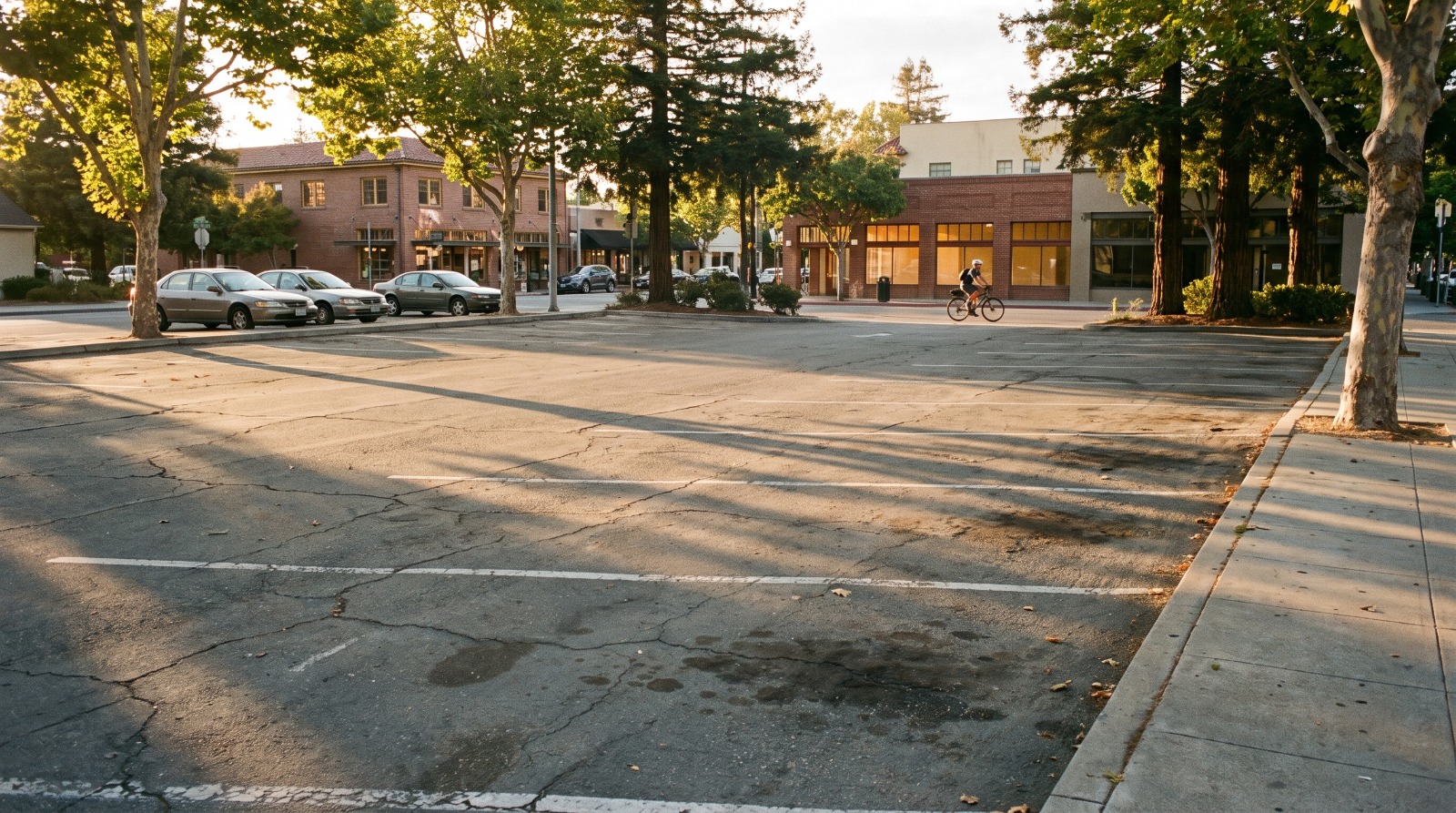
The city-owned surface parking lot at Lytton Avenue and Kipling Street in downtown Palo Alto, site of a planned 72-apartment affordable housing project. Photo: Houseberry
A Santa Clara County judge rejected all seven causes of action in the lawsuit built to stop downtown Palo Alto housing on city-owned Lot T, which puts 72 all-affordable apartments at Lytton and Kipling back on a construction schedule instead of a court calendar. Palo Alto Online reported the ruling on August 20, 2026. The case had been running since April 2025. It is not finished, because a losing plaintiff can appeal. But the city is no longer defending the basic proposition that it may build homes on its own parking lot.
What the judge actually decided
The ruling was procedural, and that is exactly why it matters. Downtown Vibrancy, a group of downtown property owners represented by land use attorney David Lanferman, never argued about height or density. Its theory was about ownership of the asphalt itself: that Palo Alto cannot repurpose a parking lot built with downtown property assessments without the consent of the property owners who paid those assessments.
That theory, if it had survived, would have frozen a lot more than one lot. Most downtown surface parking in California traces back to some assessment district or parking authority from the middle of the last century. A ruling that assessment-funded asphalt is permanently encumbered would have quietly taken hundreds of the best-located infill sites in the state off the table.
The court did not approve a building. Design review and the entitlement package are still ahead of Alta Housing, the nonprofit developer that filed its application in February 2026 while the suit was still live. What the ruling removed was the existential question hanging over all of it.
How 54 homes became 72
The project got bigger because the council pushed it bigger. Alta Housing's January 2025 concept held 54 units. At a special meeting on October 29, 2025, the council chose the larger scheme, and Mayor Ed Lauing summed up the reasoning bluntly: it "gets the most units." The city's contribution rose from about $4.1 million to $5.5 million in the same motion.
The mix leans family-sized on purpose. There are no studios, which Alta Housing CEO Randy Tsuda has said take the longest to lease. Here is the whole project on one page.
| Item | Detail |
|---|---|
| Site | Lot T, 0.43 acres, Lytton Avenue at Kipling Street (APN 120-15-100) |
| Homes | 72, all deed-restricted affordable, plus one manager unit |
| Unit mix | 33 one-bedroom, 20 two-bedroom, 19 three-bedroom |
| Affordability | At or below 80% of Santa Clara County area median income, with nearly half at 30% or below |
| Building | Six stories, five levels of housing over one parking level with 34 spaces |
| City subsidy | About $76,000 per home, roughly $5.5 million |
| Earliest construction | 2028 |
Seventy-two homes on 0.43 acres works out to roughly 167 homes per acre. In a city whose citywide median sale price was about $3.9 million in June 2026, that density is the only way the arithmetic on deed-restricted housing closes at all.
Downtown North is the neighborhood absorbing this
Lot T sits in Downtown North, the blocks between University Avenue and Palo Alto Avenue that most people picture when they say "downtown." It is a genuinely strange neighborhood in our data: Downtown North scores 3.8 out of 5 overall, which puts it 23rd of the 27 Palo Alto neighborhoods we rank, and yet it scores 4.9 on nearby merchants and 4.0 on amenities.
That gap is the whole story of the place. You can walk to a Caltrain platform, three dozen restaurants and a movie theater, and you are still in the bottom five of Palo Alto because the safety score is 2.6 and the curb appeal score is 3.5. Property crime clusters where the foot traffic and the parked cars are, and downtown has plenty of both, which drags the composite hard.
The price picture is just as odd. Downtown North's median sale price was about $3.61 million in July 2026, down from a $4.89 million peak in December 2025. That is a thin, lumpy market where a couple of condo closings swing the median by seven figures, which is what happens in a neighborhood with this little detached housing stock. Compare that to the broader Palo Alto ranking, where the top-scoring neighborhoods trade above $4 million with none of the volatility.
Seventy-two households who work here and currently commute in from Gilroy or Newark is a real change to how the blocks north of University feel on a Tuesday morning. Whether that shows up in a score is a different question, and we would not expect it to for years.
The parking argument is real, and it already has an answer
Downtown merchants are not being unreasonable to care about a surface lot. Palo Alto's answer is a six-story replacement garage at Waverley Street and Hamilton Avenue, on Lot D, whose design was released in March 2026 and which advanced past its own legal fight in June. The city is building the parking back, one block away, stacked instead of spread.
The honest version is that structured parking is expensive and takes years, and there will be a stretch where the surface lot is gone and the garage is not finished. That is a genuine cost to the businesses on Lytton. It is also the cost of every infill project anywhere, and it is temporary in a way that a permanently empty lot is not.
What this does not do for anyone shopping in Palo Alto
Seventy-two below-market apartments will not move Palo Alto's price. They are not supposed to. Every one of these homes is income-restricted and leased through a waiting list, so they never touch the for-sale market that produced a $3.9 million citywide median.
The way we look at it when we compare neighborhoods, the useful signal here is directional, not numeric. A city that will fight a two-year lawsuit to put housing on its own parking lot is a city that will keep saying yes to the next one, and Palo Alto has already shown that pattern in the seven SB 79 transit projects filed last summer. If you are weighing Downtown North against Midtown or Community Center, the downtown blocks are the ones where the built environment is going to keep changing. That is either the reason to buy there or the reason not to, and it depends entirely on whether you want a neighborhood that holds still.
The dates that matter next
Watch three things. First, whether Downtown Vibrancy appeals, which would restart a clock the city cannot control. Second, Alta Housing's entitlement hearings and Architectural Review Board sessions, where the design and the parking count get argued in public. Third, the roughly $2.2 million funding gap, which is the thing most likely to slow this down now that the legal question is settled.
A judge cleared the path. Financing is what actually builds the building.
Sources
- Palo Alto Online, "Court ruling boosts Palo Alto's efforts to build housing on downtown lot," August 20, 2026
- San Jose Spotlight, "Developer applies for Palo Alto housing project despite lawsuit"
- San Jose Spotlight, "Palo Alto seeks more housing on downtown lot project"
- City of Palo Alto, "Advancing a 100% Affordable Housing Development in Downtown Palo Alto on Surface Parking Lot T"
- CEQAnet, Notice of Exemption, SCH 2025061123, Surface Parking Lot T
- Houseberry, Downtown North neighborhood data
The Houseberry Research Team is Houseberry's reporting team: Bay Area real estate analysts, data specialists and longtime local market watchers. Every day we check the public record: building permits, city council and planning agendas, county recorder filings, state housing bills, police incident data and school results. Then we tie each story to what it means for specific neighborhoods, using Houseberry's own neighborhood data on prices, appreciation, safety, schools and amenities. Questions or corrections: Contact us.
All information provided on this website including but not limited to - school ratings, safety, amenities, user opinions, and property data - is for general informational purposes only. We do not guarantee its reliability, accuracy, or completeness. Users should independently verify information and consult appropriate professionals as needed. By using this website, you agree Houseberry is not responsible for actions, decisions, or consequences arising from reliance on the information provided
houseberry.com - CA DRE# 01847391
 Bay East ©2025. CCAR ©2025. bridgeMLS ©2025. Information Deemed Reliable But Not Guaranteed. This information is being provided by the Bay East MLS, or CCAR MLS, or bridgeMLS. The listings presented here may or may not be listed by the Broker/Agent operating this website. This information is intended for the personal use of consumers and may not be used for any purpose other than to identify prospective properties consumers may be interested in purchasing. Data last updated at October 9, 2026 12:00 AM