Palo Alto RV Parking Permits and the Homes It Never Built
Palo Alto will issue RV parking permits for 37 vehicles on two edge-of-town streets starting March 2027. The city has counted as many as 180 of them.

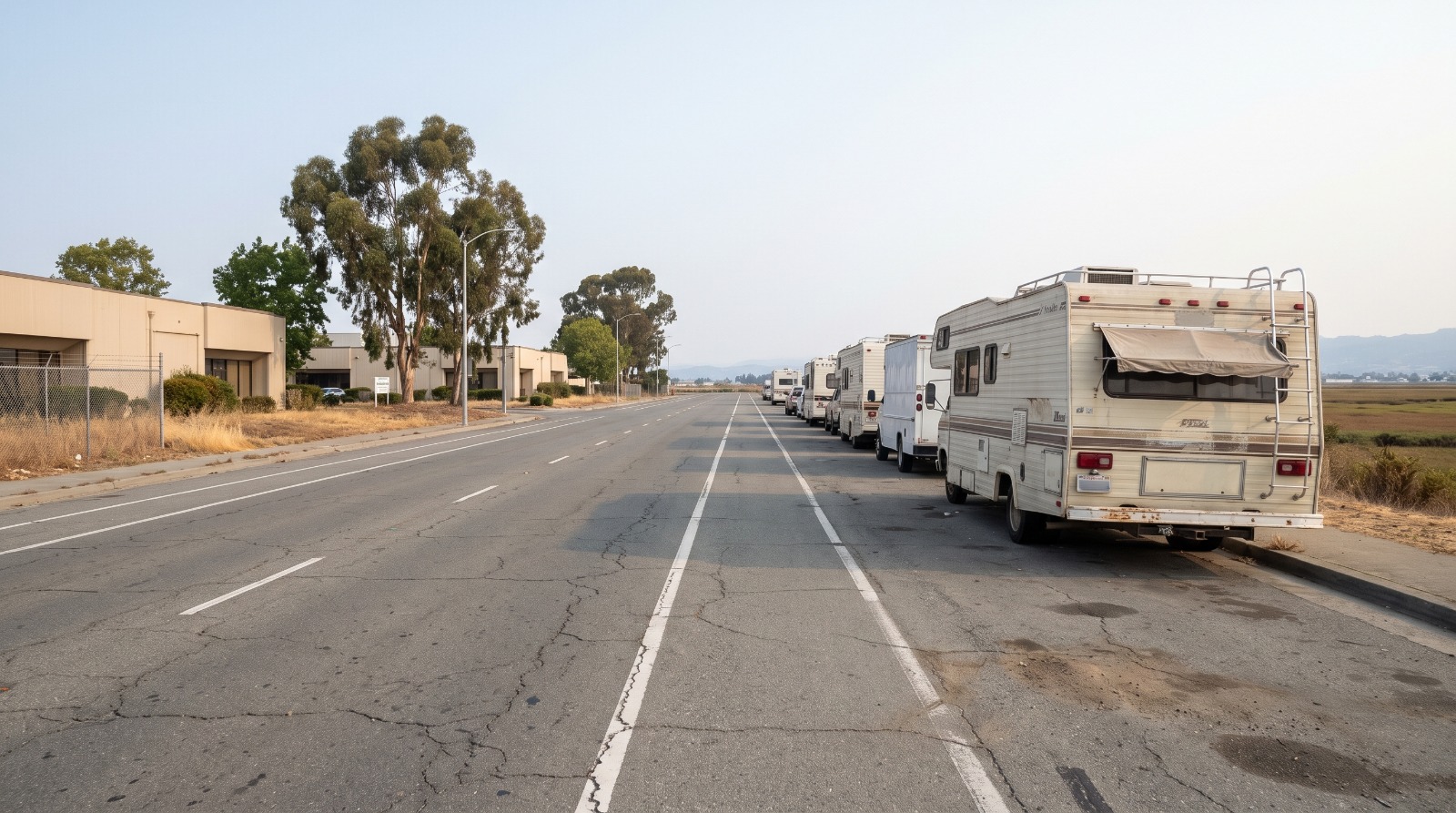
Older RVs parked nose to tail along the curb of Embarcadero Road in Palo Alto, one of two streets covered by the city's new RV parking permits. Photo: Houseberry
Palo Alto's new RV parking permits will cover 37 vehicles. The city has counted between 133 and 220 oversized vehicles parked on its streets at various points over the past year.
That gap is the story. On August 24 the City Council approved a permit pilot at two locations on the outer edges of town and set aside the broader plan, which would have rotated everyone else from one side of 22 industrial blocks to the other every six months. The permits are settled. Almost nothing else is.
The pilot, on paper:
- 20 permitted spaces on Coyote Hill Road, along the western edge of Stanford Research Park, and 17 on Embarcadero Road east of Highway 101, out by the sewage treatment plant and the airport
- $15 a month, plus proof of insurance, a signed good-neighbor agreement, and participation in a housing search
- Portable toilets and trash bins on site, landscaping on Coyote Hill, fresh bike lane striping on Embarcadero
- Eligibility limited to low-income people with existing ties to Palo Alto, such as a job in the city or a child enrolled in the schools
- Start date March 1, 2027, at a pilot cost of roughly $823,800
The 22 blocks the council walked away from
The part that died is the part that touched the streets people actually complain about. Staff had proposed one-sided parking across 13 street segments, with the legal curb flipping every six months, January through June on one side and July through December on the other.
The list ran through Park Boulevard, Olive Avenue, Ash Street and Lambert Avenue near California Avenue, then out to Transport Street, Commercial Street, Industrial Avenue, Elwell Court, Corporation Way, the 1000 block of East Meadow Circle, Embarcadero Way and Faber Place. It would have preserved room for about 116 vehicles during restriction months and 125 the rest of the year. Council members declined it. A citywide version carried a staff price tag of $4.5 million.
So the outcome is narrower than either side wanted. A few dozen people get a sanctioned, serviced place to park. Everyone else stays exactly where they are, under the same rules as last week.
Thirty-seven permits, and the arithmetic after that
Subtract 37 from roughly 130 and you have the problem nobody at the dais solved on Monday. Palo Alto's sanctioned off-street capacity is 22 RV spaces at the Geng Road lot operated by Move Mountain View, plus about 14 to 16 car-only spots at four faith-based partners. Over five years that program has moved 69 vehicle dwellers into permanent or transitional housing, which is real work at a very small scale.
Enforcement has moved the number faster than housing has. Oversized vehicles on Palo Alto streets fell from 191 on January 15, 2026 to 133 by May 6, after the city spent about $192,000 between October 20 and February 7 on enforcement, cleanup and administration, including $58,285 on towing. Where those 58 vehicles went is not recorded anywhere.
The residents and business owners at the microphone are not inventing their complaints. East Meadow Circle had 53 oversized vehicles on it in a February count. Faber Place had 16, Fabian Way 25. Chamber of Commerce CEO Charlie Weidanz told the council that Palo Alto's small businesses cannot keep operating under those conditions, and resident Barry Katz, quoted by the Daily Post after the vote, described himself as shocked and outraged. People who own machine shops on Commercial Street did not write Palo Alto's zoning code, and they are the ones absorbing the result of it.
The people in the vehicles are answering the same question from the other end. About 73 percent of Palo Alto's unhoused residents live in vehicles, against 53 percent countywide, per the Santa Clara County point-in-time count. One RV resident, Jean Leal, told CBS News Bay Area the simple version: renting an apartment or a house here is not affordable, so this is what is left.
What Palo Alto built while this was building up
Palo Alto is not short on land value or civic capacity. It is short on homes, and the shortfall is specific rather than general.
In the fifth housing cycle, 2015 through 2023, the state assigned Palo Alto 1,988 homes. The city permitted 1,236 of them, which reads like a respectable 62 percent until you sort by price.
| Income tier, 2015-2023 | Homes assigned | Homes permitted | Share |
|---|---|---|---|
| Very low income | 691 | 101 | 15% |
| Low income | 432 | 99 | 23% |
| Moderate income | 278 | 114 | 41% |
| Above moderate (market rate) | 587 | 922 | 157% |
| All tiers | 1,988 | 1,236 | 62% |
Read the last two rows together. Palo Alto permitted 157 percent of its market-rate assignment and 22 percent of everything below it, 314 homes out of 1,401. The current cycle is worse in aggregate: 6,086 homes assigned for 2023 through 2031, and 680 permits issued through December 2024, about 11 percent of the way with a quarter of the clock gone. We ran the regional version of that scoreboard this month and found no Bay Area city on pace, but very few of them are working from a $4.44 million median.
That median is the July 2026 figure on our Palo Alto city page. A one-bedroom rented for around $3,260 a month in early 2025, and roughly 41 percent of Palo Alto renter households pay more than 30 percent of income for housing. The city has some of the best public schools in California, a 4.8 out of 5 on our school score, and a curb full of people who work here and cannot rent here. Both of those are outputs of the same decades of decisions.
The RVs are parked in the three lowest-ranked neighborhoods in town
Here is the piece the news coverage keeps missing. Every street on the pilot list sits in one of three neighborhoods, and Houseberry ranks all three near the bottom of the city.
Ventura, the neighborhood wrapped around the California Avenue business district south of Oregon Expressway, scores 3.9 out of 5 and ranks 22nd of the 27 Palo Alto neighborhoods we score. Baylands, the flat industrial and marsh district east of Highway 101, scores 3.7 and ranks 24th. Page Mill, the office corridor along the road of the same name, ranks dead last at 3.5, with a 1.3 out of 5 on amenities, which is what an office park that empties at 5 p.m. looks like as a number.
Old Palo Alto scores 4.6. Crescent Park, 4.5. Duveneck-St. Francis, 4.8 and first in the city. Not one vehicle on the pilot list is parked in any of them.
There is a real reason for that, and it is not all bad faith. Wide commercial and industrial curbs are where a 32-foot motorhome physically fits, and residential streets already carry a 2 a.m. to 6 a.m. oversized-vehicle ban. But the same map showed up when we looked at where Palo Alto's SB 79 transit housing filings landed: four of nine near California Avenue, zero in Old Palo Alto or Leland Manor. The zoning held. It kept apartments out of the 4.6-and-up neighborhoods for forty years. What it could not do was keep the consequences out of the city, and the consequences found the same three zip-code corners the apartments were pushed into.
Why the city cannot simply ban them
The legal ceiling is lower than most residents assume, and two nearby cities paid to find out where it sits.
Mountain View passed ordinances in 2019 barring oversized vehicles from streets under 40 feet wide and from streets with bike lanes. The ACLU and the Law Foundation of Silicon Valley sued. Mountain View settled in 2022 and agreed to preserve at least three miles of street parking for oversized vehicles. Pacifica tried a similar ordinance and agreed to a preliminary injunction preserving two miles, plus a safe parking program. Sebastopol won at the trial level on a public-health rationale and is now at the Ninth Circuit, where the ruling will bind nine western states.
Palo Alto's own staff report says it plainly: cities that pass comprehensive restrictions seen as pushing unhoused people out of town draw lawsuits, and most of them lose or settle. California preempts local parking rules except where the Vehicle Code allows, enforcement requires posted signage, and towing runs into Fourth Amendment limits that usually require notice and a chance to fix the violation first.
A group of residents is now floating a citizen initiative for a citywide ban. It would run into the same wall, with a ballot campaign attached to the legal bill.
March 1, 2027
That is the date the first permits are supposed to be issued. Before then the council has to write ordinance language, work through additional permit sites already floated (Bryant Street near City Hall, Encina Avenue south of Forest, the fire station at 301 Alma, the airport, the golf course), and decide whether it wants a second run at the 22 blocks.
If you are shopping in Palo Alto, none of this changes the fundamentals of the neighborhoods on your list. What it should change is when you go look at them. Drive Park Boulevard on a Tuesday morning, not a Sunday afternoon. Drive East Meadow Circle. Find out how much buffer actually sits between the industrial edge and the subdivision, because on a listing page those two things are the same neighborhood name. Looking hard at the area before falling for the address is the whole reason we built Houseberry, and it matters more in a city where all the pressure has to go somewhere.
The permit program is not the test. The test is whether Palo Alto entitles enough homes over the next five years that the question stops showing up on a curb.
Sources
Council votes to restrict RVs to edges of town, Palo Alto Daily Post, August 25, 2026
Palo Alto backs away from plan to restrict RVs to certain streets, Palo Alto Online, August 25, 2026
Palo Alto considers new permit program to limit vehicle dwelling, San Jose Spotlight
February 2026 status report from the Oversized Vehicles Subcommittee, City of Palo Alto
Policy and Services Committee oversized vehicles staff report, City of Palo Alto
Oversized Vehicles community open house handout, City of Palo Alto
Palo Alto housing data and RHNA progress, SV@Home
Palo Alto neighborhood scores and median price history, Houseberry
The Houseberry Research Team is Houseberry's reporting team: Bay Area real estate analysts, data specialists and longtime local market watchers. Every day we check the public record: building permits, city council and planning agendas, county recorder filings, state housing bills, police incident data and school results. Then we tie each story to what it means for specific neighborhoods, using Houseberry's own neighborhood data on prices, appreciation, safety, schools and amenities. Questions or corrections: Contact us.
All information provided on this website including but not limited to - school ratings, safety, amenities, user opinions, and property data - is for general informational purposes only. We do not guarantee its reliability, accuracy, or completeness. Users should independently verify information and consult appropriate professionals as needed. By using this website, you agree Houseberry is not responsible for actions, decisions, or consequences arising from reliance on the information provided
houseberry.com - CA DRE# 01847391
 Bay East ©2025. CCAR ©2025. bridgeMLS ©2025. Information Deemed Reliable But Not Guaranteed. This information is being provided by the Bay East MLS, or CCAR MLS, or bridgeMLS. The listings presented here may or may not be listed by the Broker/Agent operating this website. This information is intended for the personal use of consumers and may not be used for any purpose other than to identify prospective properties consumers may be interested in purchasing. Data last updated at October 9, 2026 12:00 AM