Redwood City's Measure E would cap rents on older apartments
Measure E would bring rent control to Redwood City apartments built before 1995 and widen eviction protections to nearly every rental. Here's what changes, what it costs and how similar votes went.

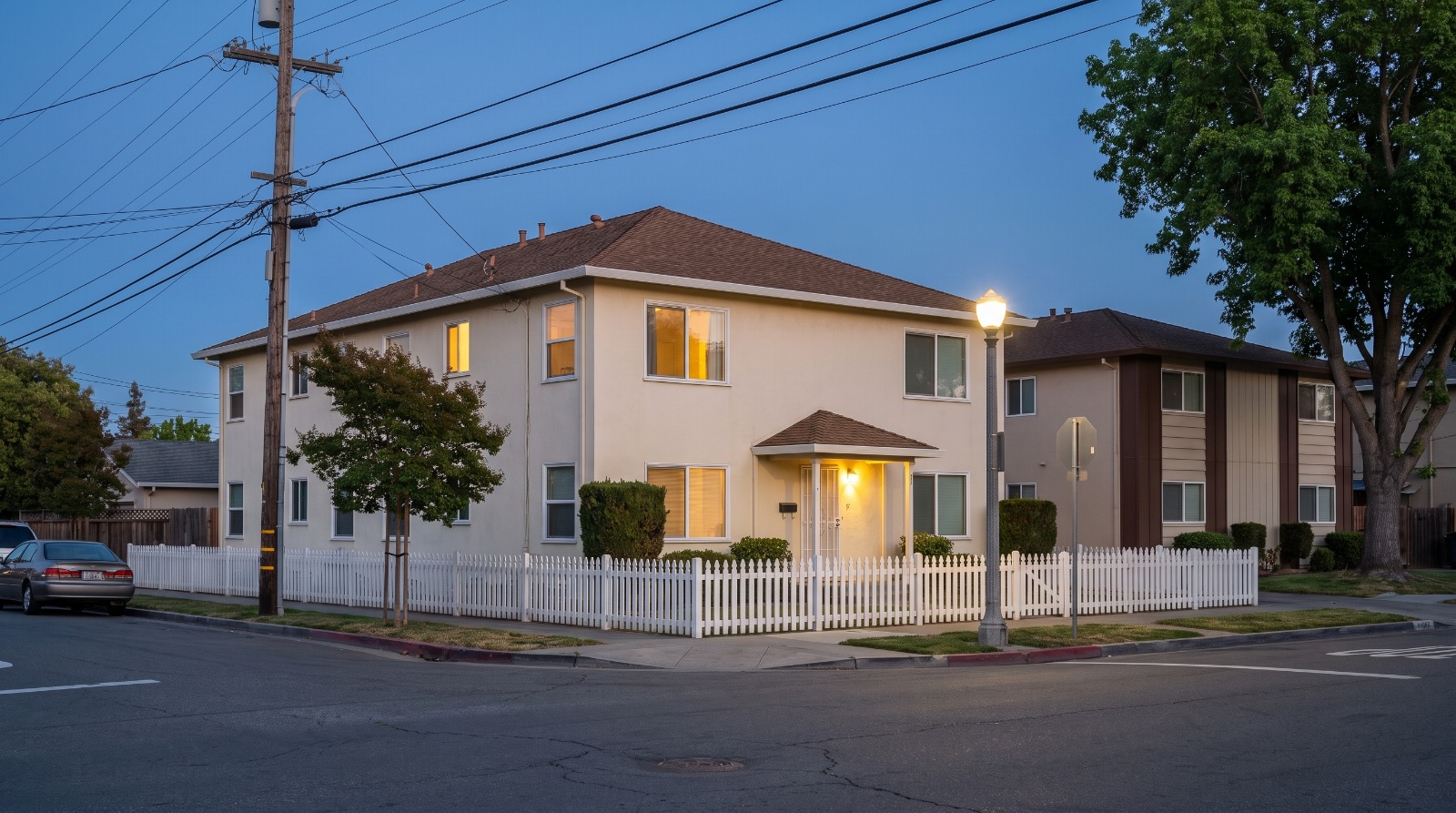
AI-rendered blue-hour view of older two-story apartment buildings on Buckeye Street in Redwood City's Staumbaugh-Heller neighborhood Photo: Houseberry
On Buckeye Street, a few blocks off Woodside Road, the apartment buildings are two stories of stucco with a shingle roof, a mailbox by the door and a picket fence out front. Nobody would call them luxury. Under Measure E, apartment buildings like these, if built before 1995, would get Redwood City's first rent control.
Ballots went out this week for the November 3 election, and Measure E asks Redwood City voters to cap yearly rent increases in apartments built before February 1, 1995 at 60 percent of inflation, with a hard ceiling of 5 percent. At today's inflation that works out to a raise of roughly 1 to 2 percent a year. State law now allows 5 percent plus inflation, up to 10.
Renters run about half the city. Census figures put owner-occupied homes at 48.6 percent of Redwood City's 29,951 households, which leaves roughly 51 percent renting. The cheapest place to buy instead is Staumbaugh-Heller, where Houseberry data puts the typical home at about $1.01 million in early October 2026. The citywide typical home is about $2.14 million.
What Measure E changes
The measure is a citizen initiative led by Faith in Action Bay Area, which turned in 4,751 valid signatures against roughly 4,500 needed. It repeals the tenant ordinance the City Council passed in October 2025 and replaces it with a new one. The City Attorney's impartial analysis lays out the main pieces. Here is how they stack up against what applies today.
| Rule | State law (AB 1482) | Redwood City today | Measure E |
|---|---|---|---|
| Yearly rent cap | 5% plus inflation, 10% max, on units 15+ years old | Same as state | 60% of inflation, 5% max, on multifamily units built before Feb. 1, 1995 |
| Rent rollback | None | None | To the rent paid on Oct. 29, 2025 |
| Just-cause eviction | After 12 months, most rentals | After 12 months | Nearly all rentals, including houses, ADUs and mobile homes |
| No-fault relocation pay | 1 month of rent | 3 to 4 months of fair market rent, lower-income households only | Larger of 4 months of fair market rent or $12,000, plus $6,000 for elderly and disabled |
| Who runs it | Courts | City | A new city rent program funded by a yearly landlord fee |
The current city rules come from the ordinance that took effect in January, as Redwood City Pulse reported. The measure also lets landlords and tenants petition for higher or lower rents, regulates buyout offers, requires safety plans before renovations and allows triple damages for violations.
One thing it cannot change is vacancy. The state's Costa-Hawkins law lets a landlord reset to market rent when a tenant moves out. So the cap protects the people who stay put, and the longer they stay, the bigger the gap between their rent and the market.
What the cap means on a real rent
Zumper's median one-bedroom in Redwood City was $3,010 as of October 4, up 8 percent in a year. Say inflation runs 3 percent. State law would let a landlord raise that rent by 8 percent, or about $241 a month. Measure E would allow 1.8 percent, about $54 a month.
That $187-a-month difference is the whole case for the measure, in one number. Supporters point to rents in older buildings that rose 57 percent over 15 years, a figure they cited to KQED. Councilmember Chris Sturken, who abstained when the council voted to oppose the measure and is campaigning for it, put it this way to NBC Bay Area: "Folks in the service sector in Redwood City depend on this measure."
Who pays, and how much
Here the numbers get uncomfortable. The measure sets a landlord fee of $84 to $120 per unit per year, which landlords cannot pass on to tenants. The city's consultant, Economic & Planning Systems, estimated in July that the program would cost $5 million to $11.1 million a year with up to 18 staff. That fee would cover 13 to 32 percent of it. Covering the full cost would take a fee closer to $246 to $622 a unit, Redwood City Pulse reported, and the California Apartment Association has put the high-end figure near $756.
The council voted 6-0 with Sturken abstaining on July 27 to formally oppose Measure E. Mayor Elmer Martínez Saballos signed the ballot argument against it and told ABC7 the measure, "although well-intentioned," is "poorly written policy." The opposition committee is run by the California Apartment Association, which said in its August coalition announcement that the Chamber San Mateo County, the realtors' association and the city's police and firefighter associations had joined it.
The research is the real counter-case. A Stanford study of San Francisco's rent control, published in the American Economic Review in 2019, found that covered tenants were more likely to stay in the city, and that landlords cut the supply of rental housing in covered buildings by 15 percent, mostly by converting to condos or rebuilding. Both findings are probably true in Redwood City too.
We think the eviction and relocation half of Measure E would do the most good for the least cost, and the funding half is the weakest part of it. Writing a fee into an initiative that covers a third of the program at best leaves the city to cover the rest or to come back and raise the fee. That is a design problem, and voters should weigh it alongside the $187 a month.
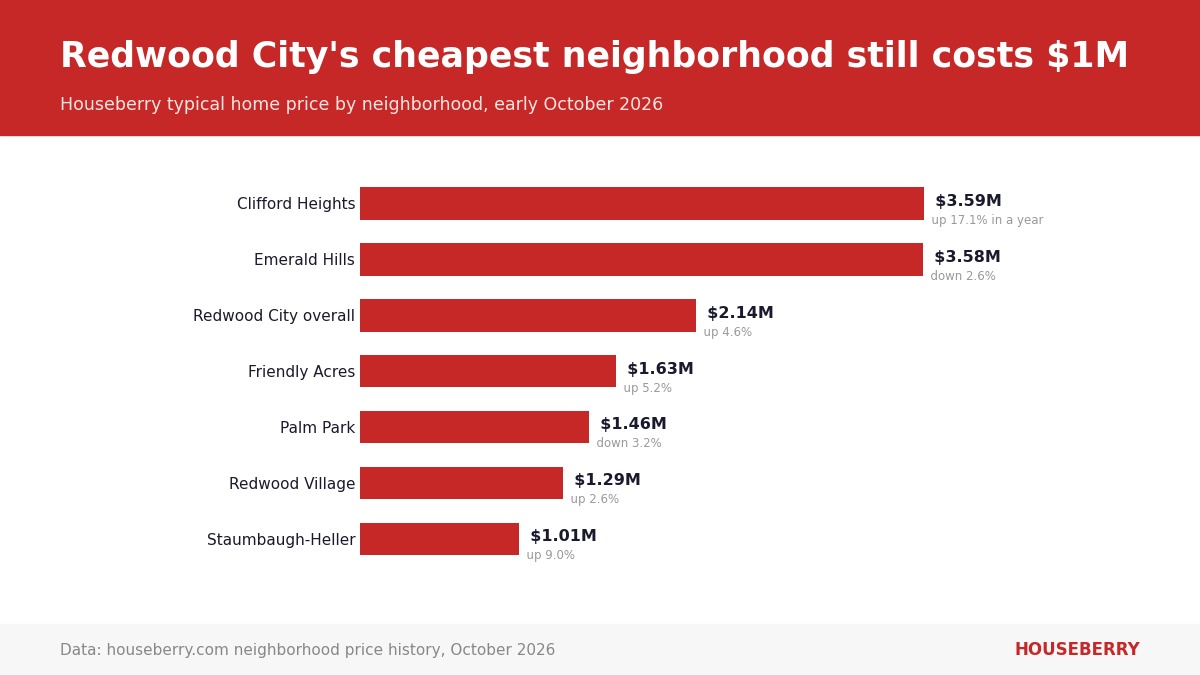
For renters who would rather buy, the price spread is wide. Houseberry's typical price runs from about $1.01 million in Staumbaugh-Heller and $1.29 million in Redwood Village to $3.59 million in Clifford Heights, a 3.6 times gap inside one city. Palm Park, at about $1.46 million, is one of the few Redwood City neighborhoods where prices fell over the past year, down 3.2 percent.
How this has gone nearby
Rent control has mostly lost at the ballot box in San Mateo County. San Mateo's Measure Q drew about 39 percent yes in 2016 and Burlingame's Measure R about 33 percent, per CAA's tally. Pacifica rejected Measure C in 2017 with 62 percent voting no. About 60 percent of Redwood City voters rejected the statewide Proposition 33 in 2024. East Palo Alto has had rent stabilization since the 1980s.
The registration deadline is October 19, and ballots must be postmarked by November 3. Whatever happens, rent rules are one more thing that shapes what a Redwood City block feels like, so compare the city's 15 neighborhoods on Houseberry's Redwood City ranking before you sign a lease or make an offer.
Sources
The Houseberry Research Team is Houseberry's reporting team: Bay Area real estate analysts, data specialists and longtime local market watchers. Every day we check the public record: building permits, city council and planning agendas, county recorder filings, state housing bills, police incident data and school results. Then we tie each story to what it means for specific neighborhoods, using Houseberry's own neighborhood data on prices, appreciation, safety, schools and amenities. Questions or corrections: Contact us.
Map of Redwood City Neighborhoods
Loading map...
View Full Map
Top Neighborhoods in Redwood City, CA



All information provided on this website including but not limited to - school ratings, safety, amenities, user opinions, and property data - is for general informational purposes only. We do not guarantee its reliability, accuracy, or completeness. Users should independently verify information and consult appropriate professionals as needed. By using this website, you agree Houseberry is not responsible for actions, decisions, or consequences arising from reliance on the information provided
houseberry.com - CA DRE# 01847391
 Bay East ©2025. CCAR ©2025. bridgeMLS ©2025. Information Deemed Reliable But Not Guaranteed. This information is being provided by the Bay East MLS, or CCAR MLS, or bridgeMLS. The listings presented here may or may not be listed by the Broker/Agent operating this website. This information is intended for the personal use of consumers and may not be used for any purpose other than to identify prospective properties consumers may be interested in purchasing. Data last updated at October 6, 2026 12:00 AM