San Francisco Rental Scam: The Advice That Failed
A San Francisco renter toured the real apartment, met a man calling himself the owner, and still lost $18,600. Every standard piece of anti-scam advice failed, and here is what actually would have caught it.
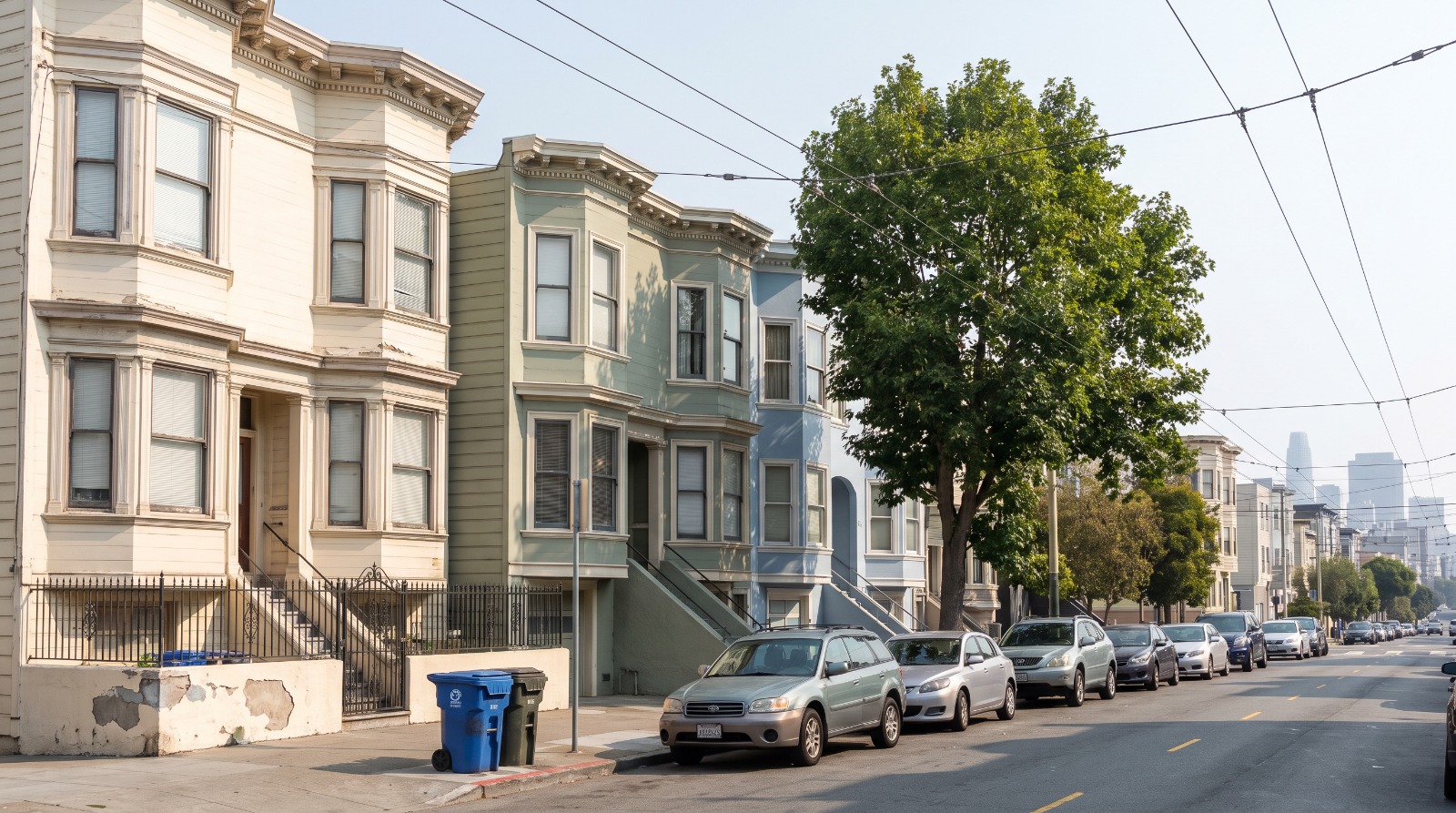
Edwardian flats along a residential block in Duboce Triangle, the San Francisco neighborhood where a cloned rental listing scam took place. Photo: Houseberry
A San Francisco product designer wired $18,600 to a stranger for an apartment he had already walked through. His roommate sent another $9,300 by Zelle. On key day the phone number went dead, and the reason the story is worth your ten minutes is that he did almost everything the standard rental-scam checklists tell you to do.
He saw the unit in person. He went to a real open house at a real address. He shook hands with a man presenting himself as the owner. And the rent was not suspiciously cheap. It was slightly expensive.
The numbers that matter here: the listing asked $6,200 a month against a San Francisco median two-bedroom rent of $6,020 in July 2026, so it was roughly 3 percent above market. Nationally, the FTC logged about $65 million in reported rental-scam losses across nearly 65,000 reports between January 2020 and June 2025, with a median loss of $1,000. This one was more than eighteen times that median.
Priced above market, which is why the usual test failed
Almost every rental-scam guide leads with the same rule: if the rent is too good to be true, walk. That rule did nothing here.
Zumper put San Francisco's median two-bedroom at $6,020 in July 2026, up 25.9 percent year over year, the highest in the country and the first time the city crossed $6,000. The median one-bedroom hit $4,180, up 22.9 percent, with active listings down about 30 percent from a year earlier. The scammer priced at $6,200 and it read as ordinary, because in this market it is ordinary.
That is the mechanism worth understanding. When rents rise 23 percent and vacancy collapses, renters stop negotiating and start racing. A market where people feel they have to commit in a day is a market where fraud gets easier, and it has nothing to do with how careful the renter is.
How the clone worked, step by step
The apartment on 15th Street in Duboce Triangle was real, the Zillow listing was real, and the open house was real. The scammer built on top of all three.
- The real listing was copied onto Craigslist with the same photos and the same address, and one thing changed: the contact information.
- The renter reached a supposed agent through the Craigslist relay and then attended the genuine open house, where a different man introduced himself as the owner. The renter assumed one person had cross-posted. Two people were involved and only one of them was real.
- A lease came back naming a landlord whose name was a scrambled version of the actual owner's name.
- The first wire failed. The scammer blamed a network error and supplied a second account at a different bank, held under a business name.
- The money went. The Google Voice number stopped working.
Amanda Fried, chief assistant treasurer at the San Francisco Treasurer and Tax Collector's Office, told the SF Standard she had not seen this shape before: "I haven't heard of a story like this before, where somebody went in person and saw it and it was real, and then they sent the deposit to a criminal." The property's actual owner, who was impersonated, told ABC7: "In today's electronic world, it's so easy to impersonate this."
The red flags, ranked by which ones would have caught this
Generic red-flag lists treat all six warnings as equal. They are not equal, and in this case three of them did nothing while three of them fired loudly.
| Red flag | Did it fire here? | How to actually check it in San Francisco |
|---|---|---|
| Rent is below market | No. The ask was $6,200 against a $6,020 median two-bedroom in July 2026 | Check the current median before you decide a price is a deal or a trap |
| Landlord will not show the unit | No. He toured the actual apartment at a real open house | Seeing it is necessary and not sufficient. Confirm who let you in |
| Same address posted twice with different contacts | Yes | Search the address on Zillow, Craigslist and Facebook. Two listings, two contacts is the FTC's own test |
| Payee name does not match the owner | Yes. Funds went to a business-name account | Pull the recorded deed from the SF Assessor-Recorder and match the name |
| A failed payment, then a new account at another bank | Yes | Treat a re-routed payment as a stop, not a hiccup |
| Wire, Zelle, crypto or gift cards | Yes | Pay by a method that can be traced and challenged |
The single cheapest check on that list is the third one, and it takes about ninety seconds. Two live listings for one address with two different phone numbers is not a cross-post. It is a clone.
Where to actually verify, in this city
San Francisco publishes more of this than most places, and almost nobody uses it.
- Who owns it. The SF Assessor-Recorder's recorded documents cover 1990 to the present and are viewable online free, with official copies at $1.81 each. Match the name on the deed to the name on your lease before money moves.
- Whether the agent is licensed. The California DRE public license lookup searches by person, company or license ID. The DRE issued a standing consumer alert in April 2026 specifically about scammers impersonating licensed California agents, which is close to exactly this method.
- Whether the unit is a registered rental. San Francisco owners must report each residential unit to the Rent Board, and the Rent Board Housing Inventory is public, including owner and property manager contact information. Almost no national scam guide mentions this and it is the strongest local tool there is.
- Where to report it. The SF District Attorney's consumer complaint form takes real estate fraud, and the federal channels are reportfraud.ftc.gov and ic3.gov.
One wrinkle specific to clone scams: reverse image search will not save you. The photos are the real listing's photos, so they trace back to a legitimate page. That is not an all-clear. If the photos lead to a listing with a different agent than the one in your inbox, the one in your inbox is the fake.
What this does not mean
It does not mean touring an apartment is pointless. It means a tour verifies the apartment, not the person collecting your deposit, and those are separate questions that most people treat as one.
It also does not mean Duboce Triangle is a problem. The neighborhood sits 76th of 92 on our overall scores in San Francisco with a 3.4 amenities score and a median home price around $3.32 million as of July 2026, roughly double the $1.64 million citywide median. Central, expensive, in demand. Scammers work where the demand is, which is the whole point.
And no arrest or charge has been reported. The FTC's own data suggests why that is normal: people ages 18 to 29 filed 46 percent of rental-scam reports involving a loss in the year ending June 2025 and were three times more likely than other adults to lose money, and Fried's point was that most victims never report at all. In 2025 the FBI's Internet Crime Complaint Center logged $275.1 million in real estate fraud losses nationally across 12,368 complaints, and California alone accounted for $3.67 billion in total internet crime losses. The reported numbers are the floor.
Questions people are asking
How do I find out who really owns a property in San Francisco?
Search the address in the SF Assessor-Recorder's recorded documents system. Records from 1990 forward are viewable online at no cost, and a downloadable official copy runs $1.81. Anything before 1990 needs an in-person visit to City Hall, Room 190.
Can a listing be a scam even if I toured the apartment?
Yes, and that is the lesson of this case. A clone scam rides on a real listing, a real address and sometimes a real open house. The tour proves the unit exists. It proves nothing about who has the right to rent it to you.
Is a wire transfer ever normal for a rental deposit?
For a first-time tenancy with an individual landlord, treat it as abnormal. Wires, Zelle, crypto and gift cards are all designed to be final. A request to send to an account in a business name that does not match the owner on the deed is the moment to stop.
How much should a two-bedroom in San Francisco actually cost right now?
Zumper put the citywide median two-bedroom at $6,020 and the median one-bedroom at $4,180 in July 2026. Neighborhood spread is wide, so compare against the specific area rather than the city number before deciding a price is unusual.
Who do I report a rental scam to in San Francisco?
The SF District Attorney's consumer complaint line, the FTC at reportfraud.ftc.gov, and the FBI's IC3. Report even if the money is gone, because the reporting rate is what determines whether the pattern gets recognized.
The reason we keep hammering on neighborhood-level homework at Houseberry is that it is the same habit that catches this. Knowing what a two-bedroom in your target neighborhood actually costs, who owns the building, and what the block is like is not paranoia. In a market where fewer than 700 homes are for sale in the entire city and rents are setting national records, it is the only thing standing between moving fast and moving fast in the wrong direction.
Sources
ABC7 News, San Francisco man scammed out of $18,600 by fake Craigslist rental listing (Aug 6, 2026)
Federal Trade Commission, Rental scams hit home: $65 million in reported losses (Dec 22, 2025)
FBI Internet Crime Complaint Center, 2025 Internet Crime Report
CBS News Bay Area, San Francisco median two-bedroom rent tops $6,000 (Jul 29, 2026)
California Department of Real Estate, consumer alerts
San Francisco Assessor-Recorder, get copies of recorded documents
Map of San Francisco Neighborhoods
Loading map...
View Full Map
Top Neighborhoods in San Francisco, CA





All information provided on this website including but not limited to - school ratings, safety, amenities, user opinions, and property data - is for general informational purposes only. We do not guarantee its reliability, accuracy, or completeness. Users should independently verify information and consult appropriate professionals as needed. By using this website, you agree Houseberry is not responsible for actions, decisions, or consequences arising from reliance on the information provided
houseberry.com - CA DRE# 01847391
 Bay East ©2025. CCAR ©2025. bridgeMLS ©2025. Information Deemed Reliable But Not Guaranteed. This information is being provided by the Bay East MLS, or CCAR MLS, or bridgeMLS. The listings presented here may or may not be listed by the Broker/Agent operating this website. This information is intended for the personal use of consumers and may not be used for any purpose other than to identify prospective properties consumers may be interested in purchasing. Data last updated at September 18, 2026 12:00 AM