San Mateo County Keeps 37% of Its Transit Tax
The Connect Bay Area measure is certified for the November ballot. San Mateo County would generate about $135 million a year and keep about $50 million of it. Here is the arithmetic and what it buys.
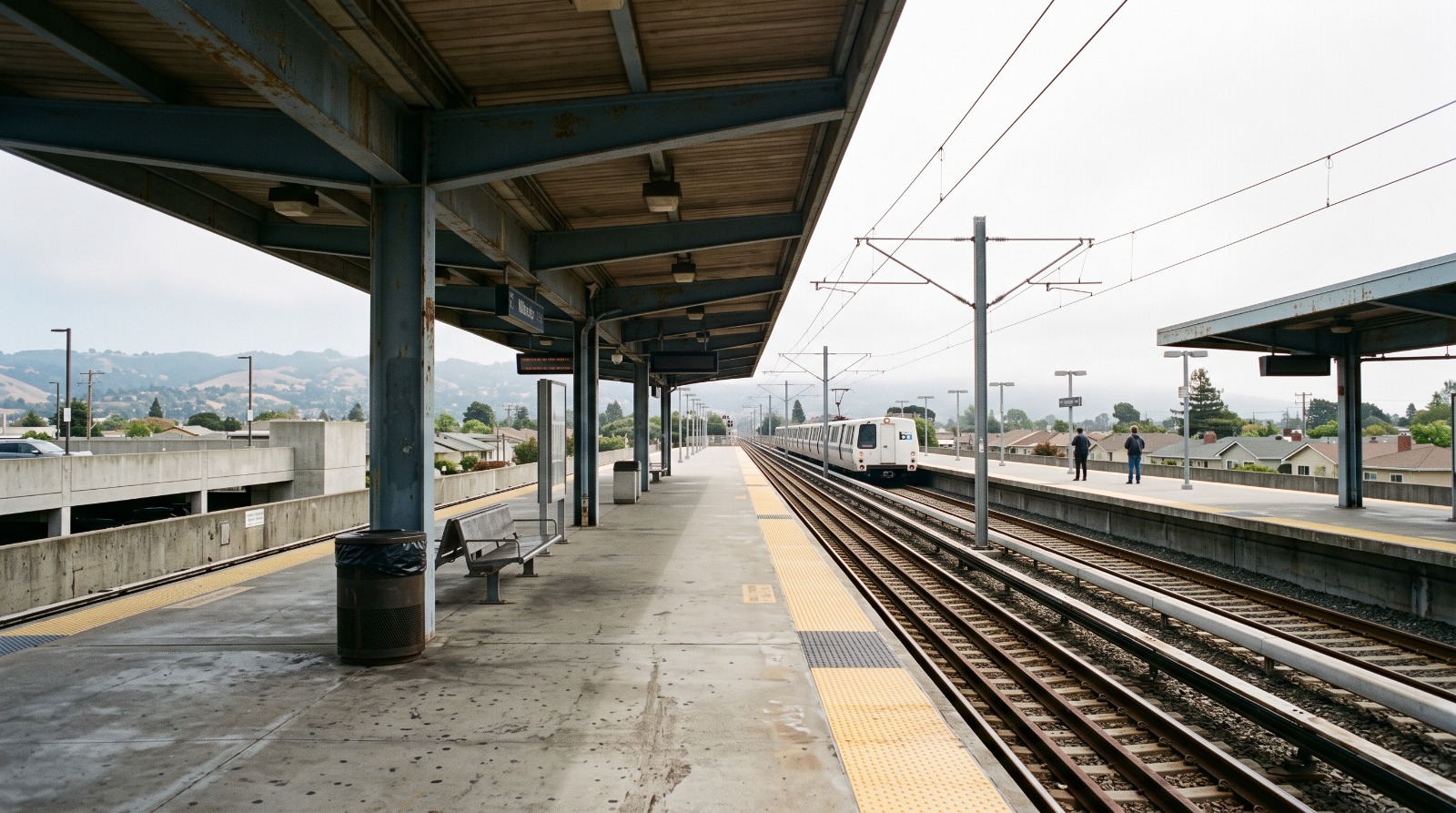
The Millbrae station platform in San Mateo County, the Peninsula's only BART and Caltrain connection and a focus of the Connect Bay Area transit tax debate. Photo: Houseberry
Thirty-seven percent. That is the share of the money San Mateo County shoppers would raise under the Connect Bay Area transit tax that comes back to San Mateo County to spend. The other 63 percent leaves.
That single number is the most useful thing a Peninsula homeowner can know about the measure now that it is locked in. The Metropolitan Transportation Commission certified Connect Bay Area for the November 3 ballot on June 30, after signature gatherers turned in more than 305,000 raw signatures and an estimated 235,503 came back valid against a bar of 205,831. It is a 14-year sales tax, a half cent in San Mateo, Santa Clara, Alameda, and Contra Costa counties and a full cent in San Francisco, authorized by SB 63 in 2025.
We are not going to tell you how to vote. We are going to lay out the money, because the money is where the Peninsula story diverges from the regional story, and because the regional coverage has almost entirely skipped it.
The arithmetic, county by county
SPUR published the comparison in June and it is worth staring at. San Mateo County generates roughly $135 million a year at the half-cent rate by fiscal 2031, per the San Mateo Daily Journal's reporting on the district's deliberations, and about $50 million of that returns to local control. Santa Clara County generates roughly $300 million a year at the same rate and keeps about $264 million.
Same tax rate. Wildly different return.
| County | Rate | Generated per year | Returned to local control | Share kept |
|---|---|---|---|---|
| San Mateo | half cent | about $135 million | about $50 million | about 37% |
| Santa Clara | half cent | about $300 million | about $264 million | about 85% |
The reason is structural, not political. Santa Clara County's transit is mostly VTA, a county agency, so money spent on transit in Santa Clara County is by definition local. San Mateo County's rail service is BART and Caltrain, both of which are multi-county operators with their own budget holes. Money that keeps a Caltrain train running through Redwood City is not "returned to source" in the accounting even though the train stops in San Mateo County six times.
That is the honest defense of the split, and it is a real one. It is also why SamTrans board member Jackie Speier was the lone no vote when the district opted in, arguing that residents lose local control, and why board president David Canepa framed his yes around accountability being nonnegotiable. Speier's line, per the Daily Journal, was that over $600 million of San Mateo County money would flow to BART and Muni alone across the life of the measure. That is accurate arithmetic.
What the $50 million is committed to
SamTrans adopted its local investment framework on June 3, and unlike most spending plans this one has actual percentages attached:
- Protect, 45 percent, meaning preventing service cuts to existing routes
- Enhance, 30 percent, reliability and rider experience
- Expand, 20 percent, service to underserved communities
- Fix, 5 percent, infrastructure maintenance
Over 14 years that is roughly $700 million for San Mateo County, administered by SamTrans, with the percentages recalibrated about every three years. Forty-five percent to simply not cutting what already exists tells you where the agency thinks it is.
The other side of the ledger is four stations
Here is where this stops being a budget abstraction for anyone who owns a home in northern San Mateo County.
BART is carrying a $376 million annual deficit and has adopted a backup plan that takes effect if the measure fails. For the Peninsula, the plan closes South San Francisco and San Bruno in January 2027, then Colma and Millbrae in July 2027, leaving Daly City and SFO as the only BART stations in San Mateo County. BART spokesperson Chris Filippi described the logic as eliminating essentially every station built after 1994 as part of extension projects, with SFO, Milpitas, and Berryessa spared. Millbrae is the one county officials keep flagging, because it is the only place on the Peninsula where BART and Caltrain touch.
Caltrain has its own hole, an average annual deficit of about $75 million starting in fiscal 2027.
So put the Houseberry data next to the closure list, because the neighborhoods most exposed are not the ones people assume. These are the highest-scoring neighborhoods on amenities in each affected city, which is our proxy for how much walkable, everyday convenience a place already has to lose:
| BART station | Closure phase in the backup plan | Strongest local neighborhood on amenities | Amenities score |
|---|---|---|---|
| South San Francisco | Phase 1, January 2027 | Orange Park | 4.1 out of 5 |
| San Bruno | Phase 1, January 2027 | Downtown San Bruno | 3.7 out of 5 |
| Millbrae | Phase 2, July 2027 | Green Hills | 4.2 out of 5 |
| Daly City | Stays open | Original Daly City | 3.7 out of 5 |
Those are strong amenity scores. Millbrae's Green Hills at 4.2 and South San Francisco's Orange Park at 4.1 are in the upper tier for the Peninsula. These are not marginal places. They are exactly the kind of built-out, transit-adjacent neighborhoods that a buyer pays a premium for precisely because of the station, and San Bruno's downtown is the same story one stop north.
What this does and does not mean
It does not mean home values in those four cities are about to move. Nothing in a ballot measure moves a median. Caltrain still runs through San Bruno and Millbrae under every scenario, at reduced frequency in the bad one, so "loses BART" is not "loses rail."
It does not mean the 37 percent figure is a scandal. It means San Mateo County voters are being asked to fund a regional network they use, with a smaller local dividend than their neighbors to the south get, and reasonable people land in different places on whether that is a fair deal.
What it does mean, practically, is that transit risk is now a line item worth checking at the address level rather than the city level. If you are shopping in northern San Mateo County this fall, the useful question is not whether the measure passes. It is how much of your commute plan depends on one BART station specifically, and what your fallback looks like at 25-minute Caltrain headways. That is the same way we look at any neighborhood factor at Houseberry, one input among schools, safety, amenities, and price rather than a single make-or-break line. We wrote up the state's $590 million emergency transit loan in June, which is the bridge holding these agencies up until November decides the rest.
Four questions Peninsula buyers are asking
When do voters decide?
November 3, 2026. The measure was certified on June 30 and confirmed in early July, and it covers Alameda, Contra Costa, San Francisco, San Mateo, and Santa Clara counties.
What does the tax actually cost a household?
It is a half-cent sales tax, so it lands on taxable purchases rather than on your property tax bill. A household spending $30,000 a year on taxable goods pays about $150 a year. That is our arithmetic, not an official estimate, and groceries and rent are not taxable, so most households will land below that.
If San Mateo County votes no but the region votes yes, what happens?
The measure is regional, and that is precisely the objection Speier raised. A county can be outvoted, which is why the local-control argument has had traction on the Peninsula even among people who ride the trains.
Should transit risk change which Peninsula neighborhood I buy in?
It should change what you verify, not necessarily where you look. Confirm which rail lines actually serve the address, check the walk time to the station you would really use, and look at how the neighborhood scores on amenities on its own merits. A place that only works with a train is a different bet than a place that would still be convenient without one.
Sources
- Metropolitan Transportation Commission: Connect Bay Area transit measure certified for November 2026 ballot
- SPUR: What the regional transit measure means for local investment in Santa Clara and San Mateo counties
- SamTrans: Connect Bay Area local investment plan
- San Mateo Daily Journal: San Mateo County opts into transit tax
- San Mateo Daily Journal: BART warning of 15 station closures if ballot measure fails
- Mass Transit: Connect Bay Area ballot measure qualifies for November ballot
All information provided on this website including but not limited to - school ratings, safety, amenities, user opinions, and property data - is for general informational purposes only. We do not guarantee its reliability, accuracy, or completeness. Users should independently verify information and consult appropriate professionals as needed. By using this website, you agree Houseberry is not responsible for actions, decisions, or consequences arising from reliance on the information provided
houseberry.com - CA DRE# 01847391
 Bay East ©2025. CCAR ©2025. bridgeMLS ©2025. Information Deemed Reliable But Not Guaranteed. This information is being provided by the Bay East MLS, or CCAR MLS, or bridgeMLS. The listings presented here may or may not be listed by the Broker/Agent operating this website. This information is intended for the personal use of consumers and may not be used for any purpose other than to identify prospective properties consumers may be interested in purchasing. Data last updated at September 13, 2026 12:00 AM