Santa Rosa's Affordable Housing Math Is Getting Harder
Santa Rosa has built 1,465 affordable homes since 2020, but the wildfire recovery money that paid for them is gone and the grant funding left over covers about $79,000 of a unit. Here is what the North Bay supply squeeze means for buyers.
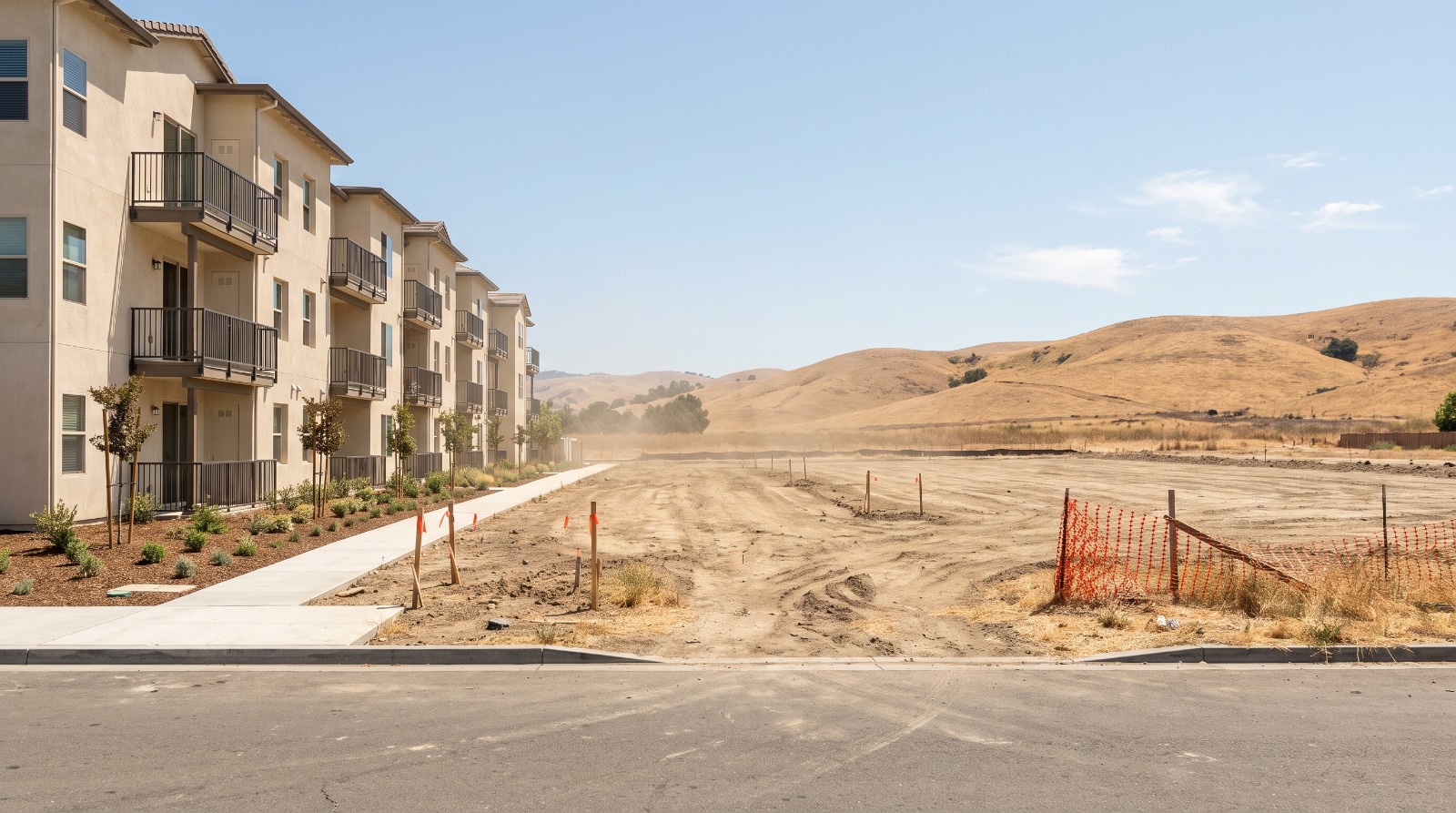
A finished affordable apartment building in Santa Rosa beside an empty graded lot with no construction underway, illustrating the stalling Santa Rosa affordable housing pipeline. Photo: Houseberry
Seventy-nine thousand dollars.
That is roughly how much of a single new affordable unit Santa Rosa can cover with the grant money it reliably receives. The city pulls up to about $3.5 million a year from federal Community Development Block Grants and state housing funds, and against the cost of building one home in Sonoma County in 2026, that money stretches about $79,000 per unit. The rest has to come from somewhere else. For eight years, the somewhere else was fire money. That is gone.
If you are shopping the North Bay because it is the last corner of the Bay Area where a buyer still has leverage, this is the number to understand. Not the median. This one.
What Santa Rosa actually delivered, and how
Give the city its due, because the record is better than most of its neighbors.
Santa Rosa is halfway through a state-assigned target of 5,326 new homes by 2031, of which 1,953 have to be reachable for lower-income households. It has finished about 1,465 affordable homes since 2020. That is a real number, and it is the kind of number most Bay Area cities cannot produce. Santa Rosa did it by stacking every funding source it could find and by getting out of developers' way on approvals.
The catch is what was in the stack. After the 2017 Tubbs Fire and the fires that followed, wildfire and disaster recovery funds poured into Sonoma County, and those dollars closed the financing gap on at least five affordable projects. Recovery money is, by definition, temporary. It has now dried up, state and federal housing budgets are contracting, construction costs have not come down, and the pipeline behind the current projects is visibly thinner.
So the honest read is not "Santa Rosa failed." It is "Santa Rosa succeeded using money that is not coming back, and now has to do the second half of the job on $3.5 million a year."
What this does to prices, and what it does not
Here is where I want to be careful, because thin affordable pipelines get written up as if they move the market next quarter. They do not.
A slowdown in subsidized housing production is a slow-acting force on prices. It shows up over years, as the gap between what people earn and what exists to rent or buy widens. What it does not do is push Santa Rosa's median home price around in 2026. Demand, rates, and inventory do that, and right now they are pointing up.
Our data has Santa Rosa's median home price at about $742,000 as of June 2026, up from roughly $614,000 a year earlier, with the 12-month low around $594,000 back in December. That is a real climb over twelve months, and it is happening in the market people keep describing as the affordable alternative.
| Median home price | Houseberry overall score | |
|---|---|---|
| Santa Rosa | ~$742,000 (June 2026) | 3.3 / 5 |
| San Francisco | ~$1.37 million (May 2026) | 3.5 / 5 |
Houseberry city data, July 2026.
Santa Rosa still costs a little over half of San Francisco and scores nearly the same overall, which is the whole North Bay pitch in one line. The pitch is real. It is also getting more expensive every quarter, and the supply that was supposed to relieve it just lost its funding.
Where the leverage actually is in Santa Rosa
City medians are blunt instruments. The spread inside Santa Rosa is what a buyer can actually use, and it is wide.
Northwest Santa Rosa, better known as Coffey Park, is the most interesting entry in our data, and it is interesting because the numbers argue with each other. The Tubbs Fire leveled roughly 1,300 homes there in a single night. What stands today is one of the most complete rebuilds in California, over 95 percent reconstructed, and the housing stock is by definition almost entirely post-2018. It scores a 4.5 out of 5 on safety, well above the city's 3.9, with a median around $667,000 as of June 2026.
And it still only ranks 21st out of 31 Santa Rosa neighborhoods overall, because its school score sits at 2.3. That is the trade in one neighborhood: the newest houses in the city, on quiet flat streets, feeding into schools our data scores below the city average. Nobody's marketing copy says that. It is exactly the kind of thing you want to know before you write an offer, not after.
At the other end, Downtown scores 2.6 overall with a 1.5 on safety despite sitting in the middle of the city's most visible reinvestment, and Bennett Valley, Fountaingrove, Skyhawk and Oakmont Village all sit at 3.7 and above. Same city, same median, radically different daily experience. If your reason for looking at Santa Rosa is that your dollar goes further, the more useful question is not whether to buy in Santa Rosa but which Santa Rosa, and that question is answerable with the full neighborhood ranking rather than a citywide average.
One thing the fire history does force into the conversation, and it belongs there: insurance. A rebuilt Coffey Park home and a Fountaingrove hillside home carry very different premiums, and in this county that difference can outweigh a $50,000 gap in list price. Get a quote before you fall in love with a house, not after.
Quick answers
Is Santa Rosa still cheaper than the rest of the Bay Area?
Yes, meaningfully. At roughly $742,000, its median sits at about 54 percent of San Francisco's. But our price history has that median climbing from about $614,000 last July, so the discount is narrowing, not widening.
Will the affordable housing slowdown push Santa Rosa prices up?
Not by itself, and not this year. Less subsidized supply tightens the market gradually over years. Rates and inventory are what set the price you pay next spring.
What should a buyer take from this?
That the North Bay's affordability advantage is a real thing being slowly eroded, and that the erosion is uneven across neighborhoods. Compare the block, not the city, and price the insurance before the mortgage.
How to use this
Do not treat a thinning affordable pipeline as a reason to rush or a reason to wait. Treat it as confirmation that the North Bay's discount has a shelf life, and that the useful work is narrowing down which neighborhood in Santa Rosa fits, on schools, safety, wildfire exposure, and daily convenience.
That is the whole reason we build these scores. The city guide gets you the headline. The Santa Rosa neighborhood pages get you the part that actually determines how a home lives.
Sources
All information provided on this website including but not limited to - school ratings, safety, amenities, user opinions, and property data - is for general informational purposes only. We do not guarantee its reliability, accuracy, or completeness. Users should independently verify information and consult appropriate professionals as needed. By using this website, you agree Houseberry is not responsible for actions, decisions, or consequences arising from reliance on the information provided
houseberry.com - CA DRE# 01847391
 Bay East ©2025. CCAR ©2025. bridgeMLS ©2025. Information Deemed Reliable But Not Guaranteed. This information is being provided by the Bay East MLS, or CCAR MLS, or bridgeMLS. The listings presented here may or may not be listed by the Broker/Agent operating this website. This information is intended for the personal use of consumers and may not be used for any purpose other than to identify prospective properties consumers may be interested in purchasing. Data last updated at September 14, 2026 12:00 AM