San Francisco's 15% to 5% Affordable Housing Cut, Explained
San Francisco is about to cut its inclusionary housing requirement from 15 percent to 5 percent, and drop it entirely for small buildings. Here is what the ordinance actually does, what the city's own analysis says about it, and the catch nobody is talking about.
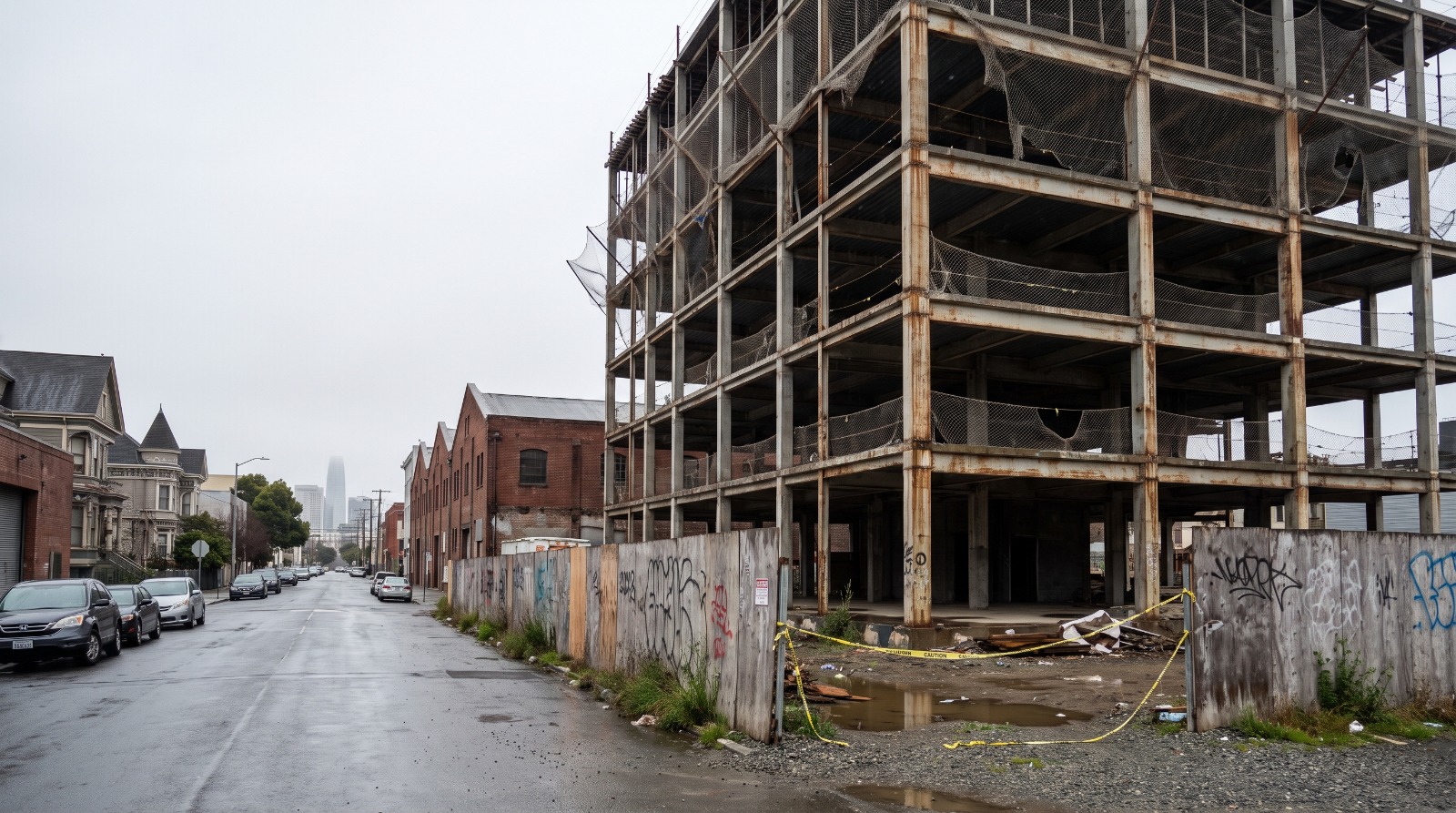
A stalled, half-built apartment frame on a San Francisco street, the kind of stuck project the city's inclusionary housing cut from 15 percent to 5 percent is meant to restart. Photo: Houseberry
The most useful thing anyone said at the committee hearing came from the mayor's own staff, and it undercut the entire proposal.
Jacob Bintliff, the economic recovery director in the Mayor's Office of Housing and Economic Development, told the Government Audit and Oversight Committee that a detailed feasibility study found no housing project is financially feasible in San Francisco today, even if the affordable housing requirement were eliminated entirely. Not reduced. Eliminated. Zero.
The committee then voted to send a reduction to the full Board of Supervisors, which takes it up Tuesday. San Francisco inclusionary housing is about to drop from 15 percent to 5 percent anyway.
I am about as pro-building as it gets, and I still think that sequence deserves a raised eyebrow.
What the ordinance actually does
The legislation, sponsored by Mayor Daniel Lurie along with Supervisors Myrna Melgar, Matt Dorsey, Stephen Sherrill and Danny Sauter, rewrites the Planning Code's inclusionary program and cuts development impact fees at the same time. Two changes matter.
| Project size | Requirement today | Under the ordinance |
|---|---|---|
| 25 units or more | 15 percent of units must be below market rate | 5 percent, for at least three years |
| Under 25 units | Below market rate requirement applies | No on-site requirement at all |
Run the arithmetic on a real building. A 100-unit project on Van Ness owes 15 below-market-rate homes today. Under the new rule it owes 5. A 24-unit infill building in the Mission owes several today. Under the new rule it owes none.
That is a large giveaway on paper. The counterargument, which is not stupid, is that 15 percent of a building nobody finances is zero homes, and 5 percent of a building that actually gets built is 5. San Francisco finished about 405 homes in the first half of 2026 while sitting on a paper pipeline of roughly 75,000 units. Fifteen percent of that gap is a rounding error. The city's inclusionary revenue tells the same story: it topped $20 million a year before the pandemic and has averaged closer to $2 million a year since 2020, not because the rate fell, but because the buildings stopped.
So the theory holds together. Cheaper math, more buildings, more of everything including affordable units. Fine.
The problem is that the city's own witness said the math still does not work at zero.
The city's own study says 5 percent is not what restarts a project
This is where the honest version of the pro-housing argument has to be careful, because our side has a bad habit of blaming every stalled project on a regulation.
The binding constraints in San Francisco right now are interest rates, construction costs, and capital that has quietly walked out of housing and into data centers. The city controller's own feasibility work concluded that even market-rate housing does not pencil at current costs. Inclusionary is a real cost. It is not the cost that is killing these projects.
Supervisor Jackie Fielder, back from medical leave, put it in one line that nobody at the hearing answered: "If macroeconomics is the culprit, why are we reducing inclusionary housing?"
Here is my answer, and it is a grudging yes rather than an enthusiastic one. Cutting inclusionary today does not restart construction today. What it does is lower the strike price for the moment financing loosens, so that when capital comes back, San Francisco is not the one city on the West Coast where the numbers still fail. You do not fix the pipeline by holding a rate high out of principle while nothing gets built. But you should be honest that you are buying an option on a future recovery, not flipping a switch now. City Hall is selling it as a switch.
This is the 2012 grand bargain, running again
The part that makes a longtime reader of these agendas laugh, or wince, is that we have done this exact trade before.
San Francisco's Housing Trust Fund was created by ballot measure in 2012, and the deal that created it was a grand bargain: a dedicated pot of affordable housing money in exchange for lower inclusionary rates on new construction. Voters went back in 2016 and adjusted the rates again. Fourteen years later, the identical shape has returned. Supervisor Melgar has cut a deal with Mayor Lurie to roughly double the Housing Trust Fund to $125 million a year, up from about $52 million today, extended thirty years, funded by capturing a share of the future property tax growth that the city's own upzoning created. In exchange, the nonprofit affordable housing developers stand down and let the inclusionary rate fall.
Melgar calls the funding mechanism a socialist principle, which is a fun thing to say out loud at City Hall: the city conferred value on private land by upzoning it, so the city takes a slice of that value back for low-income housing. She is not wrong, and the trust fund half of this bargain is genuinely good policy.
But it is the second time San Francisco has traded inclusionary percentage points for a trust fund, and last time the trade did not permanently settle anything. Nobody should present this as the end of the argument. It is the next round of the same argument.
The catch Fielder is right about
Two pieces of fine print deserve more attention than they are getting.
First, the trust fund is not law. It is a charter amendment that goes to voters in November, and it needs a simple majority to pass. The inclusionary cut, by contrast, becomes law on Tuesday if the board approves it. If the ballot measure fails in the fall, San Francisco will have given away the affordable units and received nothing at all. Fielder suggested waiting until after November for exactly that reason and got voted down in committee, two to one, with Supervisors Bilal Mahmood and Stephen Sherrill in favor of moving ahead.
Second, and this is the detail almost nobody has picked up: the $125 million does not arrive in 2027. The city will hold the trust fund at its current level through the budget crisis and only begin increasing it in fiscal year 2029 and 2030, and it will take several years after that to climb to $125 million. The inclusionary cut takes effect immediately. So even in the best case, where voters approve the measure in November, the affordable requirement drops now and the money that is supposed to replace it shows up gradually over the back half of the decade.
That is not a scandal. Budgets are budgets. But "we traded 10 points of inclusionary for $125 million a year" and "we traded 10 points of inclusionary now for $125 million a year starting around 2030, if voters agree" are different sentences, and only one of them is being said out loud.
Fielder also raised the displacement point, noting the city has lost roughly 12,000 Latino families since 2000, and that the bargain in neighborhoods like the Mission was always more height and density in exchange for high affordability. She is describing a real promise. Breaking it may still be the right call. It should at least be named as a broken promise rather than a technical adjustment.
Three questions people are actually asking
Will this make homes cheaper in San Francisco?
Not directly, and not soon. The ordinance lowers a cost for developers, not a price for buyers. San Francisco's median home price was about $1.37 million in May 2026 in our city data, and nothing in this vote moves that number this year. The realistic case is more units delivered in the late 2020s, which helps at the margin.
Does it mean fewer below-market-rate units?
Per building, yes, from 15 percent down to 5, and buildings under 25 units would owe nothing on site. Whether it means fewer BMR units in total depends entirely on whether more buildings actually get built, which is the bet the city is making. If construction stays flat, this is a straight loss.
What should I watch instead of the vote?
The November ballot measure on the Housing Trust Fund. That is the half of the bargain that can still fail, and it is the half that pays for affordable housing. Watch it more closely than Tuesday's headline.
What this means if you are comparing San Francisco neighborhoods
Very little, in the short run. That is the unglamorous truth.
The way we look at it when we compare neighborhoods, a policy change like this one belongs in the same mental category as SB 79's transit density rules: it changes what is legal and financeable years from now, not what is standing on a block today. If you are buying in the Mission or the Sunset this fall, the schools, the safety, the amenities, and the price on that street are what you are actually purchasing. Read those. The way our own San Francisco neighborhood scores shake out, the gap between two districts a mile apart is bigger than anything the Board of Supervisors will do to the inclusionary rate on Tuesday.
Just know what got traded, and by whom, and when the other half of it is supposed to arrive.
Sources
- 48 Hills: In a surreal hearing, supes move to cut affordable housing requirements
- Mission Local: S.F. eyes $125M annually for affordable housing, more than double current funding
- SF Planning: Inclusionary Affordable Housing Program
- Office of the Controller: Triennial Economic Feasibility Report, 2026
- San Francisco Charter, Sec. 16.110: Housing Trust Fund
All information provided on this website including but not limited to - school ratings, safety, amenities, user opinions, and property data - is for general informational purposes only. We do not guarantee its reliability, accuracy, or completeness. Users should independently verify information and consult appropriate professionals as needed. By using this website, you agree Houseberry is not responsible for actions, decisions, or consequences arising from reliance on the information provided
houseberry.com - CA DRE# 01847391
 Bay East ©2025. CCAR ©2025. bridgeMLS ©2025. Information Deemed Reliable But Not Guaranteed. This information is being provided by the Bay East MLS, or CCAR MLS, or bridgeMLS. The listings presented here may or may not be listed by the Broker/Agent operating this website. This information is intended for the personal use of consumers and may not be used for any purpose other than to identify prospective properties consumers may be interested in purchasing. Data last updated at September 14, 2026 12:00 AM