SF is ending the school lottery. The new lines aren't drawn yet
San Francisco's school board voted 5-2 to move to guaranteed neighborhood schools starting fall 2028. The policy is not final, the boundaries are not drawn, and the seat shortages fall where school scores are lowest.

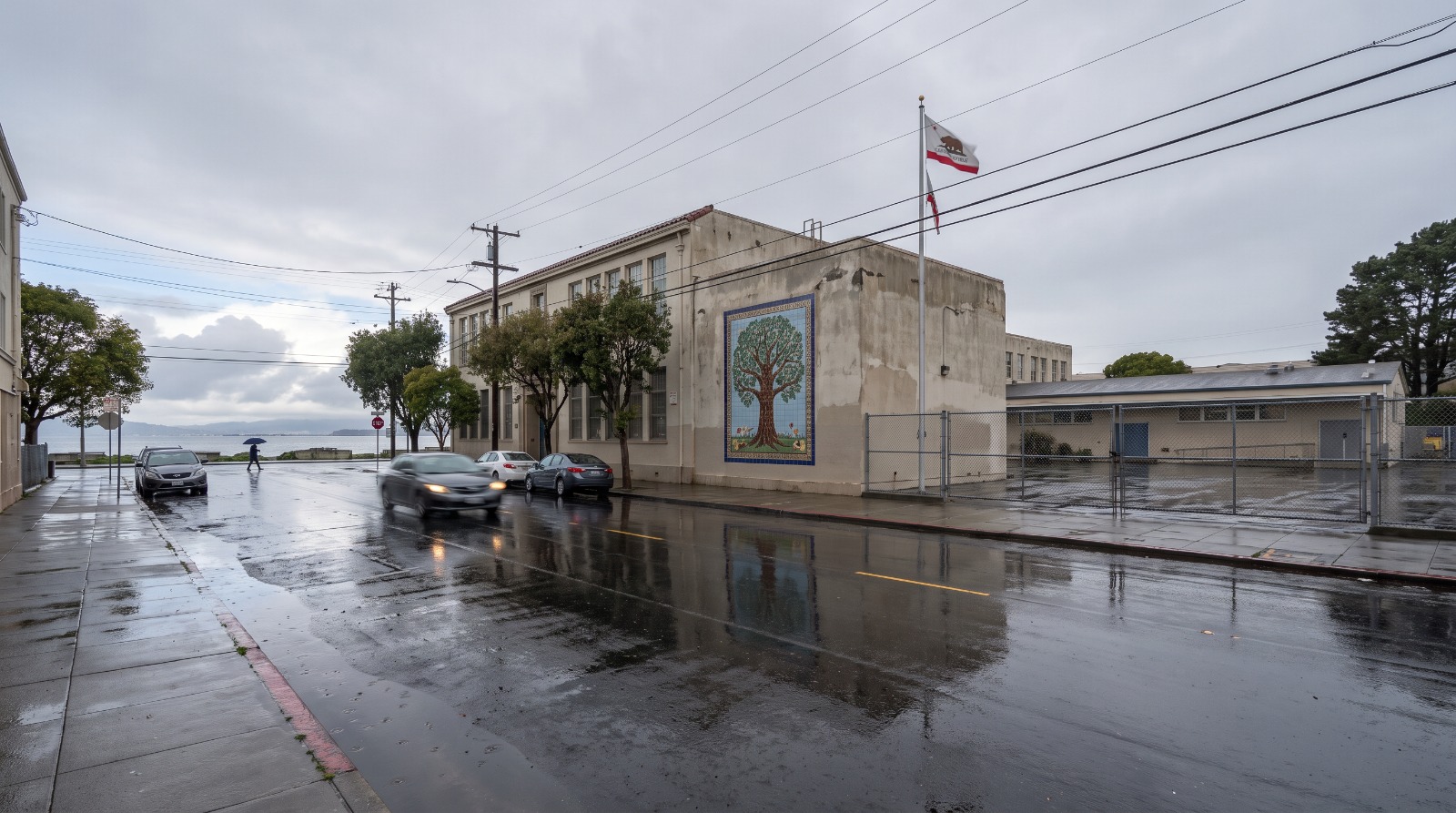
Daniel Webster Elementary School on Missouri Street on Potrero Hill in San Francisco after rain Photo: Houseberry
If San Francisco's school board follows through, a child starting kindergarten in fall 2028 will get a guaranteed seat at one school: the one assigned to their home address. No ranking a list of schools. No lottery. The only other options would be citywide programs like language immersion and K-8s, and those seats would not be guaranteed.
That is the plan the San Francisco Unified School District board backed 5-2 on Tuesday, October 13. It is not yet policy. The board voted to direct staff to build it, the 2011 lottery rules still govern, and the final vote is scheduled for April 13, 2027. The most important piece for homeowners, the map of which addresses go to which school, has not been drawn.
The district's own projections show where that map will be hardest to draw. By 2033, 19 of the 58 attendance areas are expected to run about 320 kindergarten seats short, and the shortfalls cluster in the southeast and the central city. In Houseberry's data, the 12 San Francisco neighborhoods in those areas average a school score of 2.18 out of 5, against 3.24 across all 92 neighborhoods we rank.
Is it official?
Not the policy, only the direction. The district's calendar labels the October 13 item "set assignment policy direction," and KQED described the vote as directing staff to propose the system. Board President Phil Kim, Vice President Jaime Huling, Matt Alexander, Lisa Weissman-Ward and Parag Gupta voted yes. Alida Fisher and Supryia Ray voted no.
Here is what still has to happen, from the district's school reorganization page.
| Date | Step |
|---|---|
| November 10, 2026 | Study session on where school programs go |
| December 2026 | Staff decide placement of language, citywide, special education and TK programs |
| January 12, 2027 | Board discusses those program decisions |
| February 2 and March 16, 2027 | Study sessions on the draft policy |
| April 13, 2027 | Board votes to adopt, revise or revoke the assignment policy |
| May 18, 2027 | Rollout plan |
| Fall 2027 | Applications open for 2028-29 |
In between, staff and demographers have to redraw the attendance boundaries, settle tiebreakers for citywide seats, and decide whether siblings get priority. A different board majority in April could still change it, or kill it. San Francisco has been here before. The board approved a zone-based system 6-1 in December 2020, pushed its start date twice, and Superintendent Maria Su shelved it in April 2025.
How assignment works today, and what changes
Under the current system, families rank as many schools as they like. Living inside a school's attendance area helps, but it is only the fifth tiebreaker. Younger siblings go first, then children already in a PreK or TK program in that area, then families from the low-test-score census tracts the district calls CTIP1, which cover about a fifth of the city. The attendance area comes after all of that.
It mostly works for families who want their local school. SF Standard reported that 93 percent of families who ranked their attendance-area school first got it. But the link between address and school is loose. The district said in 2022 that students from the same attendance area attended an average of 27 different schools.
| Question | Today | Under Option C |
|---|---|---|
| What your address gets you | A tiebreaker, fifth in line | A guaranteed seat, even for late applicants |
| Attendance-area lines | 58, unchanged since 2010 | Redrawn before fall 2028, not yet proposed |
| Choosing other schools | Rank as many as you want | Only citywide programs, no guarantee |
| Language immersion and K-8s | Citywide, no attendance area | Stay citywide unless converted |
| Students already enrolled | Stay put | Stay put |
Citywide and language programs hold about 40 percent of elementary seats, according to the district. That is the lever staff will pull if new lines alone cannot close the gap.
Where the new lines will be hardest to draw
The district's study sessions put numbers on it. Redrawing boundaries closes about half of the projected 320-seat kindergarten shortfall, leaving about 165 seats short, SF Standard reported. The rest would mean converting two or three citywide K-8 schools into neighborhood schools, or moving or converting four to eight language programs. The largest gaps are around Mission Bay and Daniel Webster Elementary on Potrero Hill. Bayview-Hunters Point, Visitacion Valley, Mission Bay and the central city came up short on every map the district tested.
Those are the areas where Houseberry's school scores run lowest.
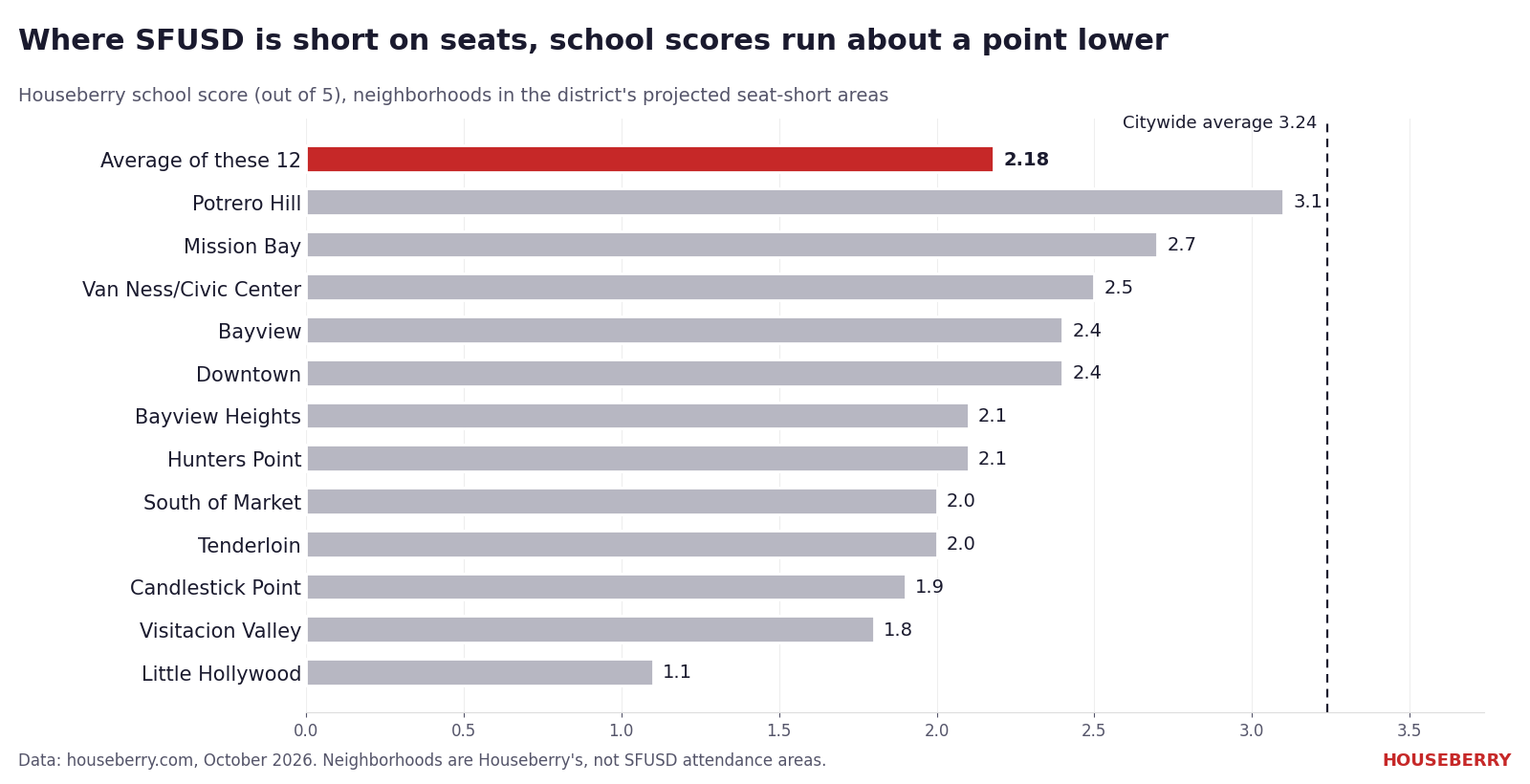
Mission Bay scores 2.7 on schools, with a typical home price of about $1.50 million in September 2026. Potrero Hill, where Webster sits, scores 3.1 at about $1.55 million. Visitacion Valley scores 1.8 at about $1.05 million, and Bayview scores 2.4 at about $916,000. Across the city, 24 of our 92 ranked neighborhoods score 4.0 or better on schools, and 20 score below 2.5.
Houseberry's school scores reflect state test results for the public schools serving each neighborhood, and our neighborhoods are not the district's attendance areas. The point is narrower. The places that need the most new seats are the places where current schools score lowest, so the redraw there will decide more than a boundary.
What the trade-off looks like in the district's own numbers
Stanford researchers ran simulations for the district, and SF Standard published them. Under Option C, the share of students attending a school within half a mile rises from 35 percent to 48 percent. The share getting their first choice falls from 67 percent to 54 percent. For Black students, first-choice results fall from 86 percent to 49 percent, and the share of Black, Latino and Pacific Islander students in high-poverty schools rises from 42 percent to 51 percent.
Families noticed. In a district survey of 2,725 families, 71 percent said Option B, which kept the guarantee but let families apply anywhere, would meet their needs. Forty-eight percent said that of Option C. Fisher, voting no, said "neighborhood schools by definition will be segregated schools." Su, who recommended Option C, told the board the school down the street "should be a good option and a certain one."
We think a guaranteed seat near home is a real gain for most San Francisco families, who today spend a winter ranking schools across town. But the vote decided almost none of what makes it work. The lines, the language-program moves and the sibling rule are all still open, and the board that approved a zone plan in 2020 never used it.
What it means if you are buying
Do not pay for a line that has not been drawn. A house inside today's attendance area for a popular school gets a fifth-place tiebreaker now and no promise about 2028, because the boundaries will be redrawn and the district says families will not know their neighborhood school until spring 2027 at the earliest. Our earlier look at the vote maps where San Francisco's highest school scores sit today.
The first real answer comes with the draft policy in February. Until then, our San Francisco school rankings show how every neighborhood scores right now, which is the only map that exists.
Sources
The Houseberry Research Team is Houseberry's reporting team: Bay Area real estate analysts, data specialists and longtime local market watchers. Every day we check the public record: building permits, city council and planning agendas, county recorder filings, state housing bills, police incident data and school results. Then we tie each story to what it means for specific neighborhoods, using Houseberry's own neighborhood data on prices, appreciation, safety, schools and amenities. Questions or corrections: Contact us.
Map of San Francisco Neighborhoods
Loading map...
View Full Map
Top Neighborhoods in San Francisco, CA





All information provided on this website including but not limited to - school ratings, safety, amenities, user opinions, and property data - is for general informational purposes only. We do not guarantee its reliability, accuracy, or completeness. Users should independently verify information and consult appropriate professionals as needed. By using this website, you agree Houseberry is not responsible for actions, decisions, or consequences arising from reliance on the information provided
houseberry.com - CA DRE# 01847391
 Bay East ©2025. CCAR ©2025. bridgeMLS ©2025. Information Deemed Reliable But Not Guaranteed. This information is being provided by the Bay East MLS, or CCAR MLS, or bridgeMLS. The listings presented here may or may not be listed by the Broker/Agent operating this website. This information is intended for the personal use of consumers and may not be used for any purpose other than to identify prospective properties consumers may be interested in purchasing. Data last updated at October 18, 2026 12:00 AM