Treasure Island’s First Condos Opened as Rentals
Treasure Island’s first condo building just opened as rentals. Here is what daily life on the island really looks like before you decide to rent or buy there.

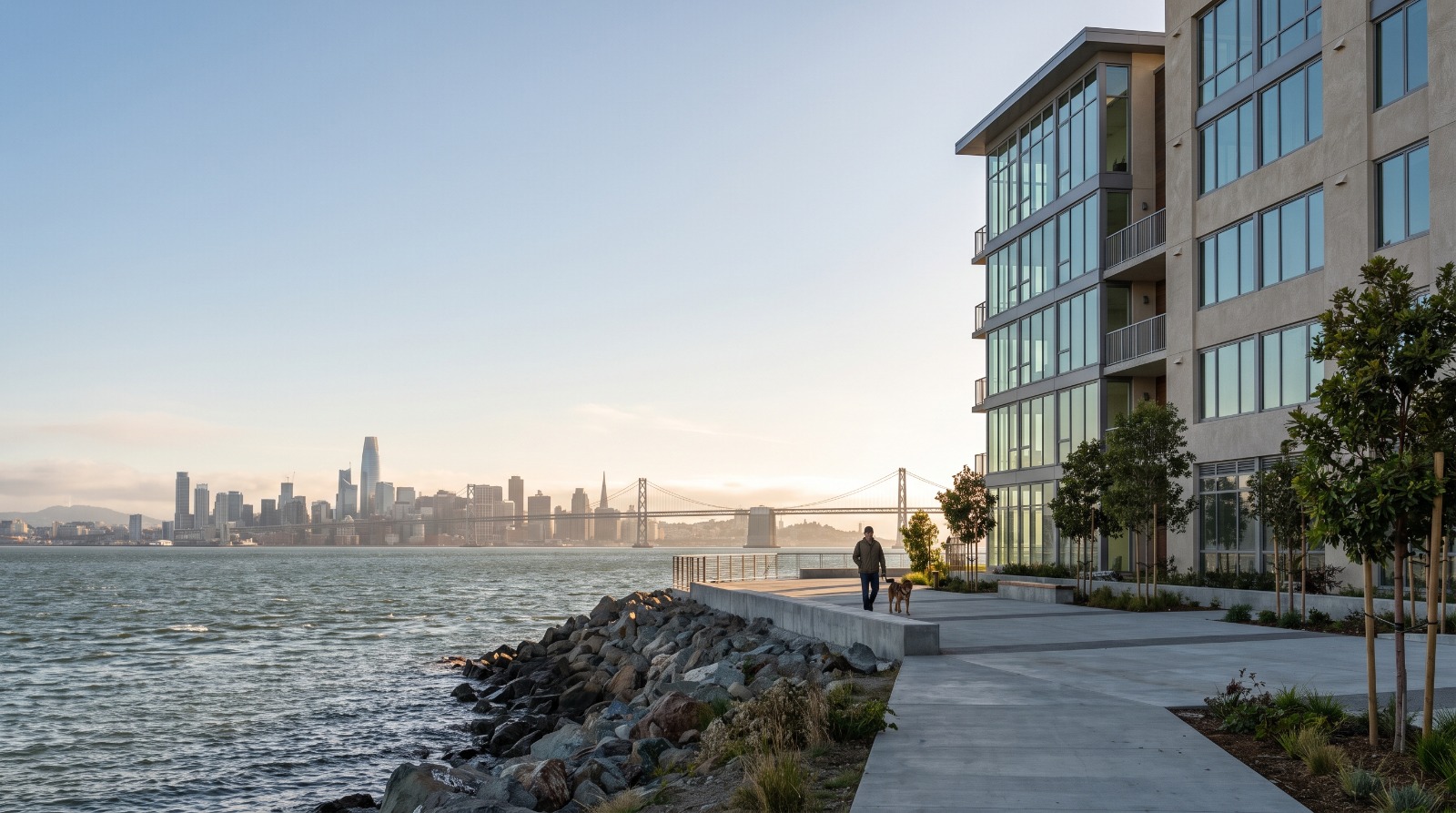
The San Francisco skyline across the bay from Treasure Island, where the first condos just opened as rentals. Photo: Houseberry
The news last week was that Treasure Island finally got its first condominium building. Look a little closer at 490 Avenue of the Palms, though, and the story turns quieter and more useful. The six-story building opened on July 17, and the 148 homes that were designed and marketed as condos are going out as rentals instead. The building’s own web address now points to an apartments site with 52 floor plans and a rent button, not a sales office.
That one detail tells you more about living on Treasure Island right now than any rendering. The view across the bay is real. So are the tradeoffs. Here is what a day on the island actually involves before you decide to rent, buy, or keep looking elsewhere.
The building meant to sell is renting instead
490 Avenue of the Palms opened this month with 148 units, including 34 front-row homes marketed as the Palms Collection. It was pitched as the island’s first for-sale condos. The developer, a group that includes Lennar, Stockbridge, and Wilson Meany, pivoted to leasing, and the units are now going out for rent. It is not the only new building doing this. Isle House, a 250-unit tower, opened as luxury rentals in 2024. The Hawkins started pre-leasing recently, with studios around $2,800 a month and three-bedrooms above $7,200, according to reporting on the project’s rollout.
For anyone hoping to own something new out here, that matters. The freshest housing on Treasure Island is mostly for rent, not for sale. If you want to buy, you are largely looking at resale in the earlier buildings or the pricier homes on the Yerba Buena side. Renting first is a low-risk way to test whether island life fits you before you commit to owning it.
One ferry, one bridge, and the last boat home
The best thing about Treasure Island is also the thing that shapes every day. It sits in the middle of the bay, about eight minutes by ferry from the Ferry Building. That commute is genuinely lovely. It is also finite. The regional transit plan describes permanent electric ferry service running roughly hourly, about 6 a.m. to 7 p.m., seven days a week, with the permanent version targeted for 2027. Miss the last boat and your options are the 25 bus or the Bay Bridge.
And there is only one way to drive on or off, across the western span. The city has a congestion-pricing program in the works to keep that bridge from clogging. Current residents are exempt, and the proposed tolls for new residents top out around $5 at peak depending on income, with a start date still to be set. Parking is not bundled into the housing either. If you are the kind of person who runs three errands across town on a Saturday, this is a different rhythm of life. If you want quiet and a ferry commute, it might be exactly right.
The grocery run is the real test
Here is the detail that never shows up in a listing photo. Treasure Island has one grocery store, Treasure Island Cove, a roughly 3,000-square-foot shop, and no full supermarket. A real grocery trip means the 25 bus to the Target at the Metreon or a Trader Joe’s, which turns a quick errand into an afternoon. A full-service market sits in the development renderings but has not been built. A weekly food bank on the island serves more than 100 families.
None of that makes Treasure Island a bad place to live. It makes it a specific one. The neighborhood around a home decides how that home actually lives day to day, and on an island that point is impossible to ignore. It is the same habit we bring to comparing neighborhoods at Houseberry, where we rank San Francisco’s neighborhoods on exactly these everyday factors rather than the finishes in the photos.
What the master plan promises, and where it stands
The long-term vision is big and, on the merits, good. The approved plan calls for about 8,000 homes, roughly 300 acres of parks and open space, and around 2,000 permanently affordable units, a quarter of the total. The island was physically raised to guard against sea-level rise. After the 2011 approval, about 1,200 homes are finished or nearly so, which is around 15 percent of the buildout. Lawsuits and a slow housing market stretched the timeline.
Eight thousand homes in the middle of the bay is the kind of supply the region badly needs, and the frustrating part is the pace, not the density. As the developer Chris Meany put it, the island now has housing for formerly homeless residents and some of the most expensive homes in the Bay Area on the same patch of land. That mix is the neighborhood being built. It just will not feel finished for years.
So is Treasure Island a good place to live?
It depends on how you weigh the trade. On one side: big-sky views, a ferry commute a lot of people would envy, quiet streets, and car-light living. On the other: one grocer, one bridge, a day shaped by the ferry schedule, and a neighborhood still under construction. There is no single right answer, only the honest question of which of those you would feel most, every day.
If you are weighing it against other parts of the city, look at the daily-life factors, transit reliability, groceries, schools, and parks, the same way you would research any address. Our earlier look at 199 new homes opening in the Outer Sunset is a good companion, since it is another spot where the ocean view and the daily commute pull in different directions. And because the newest homes here are rentals, leasing for a season is a low-risk way to find out whether the ferry romance survives a rainy February. If it does, the full San Francisco neighborhood picture is worth a longer look before you buy.
Sources
SF YIMBY: Phase one of the Treasure Island redevelopment opens
CoStar: How this artificial island became a housing development model
San Francisco County Transportation Authority: Treasure Island Transportation Program
San Francisco Public Press: One grocer keeps Treasure Island fed
The Houseberry Research Team is Houseberry's reporting team: Bay Area real estate analysts, data specialists and longtime local market watchers. Every day we check the public record: building permits, city council and planning agendas, county recorder filings, state housing bills, police incident data and school results. Then we tie each story to what it means for specific neighborhoods, using Houseberry's own neighborhood data on prices, appreciation, safety, schools and amenities. Questions or corrections: Contact us.
All information provided on this website including but not limited to - school ratings, safety, amenities, user opinions, and property data - is for general informational purposes only. We do not guarantee its reliability, accuracy, or completeness. Users should independently verify information and consult appropriate professionals as needed. By using this website, you agree Houseberry is not responsible for actions, decisions, or consequences arising from reliance on the information provided
houseberry.com - CA DRE# 01847391
 Bay East ©2025. CCAR ©2025. bridgeMLS ©2025. Information Deemed Reliable But Not Guaranteed. This information is being provided by the Bay East MLS, or CCAR MLS, or bridgeMLS. The listings presented here may or may not be listed by the Broker/Agent operating this website. This information is intended for the personal use of consumers and may not be used for any purpose other than to identify prospective properties consumers may be interested in purchasing. Data last updated at October 18, 2026 12:00 AM