Woodland Park and the Remaking of East Palo Alto
About 819 new homes and 536 renovated apartments are on the table in Woodland Park, the largest reshaping of East Palo Alto's rental stock in a generation. Here is what residents are organizing around and what the neighborhood looks like today.

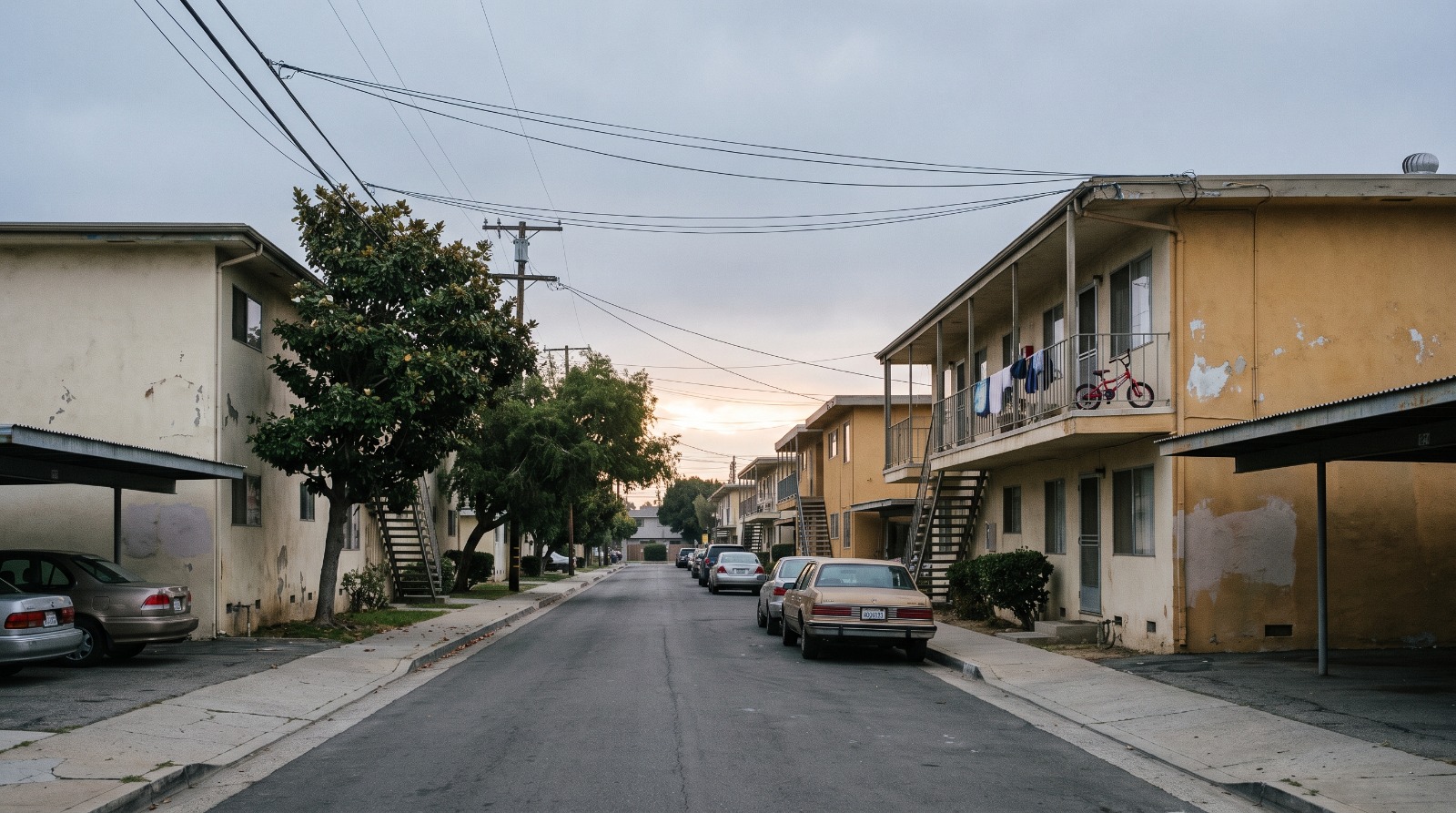
Two-story garden apartment buildings on a residential street in the Woodland Park neighborhood of East Palo Alto on a foggy morning. Photo: Houseberry
Renters in Woodland Park have one question right now, and it is a narrow one. Will the apartment they live in still be theirs in five years, at a rent they recognize? Woodland Park Communities, the Sand Hill Property affiliate that has been buying up this East Palo Alto neighborhood since 2016, has pre-applications in for roughly 819 new homes while renovating 536 existing apartments, and residents began organizing around it this month.
The short answer, based on what has actually been filed: nothing is entitled, nothing is approved, and the developer has committed in writing to replacing every rent-stabilized unit one for one, at the same rent, with the same number of bedrooms. That commitment is a promise on a website, not a condition of approval. The distance between those two things is the entire story of the next two years in East Palo Alto.
What is actually on the table
Two pre-applications are moving, and they cover different corners of the same neighborhood. The West Bayshore and Newell area would add 253 apartments and 60 townhomes while renovating 315 existing units across eight buildings. The O'Keefe and Manhattan area would add 392 apartments and 114 townhomes while renovating 221 existing ones. That is 819 new homes and 536 renovated ones, as The Real Deal detailed in May 2026.
You will see bigger numbers in other coverage, and they are not wrong. Counting the older Euclid Avenue improvement area and everything the company controls, the full program has been described as more than 1,300 units. Which number you use depends on which filings you are counting. The 819 figure is the one attached to paperwork the city has in hand right now, so that is the one worth holding onto.
For scale: East Palo Alto has roughly 30,000 residents in about two and a half square miles. Adding 819 homes to a city that size moves the whole rental market.
Why the one-for-one promise is the whole ballgame
East Palo Alto has had rent stabilization since 1988 and a modernized ordinance since 2010, and it covers most residential tenancies in the city along with just-cause eviction protection. Woodland Park is where a large share of those units physically are. So the pledge on the developer's own project site, that all existing rent-stabilized units will be replaced one for one and that every current tenant can stay, is doing enormous work.
Residents have a concrete reason to want that in an ordinance rather than a FAQ. In April 2026, Palo Alto Online reported that the city had granted a group of these tenants rent relief and the developer declined to pay it. Whatever the merits of that particular dispute, it is the kind of thing that teaches a neighborhood to read the fine print. Organizing now, before entitlements, is the only moment when tenants have leverage over what gets written into the conditions of approval.
Here is the part worth being fair about. Replacing aging 1960s garden apartments is genuinely good for the people living in them, assuming they get to come back. Single-pane windows, failing plumbing and no insulation are not heritage. A rebuild that adds 819 homes and keeps every stabilized unit would be one of the better outcomes available in this region. It has just never been done at this scale here, which is why nobody in Woodland Park is taking it on faith.
What East Palo Alto looks like right now, by the numbers
This is the part people search for and rarely get straight. East Palo Alto scores 2.9 out of 5 overall in our data, built from schools at 2.5, safety at 3.0, amenities at 3.5, public spaces at 4.0 and curb appeal at 3.0. The median sale price was about $1.12 million in July 2026, up from roughly $1.01 million a year earlier.
So why is East Palo Alto cheaper than everything around it? Not because of any single factor. The city spent decades with a thin commercial tax base and a school district that has struggled, and it carries a reputation that lags its actual present by roughly fifteen years. The safety score of 3.0 is mid-pack for the region and nowhere near the number the neighborhood's reputation implies. The public spaces score of 4.0 reflects real investment: Martin Luther King Jr. Park, Bell Street Park and a genuinely improved pedestrian network.
The schools picture needs care rather than a headline. Costano Elementary scores 0.7 out of 5 in our data, which is low by any measure. Menlo-Atherton High, which serves East Palo Alto students, scores 4.3. A family here can have a hard elementary experience and a strong high school one, and a single score at either end is a starting point for questions, not a verdict on a child.
The comparison that surprised us
Everyone reaches for Palo Alto as the comparison, and the gap there is exactly what you would expect: Palo Alto averages 4.2 out of 5 with a citywide median around $3.9 million in June 2026, roughly three and a half times East Palo Alto's. That comparison is famous and not very useful, because nobody is choosing between those two places.
The useful one is Belle Haven, the Menlo Park neighborhood on the other side of the Bayfront Expressway, close enough that some blocks share a bus stop. Belle Haven scores 2.4 out of 5, with safety at 2.1 and amenities at 2.8, and it ranks 14th of the 15 neighborhoods we score in Menlo Park. Its median sale price was about $1.31 million in July 2026.
Read those side by side. Belle Haven costs about $190,000 more and scores half a point lower. A buyer paying the Menlo Park premium there is buying the school district and the city name, not a better-scoring neighborhood. That is the sort of thing that only shows up when you look at the area before you look at the address, which is the habit we built Houseberry around.
How to think about this if you live here or are looking here
If you rent in Woodland Park, the calendar matters more than the renderings. Pre-application is early. The moment that decides your rent is when the city writes conditions of approval, and that is a public process with hearings you can show up to. Get the replacement commitment into the conditions, not the brochure.
If you are buying in East Palo Alto, understand what 819 new homes does and does not do. More supply in a small city usually softens rent growth and rarely softens for-sale prices, because the new units are apartments and townhomes, not the detached stock that sets the median. What it does change is the amenity base. A neighborhood that adds this many households tends to get retail, transit frequency and street improvements it could not previously support, and those are the inputs behind our amenities and public spaces scores.
And if you are comparing this city against the rest of the Peninsula, do it on the East Palo Alto ranking data rather than on what somebody told you in 2009. The thing that should actually give a buyer here pause has nothing to do with the safety score. It is that a neighborhood this consequential can be reshaped by pre-applications most residents only learned about from a newspaper.
Sources
- Palo Alto Online, "A neighborhood in limbo: Woodland Park residents organize amid redevelopment plans," August 21, 2026
- The Real Deal, "Sand Hill affiliate plots hundreds of apartments, townhomes in East Palo Alto," May 21, 2026
- The Registry, "Sand Hill's Woodland Park Communities Plans 1,300-Plus Units in East Palo Alto"
- Woodland Park Communities, project commitments (developer statements)
- City of East Palo Alto, Rent Stabilization Program
- Houseberry, East Palo Alto neighborhood data
The Houseberry Research Team is Houseberry's reporting team: Bay Area real estate analysts, data specialists and longtime local market watchers. Every day we check the public record: building permits, city council and planning agendas, county recorder filings, state housing bills, police incident data and school results. Then we tie each story to what it means for specific neighborhoods, using Houseberry's own neighborhood data on prices, appreciation, safety, schools and amenities. Questions or corrections: Contact us.
All information provided on this website including but not limited to - school ratings, safety, amenities, user opinions, and property data - is for general informational purposes only. We do not guarantee its reliability, accuracy, or completeness. Users should independently verify information and consult appropriate professionals as needed. By using this website, you agree Houseberry is not responsible for actions, decisions, or consequences arising from reliance on the information provided
houseberry.com - CA DRE# 01847391
 Bay East ©2025. CCAR ©2025. bridgeMLS ©2025. Information Deemed Reliable But Not Guaranteed. This information is being provided by the Bay East MLS, or CCAR MLS, or bridgeMLS. The listings presented here may or may not be listed by the Broker/Agent operating this website. This information is intended for the personal use of consumers and may not be used for any purpose other than to identify prospective properties consumers may be interested in purchasing. Data last updated at October 9, 2026 12:00 AM