Eight Stories Behind a Julia Morgan Landmark in the Marina
Fourteen months after winning approval for a modest expansion, the Marina retirement community behind a landmarked Julia Morgan building refiled for something far bigger, on a block zoned for 40 feet.

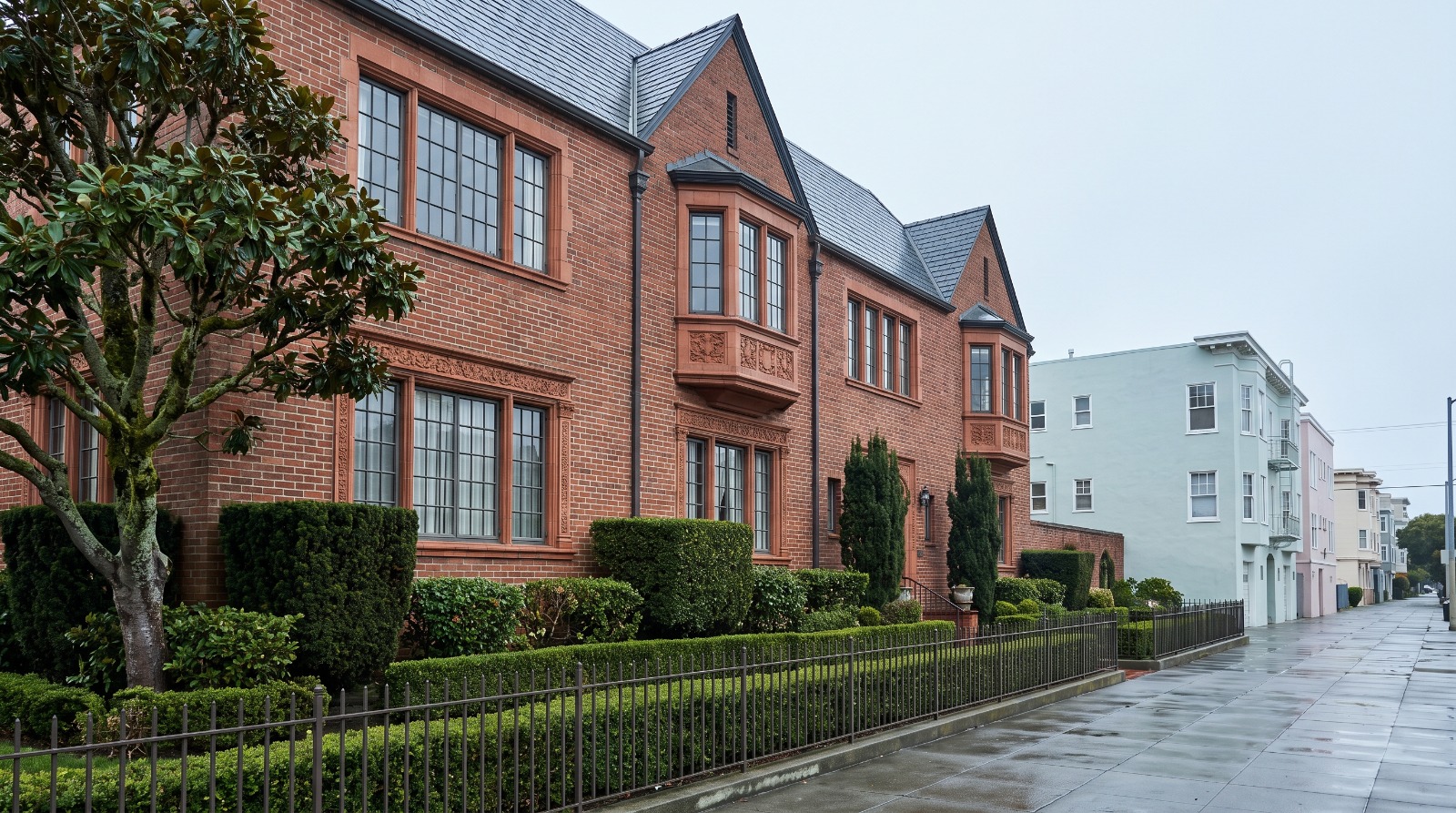
The landmarked 1925 Julia Morgan brick building at 3400 Laguna Street in the Marina District of San Francisco, where a 130-unit senior housing expansion has been filed. Photo: Houseberry
On August 28, plans were filed to put an eight-story building on a Marina District block where the height limit is 40 feet. The applicants are Heritage on the Marina and Sequoia Living, the address is 3400 Laguna Street, and the proposal totals 130 units and 196,700 square feet, rising behind the 1925 Julia Morgan building the city landmarked less than two years ago.
The part nobody has written yet: they already won. In June 2025, after a joint Planning Commission and Historic Preservation Commission hearing, this site received full approvals, and the Board of Supervisors upheld them 10 to 1, with only Connie Chan opposed. That approved project raised the site to 109 care suites and stayed inside the 40-foot limit. Fourteen months later the same applicants filed something taller, larger, and structured around a state law that overrides the limit entirely.
What is on the table, in short:
- 130 units total: 112 independent living, 8 assisted living, and 10 apartments kept inside the Morgan Building
- Eight stories and 196,700 square feet, of which 134,180 square feet is housing
- Full demolition of the 1957 Perry Building and the 1963 health care center, where the prior version demolished only part
- The 1929 Stone Cottage relocated to the corner of Francisco and Laguna and rehabilitated as a future Julia Morgan museum
- 29 car spaces and 46 bicycle spaces, down from the 36 cars in the approved version
- HKIT Architects on design, with Page and Turnbull on historic preservation
The site, and why 40 feet is the whole argument
3400 Laguna sits on the east side of Laguna between Bay and Francisco, on a 68,005-square-foot parcel recorded as Block 0471, Lot 003. That puts it catty-corner from Moscone Recreation Center, whose ball fields and tennis courts run the block from Chestnut up to Bay. The Chestnut Street shops are two blocks south. Fort Mason is up and to the northeast.
The parcel is zoned 40-X. Forty feet. The 2024 environmental filing for the earlier version stated flatly that new construction would not exceed 40 feet, consistent with the zoning district limit. Eight stories is not 40 feet, and neither the applicants nor the coverage has published a height in feet, which is the first number anyone should ask for.
The route over the limit is the State Density Bonus. The application asks to raise residential capacity 20 percent above base zoning and requests waivers for height, building area, rear yard setback and dwelling unit exposure. That is a state law doing to a San Francisco height district precisely what the state law was written to do.
| Approved June 2025 | Filed August 2026 | |
|---|---|---|
| Total units on site | 109 care suites | 130 units |
| Height | Under 40 feet, per the 2024 environmental filing | Eight stories, height in feet not published |
| Floor area | About 58,000 sq ft of new space added | 196,700 sq ft total, 134,180 of it housing |
| Demolition | Partial | Full: Perry Building and health care center |
| Car parking | 36 | 29 |
| Approval path | Conditional use and certificate of appropriateness | State Density Bonus with four waivers |
Read across that table and the shape of the decision is obvious. Every line moved in the same direction at once, and the last line is what made the rest possible.
The landmark protects the buildings, not the view of them
Ordinance 302-24, adopted December 17, 2024, made this an Article 10 city landmark under the name Ladies Protection and Relief Society, Landmark 320, covering the entire 68,005-square-foot site.
Read the ordinance closely and the mechanism becomes obvious. The 1925 Morgan Building, the 1929 Stone Cottage and the front garden with its cast-iron fence are contributing resources. The 1957 Perry Building and the 1963 health care clinic are listed as non-contributing. That single distinction is why the two mid-century buildings can come down, and why an eight-story structure can go up behind the brick.
Landmark designation in San Francisco protects fabric. It does not freeze a site’s development capacity and it does not protect a sightline to a protected building. The opposition group that formed around the 2025 version, Save the Marina’s Heritage, put the objection plainly through its attorney, who called the earlier proposal “The Monster In the Marina” and argued it would block views of the Julia Morgan building from three sides. That was aimed at a project under 40 feet.
Two blocks of Laguna, two different state laws
Walk north on Laguna and the Marina Safeway site at 11 to 15 Marina Boulevard is proposing 790 apartments in towers reaching 297 feet, deemed eligible in March 2026 for AB 2011 streamlining. At 3400 Laguna, 130 units are moving on the State Density Bonus. Two state override tools, two projects, one neighborhood, the same year.
That is not a coincidence and it is not a conspiracy. It is what happens when a city zones a flat, walkable, high-demand neighborhood for 40 feet across four decades. The state wrote tools to get around exactly that, applicants found them, and the Marina has become the clearest test in San Francisco of what those tools actually do. We have covered both halves of the Safeway fight, the AB 2011 eligibility question and the contamination timeline running underneath it, and the Heritage filing belongs in the same file.
What 120 senior units actually cost to live in
More than most people assume, and that is the honest limit on calling this an affordability win.
Independent living in the Marina District averaged $5,117 a month as of August 28, 2026, against a $4,174 California average and a $3,520 national one. Heritage itself lists independent living starting near $4,525 a month and assisted living from $6,415, with continuing-care entry beginning at $124,000. Nothing in the filing indicates any of the new units would be deed-restricted below market.
Set that against the neighborhood it sits in. The Marina had a median home price of $5.09 million in July 2026, roughly 136 percent above the $2.16 million citywide median. Houseberry scores the Marina 3.6 overall, with a 4.2 for amenities and a 4.1 for safety, which ranks it 43rd of the 92 San Francisco neighborhoods we score.
So this is market-rate senior housing in one of the most expensive neighborhoods in the country. It is still worth building. Every older Marina homeowner who moves into a building like this releases a house into a city that delivered only 405 homes ready for occupancy in the first half of 2026, against a state target of 82,069 by 2031. But nobody should call it affordable, and the genuinely affordable senior pipeline is the one starved of capital, with more than $1 billion in gap funding needed for projects San Francisco has already entitled.
The objection worth taking seriously
Not the views. The residents.
People live at 3400 Laguna right now, in a campus with roughly 86 units of capacity and, by definition, a high average resident age. The new plan demolishes the Perry Building outright, and the Perry Building is where most of them are. Full demolition instead of partial demolition means relocation instead of phasing. Nobody has published a plan for where those residents go during a build whose cost and timeline the applicants say have not yet been established.
That is a real question and a bigger one than a sightline. The 2025 approval, whatever its faults, kept more of the existing campus standing while it built.
The second open question is institutional. Sequoia Living, which operates The Sequoias in San Francisco, appears as a joint applicant with Heritage for the first time in this filing, and nobody has explained what changed between the two nonprofits. A merger, a management agreement and a joint venture carry very different implications for who ends up controlling a landmarked block of the Marina.
What to watch
No hearing date has been set, so the entitlement path is the thing to track.
Three specific items. First, the height in feet, which the applicants have not disclosed and which the Planning Department will publish the moment a case number attaches. Second, whether this filing amends case 2022-009819, the one that produced the 2025 approval, or opens a new case, because that determines whether the approved project is dead or sitting in reserve as a fallback. Third, whether the density bonus is being claimed under the senior housing pathway, which carries its own rules about who can live there.
The Marina spent forty years insisting it was finished being built. Two applications on one street this year say otherwise, and neither of them will be settled at a design review.
Sources
- SF YIMBY, increased plans for the Julia Morgan retirement community, August 28, 2026
- SF YIMBY, final approvals met for the 3400 Laguna Street project, June 2025
- San Francisco Planning, Landmark 320 designation ordinance 302-24
- SF YIMBY, joint Commission hearing scheduled for 3400 Laguna Street, March 2025
- CEQAnet, SCH# 2024050241, environmental record for the earlier expansion
- The Frisc, neighbors on the earlier Heritage expansion
- Traded, Sequoia Living and the Marina redevelopment
- A Place for Mom, Marina District independent living costs
- Caring.com, Heritage on the Marina pricing and license
- SF YIMBY, Marina Safeway deemed eligible for AB 2011 approval
- SPUR, San Francisco housing element targets
- The Frisc, San Francisco built roughly 400 homes in the first half of 2026
- Bisnow, the Bay Area senior housing pipeline and its funding gap
The Houseberry Research Team is Houseberry's reporting team: Bay Area real estate analysts, data specialists and longtime local market watchers. Every day we check the public record: building permits, city council and planning agendas, county recorder filings, state housing bills, police incident data and school results. Then we tie each story to what it means for specific neighborhoods, using Houseberry's own neighborhood data on prices, appreciation, safety, schools and amenities. Questions or corrections: Contact us.
All information provided on this website including but not limited to - school ratings, safety, amenities, user opinions, and property data - is for general informational purposes only. We do not guarantee its reliability, accuracy, or completeness. Users should independently verify information and consult appropriate professionals as needed. By using this website, you agree Houseberry is not responsible for actions, decisions, or consequences arising from reliance on the information provided
houseberry.com - CA DRE# 01847391
 Bay East ©2025. CCAR ©2025. bridgeMLS ©2025. Information Deemed Reliable But Not Guaranteed. This information is being provided by the Bay East MLS, or CCAR MLS, or bridgeMLS. The listings presented here may or may not be listed by the Broker/Agent operating this website. This information is intended for the personal use of consumers and may not be used for any purpose other than to identify prospective properties consumers may be interested in purchasing. Data last updated at October 13, 2026 12:00 AM