730 Stanyan Opens With 160 Homes Across From the Park
The old McDonald's lot at Haight and Stanyan is now an eight-story building with 160 affordable homes in it. Here is what actually changed on that corner, and what did not.
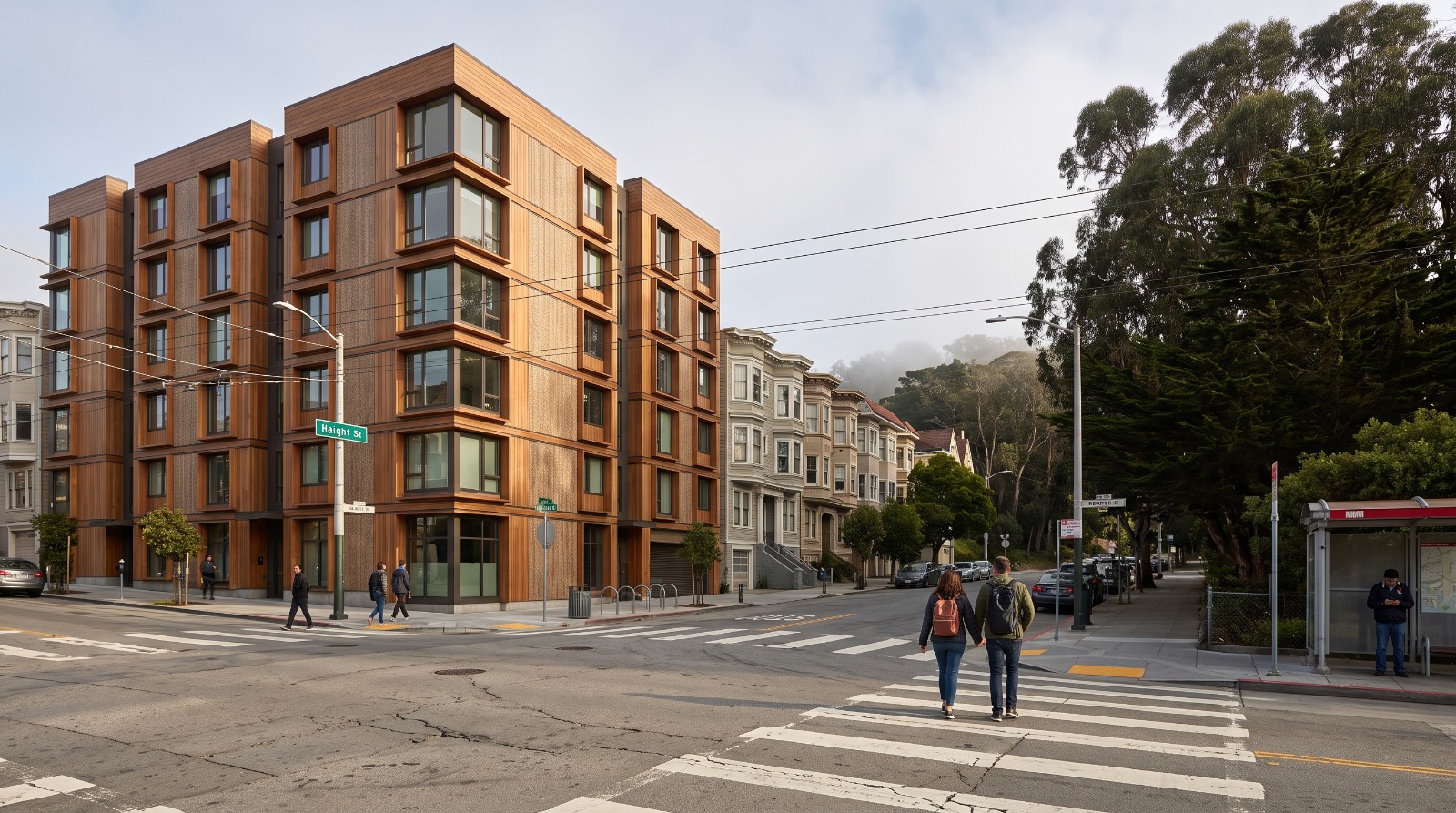
The corner of Haight and Stanyan in San Francisco beside Golden Gate Park, where 730 Stanyan opened with 160 affordable homes. Photo: Houseberry
Stand at Haight and Stanyan and look east. Golden Gate Park starts across the street, close enough that the eucalyptus does most of the work on your view. For most of the last ten years the thing at your back was a construction fence, and before the fence it was a McDonald's with a parking lot that had become the Upper Haight's permanent argument with itself. As of Tuesday, it is an eight-story building with 160 affordable homes in it, and people live there.
730 Stanyan held its ribbon cutting on July 28, and per the San Francisco Examiner it is the first affordable housing project in the Haight in nearly 20 years. That gap is the part worth sitting with. Two decades in a neighborhood people move to specifically because they like how it feels to walk around it.
Eight years, three uses, one lot
The city bought the property in 2018 for $15.5 million. The McDonald's closed that same year and came down about two years later, which left a fenced dirt lot on one of the busiest pedestrian corners on the west side.
Then it became something else. From 2020 into 2021 the lot ran as a sanctioned tent site, the 730 Stanyan Safe Sleeping Village, which closed when the city moved people indoors and construction planning picked back up. Building permits cleared in October 2022. Ground broke in 2023. The building topped out and finished in 2025, and leasing filled it this year.
The final number is $153.2 million for 160 homes, funded with federal tax credits, the Mayor's Office of Housing and Community Development, and the 2019 affordable housing general obligation bond San Francisco voters passed. Do the division and it lands around $957,000 a home. That is a real number and it is not a small one. It is also lower than the roughly $166 million, about $1 million per unit, that the SF Standard reported when the project was still working through approvals. Coming in under a Bay Area construction estimate is rare enough that it deserves a mention.
Who the 160 homes are for
The mix is the most interesting thing in the file. Thirty-five studios, 43 one-bedrooms, 42 two-bedrooms, and 40 three-bedrooms. Forty three-bedroom apartments in a city that mostly builds studios and juniors is a deliberate choice, and it tells you the developers, the Tenderloin Neighborhood Development Corporation and the Chinatown Community Development Center, were aiming at households with kids rather than at the easiest lease-up.
Income targeting runs from 25 to 80 percent of area median income, which was $65,450 for a single person in 2025. Twelve of the homes are set aside for families coming out of homelessness and 20 for young adults ages 18 to 25. And 40 percent of the units carry a neighborhood preference for existing District 5 residents, which is the detail almost nobody covers and the one that most directly answers the question people in the Haight were actually asking, which was whether any of this would be for them.
Worth translating that income band into dollars, because "affordable housing" gets used so loosely that it stops meaning anything. At 25 to 80 percent of area median income, a single-person household in this building is earning somewhere between roughly $16,000 and $52,000 a year against that $65,450 benchmark. That is the range that covers a preschool aide, a part-time caregiver, a line cook, a retired resident on a fixed income. It is not the range that covers a mid-career software engineer, and the two get lumped together in the phrase "below market rate" all the time.
If you want the closest comparison in the city, we wrote about Hayes Valley's 64 affordable homes at 78 Haight two weeks ago. Same corridor, same street name, a quarter of the size, and a useful reminder that these buildings are not interchangeable.
The ground floor is the part that changes a corner
Unit counts get the headline. Ground floors decide how a block feels at 4 p.m. on a Thursday.
730 Stanyan is built with an early childhood education provider, a workforce development center, a commercial kitchen for food entrepreneurs, a community room off a ground-floor plaza, two courtyards, a fifth-floor terrace looking into the park, and an urban farming deck on the roof. The street-level retail space is still looking for a tenant, which is the one loose end. A dark storefront on that corner would waste the whole point of putting the plaza there.
That is the honest test of a project like this, and it is the same test we apply when we score a neighborhood's amenities. Not the press release. Whether the doors on the sidewalk open, and whether they stay open after the ribbon is cut.
What this does and does not change
It does not change the Haight's data much, at least not yet. The Haight Ashbury neighborhood page currently shows a 3.5 out of 5 overall, with schools at 3.8, safety at 3.7, and amenities at 3.6, which puts it 25th citywide for amenities among the San Francisco neighborhoods we rank. One building, even a good one, does not move a neighborhood-level score. Scores move when a pattern holds for a few years.
What it does change is one intersection, which is a smaller claim and a truer one. Corners like this are where the difference between a neighborhood's reputation and a neighborhood's reality actually lives, and it is why we push people to look at the specific block before they look at the listing. A house four doors up the hill from an active plaza with a childcare center in it is a different daily experience than the same house four doors up from a fenced lot, and neither one shows up in a citywide average.
For anyone shopping the west side right now, the practical move is to walk this stretch of Haight between Stanyan and Ashbury at two different hours, then compare it against how San Francisco neighborhoods rank overall instead of against the version of the Haight you remember. And watch the ground-floor retail. When that space fills, we will know whether the corner really turned or just got a new building on it.
Sources
- San Francisco Examiner: Haight Street housing project to serve SF families and youth
- CBS News Bay Area: San Francisco unveils affordable housing complex at former Haight-Ashbury McDonald's site
- The San Francisco Standard: 100% affordable housing project at old McDonald's site could bring 160 homes
- Hoodline: 730 Stanyan Safe Sleeping Village residents packing up ahead of site closure
- Houseberry: Haight Ashbury neighborhood guide
All information provided on this website including but not limited to - school ratings, safety, amenities, user opinions, and property data - is for general informational purposes only. We do not guarantee its reliability, accuracy, or completeness. Users should independently verify information and consult appropriate professionals as needed. By using this website, you agree Houseberry is not responsible for actions, decisions, or consequences arising from reliance on the information provided
houseberry.com - CA DRE# 01847391
 Bay East ©2025. CCAR ©2025. bridgeMLS ©2025. Information Deemed Reliable But Not Guaranteed. This information is being provided by the Bay East MLS, or CCAR MLS, or bridgeMLS. The listings presented here may or may not be listed by the Broker/Agent operating this website. This information is intended for the personal use of consumers and may not be used for any purpose other than to identify prospective properties consumers may be interested in purchasing. Data last updated at September 14, 2026 12:00 AM