Bay Area Heat Wave: The 24-Degree Gap Between Neighborhoods
A heat advisory covers the inland Bay Area this weekend. Climate data for 25 neighborhoods shows which ones run hottest, which stay cool under the fog, and how far apart the two ends sit.

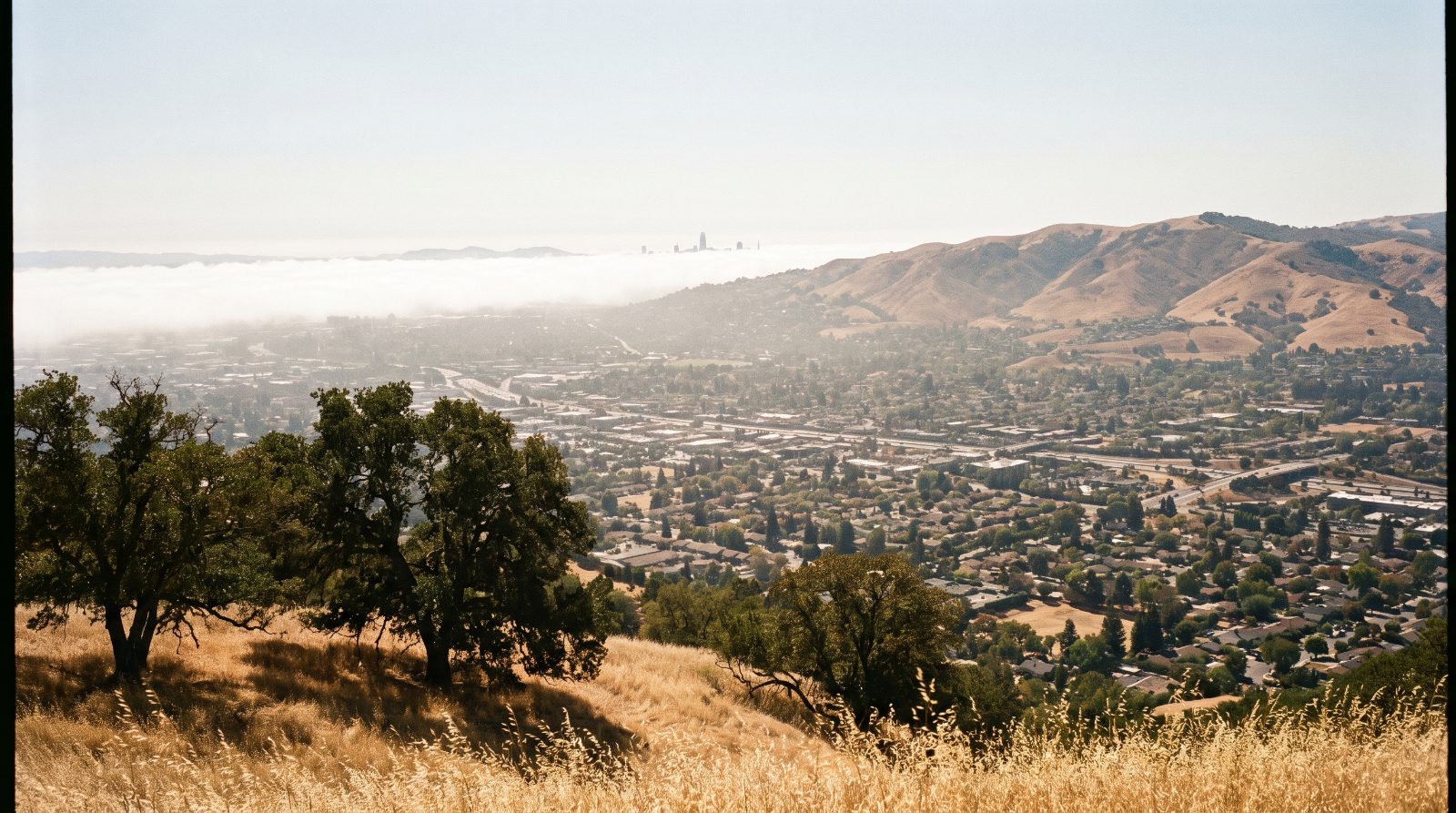
Bay Area heat wave view from Mount Diablo over a hazy Walnut Creek valley toward fog covering San Francisco Bay Photo: Houseberry
On a typical July afternoon in Brentwood Park, out in far eastern Contra Costa County, the average high is 89 degrees. In San Francisco’s Outer Sunset, the warmest month is September, and its average afternoon peaks at 65 while the fog sits over Ocean Beach. Both figures are 30-year climate averages from Houseberry’s neighborhood pages.
This weekend pushes both ends higher. A National Weather Service heat advisory runs from 11 a.m. Saturday to 10 p.m. Sunday across the East Bay, the South Bay, the bay shoreline and the inland hills, with inland highs forecast in the mid-90s to near 103.
To see how differently that heat lands, we pulled the weather data from 25 Houseberry neighborhood pages on October 2, from the Pacific edge to the inland valleys. Brentwood Park runs hottest and the Outer Sunset coolest, a 24-degree gap in warmest-month average highs. Ten of the 25 average 84 degrees or more in their warmest month, and every one of those ten sits inland.
What the weather service expects through Sunday
The advisory covers most of the region away from the ocean. The NWS San Francisco Bay Area forecast discussion issued Thursday night lists the East Bay, the South Bay, the San Francisco Bay shoreline, the Santa Cruz Mountains, the Sonoma Coastal Range and the North Bay interior mountains, along with parts of Monterey and San Benito counties.
Forecast highs run from the middle 90s to near 103 inland, the 80s to low 90s around the bays, and the upper 60s to mid 70s on the Pacific coast. Overnight lows stay in the upper 60s to mid 70s in the higher elevations and the mid to upper 60s in the interior East and South Bay, which the forecasters say will limit overnight recovery. CBS News Bay Area reported San Francisco near 75 on Friday.
The same discussion says the advisory may need to be extended, with hazardous heat still likely early next week and only a couple of degrees of cooling in the outlook. We looked at which BART corridors slow first in the heat last month.
The NWS heat safety page covers the basics, and county emergency services pages post cooling center locations when they open. The advisory posted on the Bay Area NWS office page keeps its advice short: drink water, take breaks in shade or air conditioning, move outdoor plans to cooler hours, and never leave people or pets in a parked car.
The hottest Bay Area neighborhoods in a normal summer
Our comparison uses the average high in each neighborhood’s warmest month, taken from the weather block on its page. It is a 30-year climate average, so it describes a typical hot stretch there, not this weekend’s forecast.
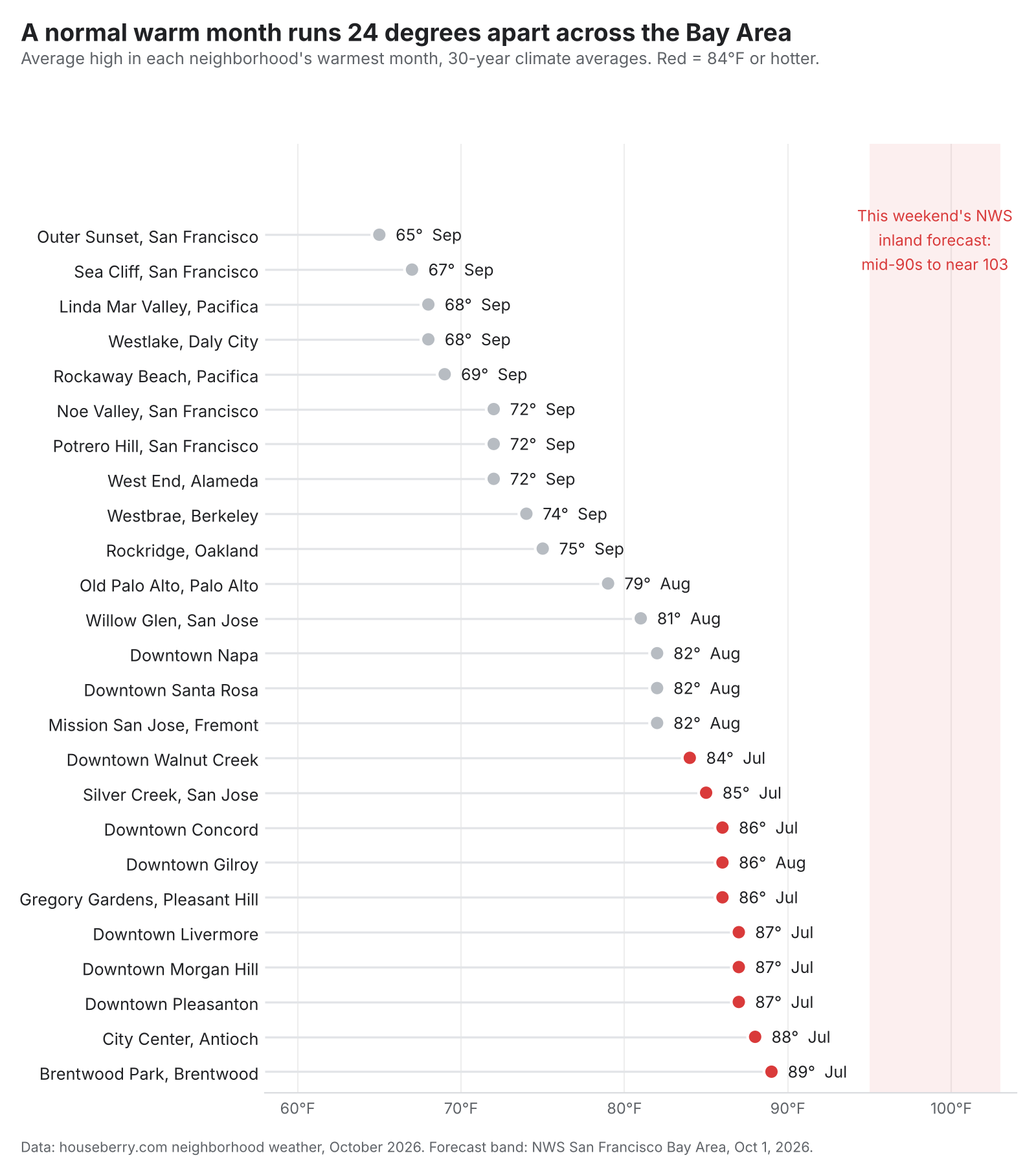
Brentwood Park tops the list at 89 in July. It also ranks 2nd of 99 Brentwood neighborhoods for sunshine and gets about 14 inches of rain a year, the driest in the city. City Center in Antioch follows at 88. Downtown Livermore, Downtown Pleasanton and Downtown Morgan Hill all average 87 in July, and Downtown Concord, Gregory Gardens in Pleasant Hill and Downtown Gilroy each sit at 86.
This weekend’s inland forecast runs well above those averages. The top of it, near 103, is 14 degrees above Brentwood Park’s July average and 17 above Downtown Concord’s.
Downtown Walnut Creek marks the edge of the hot group at 84 in July. Its page puts it in the 90th percentile for Bay Area sunshine, and Downtown Pleasanton reaches the 97th, the highest of the 25. Every neighborhood in the East Bay neighborhood rankings carries the same weather block, so any address under this weekend’s advisory can be checked the same way.
Coolest neighborhoods in the Bay Area: the fog belt holds
The five coolest neighborhoods in our set all face the Pacific. The Outer Sunset averages 65 in its warmest month, Sea Cliff 67, Linda Mar Valley in Pacifica and Westlake in Daly City 68 each, and Rockaway Beach in Pacifica 69. All five sit in the 1st percentile for Bay Area sunshine, and the Outer Sunset ranks 92nd of 92 San Francisco neighborhoods for sun, at 71 percent of possible sunshine.
San Francisco has its own split. Noe Valley, 3rd of 92 for sunshine in the city, averages 72 in September, 7 degrees warmer than the Outer Sunset a few miles west. Potrero Hill also averages 72.
Across the bay the warm-up is gradual. West End in Alameda averages 72, Westbrae in Berkeley 74 and Rockridge 75. Rockridge is the sunniest of Oakland’s 130 neighborhoods on its page and still falls in the 33rd percentile across the Bay Area.
| Neighborhood | Warmest month avg high | Summer day | Winter day | Sunshine |
|---|---|---|---|---|
| Outer Sunset, San Francisco | 65° (Sep) | 55° to 63° | 46° to 58° | 71% |
| Sea Cliff, San Francisco | 67° (Sep) | 55° to 65° | 46° to 58° | 72% |
| Linda Mar Valley, Pacifica | 68° (Sep) | 53° to 66° | 45° to 58° | 72% |
| Westlake, Daly City | 68° (Sep) | 53° to 66° | 46° to 58° | 73% |
| Rockaway Beach, Pacifica | 69° (Sep) | 53° to 66° | 45° to 58° | 73% |
| Downtown Livermore | 87° (Jul) | 56° to 86° | 40° to 58° | 80% |
| Downtown Morgan Hill | 87° (Jul) | 54° to 85° | 40° to 61° | 80% |
| Downtown Pleasanton | 87° (Jul) | 56° to 85° | 41° to 59° | 81% |
| City Center, Antioch | 88° (Jul) | 58° to 86° | 41° to 57° | 80% |
| Brentwood Park, Brentwood | 89° (Jul) | 58° to 87° | 41° to 57° | 80% |
The summer column carries most of the difference. Summer afternoons in the five coolest neighborhoods top out between 63 and 66 degrees, against 85 to 87 in the five hottest. Summer mornings start close together, 53 to 55 on the coast and 54 to 58 inland.
Why an October heat wave lands differently on the coast
All 10 bayside and coastal neighborhoods in our set, from the Outer Sunset to Rockridge, reach their warmest month in September. Six in Palo Alto, San Jose, Fremont, Gilroy, Napa and Santa Rosa peak in August. The nine inland neighborhoods from Walnut Creek and Concord out to Brentwood and Morgan Hill peak in July.
That calendar shapes this weekend. For the fog belt, early October still falls in its warm season, and San Francisco’s forecast near 75 on Friday is 10 degrees above the Outer Sunset’s September average. For the inland valleys, the forecast runs well past even their July normals, which matches the NWS key message of hazardous heat for most inland locations.
Sunshine is the smaller gap
The headline weather number on each page is percent of possible sunshine, and across these 25 neighborhoods it only runs from 71 to 81 percent. Temperature is where they pull apart. Winter flips the pattern: average winter highs land between 57 and 61 everywhere, while winter lows run colder inland, 38 in Downtown Santa Rosa and 39 in Downtown Napa against 45 and 46 along the coast.
Rain splits along its own lines. Brentwood Park and City Center in Antioch get about 14 inches a year, and Downtown Santa Rosa about 31.
Questions about Bay Area heat and microclimates
Which Bay Area neighborhoods stay coolest in a heat wave?
The Pacific-facing fog belt. In the 30-year averages on Houseberry’s pages, the Outer Sunset (65), Sea Cliff (67), Linda Mar Valley (68), Westlake (68) and Rockaway Beach (69) have the coolest warmest-month highs of the 25 neighborhoods compared. This weekend’s coastal forecast is the upper 60s to mid 70s.
What are the hottest cities in the Bay Area?
In this comparison, far eastern Contra Costa runs hottest. Brentwood Park averages 89 in July and City Center in Antioch 88, followed by downtown Livermore, Pleasanton and Morgan Hill at 87.
How long will the October 2026 heat wave last?
The advisory runs from 11 a.m. Saturday, October 3, to 10 p.m. Sunday, October 4. The NWS forecast discussion issued Thursday night says it may be extended, with hazardous heat likely early next week and only slight cooling expected.
Where does this weather data come from?
Each neighborhood page labels its sunshine and temperature figures as 30-year climate averages for that location. We read 25 pages on October 2, 2026, chosen to span the coast, the bayside cities and the inland valleys. One page we checked, Evergreen in San Jose, showed no weather block and is left out.
Sources
- National Weather Service San Francisco Bay Area, Area Forecast Discussion, issued October 1, 2026
- National Weather Service San Francisco Bay Area office, current hazards
- CBS News Bay Area, heat advisory for the first weekend of October, October 2, 2026
- National Weather Service, Heat Safety Tips and Resources
- Neighborhood weather data (30-year climate averages) from 25 houseberry.com neighborhood pages, read October 2, 2026
The Houseberry Research Team is Houseberry's reporting team: Bay Area real estate analysts, data specialists and longtime local market watchers. Every day we check the public record: building permits, city council and planning agendas, county recorder filings, state housing bills, police incident data and school results. Then we tie each story to what it means for specific neighborhoods, using Houseberry's own neighborhood data on prices, appreciation, safety, schools and amenities. Questions or corrections: Contact us.
Map of East Bay Neighborhoods
Loading map...
View Full Map
Top Neighborhoods in East Bay, CA





All information provided on this website including but not limited to - school ratings, safety, amenities, user opinions, and property data - is for general informational purposes only. We do not guarantee its reliability, accuracy, or completeness. Users should independently verify information and consult appropriate professionals as needed. By using this website, you agree Houseberry is not responsible for actions, decisions, or consequences arising from reliance on the information provided
houseberry.com - CA DRE# 01847391
 Bay East ©2025. CCAR ©2025. bridgeMLS ©2025. Information Deemed Reliable But Not Guaranteed. This information is being provided by the Bay East MLS, or CCAR MLS, or bridgeMLS. The listings presented here may or may not be listed by the Broker/Agent operating this website. This information is intended for the personal use of consumers and may not be used for any purpose other than to identify prospective properties consumers may be interested in purchasing. Data last updated at October 3, 2026 12:00 AM