You can now sell an ADU separately in these California cities
California lets each city decide whether a backyard ADU can be sold on its own. Here is every place we could confirm that allows it, the cities studying it, what the state law requires, and how the price math compares.

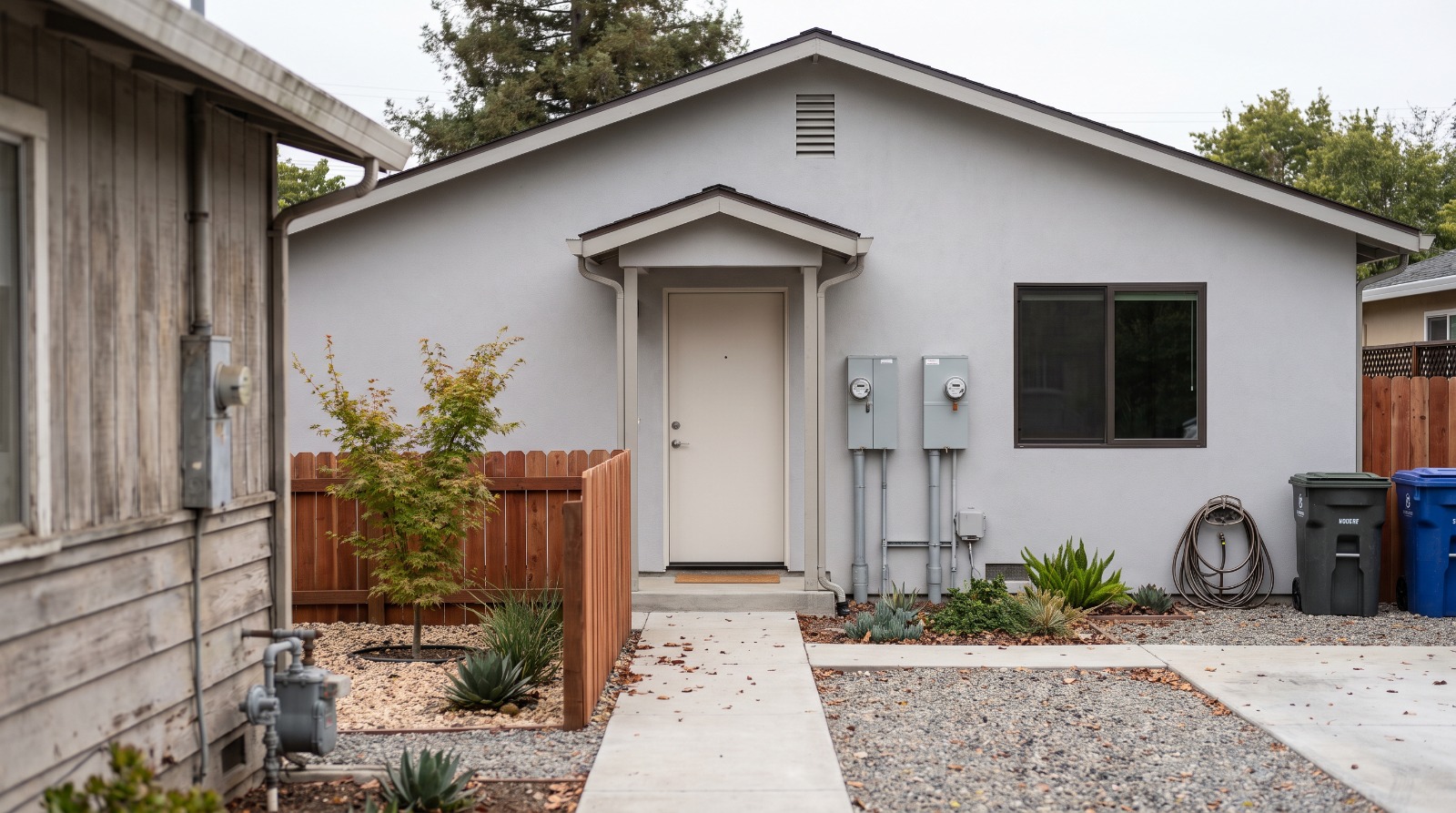
A new backyard ADU in San Jose with its own electric and gas meters beside the entry, behind an older ranch house Photo: Houseberry
In June 2026, a 749-square-foot backyard unit on Josefina Street in San Jose sold on its own for $530,000. Two bedrooms, one bath, its own utility meters, no HOA dues. It was the first ADU in California sold as a separate condo, and almost three years after the state made that legal, it is still the only one we could confirm.
That is because the state law only opens the door. Each city or county has to pass its own ordinance before an owner can split off a backyard unit and sell it. As of mid-October 2026, we count nine places where that is already allowed, Alameda finishing its version this fall, and at least five more talking about it.
The gap between a house and its backyard cottage is the whole point. Houseberry's San Jose data puts the typical San Jose home at about $1.63 million in September 2026, a little more than three times what that first ADU sold for.
Where you can sell an ADU separately right now
Here is every opt-in we could verify, in the order they took effect. We confirmed adoption with city or county records or local reporting for each. For Santa Monica and West Hollywood we found the council action but not the final ordinance date, so treat those two months as approximate.
| Place | In effect | The rule worth knowing |
|---|---|---|
| San Jose | July 2024 | First in the state. First sale closed June 2026 at $530,000 |
| Santa Monica | Late 2024 | Passed with the city's housing element update |
| Santa Cruz (city) | Early 2025 | Displaced tenants get the first right to buy plus relocation pay |
| West Hollywood | February 2025 | Zoning text change allowing ADUs to be sold as condos |
| San Francisco | July 2025 | Only ADUs permitted on or after May 1, 2025, with no protected-tenant evictions since 2005 |
| San Diego (city) | August 22, 2025 | Not yet in the coastal zone. Owner-occupant buyers get the first 30 days |
| Sebastopol | January 2026 | First in Sonoma County. City fees of $500 to $1,500 |
| Berkeley | February 2026 | Tenants in rent-controlled ADUs get up to 90 days to buy first |
| San Diego County (unincorporated) | April 4, 2026 | Tenant first refusal and a buyer owner-occupancy affidavit added September 18 |
San Francisco's version is the narrowest. The unit's permit has to be issued on or after May 1, 2025, it cannot share a wall with older units unless they were all built together, and the lot cannot have had a no-fault eviction of a protected tenant since 2005. Law firm SirkinLaw puts city fees at about $14,000 for Public Works plus about $3,700 for inspection, and Public Works takes 9 to 12 months.
San Jose's is the opposite. The city publishes a condo checklist, assigned two "ADU Ally" staff to help applicants, and processed the first conversion in 89 days.
Alameda is close behind. The council introduced its ordinance in September, and on October 13 the city filed its state environmental exemption for it. Occupied units come with a 60-day first offer to the tenant. Our Alameda ADU condo explainer covers that city's rules step by step.
Where it might be legal soon
Los Angeles is the big one. A July 2025 motion by Councilmembers Nithya Raman and Bob Blumenfield, Council File 25-0753, told city planners to draft an ordinance. As of this summer it was still in committee with no draft.
Sacramento put a "For-sale ADU's (AB 1033) Ordinance" on its 2026 planning work program in January, with a commission workshop in the second quarter and adoption hearings in the third. We found no record of either hearing yet.
Palo Alto's council voted 4-3 on August 17, 2026 to send the idea to its Planning and Transportation Commission, with a recommendation due by the end of the year. Santa Rosa is studying it, the Press Democrat reported in June. Santa Cruz County supervisors referred it to staff in April 2025, and the county's housing advisory commission weighed its options in March 2026 without recommending an ordinance.
Oakland shows up on some online lists of adopters. We could not confirm it. The state's December 2025 review of Oakland's most recent ADU ordinance does not mention condos.
What the state law requires
The law is short and the requirements are not. Under Government Code section 66342, once a city opts in, the house and the ADU can be sold separately as condominiums if the owner:
- sets up a condominium under the state's Davis-Stirling Act and follows local subdivision rules
- passes a safety inspection before the condo plan is recorded
- gets written, recorded consent from every lienholder, who can refuse or attach conditions
- gives buyers a required notice about lender consent and notifies the water, sewer, gas and electric providers
- gets the HOA's written approval, if the property is already in one
There is an older path too. The 2021 law AB 587 lets a qualified nonprofit build an ADU and sell it to a lower-income buyer anywhere in the state, no local ordinance needed.
No bill in 2025 or 2026 made separate sales mandatory. The two ADU bills Governor Newsom signed on September 29, 2026, AB 956 and SB 1117, deal with how many units you can build and what fees you pay. Our rundown of AB 956 explains the two-detached-ADU change that takes effect January 1, 2027.
What a sold ADU would compete with
The case for selling an ADU is that it creates a starter home in a city where houses cost seven figures. Houseberry's September 2026 price data shows how wide that gap runs in the places that allow it or are considering it.
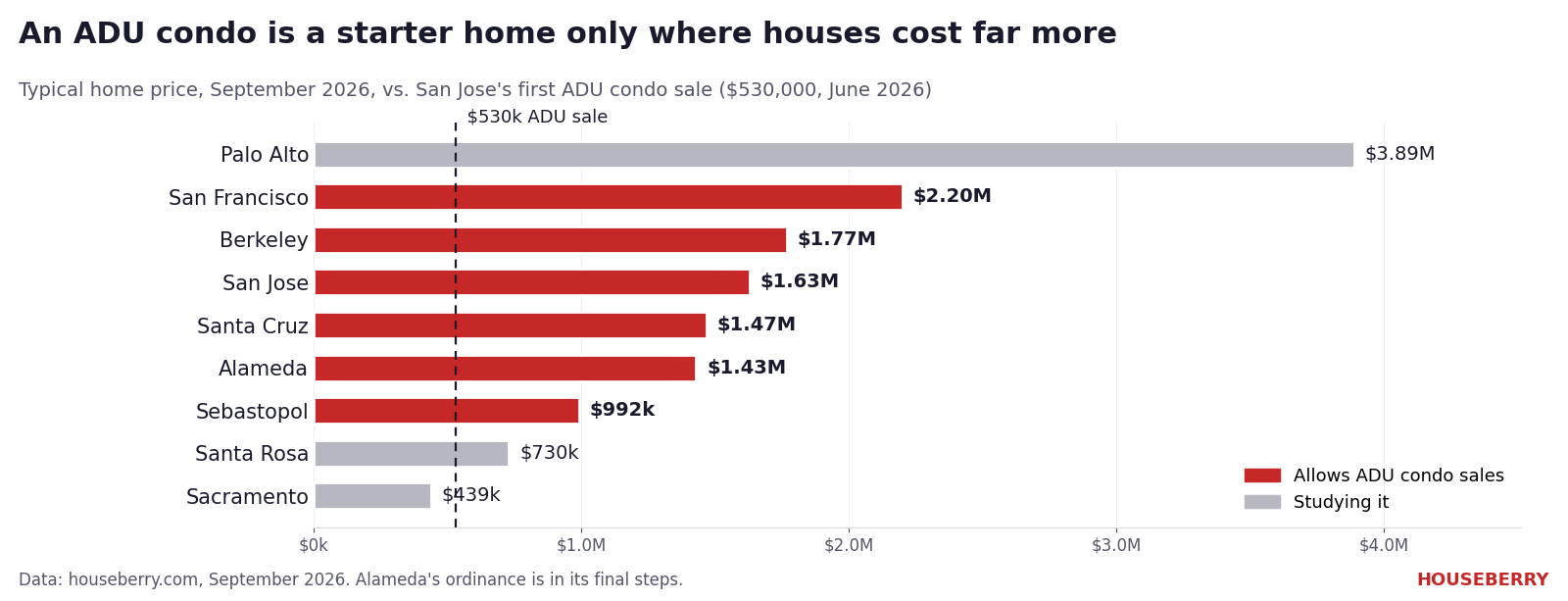
In the Bay Area cities with rules on the books, the typical home runs about $1.43 million in Alameda, $1.63 million in San Jose, $1.77 million in Berkeley and $2.2 million in San Francisco, per Houseberry's Berkeley data and our other city pages. That is 2.7 to 4.2 times the San Jose sale. In Palo Alto, which is still deciding, the typical home is about $3.89 million.
Sacramento flips the math. Houseberry puts the typical Sacramento home at about $439,000, lower than what the first ADU condo fetched in San Jose. A backyard unit there would compete with whole houses on price, so a separate sale pencils mainly on lots where the main house is worth far more than the city's typical home. Sebastopol, at about $992,000, and Santa Rosa, at about $730,000, sit in between.
The lender is the real gatekeeper
The hardest step is usually the bank. If the main house has a mortgage, the lender has to consent in writing, usually through a payoff, a refinance or a partial release, and nothing in the law forces it to. Fannie Mae waives its project review for condo projects of two to four units, according to its Selling Guide, which helps a buyer get a loan. It does not help the seller's existing lender say yes, and appraisers still have almost no comparable sales to work from.
That explains why developers, not homeowners, are running the first conversions. The San Jose sale was a developer project, built to prove the model. Owners with a paid-off house or a cooperative lender are the ones best placed to follow.
Statewide, California permitted 30,354 ADUs in 2024, up from 1,336 in 2016, and ADUs were 26.6 percent of all homes permitted that year, according to the state housing department's ADU handbook. Almost none of them can be sold on their own.
Opt-in has produced one sale
We think separate sale should be the statewide default. Nearly three years of letting each city decide has produced nine yeses, a handful of studies and one sale we could confirm. A two-bedroom cottage for about a third of a San Jose house is the kind of starter home the Bay Area has mostly stopped building. The cities that worry about it can still set rules on tenants and owner-occupancy, as Berkeley and San Diego County did.
If you own a lot with room in back, start with where your neighborhood sits on price. Our East Bay neighborhood ranking covers Berkeley and Alameda block by block, and the gap between a typical house and a $530,000 cottage is the number that tells you whether a sale would pencil.
Sources
- California Government Code section 66342
- City of San Jose on the first ADU condo sale
- ABC7 on the $530,000 San Jose sale
- Reuben, Junius and Rose on San Francisco's ADU condo law
- Berkeley Ordinance 7,999-N.S.
- San Diego County ADU ordinance page
- Press Democrat on Sebastopol's vote
- Los Angeles Council File 25-0753
- Palo Alto Daily Post on the August 17 vote
- CEQAnet: Alameda ADU condominium conversion notice of exemption
- California HCD ADU Handbook, March 2026
The Houseberry Research Team is Houseberry's reporting team: Bay Area real estate analysts, data specialists and longtime local market watchers. Every day we check the public record: building permits, city council and planning agendas, county recorder filings, state housing bills, police incident data and school results. Then we tie each story to what it means for specific neighborhoods, using Houseberry's own neighborhood data on prices, appreciation, safety, schools and amenities. Questions or corrections: Contact us.
Map of East Bay Neighborhoods
Loading map...
View Full Map
Top Neighborhoods in East Bay, CA





All information provided on this website including but not limited to - school ratings, safety, amenities, user opinions, and property data - is for general informational purposes only. We do not guarantee its reliability, accuracy, or completeness. Users should independently verify information and consult appropriate professionals as needed. By using this website, you agree Houseberry is not responsible for actions, decisions, or consequences arising from reliance on the information provided
houseberry.com - CA DRE# 01847391
 Bay East ©2025. CCAR ©2025. bridgeMLS ©2025. Information Deemed Reliable But Not Guaranteed. This information is being provided by the Bay East MLS, or CCAR MLS, or bridgeMLS. The listings presented here may or may not be listed by the Broker/Agent operating this website. This information is intended for the personal use of consumers and may not be used for any purpose other than to identify prospective properties consumers may be interested in purchasing. Data last updated at October 18, 2026 12:00 AM