California Forever: No Solano Jobs Without Streamlined Housing
California Forever says the shipyard and the factory do not happen without streamlined housing in Solano County. What is actually proposed, what streamlining would skip, and what Solano costs today.
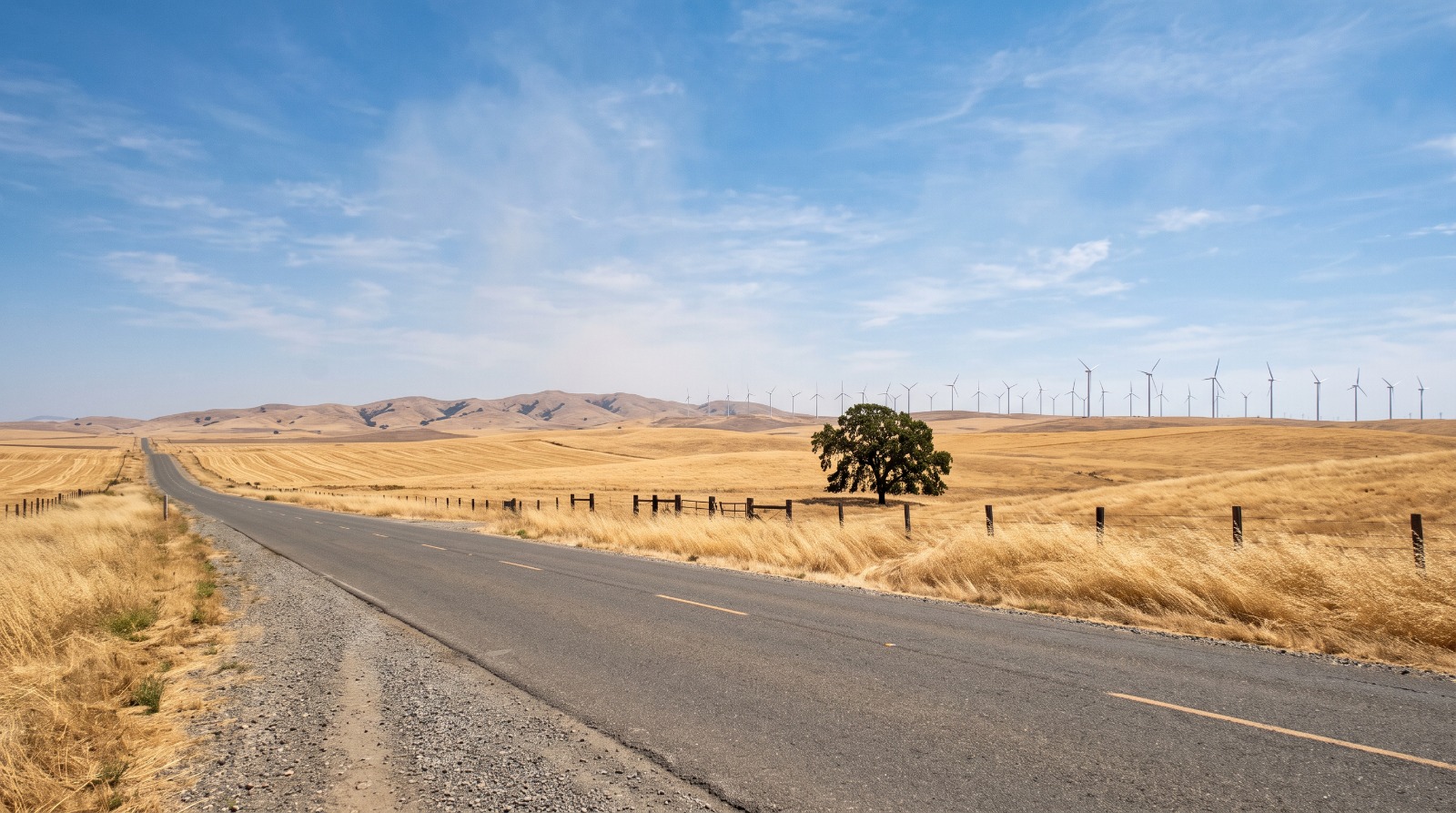
Farmland and wind turbines in eastern Solano County near Suisun City, where California Forever proposes annexing nearly 23,000 acres for a new community. Photo: Houseberry
On August 4 California Forever published a short post titled, more or less, that the shipyard and the factory will not work without homes. Read past the framing and it is a package demand: the company wants Solano County and Sacramento to fast-track the industrial projects and the 22,873-acre Suisun City housing annexation together, and it is explicitly opposing narrow legislation that would streamline only the jobs half.
Two facts make that demand read differently than the headline suggests. The company already lost its anchor tenant, in July, over exactly this. And as of August 3 there was no bill, no trailer-bill language, and no section number, with the legislative session ending August 31.
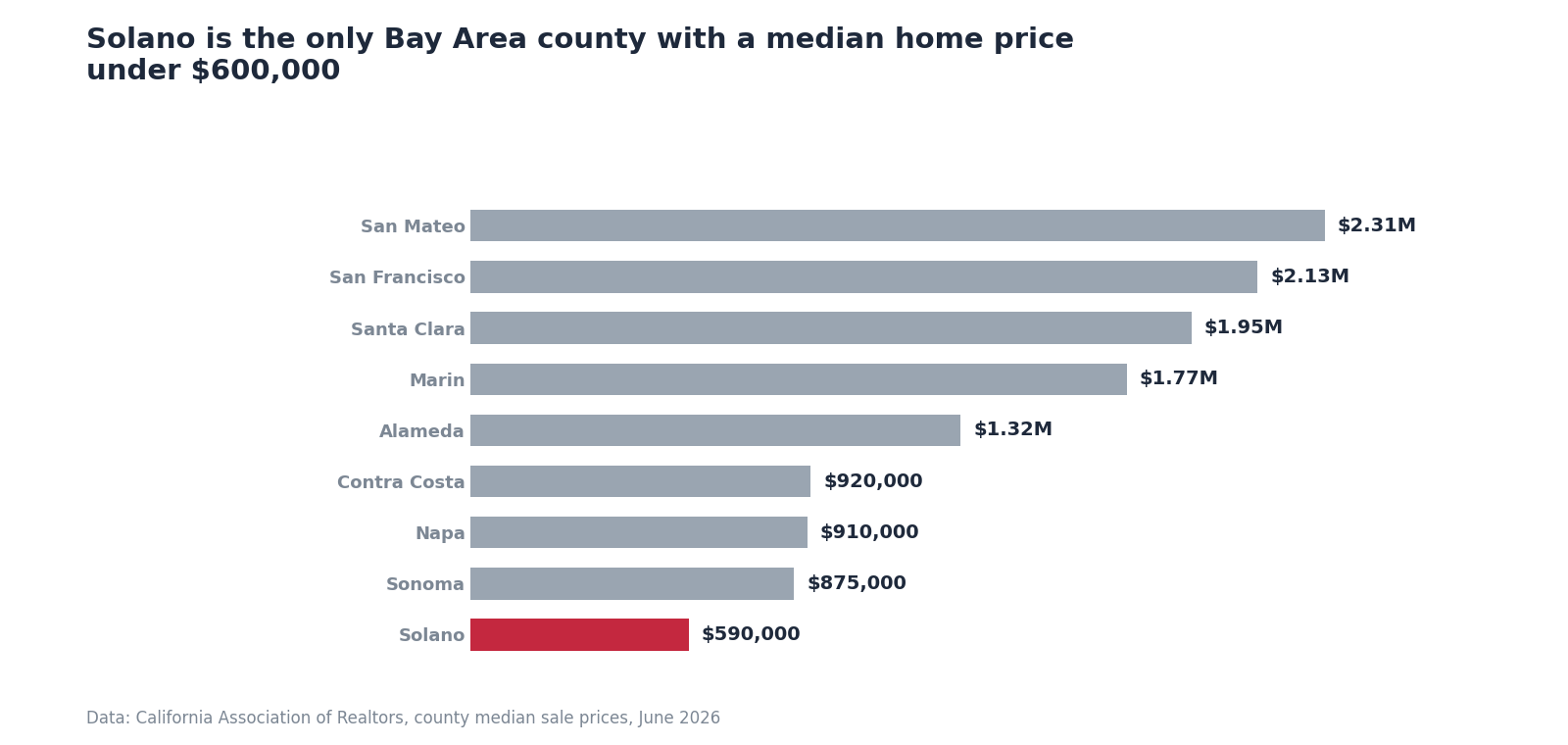
I am about as pro-housing as a person can be, and Solano is the last genuinely affordable doorstep in this region. The county median was $590,000 in June 2026 against $1.4 million for the nine-county Bay Area. But the trade being asked for here is not really about homes. It is about who gets to say no, and to what.
The anchor tenant already left
On July 28, defense shipbuilder Saronic chose Texas over Solano County for a $3.2 billion facility, taking an estimated 10,000 jobs with it. California Forever's stated reason was permitting: a key site-selection criterion was breaking ground within months, which the company said is not possible in California without special legislation, and the legislation did not pass in time.
So the August 4 statement is a post-loss argument, not a threat held over anyone's head. That distinction matters both ways. It makes the company's frustration legitimate, because a real employer really did walk. It also means the specific promise on the table now, roughly 40,000 on-site shipyard jobs at full build-out per the pro-side economic analysis, is a promise about a tenant nobody has named.
What is actually proposed, in numbers
The regulatory filing is the only document that counts here, and it is bigger than most coverage conveys. The Notice of Preparation filed with the state on November 12, 2025 describes annexing 22,873 acres of unincorporated Solano County into Suisun City, split between a 7,136-acre area plan and a 15,737-acre specific plan.
Inside that footprint: 65,217 dwelling units in a first 20-year phase, about 173,913 at full build-out, a target of 400,000 residents by 2071, a 1,410-acre industrial park at Lambie, a 2,100-acre advanced manufacturing campus called Solano Foundry, and a 5,726-acre Travis Air Force Base protection zone. The shipyard site is 7,500 acres at Collinsville on the Sacramento River, not Mare Island.
Now put two numbers side by side, because I have not seen anyone else do it. Solano County contains 168,369 total housing units as of the Census Bureau's July 1, 2025 estimate. The Suisun expansion proposes 173,913. This is not a plan to grow Solano County. It is a plan to build a second Solano County next to the first one, in a county that has averaged fewer than 1,000 permitted homes a year for nineteen years. At that historical pace, phase one alone takes 65 years.
Suisun City has 29,454 residents today. The build-out target would make it roughly thirteen times its current size.
What streamlining would actually skip
This is the part worth being precise about, because the company has not put its ask in writing and the reporting is a mix of confirmed and rumored.
| The mechanism | What it would skip | Status as of August 11, 2026 |
|---|---|---|
| Environmental Leadership Development Project designation, reliance on a 2008 EIR, a 270-day litigation cap | A current environmental review and the normal CEQA litigation window | Reported by CalMatters in June 2026. No bill text public. |
| CEQA exemption for roughly 19,000 of the annexation acres | Environmental review across most of the footprint | Attributed to Rio Vista officials. Unconfirmed. |
| Changing LAFCO annexation law | Solano County and Solano LAFCO's authority over the annexation | Described as a rumor by opponents. Unconfirmed. |
| Delivery through a budget trailer bill | Committee hearings and the normal bill process | Reported intent. No language filed as of August 3, 2026. |
Note what is already true without any of that. The annexation route requires no countywide vote. Suisun City's own project FAQ says so plainly. A council majority plus LAFCO approval is the whole democratic test, and Suisun City has no voter-approved urban growth boundary, unlike Benicia and Vacaville.
That is not an accident of geography. Solano County voters passed the Orderly Growth Initiative in 1984 and renewed it in 1996 and 2007, requiring a countywide vote to convert agricultural land to urban use. California Forever's first attempt was a 2024 ballot measure that would have done exactly that, and the company withdrew it in July 2024 after the county's own fiscal analysis projected $634 million in annual service costs against $531 million in revenue at build-out, and after roughly $9 million in advertising failed to move the polling. The annexation strategy that replaced it is the second consecutive route around a rule voters have affirmed three times.
I want to be fair to the company here, because the counter-argument is real. CEQA genuinely is used to stop housing, the Lambie industrial park has sat less than 5 percent developed since it was designated for maritime use in 1980, and a 400,000-person plan reviewed at the normal pace will be reviewed for a decade. A January 2026 FM3 poll of 400 Suisun City voters found 58 percent opposed and 19 percent in support, rising to 65 percent opposed after both arguments. That is exactly the kind of number that makes a developer prefer a council to an electorate, and exactly the kind of number that makes opponents call it a short circuit.
The opposition letter is bigger than Solano
More than 50 organizations signed the letter delivered to legislators and the governor's office in early August. Its four objections are specific: no last-minute budget trailer bills granting special environmental exemptions, no CEQA streamlining for the shipbuilding component, no modification of LAFCO annexation procedures, and no override of a county voter initiative.
The signature list is the interesting part. Both the Solano County Democratic Central Committee and the Solano County Republicans signed. So did the California Farm Bureau and the Solano County Farm Bureau, the Sierra Club, NRDC, Save the Bay, San Francisco Baykeeper, Greenbelt Alliance, Save Mount Diablo, the Planning and Conservation League, the Tri-City NAACP and the National Union of Healthcare Workers.
It is also worth saying out loud that a meaningful share of the signatories are statewide or Southern California organizations, including Los Angeles Audubon, the Environmental Center of San Diego and the Northcoast Environmental Center. That is not a gotcha. It tells you what the letter is really about. This is a fight over a CEQA precedent as much as a fight over Solano County farmland, which is why it drew signatures from 400 miles away. On the other side, a building trades coalition and a group called Solano Forward have written to legislators in support.
What Solano actually costs, and how long the train takes
Nobody covering this story has printed a home price, which is strange, because affordability is the whole pitch.
| Place | Median sale price | Month |
|---|---|---|
| Rio Vista | $469,900 | June 2026 |
| Suisun City | $565,000 | July 2026 |
| Vacaville | $675,000 | July 2026 |
| Fairfield | $685,000 | June 2026 |
| Solano County (CAR) | $590,000, up 3.2% year over year | June 2026 |
| Nine-county Bay Area (CAR) | $1,400,000, flat year over year | June 2026 |
City figures come from MLS-derived market trackers and the county and regional figures from the California Association of Realtors' June 2026 report, so the methodologies differ and the small cities are thin-volume. The direction is not in doubt. A buyer moving from the regional median to Suisun City saves about $835,000, and Solano is the only Bay Area county under $600,000.
The transit case is better than most people realize, and also more awkward for the plan than it looks.
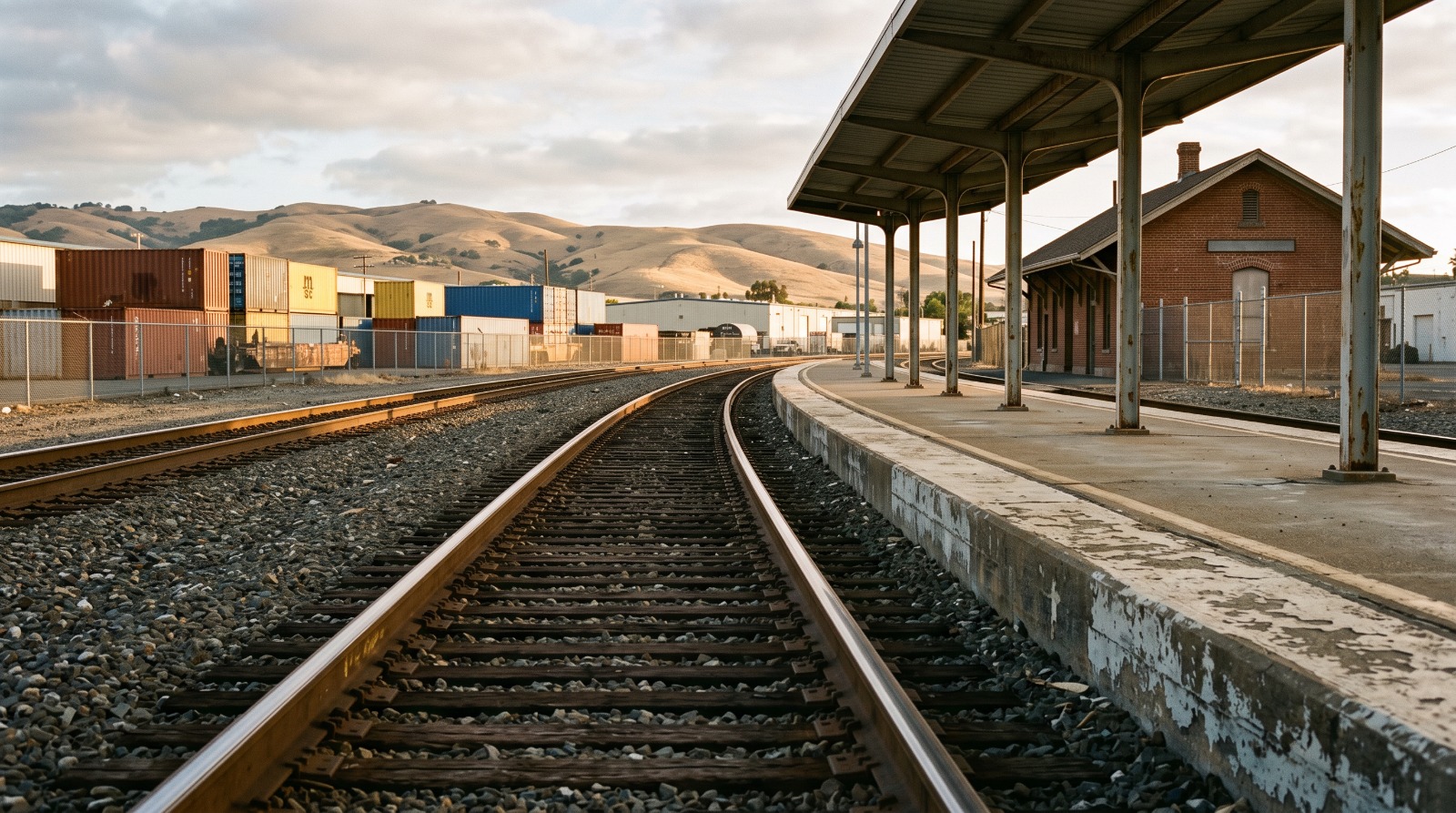
Capitol Corridor runs 15 weekday round trips through Suisun-Fairfield, reaching downtown Sacramento in about 30 minutes and Richmond BART in about 40. That is real intercity rail at a $565,000 median, which is close to unique in this region. The awkward part is that the new community would be built east of the station, and the November 2025 filing does not specify how it connects to the one transit asset the county already owns.
Solano is also softening right now, not overheating. Fairfield homes took 58 days to sell in June 2026 against 45 a year earlier, and Vacaville 66 days in July against 45. The pro-housing case here rests on a 44-year build-out horizon, not on current demand pressure, and it should be argued that way.
The uncomfortable comparison inside the same county
We do not have neighborhood pages for Fairfield, Vacaville or Suisun City, so I will use the two Solano cities we do cover, which happen to make the point better anyway.
Benicia scores 4.1 out of 5 overall with a 4.7 for safety, and its median was $838,520 in July 2026. Vallejo scores 2.2 overall with a 2.1 for safety, and its median was $538,820 in May 2026. Same county, twelve miles apart, a $299,700 gap. Neither city has a land shortage. Vallejo has vacant parcels downtown right now.
What separates them is schools and safety, not acreage. Which is the honest question to put to a plan whose entire pitch is supply: Solano County's existing price spread was not created by a shortage of land, and 173,913 homes on farmland do not obviously fix a 2.1 safety score in Vallejo. For comparison, Concord, the I-680 commuter city Solano buyers usually weigh against Fairfield, was $794,790 in June 2026 with a 2.8 overall score, and it sits inside the 258 East Bay neighborhoods we rank.
What happens next, and the date to watch
August 31 is the end of the legislative session. Governor Newsom's office has convened Solano supervisors, California Forever, Assemblymember Lori Wilson and Senator Christopher Cabaldon, and the company has spent about $455,000 lobbying since 2025, per CapRadio's August 3 session-closeout rundown. If something is going to move this year, it moves in the next three weeks and it moves as a rider.
On the local track, the draft EIR is expected to finish initial processing around the end of 2026, and Solano LAFCO review typically runs 6 to 18 months after certification, so a LAFCO decision lands in 2027 or 2028. LAFCO has already asked Suisun City to pause. None of that requires a single voter.
If you are shopping in Fairfield, Vacaville or Suisun City this fall, none of this changes your offer. The first home in this plan is many years out and its price is unknowable. What it changes is the twenty-year question, and that one is genuinely open. I would rather this region build a city on the Suisun plain than keep pretending 168,369 housing units is enough for a county on the edge of the Bay Area. I would also rather it be built by a process that Solano County voters can lose fairly than by a rider nobody read.
Sources
- California Forever, “Solano Shipyard and Solano Foundry will not work without homes,” August 4, 2026
- Daily Republic, coverage of the same statement, August 5, 2026
- CEQAnet, Suisun Expansion Project Notice of Preparation, SCH 2025110452, November 12, 2025
- Solano Together, the multi-organization opposition letter and its signatories, August 2026
- CBS News Sacramento, Saronic chooses Texas over Solano County, July 28, 2026
- Bay Area Council Economic Institute, jobs and revenue analysis, January 21, 2026
- Vallejo Sun, on the 2024 ballot-measure withdrawal and the county fiscal report
- Vallejo Sun, FM3 Research poll of Suisun City voters, January 2026
- Suisun Expansion Project FAQ, on whether a public vote is required
- Capitol Corridor weekday schedules, effective December 8, 2025
- Solano Orderly Growth Committee, on the 1984 initiative and city growth boundaries
- US Census Bureau QuickFacts, Solano County housing units and population
- California Association of Realtors, June 2026 county median prices
- CapRadio, on the end-of-session deals to watch, August 3, 2026
All information provided on this website including but not limited to - school ratings, safety, amenities, user opinions, and property data - is for general informational purposes only. We do not guarantee its reliability, accuracy, or completeness. Users should independently verify information and consult appropriate professionals as needed. By using this website, you agree Houseberry is not responsible for actions, decisions, or consequences arising from reliance on the information provided
houseberry.com - CA DRE# 01847391
 Bay East ©2025. CCAR ©2025. bridgeMLS ©2025. Information Deemed Reliable But Not Guaranteed. This information is being provided by the Bay East MLS, or CCAR MLS, or bridgeMLS. The listings presented here may or may not be listed by the Broker/Agent operating this website. This information is intended for the personal use of consumers and may not be used for any purpose other than to identify prospective properties consumers may be interested in purchasing. Data last updated at September 25, 2026 12:00 AM