Howard Terminal Is Moving Again. The 3,000 Homes Are Not
Port of Oakland commissioners voted 6 to 0 to open a one-year negotiating window at Howard Terminal. The Oakland Roots want a stadium there. The 3,000 homes from the A's plan are not coming back, and here is why.
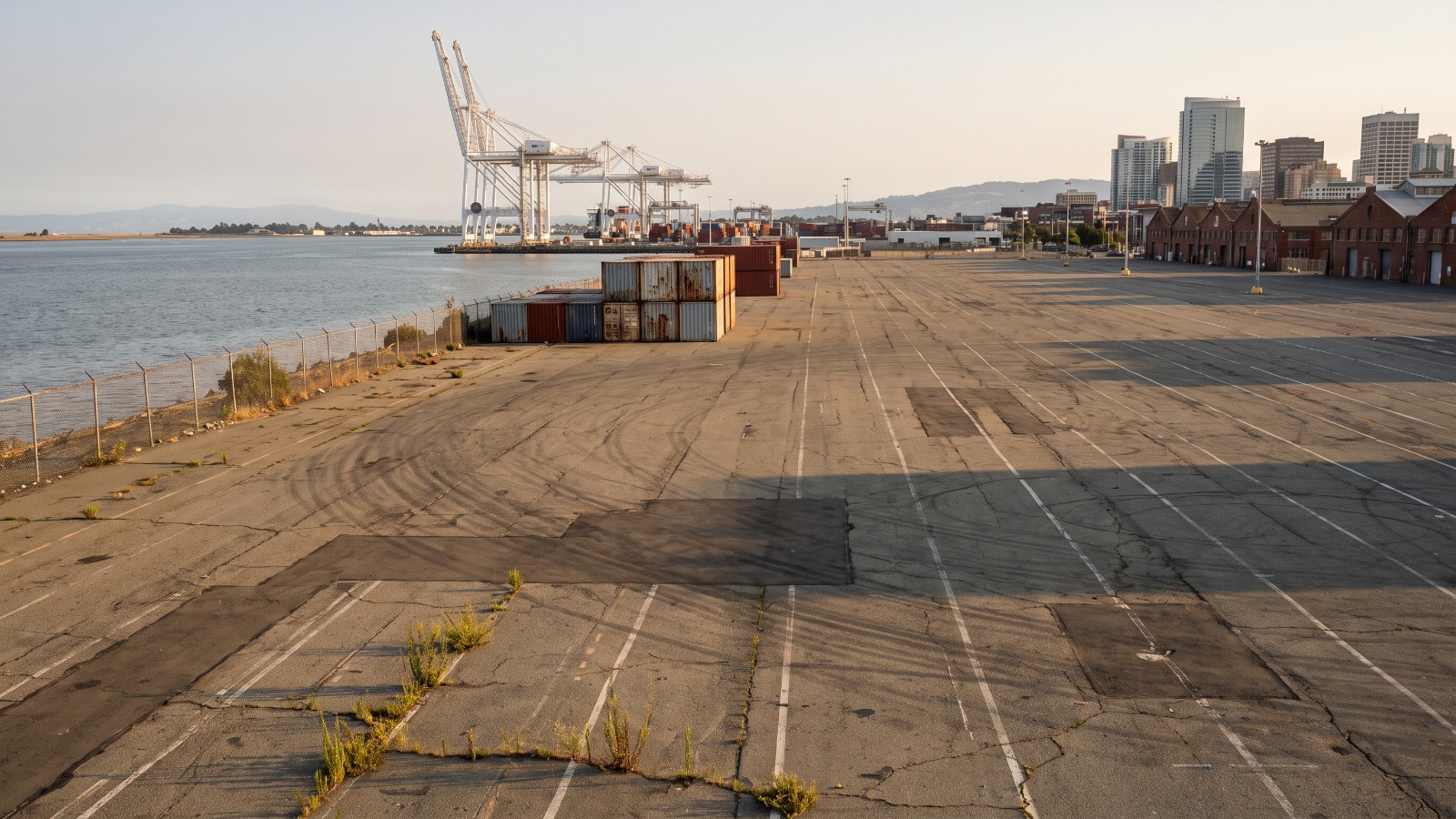
The empty asphalt of Howard Terminal on the Oakland Estuary, with Port of Oakland gantry cranes and the Jack London Square skyline behind it. Photo: Houseberry
The document the Port of Oakland's board took up at its September 10 meeting does not authorize a stadium. It authorizes a conversation. Commissioners voted 6 to 0, with one member absent, to open a one-year exclusive negotiating window over Howard Terminal, the 50-acre former marine terminal at 1 Market Street on the estuary edge of Jack London Square. What the Oakland Roots got is twelve months of a locked door and the right to come back with a real plan. The A's held the identical piece of paper in April 2018.
The useful question is what quietly changed about the site since the last time this happened. One thing did, and it barely made the coverage. The roughly 3,000 homes that came with the ballpark plan are gone. Not trimmed. Gone, and gone before the Roots ever filed a bid.
What the commissioners actually voted on
An exclusive negotiating agreement is a promise not to shop the site to anyone else while a developer does homework. It is not an approval, a lease, an entitlement, or a building permit.
The deliverables are the interesting part. Inside 90 days, each party owes the Port a refined project description, a site plan, the acreage it wants, and parking and access plans. Over the rest of the year they owe an entitlement strategy, a financial feasibility report, option terms and a capital improvements schedule. SFist reported the 6 to 0 vote and the $25,000 fee on September 19.
Financial feasibility is the line to watch. That is where waterfront stadium plans usually stop, and where the last one stopped.
The word exclusive is carrying less weight than the headlines suggest
Both finalists got one. The Port is running two incompatible ideas on the same 50 acres for a year to see which survives contact with a spreadsheet.
The Roots want a stadium. Industrial Realty Group wants maritime commodity handling and logistics, which is the use the Port has quietly preferred here for most of the last decade. One of the year-one deliverables is confirming how much acreage each party actually gets, which is a polite way of saying the Port has not decided. About four acres in the southwestern corner are spoken for regardless, reserved for the Inner Harbor Turning Basin widening.
The vote still matters. But "Roots land exclusive deal" describes a starting gun, not a finish line.
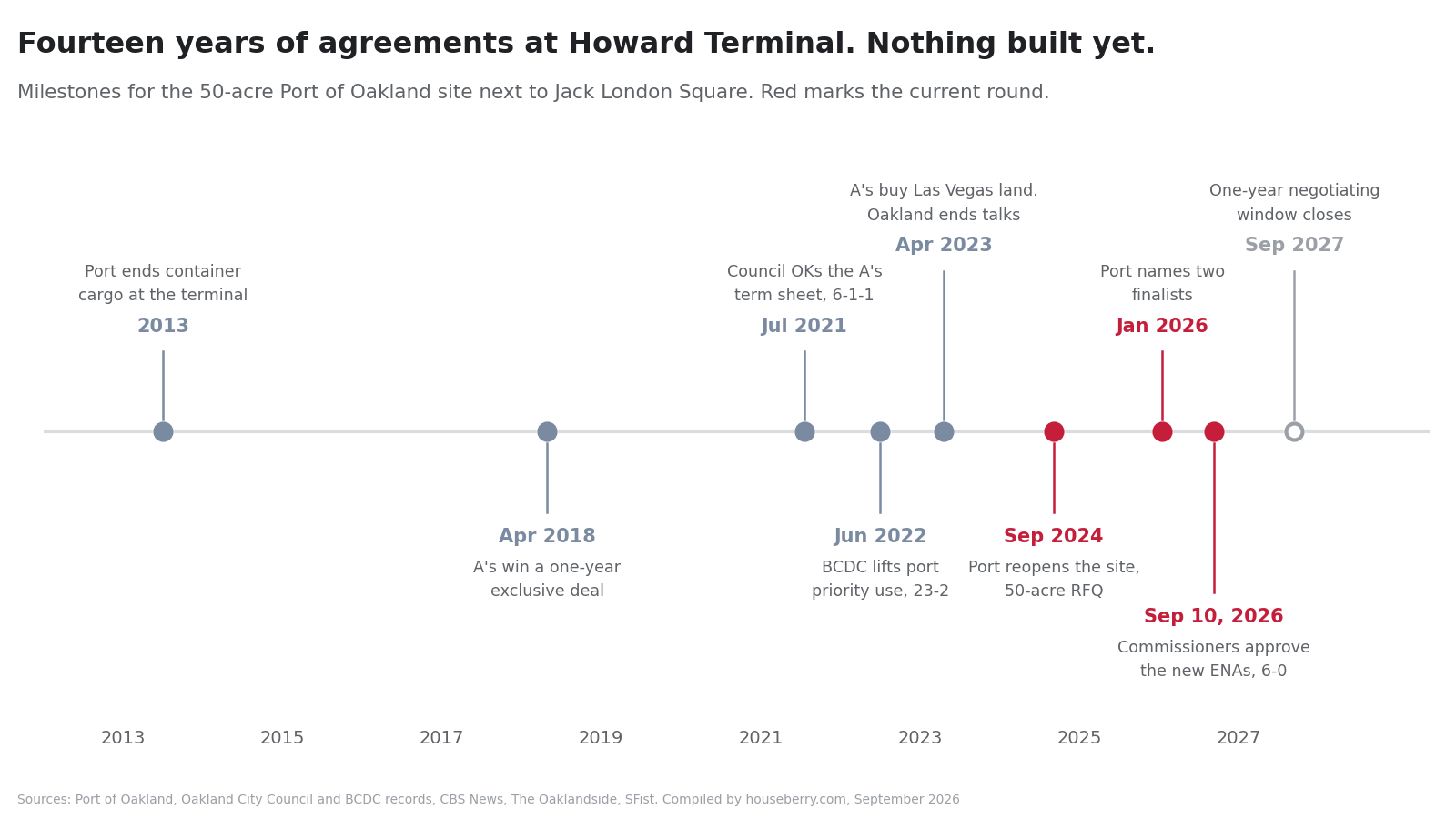
The A's held this same piece of paper in 2018
This is the second exclusive negotiating agreement at Howard Terminal in eight years. The first one got much further.
Port commissioners approved a one-year exclusive negotiating agreement with the A's on April 26, 2018. The plan that grew out of it was enormous: a 34,000-seat ballpark, about 3,000 homes, 1.5 million square feet of commercial space, and a performance venue. Oakland's City Council approved a term sheet 6 to 1 to 1 in July 2021 and certified the environmental impact report 6 to 2 in February 2022. The Bay Conservation and Development Commission then voted 23 to 2 to lift port priority use from the site.
Then it died anyway. The A's bought land in Las Vegas in April 2023, Oakland ended negotiations, the agreement lapsed that May, and the team is now playing in Sacramento on the way to Nevada. The wall was never zoning or CEQA. It was who pays for the roads, the utilities and the grade separations on a site that has none of them. The A's cleared harder procedural hurdles than the Roots have even reached, and the ground is still asphalt.
The 3,000 homes came off the table before the Roots ever bid
Housing is missing from the Roots proposal because the Port never asked for it. The club did not leave it out.
When the Port reopened the site in September 2024, the solicitation said it would consider maritime, light industrial, commercial, recreational and water-oriented uses. Read that list again. Residential is not on it.
The reason is a piece of nineteenth-century property law that governs most of the Oakland shoreline. Howard Terminal is public trust land, granted by the state to the City and administered by the Port, and the trust limits it to commerce, navigation, fisheries and related public uses. Housing does not qualify. The A's did not argue their way around it. They got a statute. AB 1191, carried by then-Assemblymember Rob Bonta in 2019, authorized a State Lands Commission trust exchange for the Howard Terminal property so housing could legally go there.
Nobody has asked the Legislature for a second one. Until somebody does, the answer to "will there be housing at Howard Terminal" is no, and it is a legal no, not a political one.
I think that is a genuine loss and I am not going to soften it. Three thousand homes on 50 flat acres where nobody lives, half a mile from West Oakland BART and walking distance to the Amtrak platform at Jack London Square, is close to the easiest housing argument anyone in the East Bay will ever get to make. The state already wrote the law once.
The counterargument deserves its due. A privately financed soccer stadium is something a mid-sized club can actually build, and Oakland has spent fourteen years learning what the alternative looks like. We have written about a West Oakland site approved for 1,032 homes that now wants to be a parking lot while it waits for financing. Approvals are not buildings.
What people are paying on either side of the site right now
Both neighborhoods flanking Howard Terminal sit near the bottom of our Oakland ranking, for different reasons. Here is where they stand before anything is built.
| Produce and Waterfront (Jack London Square) | Prescott (West Oakland) | Oakland citywide | |
|---|---|---|---|
| Position relative to the site | The site sits at its western end | Inland, northwest of the site | Not applicable |
| Houseberry overall score | 2.1 of 5, 91st of 130 neighborhoods | 2.1 of 5, 90th of 130 neighborhoods | 2.6 of 5 |
| Safety | 1.6 of 5 | 2.6 of 5 | 3.0 of 5 |
| Schools | 2.2 of 5 | 1.5 of 5 | 2.1 of 5 |
| Amenities | 3.3 of 5 | 2.9 of 5 | 3.2 of 5 |
| Median sale price | No neighborhood median published, too few recent sales | About $630,000, July 2026 | About $974,000, August 2026 |
The blank in that table is a finding. Produce and Waterfront, the strip between the Embarcadero rail tracks and the estuary that contains Jack London Square, does not sell enough homes in a year for us to publish a neighborhood median. There is almost nothing there to buy, because there is almost nothing there to live in. That is the condition a stadium would be dropped into.
The scores tell the rest. Produce and Waterfront rates 3.3 of 5 on amenities, which is Yoshi's and Drake's and the Sunday farmers market doing real work, and 1.6 on safety, the lowest number on this page. Prescott, the West Oakland neighborhood most people call the Lower Bottoms, inverts it: 2.6 on safety, 2.9 on amenities, Victorians on flat, bikeable blocks. Same overall score, one rank apart, almost nothing in common.
West Oakland's discount is the number a stadium would move first
West Oakland has spent the last year trading between 21 and 31 percent below the Oakland median, and that gap is the thing worth watching, not the stadium renderings.
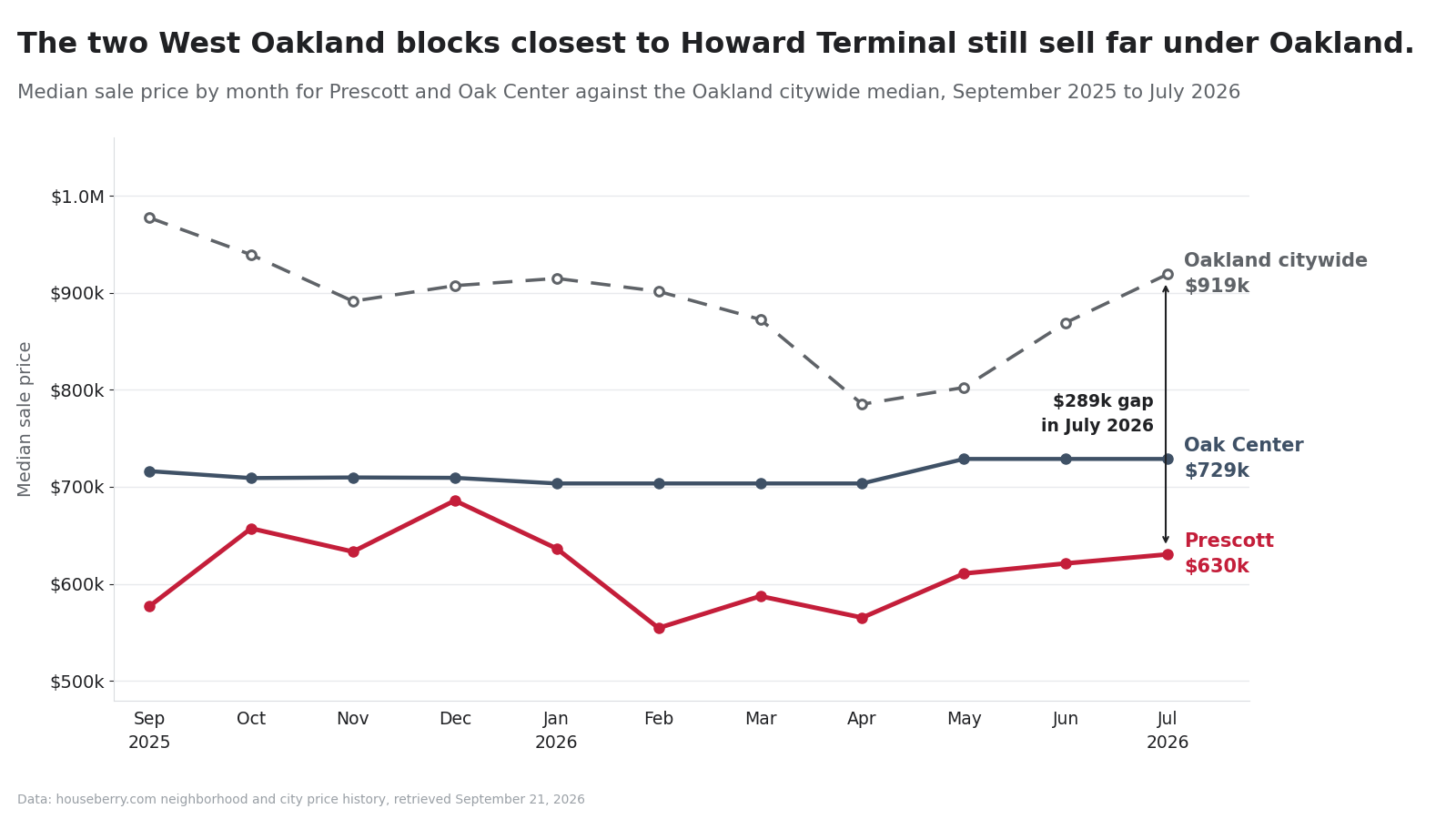
Prescott closed July 2026 at about $630,000, roughly 31 percent under the citywide figure. Oak Center, West Oakland's historic preservation district and the largest in the city with something like 500 restored pre-1925 houses, sat at about $729,000. Oakland citywide bottomed at roughly $785,000 in April 2026 and recovered to about $974,000 by August.
West Oakland is not tracking the city. It is its own market, discounted for reasons a soccer stadium does not touch: freeway and rail proximity, soil history, schools scoring 1.5 of 5, and a century of industrial land use. A 25,000-seat venue a mile away changes none of that.
What it could change is the block-by-block edge closest to the water, the way Brooklyn Basin did on the other side of Jack London Square. That is a narrow strip, and it is where speculation lands first. Treat a stadium headline as a reason to look harder at the specific block, not the zip code.
The honest case for not getting excited
The Roots have a stadium problem before they have a site problem, and the calendar is unkind.
Their Coliseum lease runs out on December 21, 2026. The published concept is two phases: a modular 15,000-seat venue first, estimated at roughly $129 million, then a permanent 25,000-seat stadium designed by HOK. Club leadership has said it would be paid for principally through private sources of equity, with some site infrastructure possibly eligible for public money. A more honest financing posture than the A's ever took, and a much smaller building.
Even so, a modular stadium on Howard Terminal by 2027 is not happening. The negotiating window alone runs into late 2027. After that comes a lease or disposition agreement back before the board, then city entitlements, then CEQA, then a BCDC permit for shoreline work. None of those are formalities on a former marine terminal with contaminated soil and an active rail corridor past the gate.
The dates that will actually tell you something
The next real checkpoint is about 90 days out, in mid to late December 2026, when the Roots owe the Port a refined project description, a site plan and a stated acreage.
That filing is the first time anyone outside the negotiation sees how much of the 50 acres the club wants and where the stadium sits. Whether Industrial Realty Group's logistics concept is still standing next to it will tell you as much as the drawings do. After that, the financial feasibility report in 2027 is the document that decides this. The window closes around September 2027 either way.
Until one of those lands, this is a real estate story about a piece of paper. The way we look at it when we compare neighborhoods at Houseberry, a 2.1 overall score and a $630,000 median in West Oakland are facts you can act on this month. A stadium might exist in 2030. If you are shopping either side of the estuary, start with how Oakland's neighborhoods actually rank today. The asphalt has been there since 2013. It can wait a little longer.
Sources
The Oaklandside, "Oakland Roots land exclusive deal with the Port of Oakland to develop Howard Terminal," Jose Fermoso, September 18, 2026
SFist, "Oakland Roots Reach Deal to Develop Howard Terminal Site," September 19, 2026
NBC Bay Area, "Oakland Roots reach agreement to develop Howard Terminal site," September 2026
Port of Oakland, Board of Port Commissioners meeting agenda and resolutions, September 10, 2026
Port of Oakland, "Port of Oakland seeks development concepts for Howard Property," September 6, 2024
CBS News Bay Area, "Port Approves Exclusive Negotiations With A's For Howard Terminal," April 27, 2018
California Legislature, AB 1191 (Bonta, 2019), State Lands Commission trust lands exchange, Howard Terminal property
Oakland City Council and Bay Conservation and Development Commission records on the Waterfront Ballpark District at Howard Terminal, 2021 and 2022
San Francisco YIMBY, "Oakland Roots Releases Plans for Howard Terminal Soccer Stadium," January 2025
KQED, "Years After A's Deal Died, Port of Oakland Looks to Soccer Club for Waterfront Stadium," 2026
Houseberry, Oakland neighborhood rankings, city guide and neighborhood price history, retrieved September 21, 2026
Map of Oakland Neighborhoods
Loading map...
View Full Map
Top Neighborhoods in Oakland, CA






All information provided on this website including but not limited to - school ratings, safety, amenities, user opinions, and property data - is for general informational purposes only. We do not guarantee its reliability, accuracy, or completeness. Users should independently verify information and consult appropriate professionals as needed. By using this website, you agree Houseberry is not responsible for actions, decisions, or consequences arising from reliance on the information provided
houseberry.com - CA DRE# 01847391
 Bay East ©2025. CCAR ©2025. bridgeMLS ©2025. Information Deemed Reliable But Not Guaranteed. This information is being provided by the Bay East MLS, or CCAR MLS, or bridgeMLS. The listings presented here may or may not be listed by the Broker/Agent operating this website. This information is intended for the personal use of consumers and may not be used for any purpose other than to identify prospective properties consumers may be interested in purchasing. Data last updated at September 21, 2026 12:00 AM