Mare Island Is for Sale. What That Means for Vallejo Buyers
Two million square feet of the former Mare Island shipyard just hit the market. The numbers behind Vallejo's price gap with the rest of the North Bay, and what this sale changes.

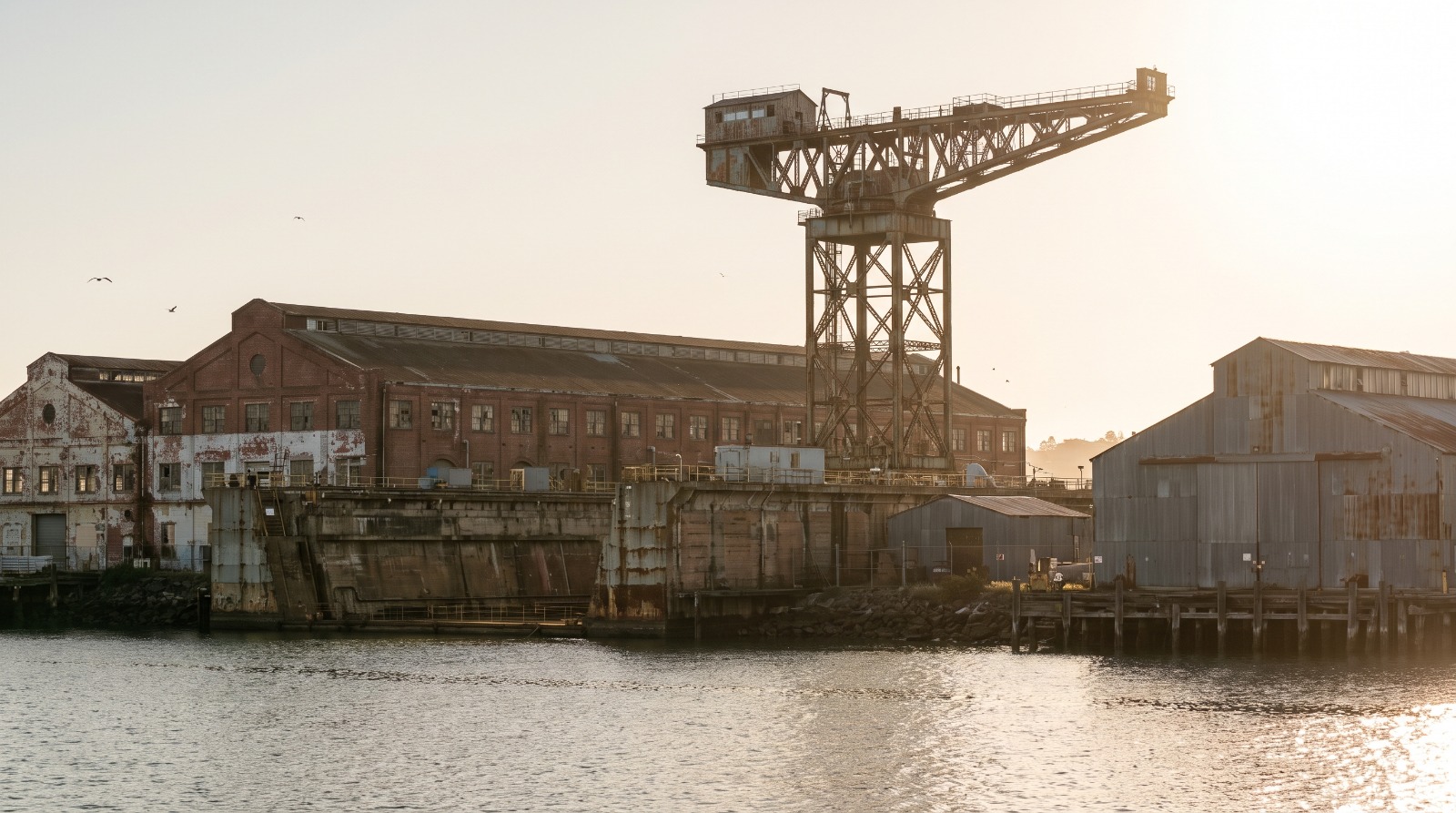
Historic crane and brick shipyard buildings on the Mare Island waterfront in Vallejo, the former Navy shipyard now up for sale Photo: Houseberry
$544,870 buys the median Vallejo home as of July 2026. Across the causeway from those houses, 2 million square feet of the former Mare Island Naval Shipyard just went up for sale in a single listing. Those two numbers belong in the same story, because the shipyard is the biggest open question hanging over the cheapest housing market on the San Francisco Bay.
The numbers that matter: Vallejo’s median is up about 4 percent in a year while most North Bay cities went sideways or down. The next-cheapest city that touches the Bay costs about $200,000 more. And the asset that could change Vallejo’s jobs picture just changed hands to whoever shows up with the biggest check.
What is actually for sale on Mare Island
The Nimitz Group, the ownership team that took over the island’s developable land from Lennar, has put the shipyard core on the market: about 2 million square feet of industrial buildings across 350 acres, with brokerage JLL hired to find operators or a buyer. The Registry notes it is one of the only privately held shipyards on the West Coast, listed just as federal shipbuilding mandates fuel the largest maritime buildout since World War II.
What is not for sale: the houses. This is the dry docks, cranes, and big-shed industrial spine of the island, not the residential blocks. Nobody is auctioning a neighborhood.
What Mare Island has quietly become
Mare Island was the Navy’s first station on the West Coast, running from 1854 until the base closed in 1996, and the island now carries more than 100 businesses, Touro University’s roughly 1,400 students, a nature preserve, and a residential community. Factory OS builds modular apartments in a 125,000-square-foot plant there, leased in 2024. The place stopped being a ghost base years ago. It just never finished becoming a town.

As a neighborhood, we score Mare Island at 2.1 out of 5 overall, eighth of Vallejo’s 23 ranked neighborhoods, with a median sale price of about $678,000 in July 2026, down roughly 9 percent from a year earlier. The subscores tell you exactly what living there is like: public spaces score 4.0, nearby merchants score 0.3. Shoreline trails and history in every direction, and a drive into Vallejo proper for a gallon of milk.
That merchants number is the redevelopment story in miniature. Large stretches of the island are still industrial or vacant, and the master plan that would fill them, covering about 800 acres of the 5,000-acre island, is not due for approval until 2027.
The North Bay price table
Here is Vallejo against its neighbors, and the gap is not subtle.
| City | Median sale price | As of |
|---|---|---|
| Vallejo | $544,870 | July 2026 |
| Santa Rosa | $742,180 | June 2026 |
| Napa | $821,380 | July 2026 |
| Benicia | $838,520 | July 2026 |
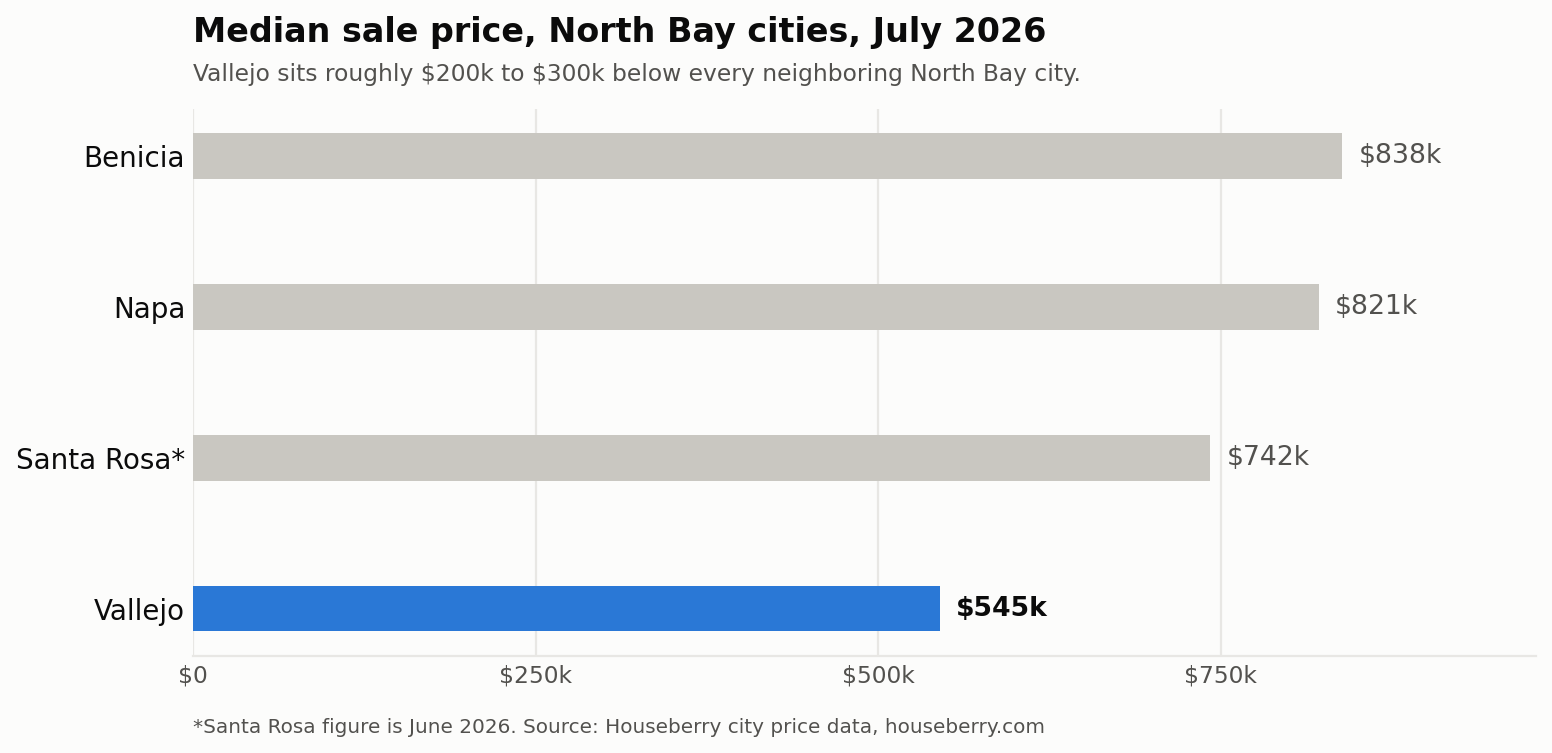
Interpret those gaps for a second. Benicia, directly across the Carquinez Strait, costs $293,650 more at the median, a 54 percent premium for what is functionally the next exit. And unlike its pricier neighbors, Vallejo is moving up: the median has climbed from $521,790 in August 2025 to $544,870 in July 2026, about 4.4 percent, per our city price history, over a stretch when Santa Rosa and Napa both sold below their year-ago levels.
Vallejo also holds a card no other discount market in the region has: a ferry that puts downtown San Francisco about an hour away without touching a bridge toll plaza.
What this sale does and does not mean for prices
What it plausibly means: a serious industrial buyer signs long leases, hires shipyard-scale headcount, and Vallejo gets the kind of blue-collar payroll base the Bay Area keeps saying it wants. Trades jobs at a working shipyard are exactly the incomes that buy $545,000 houses. That is the bull case, and the federal shipbuilding push makes it more than a fantasy.
What it does not mean: a rerun of a waterfront condo boom. The listing is industrial, the master plan is unapproved until 2027, and this island has burned optimistic timelines before, with seismic, soil, and records problems pushing earlier phases back for years. Nobody should underwrite a Vallejo purchase on the shipyard trading.
And the discount exists for documented reasons. Citywide, Vallejo scores 2.1 on safety and 2.2 on schools by our count. Buyers who skip that homework and shop on price alone find out why the price was the price. The city’s value rankings are where the tradeoffs sit side by side, neighborhood by neighborhood.
Questions buyers keep asking
Why is Vallejo so much cheaper than the rest of the Bay Area?
Distance, schools, and safety scores, in that order, priced in over decades. Vallejo’s median of about $545,000 in July 2026 reflects a city that lost its Navy payroll in 1996 and never fully replaced it. The discount is real, and so are its causes.
Is Mare Island a good place to live?
It depends on your errand tolerance. The neighborhood scores 4.0 on public spaces and 0.3 on nearby merchants in our data, which is the most lopsided profile in Vallejo. Historic housing, water on three sides, and a drive for almost everything daily.
Will the shipyard sale raise Vallejo home prices?
Not by itself, and not soon. A sale becomes payroll only after a buyer, permits, and hiring, which is a multi-year chain. The July 2026 median was already up about 4 percent year over year without any shipyard news, which says the value story does not depend on this deal.
The bottom line: Mare Island’s listing is the most interesting thing to happen to the North Bay’s cheapest market in years, and the right way to play it is to buy Vallejo for what it costs today, not for what a shipyard might become. We keep the Vallejo numbers updated monthly at Houseberry, and this is one city where reading them first genuinely pays.
Sources
The Registry: Nimitz Group's 2M sq ft Mare Island shipyard hits the market in Vallejo
Mare Island Company: Master plan FAQs
North Bay Business Journal: New owner at Mare Island reprioritizes redevelopment master plan
Houseberry Vallejo city, neighborhood, and value data, July 2026
The Houseberry Research Team is Houseberry's reporting team: Bay Area real estate analysts, data specialists and longtime local market watchers. Every day we check the public record: building permits, city council and planning agendas, county recorder filings, state housing bills, police incident data and school results. Then we tie each story to what it means for specific neighborhoods, using Houseberry's own neighborhood data on prices, appreciation, safety, schools and amenities. Questions or corrections: Contact us.
All information provided on this website including but not limited to - school ratings, safety, amenities, user opinions, and property data - is for general informational purposes only. We do not guarantee its reliability, accuracy, or completeness. Users should independently verify information and consult appropriate professionals as needed. By using this website, you agree Houseberry is not responsible for actions, decisions, or consequences arising from reliance on the information provided
houseberry.com - CA DRE# 01847391
 Bay East ©2025. CCAR ©2025. bridgeMLS ©2025. Information Deemed Reliable But Not Guaranteed. This information is being provided by the Bay East MLS, or CCAR MLS, or bridgeMLS. The listings presented here may or may not be listed by the Broker/Agent operating this website. This information is intended for the personal use of consumers and may not be used for any purpose other than to identify prospective properties consumers may be interested in purchasing. Data last updated at October 3, 2026 12:00 AM