Mountain View Trades 29 Rent-Controlled Homes for 216 Condos
A 216-condo builder's remedy project on Gamel Way would demolish 29 rent-controlled Mountain View apartments. Here is what the six remaining households are actually owed, and what the city gets.
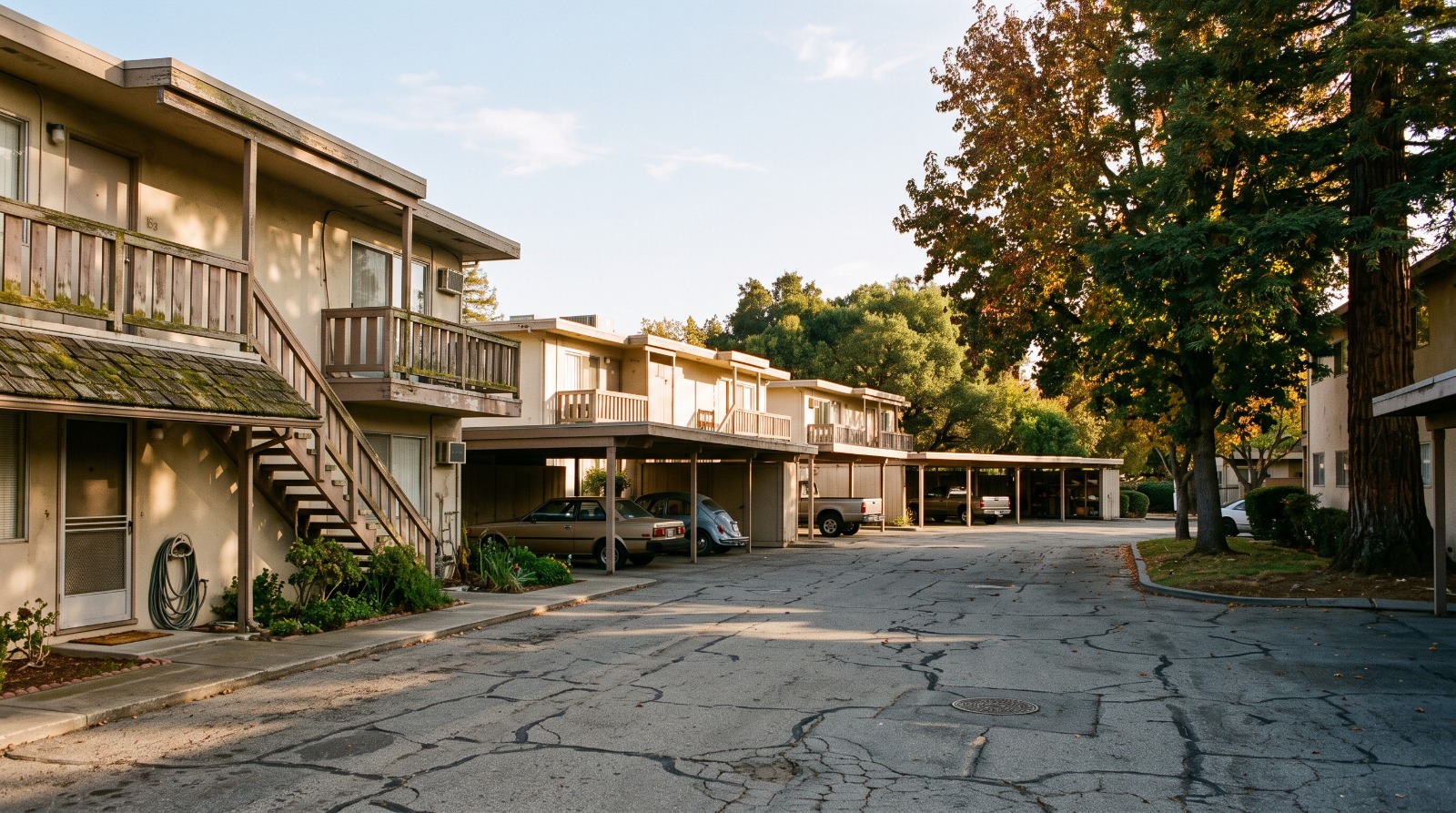
Two-story 1960s garden apartment buildings on a Mountain View cul-de-sac off Escuela Avenue, the kind of rent-controlled housing the Gamel Way condo project would replace. Photo: Houseberry
On September 8 the Mountain View City Council holds a public hearing on selling a street. Gamel Way is a short cul-de-sac off Escuela Avenue, directly across from Castro and Mistral elementary schools, and vacating it is the last procedural piece of a project that turns 29 rent-controlled apartments into 216 condominiums.
Six households are still living there. By my read of the two ordinances that apply, a qualifying household on that block is owed something on the order of $160,000 in relocation money, most of it a 42-month rent-differential payment required by state law. Almost nobody covering this story has added that up, and it changes how the block reads.
I am for this project. Two hundred and sixteen homes on 2.3 acres across the street from two elementary schools is exactly the trade the region keeps saying it wants. But the honest version has to include what gets destroyed on the way, and one thing here gets destroyed permanently.
What is actually on the September 8 agenda
Not the project. The street. On June 23 the council voted unanimously, on consent, to declare its intent to vacate Gamel Way. September 8 is the hearing where it decides whether to actually vacate and sell it. The price in the 2021 development agreement was $4.8 million, and no 2026 appraisal has been made public, so treat that figure as the old number, not the September number.
The project itself, per the city's own project page, is still in CEQA review. Nothing is entitled.
- 1919 to 1945 Gamel Way and 574 to 584 Escuela Avenue, about 2.3 acres, zoned R3-1 multiple-family residential
- 216 condominiums in seven stories over two levels of underground parking
- 29 existing rent-controlled apartments demolished, 6 of them still occupied as of July 2026
- 44 below-market-rate units per the developer, of which 29 are replacement condos priced to the current tenants' income levels (the city page describes it as 20 percent affordable)
- Applicant DeNardi Wang Homes, through D/S Gamel Way LLC
- Pending alongside it: a vesting tentative map for condominium purposes and a permit to remove 12 heritage trees
This is builder's remedy on an ordinary residential street
The site is not in East Whisman, not in North Bayshore, not in San Antonio, not in the Moffett Boulevard plan area. It is plain R3-1 land, and that is the whole reason the project took the shape it did.
The applicant filed an SB 330 preliminary application on April 6, 2023 and a formal application on July 27, 2023, while Mountain View's housing element was uncertified. That locked in builder's remedy status, which the project keeps even though the state has since certified the element. A 2021 council approval had this site at roughly 118 units. Builder's remedy took it to 216, and required 20 percent affordable instead of the city's usual 15.
There was no plan-based path to 216 units on that parcel, which is also why the developer needs the street. This is the R3 question in miniature, and the council already knows it. On February 10, 2026 it voted 5 to 1 to update land designations and objective standards across the R3 district, which holds roughly half of Mountain View's multifamily housing and nearly all of its rent-controlled units.
What the six remaining households are actually owed
Two regimes stack, and the reporting on this project has skipped both. State law sets the floor. The city adds to it, and the city added again eight months ago.
| Source | Benefit | Amount for a two-bedroom household |
|---|---|---|
| SB 330 (state) | 42 months of rent differential between the old rent and a comparable replacement, plus moving costs and a right of first refusal | roughly $128,000 at Mountain View's $4,546 average two-bedroom rent |
| Tenant Relocation Assistance Ordinance | Cash equal to three months of median rent for a similar unit, paid per unit | roughly $13,600 |
| TRAO, special circumstances | Additional payment for households with a senior 62 or older, a disabled member, or a dependent under 19 | $8,503 and indexed annually |
| December 9, 2025 expansion | Additional benefit for low-income households, indexed to inflation, plus capped moving expenses | about $9,400, plus up to $2,250 in moving costs |
That math is mine, not the city's, and it uses RentCafe's August 1, 2026 Mountain View two-bedroom average of $4,546 against a tenant paying around $1,500. The September 8 staff report should carry the project's own figures. But the order of magnitude holds, and it is not nothing. The SB 330 differential alone runs three and a half years.
The December 9, 2025 expansion is the freshest piece and the least reported. The council voted unanimously to add roughly $9,400 for low-income households, index it to inflation, cap one-way moving expenses at $1,670 for a one-bedroom, $2,250 for a two-bedroom and $2,880 for three or more, and extend the renovation-displacement window from 90 to 120 days. The vote had been delayed from October after landlord pushback. Eligibility under the relocation ordinance runs to 120 percent of county median income plus $5,000, which in 2026 is $207,200 for a family of four.
A hundred and sixty thousand dollars is real money and it is also not a home. Tania Peneva, one of the residents the Mountain View Voice spoke to, has watched her rent go from about $850 in the late 1990s to about $1,500. Humberto and Maria Cruz left four years ago after two termination notices, paid $1,250 a month here, and now pay $3,500 for a mobile home. Relocation money buys about three and a half years of the gap. It does not buy the twenty-fifth year.
The swap nobody names: 29 permanently stabilized units for 216 that never can be
This is the part that should bother pro-housing people, and I say that as one. The 29 apartments on Gamel Way are covered by the Community Stabilization and Fair Rent Act, which applies to buildings of three or more units built before February 1, 1995. Rent stabilization and just-cause eviction, permanently attached to those units.
The 216 condominiums replacing them are exempt twice over. Condos are exempt. Post-1995 construction is exempt. Not one of the new homes can ever be rent-stabilized under the CSFRA, and 44 deed-restricted units is a different instrument with a different term. The city gains 187 net homes and loses its last 29 permanently controlled units on that block.
It is not a one-off, either. The city told the Voice that since 2016, 24 projects have displaced or will displace tenants from 891 rent-controlled units, 748 of them occupied. That is a policy running quietly in the background of every Mountain View approval, and no one has priced it.
216 condos against a city that has permitted 17 percent of its target
Here is the context that makes me support the project anyway. Mountain View's 2023-2031 state housing allocation is 11,135 homes, including 4,370 for very-low and low-income households. Through December 2024 it had permitted 2,571, or 23.1 percent overall, and the breakdown is the story.
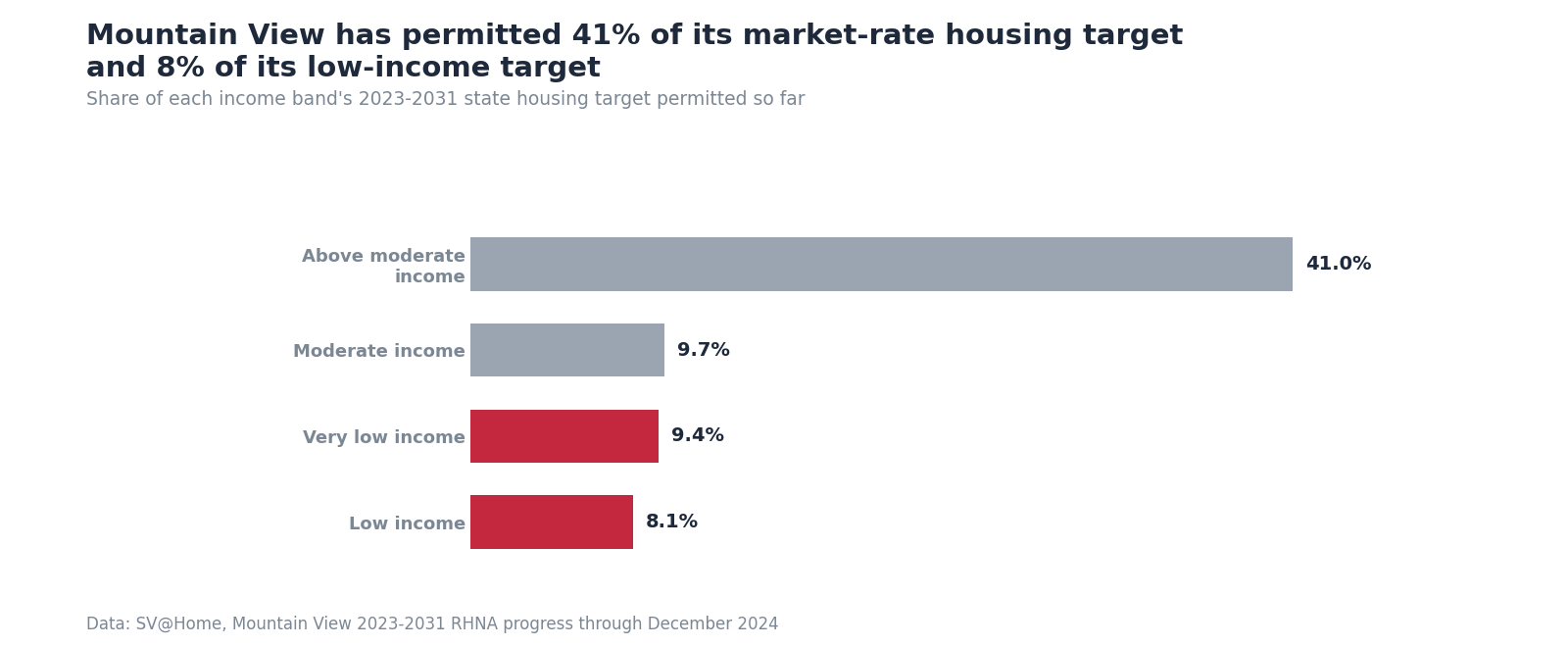
Forty-one percent of the market-rate obligation. Eight point one percent of the low-income one. That gap is not a scandal, it is what happens when the only housing that pencils is the housing that sells. Since mid-2022 the city has permitted 1,867 homes, about 16.8 percent of an eight-year target, while 3,606 approved homes sit unbuilt and 4,914 more grind through entitlement. A city with that record does not get to be precious about 216 condos on 2.3 acres next to two elementary schools.
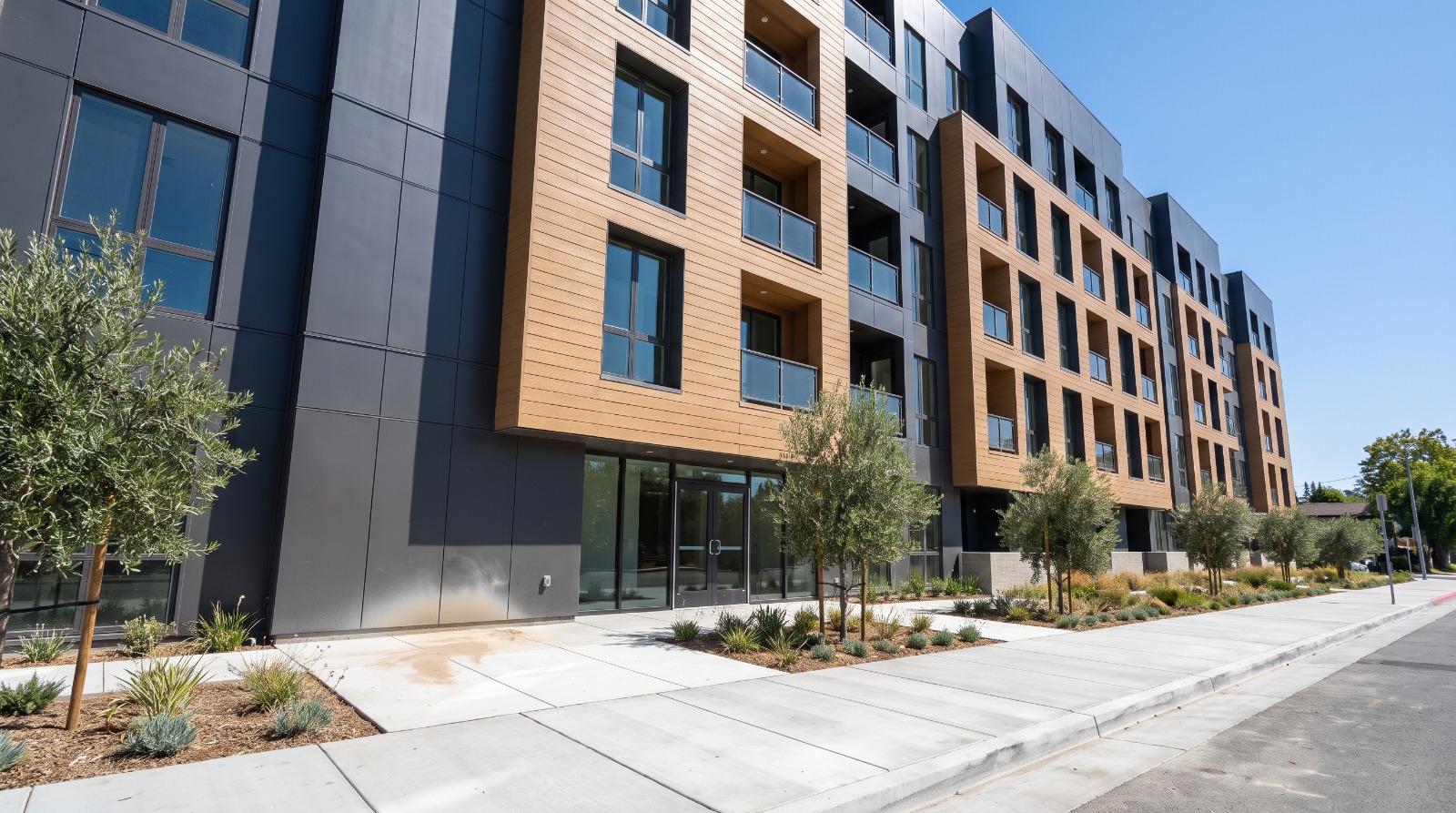
And there is a version that costs nobody their home. In March 2026 the council unanimously approved 323 units at 555 West Middlefield Road, 86 of them affordable, on 14.5 acres, with zero displacement. Gamel Way is harder because the land already had housing on it. The lesson is not to stop building. It is that a city with 4,914 units stuck in review should be clearing the empty sites faster than the occupied ones.
What the block is worth, and what it scores
The Escuela and Rengstorff corridor falls in what we call San Antonio, Rengstorff and del Medio, and it is the most interesting neighborhood in the city on our numbers. Schools 4.6 out of 5, fourth-best of Mountain View's eight neighborhoods. Safety 2.6, dead last of the eight. The median moved from $1.71 million in January 2026 to $2.4 million in July, the widest swing in the city, against a citywide median of $2.92 million in July 2026.
Read that combination honestly and the displacement story gets sharper, not softer. This is the one neighborhood in Mountain View where a household could still reach a 4.6 school score at a below-city price. The gap between what the land scores and what it costs is precisely what made a 216-unit project pencil here rather than in Grant or Sylvan Park, which leads the city at 4.3 overall. The value gap that attracted the developer is the same gap that made those apartments worth defending.
For scale, Mountain View's two best neighborhoods rank 95th and 96th of the 459 neighborhoods we rank across Silicon Valley. This is a good city, not a spectacular one, and it is one of the few on the Peninsula still adding meaningful density near jobs.
What to watch
The September 8 staff report is the document that matters, and it should post to the city's Legistar portal in late August. It will carry the current appraisal on the street, the updated relocation terms, and most likely a unit-by-unit occupancy table for the six remaining households. That table is the story.
Two things I would watch after that. Whether the council attaches any condition tying the street sale to confirmed relocation payments, which it has the leverage to do and has not signaled. And whether the 29 replacement condos come with an enforceable right to return at the tenants' income levels, or a right of first refusal that expires before the building opens. Seven stories takes years. Six households have to live somewhere in the meantime, and where they land is the part the entitlement documents never say.
Sources
- City of Mountain View, 1919-1945 Gamel Way builder's remedy project page
- City of Mountain View, Tenant Relocation Assistance Ordinance council staff report and 2026 income limits
- City of Mountain View, Tenant Relocation Assistance
- Mountain View Voice, “Mountain View expands tenant displacement protections,” December 15, 2025
- Mountain View Voice, “‘We made a home here’: Gamel Way residents face eviction,” August 7, 2026
- San José Spotlight, “Mountain View residents face eviction to make way for condos,” August 10, 2026
- SV@Home, Mountain View 2023-2031 RHNA allocation and permit progress
- Hoodline, on the February 2026 Environmental Planning Commission housing pipeline report
- RentCafe, Mountain View average rents, August 1, 2026
- Houseberry, Mountain View city guide and price history
All information provided on this website including but not limited to - school ratings, safety, amenities, user opinions, and property data - is for general informational purposes only. We do not guarantee its reliability, accuracy, or completeness. Users should independently verify information and consult appropriate professionals as needed. By using this website, you agree Houseberry is not responsible for actions, decisions, or consequences arising from reliance on the information provided
houseberry.com - CA DRE# 01847391
 Bay East ©2025. CCAR ©2025. bridgeMLS ©2025. Information Deemed Reliable But Not Guaranteed. This information is being provided by the Bay East MLS, or CCAR MLS, or bridgeMLS. The listings presented here may or may not be listed by the Broker/Agent operating this website. This information is intended for the personal use of consumers and may not be used for any purpose other than to identify prospective properties consumers may be interested in purchasing. Data last updated at September 25, 2026 12:00 AM