Nobody voted on these 119 Mountain View condos. Expect more
Toll Brothers will replace Hacker Dojo's old building on Maude Avenue with 119 condos, approved by one city official with no hearing. Here is what the new rule lets neighbors do, and by when.

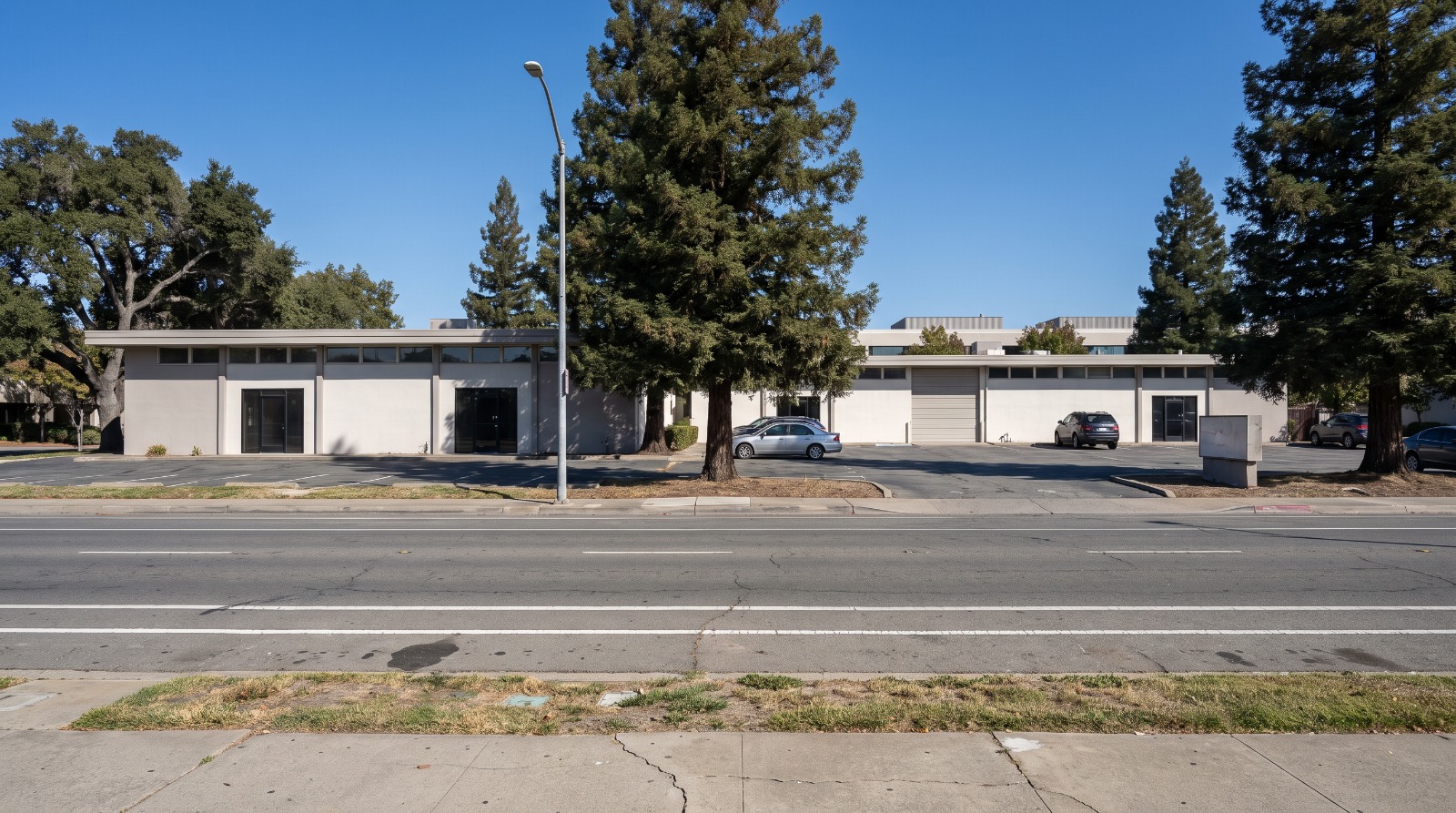
AI-generated illustration of one-story commercial buildings and mature trees on Maude Avenue in Mountain View, the site of 119 approved condos Photo: Houseberry
The one-story building Hacker Dojo moved out of on October 12 is coming down. Toll Brothers will replace it, and the 1960s warehouse next door, with a six-story building of 119 condominiums at 855 and 875 Maude Avenue in Mountain View. Nobody voted on it. Community Development Director Christian Murdock approved the project on October 27, and two days later the city filed a state notice saying it needs no environmental review at all.
This is how a lot of Mountain View housing will get approved from now on. Since July, a project that qualifies for the state's AB 130 environmental exemption can be signed at the director's desk, and the public gets a hearing only if someone asks for one in writing. The block sits in Moffett-Whisman, where the typical home was worth about $1.45 million in October 2026, according to Houseberry's price data, roughly $82,000 less than a year earlier.
What the condos replace on Maude Avenue
The two lots sit on the stretch of Maude between Clyde and Logue, near the Sunnyvale line. The 855 building is a 1966 flex space that Hacker Dojo, the nonprofit coworking and hacker space, called home from 2022 until this month. Board chair Emily Johnson told the Mountain View Voice the group had outgrown it, and the Voice reported the building had heating, cooling and plumbing problems and was set for demolition next year. The Dojo reopened at 3200 Patrick Henry Drive in Santa Clara with twice the room. Next door, 875 to 879 Maude is a one-story warehouse built in 1963, according to commercial listing records.
What goes up is one building of one-, two- and three-bedroom condos over the garage. Floor area jumps from about 31,208 square feet to about 300,643, nearly 10 times as much building on the same land. That works out to about 65 homes an acre, more than triple the density of the 36 rowhomes Prometheus proposed on San Rafael Avenue on a lot almost the same size.
Location is the case for it. By our measurement from the coordinates in the city's filing, the site is less than a quarter mile from VTA's Middlefield light rail station. It also sits inside the East Whisman Precise Plan, the zoning the City Council adopted 6-0 in November 2019 to turn more than 400 acres of low office buildings into a district with room for up to 5,000 homes, the Voice reported at the time. The city's filing places this lot in the plan's medium-intensity mixed-use area and finds the building consistent with it.
The only vote came in June
The one vote tied to these condos happened months ago, when the City Council agreed unanimously to stop voting on projects like them.
AB 130, signed June 30, 2025, wrote a new exemption into state law, Public Resources Code section 21080.66. Housing on an infill site of up to 20 acres skips the state's environmental review entirely if it matches local zoning, clears a density floor, stays off farmland, wetlands, fire zones and the other excluded sites, and tears down no listed historic building. The law does not say who signs the approval. Mountain View answered that with Section 36.44.75 of its zoning code, which the council introduced 7-0 in May and adopted in June, Mountain View YIMBY reported.
Under that rule the director decides. Owners and tenants within 750 feet get mailed notice once an application is complete. Anyone gets at least 14 days to comment, and a public hearing happens only if the applicant or someone else asks for one in writing inside that window. The decision can be appealed to the council. The exemption filing for Maude Avenue records the director's October 27 approval and no hearing.
Compare March. Before the rule took effect, a 456-home building at 490 E. Middlefield Road, near the same light rail station, used the same state exemption and still went to a council hearing for a 6-0 vote. City staff told the planning commission in April that four projects had used the exemption in the previous six months, with more under review. Expect more filings that look like this one.
Here is how the new route compares with Mountain View's usual one and with SB 35, the state's older fast lane, which SB 423 extended in 2023.
| Question | Mountain View's usual route | SB 35 and SB 423 | AB 130 with the city's new rule |
|---|---|---|---|
| Who decides | City Council or zoning administrator, after hearings | City staff, against objective standards | Community Development Director |
| Public hearing | Yes | No | Only on written request |
| State environmental review | Yes, unless another exemption applies | No | No |
| Affordable share the state requires | None beyond city rules | 10 or 50 percent at 80 percent of area median income or below | None beyond city rules |
| State wage rules | None | Prevailing wage above 10 homes | Only if fully affordable or taller than 85 feet |
Three feet under the labor line
AB 130 attaches state labor rules in three cases. A building that is 100 percent affordable to lower-income households pays prevailing wage. A building taller than 85 feet takes on SB 35's skilled-and-trained workforce standard, which fills the job with apprentices and graduates of state-approved programs. A third rule applies only in San Francisco.
Maude Avenue is 15 percent affordable and 82 feet tall. By our reading of the statute, it triggers none of them. In September we covered a Santa Cruz affordable building, about 95 feet tall, that lost this same exemption over its labor conditions. This one clears the line by 3 feet.
That is the bargain AB 130 struck. SB 35 asks for prevailing wage and a deeper affordable share in exchange for skipping hearings. AB 130 asks for neither, only that the building match zoning the city already adopted. It does not waive cleanup. The city's memo cites completed environmental site assessments and a site management plan approved by the regional water board, and the statute requires any contamination to be removed or mitigated to state and federal standards before the city issues a certificate of occupancy.
We think the city got this one right
The East Whisman plan was the debate. Mountain View spent years on it, studied it and voted on it in 2019. A building that follows that plan, near light rail, on a lot holding two 60-year-old one-story buildings, should not need a second fight over what the first one settled.
The honest cost is the hearing room. Under the old route a neighbor could stand at a microphone and argue about the heritage trees or the garage entrance in front of the people who decide. Now the venue is a mailer, a 14-day window and a written request. One fix would help a lot. The city's filing says the memo explaining why this project qualifies is available on request. If one official makes the call, that memo should be online the day the notice goes out.
What 119 condos mean for Moffett-Whisman
One building will hold about a year's worth of the neighborhood's home sales. Houseberry's price data counts 243 sales in Moffett-Whisman over the past 24 months, roughly 120 a year and the most of any Mountain View neighborhood we track with its own sales data.
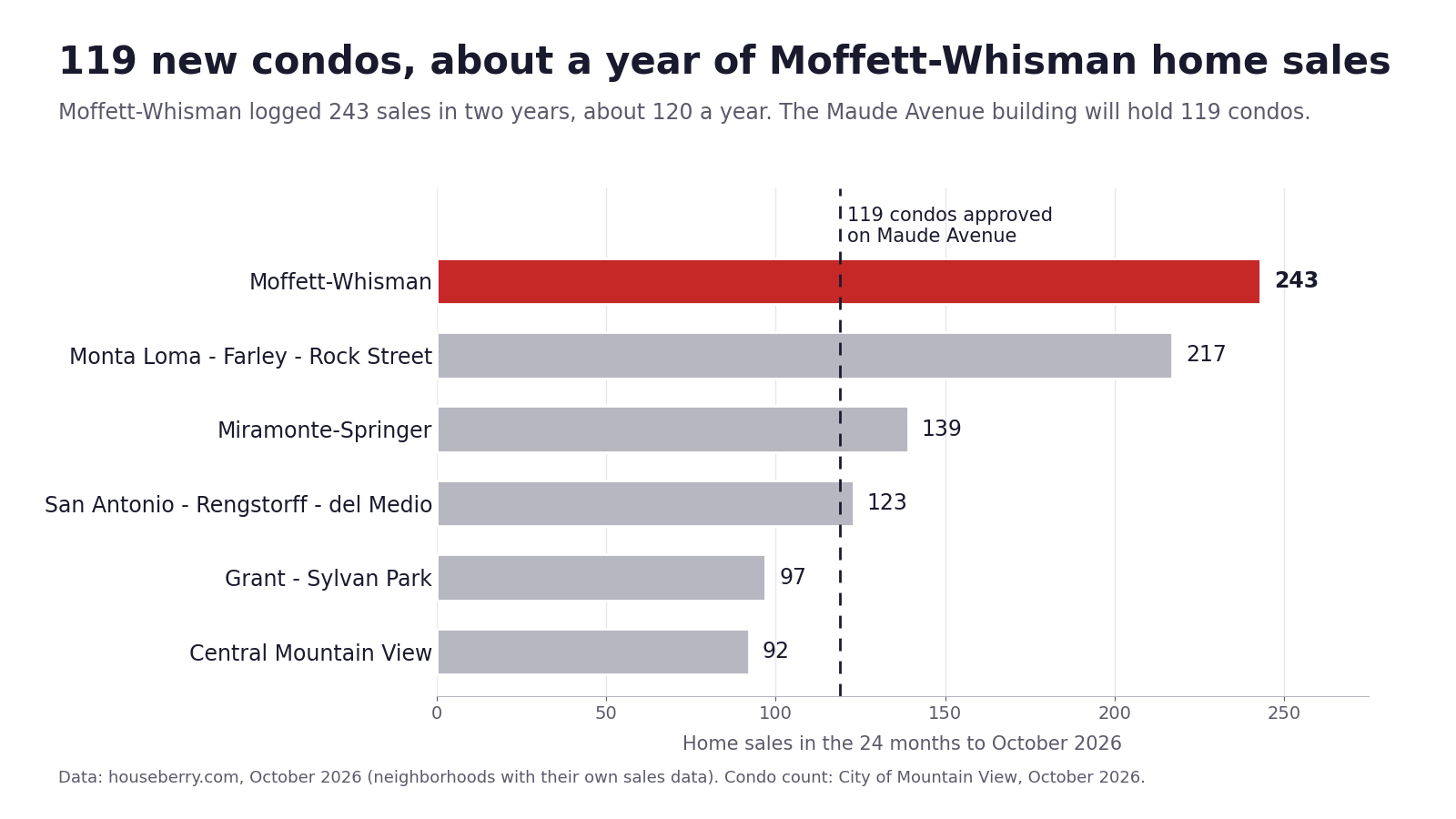
It is also one of the city's cheaper places to buy. The typical Moffett-Whisman home, about $1.45 million in October 2026, costs about 45 percent of the typical Miramonte-Springer home, about $3.23 million, by Houseberry's numbers. Our Mountain View neighborhood ranking puts Moffett-Whisman 7th of 8 at 3.4 out of 5 overall, with a 4.0 school score and a 2.8 safety score. Its 3.4 amenities score edges the citywide 3.3 on our Mountain View city page.
Toll Brothers has not posted prices or a sales date that we could find. A condo in a six-story building is a different product from the townhomes that make up much of Moffett-Whisman's sales, so treat the neighborhood figure as a reference point, not a forecast.
Two dates are left for anyone who objects. An appeal to the council is due within 10 days after the director's findings were mailed or emailed, around November 6 if they went out the day of the decision. A lawsuit over the exemption has to be filed within 35 days of the October 29 notice, by December 3. The next project may not wait that long to reach your street, and if you own or rent within 750 feet of one, that mailed notice is your hearing. Before it arrives, see how your part of town scores on our Mountain View neighborhood ranking.
Sources
- CEQAnet, 855 and 875 Maude Avenue Project, Notice of Exemption, SCH 2026101180, filed October 29, 2026
- Mountain View City Code Section 36.44.75, administrative housing approvals
- California Public Resources Code section 21080.66
- Mountain View Voice, Hacker Dojo leaves Mountain View for larger spot in Santa Clara, October 12, 2026
- Mountain View YIMBY, Council adopts an interim AB 130 streamlining ordinance, May 27, 2026
- Mountain View YIMBY, Two major housing projects advance in East Whisman, March 11, 2026
- Mountain View YIMBY, transcript of the April 15, 2026 Environmental Planning Commission meeting
- Mountain View Voice, Mountain View tightens affordable housing requirements for developers, May 15, 2026
The Houseberry Research Team is Houseberry's reporting team: Bay Area real estate analysts, data specialists and longtime local market watchers. Every day we check the public record: building permits, city council and planning agendas, county recorder filings, state housing bills, police incident data and school results. Then we tie each story to what it means for specific neighborhoods, using Houseberry's own neighborhood data on prices, appreciation, safety, schools and amenities. Questions or corrections: Contact us.
Map of Mountain View Neighborhoods
Loading map...
View Full Map
Top Neighborhoods in Mountain View, CA






All information provided on this website including but not limited to - school ratings, safety, amenities, user opinions, and property data - is for general informational purposes only. We do not guarantee its reliability, accuracy, or completeness. Users should independently verify information and consult appropriate professionals as needed. By using this website, you agree Houseberry is not responsible for actions, decisions, or consequences arising from reliance on the information provided
houseberry.com - CA DRE# 01847391
 Bay East ©2025. CCAR ©2025. bridgeMLS ©2025. Information Deemed Reliable But Not Guaranteed. This information is being provided by the Bay East MLS, or CCAR MLS, or bridgeMLS. The listings presented here may or may not be listed by the Broker/Agent operating this website. This information is intended for the personal use of consumers and may not be used for any purpose other than to identify prospective properties consumers may be interested in purchasing. Data last updated at November 2, 2026 12:00 AM