Sacramento County battery permits doubled without the tax credit
County permit records show home battery filings more than doubled in 2026, the first year without the federal credit. SMUD's rebate deadline explains most of it, and we priced a battery after the cut.

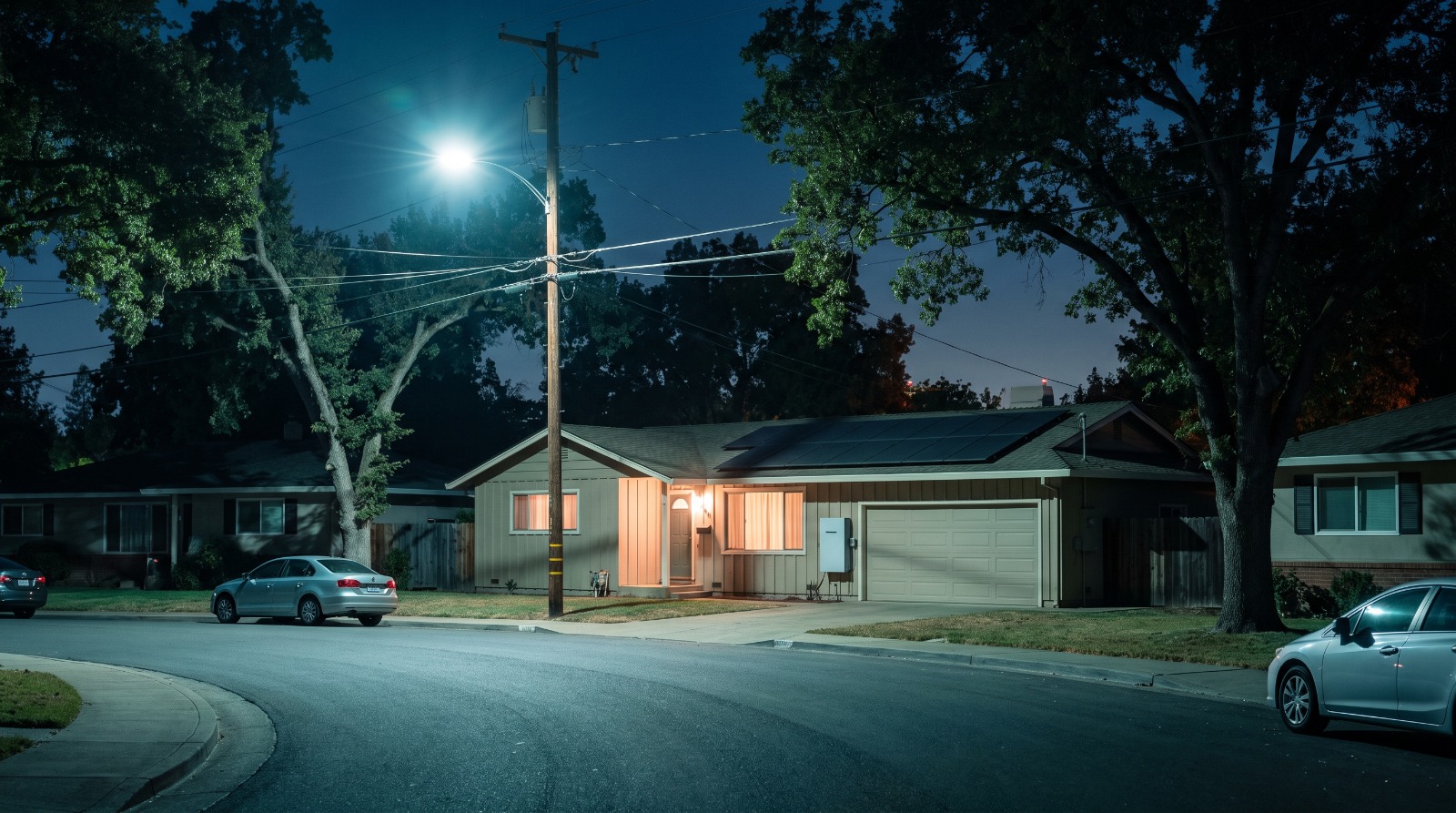
AI-rendered night view of a 1960s ranch house with rooftop solar panels on a Carmichael-style street in Sacramento County Photo: Houseberry
Unincorporated Sacramento County took about 1,430 building permit filings for home batteries between Jan. 1 and Oct. 28, by our count of the county's own permit records. The same stretch of 2025 produced about 550. That is 2.6 times as many, in the year the federal homeowner tax credit for batteries went away.
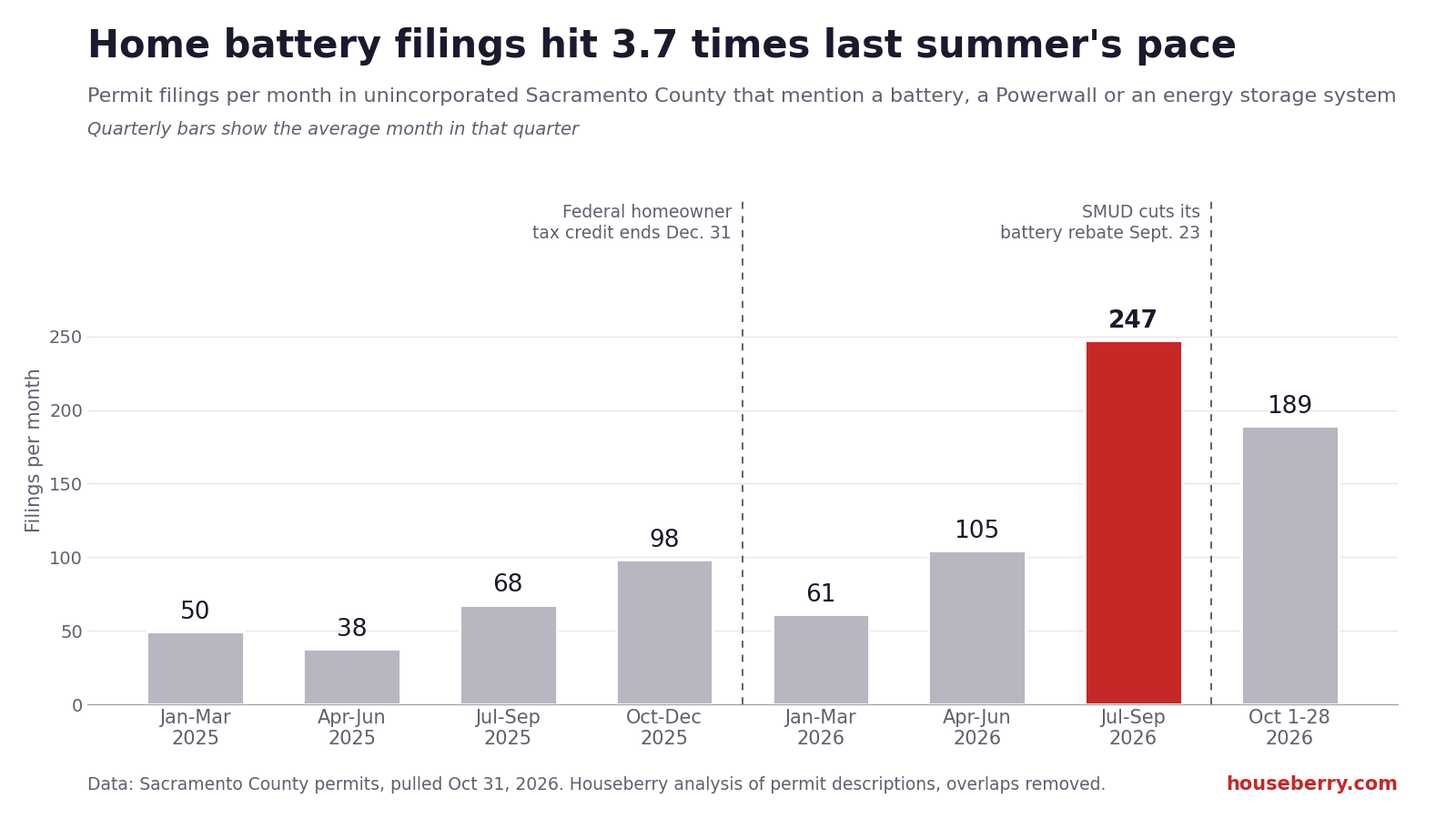
SMUD moved this market. The utility was paying $500 per kilowatt-hour of battery, up to $10,000 a home, then cut that to $300 and $6,000 for projects sent in after Sept. 22. From July through September, battery filings ran about 3.7 times the pace of the same months in 2025. Price a battery now and the most common setup in these permits gets a check $4,000 smaller than it would have in August.
The filings come from the county's unincorporated communities, from Antelope and Carmichael to Arden-Arcade, and they share one sky. Houseberry's 30-year climate data puts Carmichael at 80 percent of possible sunshine, about the same as every other place in the county we checked.
The word "battery" overstates the jump. The jump is still real
Our daily sweep first counted only filings with the word "battery" in the work description: 586 this year against 189 last year, a tripling. We re-ran those queries against the county's permit data on Oct. 31 and got the same totals. Then we read the records.
Installers changed how they write. A 2025 line read "Install of a 4.8kW roof mount photovoltaic system with Tesla 3 Powerwall." No "battery." By October 2026 the busiest installers wrote "Installation of (1) Tesla PW3 Battery," so the word spread faster than the hardware. Counting any filing that mentions a battery, a Powerwall or an energy storage system, once each, gives about 550 last year and about 1,430 this year. That is the number we stand behind.
Not every record is a new battery in a house. We read 129 records from August 2025, August 2026 and October 2026. Roughly three in four were new home batteries. About one in ten were revisions to permits already filed ("Moved battery location"), and the rest were mostly commercial gear, such as cell tower batteries and backup power for baggage screening at Sacramento International Airport. The smaller 2025 sample looked similar, so the ratio holds even if both totals shrink by a quarter.
The rush followed SMUD's calendar
Through September 2025, the county took about 52 battery filings a month. In November and December that doubled to about 105, as buyers raced the federal 25D credit. The IRS treats the expense as made when installation is complete, so a battery finished Jan. 2 got nothing.
Then the credit died. Filings dipped to about 61 a month in the first quarter, then climbed to about 105 a month in spring. July brought 211. August matched it, and September reached about 320, as many as the whole April-to-June quarter.
SMUD's battery program page explains September. Projects submitted for interconnection by Sept. 22 and enrolled by Dec. 31 get $500 per kilowatt-hour. Anything submitted from Sept. 23 gets $300.
We think 2026 is mostly a rebate rush.
October is the complication. Its 189 filings through Oct. 28 are more than twice October 2025's, and they came after the cut. Some of that is paperwork for jobs already in SMUD's queue, which still need a county permit before they can enroll by Dec. 31. November and December will show how much demand is left once that queue clears.
What a battery costs a Carmichael homeowner now
The most common job in the October filings is one Tesla Powerwall 3 plus one expansion pack added to existing panels, about 27 kilowatt-hours. Across 34 battery-only permits we read from October, the median valuation was $26,000. Under the old terms that job earned SMUD's $10,000 cap. Under the new terms it earns $6,000, and Tesla owners also collect $110 a quarter for letting SMUD draw on the battery during peak events.
The savings come from SMUD's clock. On its time-of-day rate, a summer weekday kilowatt-hour between 5 and 8 p.m. costs 37.65 cents. Solar you send back to the grid earns 9.6 cents. By our math, a battery that moves 10 kilowatt-hours of midday solar into the evening saves about $430 a year, and the Tesla payments add $440. Call it $72 a month.
Net of the old check, the $26,000 job pays back in roughly 18 years. Net of the new one, about 23. On the bill alone that is slow. What these households are buying is the backup switch listed on most of the permits, with SMUD paying part of the price.
One catch for older solar homes in Carmichael and Fair Oaks. Panels approved before March 1, 2022 can stay on net metering through 2030, but taking SMUD's battery money moves the home onto its Solar and Storage Rate, where exports earn that 9.6 cents.
Antelope and Carmichael lead, and the sun is not why
Almost half of this year's filings carry a Sacramento mailing address, which in county records means unincorporated places such as Arden-Arcade and Vineyard. Among the named communities, Antelope and Carmichael are close to tied. The figures below are our estimates, scaled from each community's mention counts. Houseberry ranks neighborhoods in two of these places, Carmichael and Fair Oaks.
| Community | 2026 battery filings, estimated | Share |
|---|---|---|
| Sacramento mailing addresses such as Arden-Arcade or Vineyard | 656 | 46% |
| Antelope | 183 | 13% |
| Carmichael | 180 | 13% |
| Fair Oaks | 107 | 7% |
| Orangevale | 74 | 5% |
| North Highlands | 64 | 4% |
| Rio Linda | 48 | 3% |
| Elverta | 22 | 2% |
| Galt, Wilton, Gold River and others | 95 | 7% |
Sunshine does not explain that order. Houseberry's climate data gives Carmichael 80 percent of possible sunshine, Lake Natoma Heights in Fair Oaks 79 percent and Vineyard 80 percent. One point separates a ranch house near Lake Natoma from a new tract home south of Florin Road. Installers explain more. Four firms, Nanofy California, ILUM Solar, ES Solar and North Valley, filed 31 of the 34 battery-only permits we read from October.
Solar rose with the batteries. The county's instant SolarAPP+ permits for new rooftop systems went from 279 to 614 over the same windows, though the program is not new here (232 were issued in 2024). Leasing companies still claim a federal credit on systems they own, and SEIA notes that the 2027 in-service deadline for solar does not apply to storage. PG&E's net billing rules do not reach these homes. SMUD writes its own.
The case that this lasts
Our rush reading has a real counter. A $6,000 check still covers almost a quarter of a $26,000 job, the evening price gap is 28 cents, and a leased battery still carries federal money. If November holds near October's pace, this summer set a higher floor.
For buyers, the rush leaves paperwork worth asking about. A battery enrolled in SMUD's program carries a three-year contract, and SMUD's terms require a prorated repayment of the enrollment check if the owner leaves early, unless the new owner takes over the agreement. On a $10,000 enrollment that is real money at closing. Ask for the enrollment date with the disclosures, then compare the blocks around the house on Houseberry's Sacramento neighborhood ranking.
Sources
- Sacramento County permits layer (ArcGIS), queried Oct. 31, 2026
- SMUD: Battery storage for homeowners
- SMUD: My Energy Optimizer Partner terms and conditions
- SMUD: Solar and Storage Rate
- SMUD: Residential rates
- IRS: FAQs on the 2025 changes to Section 25D
- SEIA: Clean energy provisions in the 2025 federal tax law
The Houseberry Research Team is Houseberry's reporting team: Bay Area real estate analysts, data specialists and longtime local market watchers. Every day we check the public record: building permits, city council and planning agendas, county recorder filings, state housing bills, police incident data and school results. Then we tie each story to what it means for specific neighborhoods, using Houseberry's own neighborhood data on prices, appreciation, safety, schools and amenities. Questions or corrections: Contact us.
Map of Sacramento Neighborhoods
Loading map...
View Full Map
Top Neighborhoods in Sacramento, CA



All information provided on this website including but not limited to - school ratings, safety, amenities, user opinions, and property data - is for general informational purposes only. We do not guarantee its reliability, accuracy, or completeness. Users should independently verify information and consult appropriate professionals as needed. By using this website, you agree Houseberry is not responsible for actions, decisions, or consequences arising from reliance on the information provided
houseberry.com - CA DRE# 01847391
 Bay East ©2025. CCAR ©2025. bridgeMLS ©2025. Information Deemed Reliable But Not Guaranteed. This information is being provided by the Bay East MLS, or CCAR MLS, or bridgeMLS. The listings presented here may or may not be listed by the Broker/Agent operating this website. This information is intended for the personal use of consumers and may not be used for any purpose other than to identify prospective properties consumers may be interested in purchasing. Data last updated at November 2, 2026 12:00 AM