WellSpace's Stockton Boulevard campus gets no public hearing
State law lets WellSpace Health build a 200-bed treatment center and a crisis center on Stockton Boulevard with no public hearing. Here is what the city's two notices say, what goes inside and where neighbors still have a say.

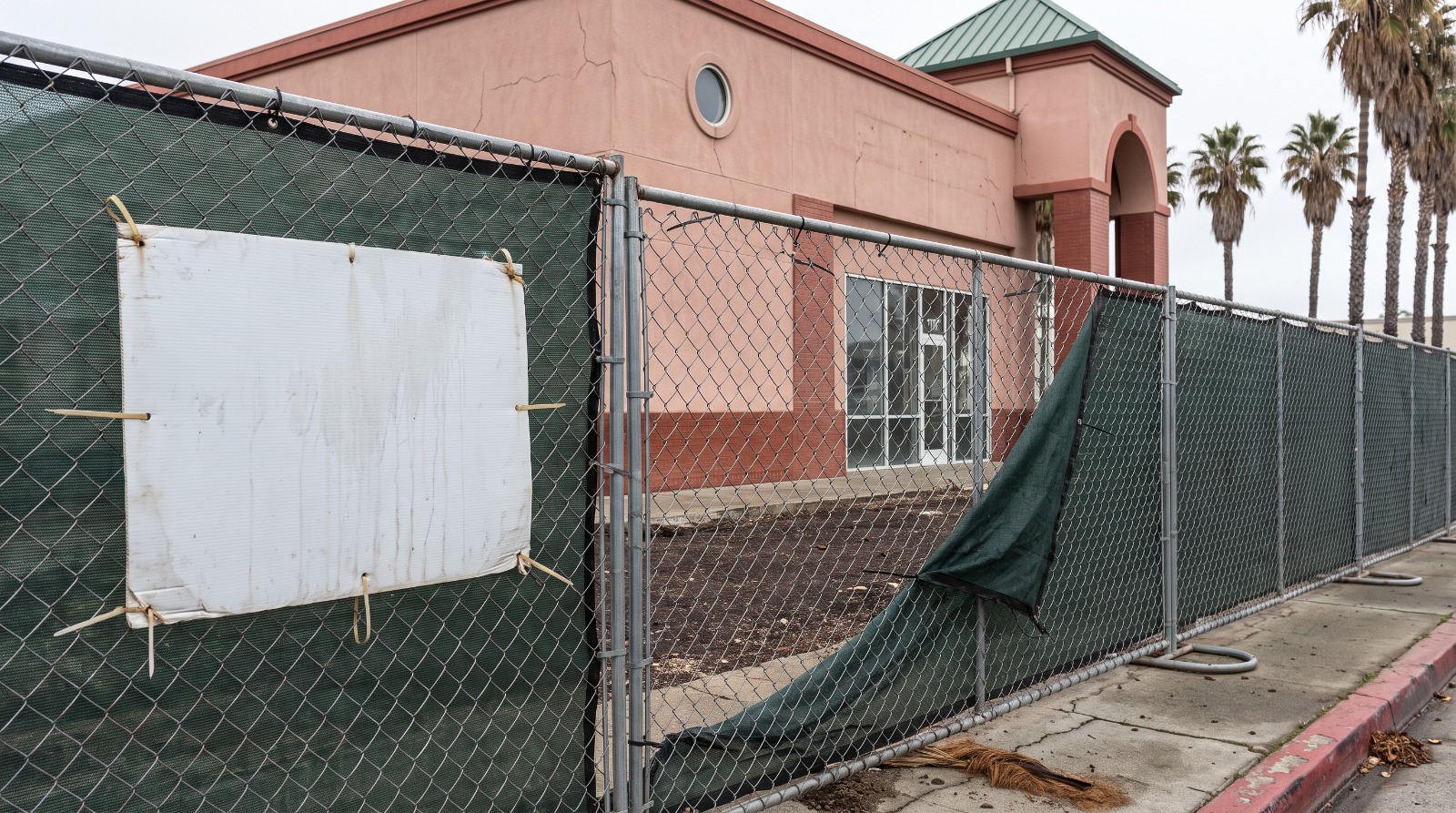
AI-rendered detail of the green-screened fence and a blank notice board along the WellSpace Health property on Stockton Boulevard in Sacramento Photo: Houseberry
The storefront glass at 6760 Stockton Boulevard stays. The permit says so. Behind it, WellSpace Health plans a sobering center, a peer-run crisis respite, a detox clinic and, upstairs, a 988 crisis call center built with the state's Office of Emergency Services. Next door at 6800, a new two-story building would hold 200 residential treatment beds.
Neither building gets a public hearing.
Two notices the City of Sacramento filed with the county clerk on October 29, for the treatment center and the crisis center, explain why. State grant money pays for both, and state law makes grant-funded treatment buildings a permitted use, with no conditional use permit and no discretionary review.
This is a story about who gets a say over a treatment campus in Little Saigon, and where that say went. We covered what WellSpace filed in our October 13 look at the campus. For people in Lemon Hill, Fruitridge Manor and the blocks around the lot, the city's hearing room is not where any of this gets decided.
One paragraph of state law took the hearing off the calendar
Both planning files, PLN26-01279 and PLN26-04125, opened as requests for site plan and design review, the step where the city can ask for changes to a building's layout and look. The notices close that step before it starts.
The reason is section 5960.3. A project paid for by the state's Behavioral Health Continuum Infrastructure Program is "deemed consistent" with local plans and "allowed as a permitted use" in its zone, and no city may require a conditional use permit or any other discretionary review. So the notices conclude that neither project needs a permit under Title 17, Sacramento's zoning code.
No discretion also means no environmental review. Both notices check the "ministerial" box under section 15268 of the state's environmental review guidelines, the exemption for approvals where staff only confirm that fixed rules are met.
The statute carries its own environmental exemption too, with nine conditions, among them prevailing wages, a 30-year covenant keeping the building in treatment use and no growth in the site's developed footprint. That last one would be hard to square with a new 53,400 square foot building on a cleared lot. The notices skip it.
Filing a notice of exemption also starts a legal clock. State law generally gives anyone who disputes an exemption 35 days from the filing to sue, a deadline the California Supreme Court enforced in a 2010 Stockton case. Counted from October 29, that runs to Thursday, December 3.
A sobering center and a 988 line behind the old storefront
One building is new and residential, with 200 beds. The other is a remodel built around stays of 24 hours or less.
| Filing | 6800 Stockton Blvd | 6760 Stockton Blvd |
|---|---|---|
| Planning file | PLN26-01279 | PLN26-04125 |
| Building | New, two stories, about 53,400 sq ft | Existing, two stories, 32,000 sq ft |
| Lot | 3.17 acres | 3.67 acres |
| Inside | 200 residential beds and a separate detox wing for men | Sobering center, crisis respite, outpatient detox and clinic, 988 center upstairs |
| City permit value | $30,171,943 | $11,537,996 |
| Status on Oct. 31 | Plan check | Plan check |
The crisis center work covers 28,802 square feet, by the city's permit record. On the first floor the notice lists a sobering center, peer crisis respite, a certified community behavioral health clinic, outpatient detox, addiction medication through an on-site federally qualified health center and an "Integrated Resource Center." Upstairs, the 988 center builds on work WellSpace already does, answering 988 calls, texts and chats around the clock for the Greater Sacramento region.
WellSpace's August 3 announcement also promised the campus a second site for its Crisis Receiving for Behavioral Health program, a voluntary stay of about 4 to 12 hours for someone in a mental health or drug crisis. The first site runs 16 chairs at 70 percent average occupancy, according to a May 20 letter from the county's Behavioral Health Commission. About 10 percent of patients arrive with police, and 15 to 20 percent come in between 10 at night and 5 in the morning.
The 6810 demolition has no building in it
The largest figure in the September permits, a 138,085 square foot demolition at 6810 Stockton Blvd, is the lot itself.
The treatment center notice puts the parcel at 3.174 acres, about 138,000 square feet. The site wrecking permit, issued September 11 to Legacy Stone Works, says its scope "only includes site demo" and that there is no building on site. Its $5,468,156 value matches, to the dollar, the site permit for grading, a new sewer main and a surface parking lot, which was still waiting for plan check on October 31.
Cars will reach the treatment building from Stockton Boulevard and Riza Avenue, the notice says. No new WellSpace permit has appeared on the lot since our October count of about $67.5 million.
The address 6810 is also where Sacramento County lists its Safe Stay site, 155 cabins for up to 175 adults. Neither notice mentions the cabins, and the county's page gives no closing date.
The county budget is where this campus can stall
We think the state was right to take the hearing off the table.
Sacramento's 988 line went from 16,115 calls in 2024 to 27,737 in 2025, about 76 a day, and the crisis chairs WellSpace already runs sit 70 percent full on average. A hearing on a lot WellSpace says sat vacant for more than a decade would mostly have added months.
The trade-off lands on the shops across Stockton Boulevard. A conditional use permit is where a city usually writes in conditions such as a security plan, lighting or a contact line for neighbors, and that lever is gone unless WellSpace offers those things on its own.
The bigger risk is operating money. State grants build rooms. They do not pay the overnight nurse. Sacramento County ended its $915,000-a-year contract supporting WellSpace's 988 work on July 1, amid what the commission calls a projected $101 million structural deficit, and in a June 4 reply declined to restore it. The commission also says Medi-Cal leaves about a 35 percent gap in the crisis receiving program's costs, because overnight safety work such as nurse rounds is not billable.
That is where neighbors still have a voice, at the commission, which took public comment on WellSpace's 988 money in May, and at the Board of Supervisors, which sets the budget. District 2 Supervisor Patrick Kennedy said in the county's release on the April 7 groundbreaking for the campus's first building that "investments like this help ensure our community members can get the care and support they need." We found no public statement on either notice from Councilmember Eric Guerra, whose District 6 includes the lot.
The Riza Avenue end of Little Saigon
The lot sits at Riza Avenue, one end of the stretch to 47th Avenue that the city calls the heart of the Little Saigon corridor. The city plans a $2.2 million gateway landmark there, with construction set for March 2027 through June 2028, inside the two-year window WellSpace gave in August for the 200-bed program and the crisis center.
Houseberry scores six neighborhoods within about a mile of the lot, and none ranks in the top third of the city's 185 on our overall score. Florin is highest at 70th and Lemon Hill lowest at 143rd. Five of the six rank 144th or lower on amenities, by Houseberry's analysis of its Sacramento ranking in October 2026. Houseberry's Lemon Hill page names this stretch of Stockton Boulevard, with its pho shops, taquerias and international groceries, as the neighborhood's eastern edge.
December 3 is the date with a stake. If no one sues by then, the 200 beds at 6800 wait only on the city's plan checkers, and the fight over whether the campus works moves to the county budget. Before then, see where Lemon Hill, Florin and the rest of South Sacramento land on Houseberry's Sacramento neighborhood ranking.
Sources
- Notice of Exemption, WellSpace treatment center, SCH 2026101250
- Notice of Exemption, WellSpace CRISIS Center, SCH 2026101251
- Welfare and Institutions Code section 5960.3
- City of Sacramento permits applied, WellSpace projects
- City of Sacramento permits issued, WellSpace projects
- Sacramento County Behavioral Health Commission letter, May 2026
- Sacramento County Behavioral Health Services reply, June 2026
- WellSpace Health crisis system
- WellSpace Health campus announcement, August 2026
- Sacramento County groundbreaking release, April 2026
- City of Sacramento Little Saigon Gateway fact sheet
- Sacramento County Stockton Boulevard Safe Stay
- Stockton Citizens for Sensible Planning v. City of Stockton (2010)
The Houseberry Research Team is Houseberry's reporting team: Bay Area real estate analysts, data specialists and longtime local market watchers. Every day we check the public record: building permits, city council and planning agendas, county recorder filings, state housing bills, police incident data and school results. Then we tie each story to what it means for specific neighborhoods, using Houseberry's own neighborhood data on prices, appreciation, safety, schools and amenities. Questions or corrections: Contact us.
Map of Sacramento Neighborhoods
Loading map...
View Full Map
Top Neighborhoods in Sacramento, CA



All information provided on this website including but not limited to - school ratings, safety, amenities, user opinions, and property data - is for general informational purposes only. We do not guarantee its reliability, accuracy, or completeness. Users should independently verify information and consult appropriate professionals as needed. By using this website, you agree Houseberry is not responsible for actions, decisions, or consequences arising from reliance on the information provided
houseberry.com - CA DRE# 01847391
 Bay East ©2025. CCAR ©2025. bridgeMLS ©2025. Information Deemed Reliable But Not Guaranteed. This information is being provided by the Bay East MLS, or CCAR MLS, or bridgeMLS. The listings presented here may or may not be listed by the Broker/Agent operating this website. This information is intended for the personal use of consumers and may not be used for any purpose other than to identify prospective properties consumers may be interested in purchasing. Data last updated at November 2, 2026 12:00 AM