Pasadena moves to ban data centers except on its campuses
Pasadena's proposed zoning would ban commercial data centers citywide and allow only campus facilities at colleges and hospitals, at least 100 feet from homes. Here is what the rule does, why the city wrote it, and the neighborhoods closest to the campuses.

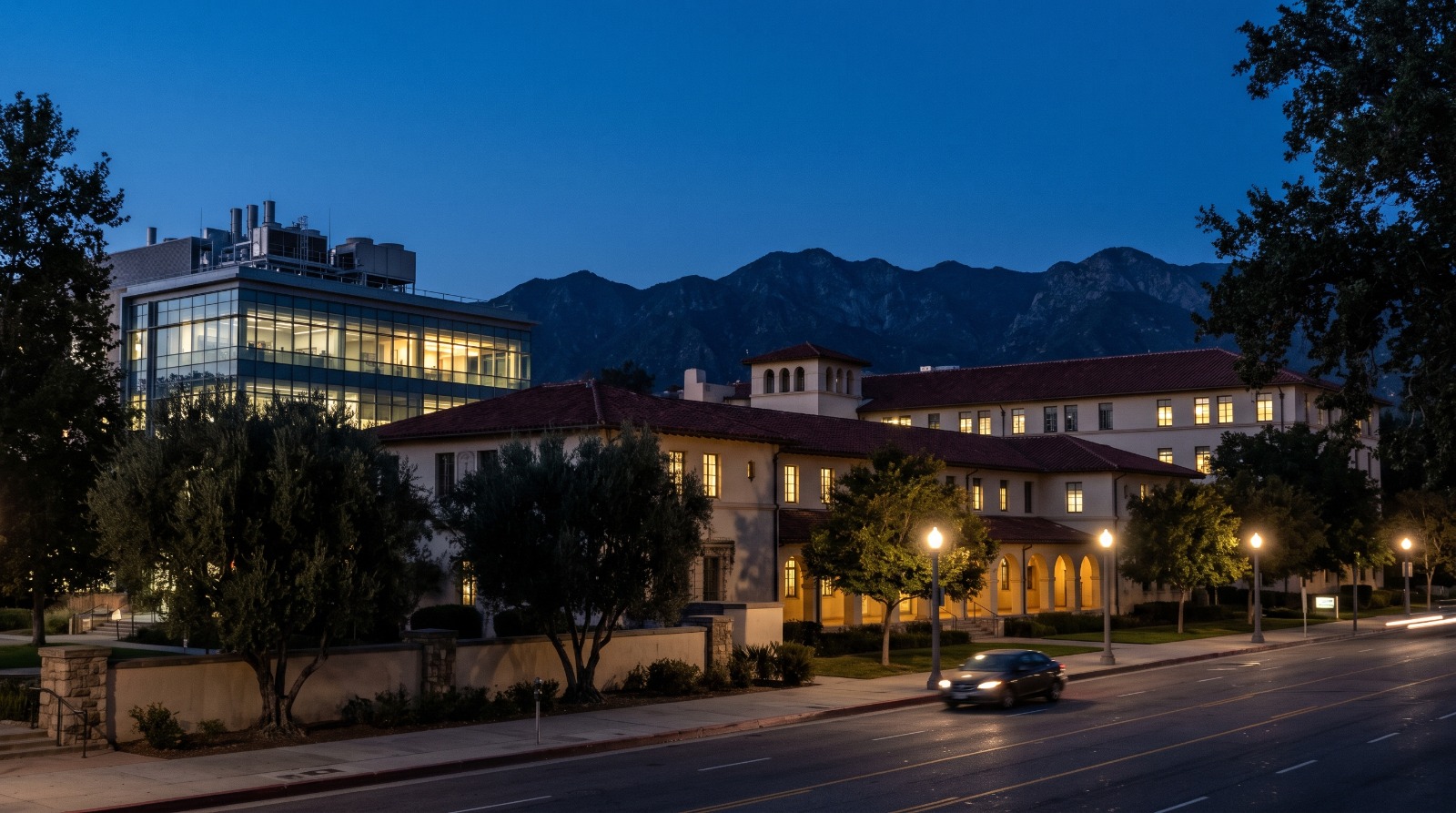
AI-generated blue-hour view of a Pasadena university campus edge on California Boulevard with the San Gabriel Mountains behind Photo: Houseberry
Pasadena wants to keep commercial data centers out of the city entirely and let only its colleges and hospitals run them, behind a 100-foot buffer from the nearest home. The zoning change went to the Planning Commission on Wednesday, Nov. 18, according to Pasadena Now, and goes to the City Council next if the commission endorses it.
For a homeowner, the plain outcome is this. A server warehouse cannot be built on an industrial lot down the street from you. The ones that can be built would sit on a short list of campuses, including Caltech, ArtCenter, Fuller Seminary, Huntington Memorial Hospital and Las Encinas Hospital.
That matters in a city where the typical home sold for about $1.32 million in October 2026, according to Houseberry's Pasadena price history, and where the city owns its own electric utility.
Why the city is writing this now
Pasadena's zoning code never defined a data center. That gap technically makes them an unpermitted use, but it also leaves room for a developer to call one an office or a research lab. Acting Planning Director Jason Mikaelian wrote this summer that the city should add a clear definition even if data centers stay banned everywhere, Pasadena Now reported in July.
The power numbers drove the rest. City staff estimate that a 10,000-square-foot data center can draw up to 10 megawatts, about the annual electricity use of 8,000 households. Pasadena Water and Power briefed the council on demand in March. In April the council's housing and planning committee raised water and power strain and the thin community benefit.
The staff report's conclusion is blunt: data centers "offer limited economic advantages for Pasadena." Economic development staff found no meaningful job gains or spillover for local businesses.
Who lives next to the campuses
The facilities this ordinance would still allow sit on campuses that border residential blocks. Houseberry scores 24 Pasadena neighborhoods. Two of the closest to Caltech and Huntington Hospital are South Lake and Madison Heights, and they score identically on two of our measures while their prices differ by almost $300,000.
| Neighborhood | Houseberry overall | Safety | Typical price, Oct. 2026 |
|---|---|---|---|
| South Lake | 3.2 | 3.8 | $770,000 |
| Madison Heights | 3.2 | 3.8 | $1.06 million |
| Pasadena citywide | $1.32 million |
The 100-foot buffer and the noise study are aimed at exactly these streets. Cooling equipment hums around the clock. A rooftop chiller array on a lab building is a different neighbor than a library.
We think Pasadena drew the line in the right place. A city with its own utility has to plan every new megawatt itself, and a 10-megawatt building that employs a handful of people is a poor trade for a grid that also has to carry heat pumps, EV chargers and new apartments. Keeping computing tied to Caltech's and the hospitals' own work is a reasonable compromise.
The counter-case deserves a hearing. Caltech is one of the country's top research universities, and modern research runs on computing. A rule that caps how a campus can grow its own capacity could push work to other cities. The ordinance answers that by allowing campus facilities, and the conditional use permit is where the fight over size will happen.
Pasadena is not alone. Monterey Park voters approved a ban on certain large data centers in June with 88 percent support, and Alhambra adopted a prohibition that voters affirmed this month with 83 percent. Seven new state data center laws take effect Jan. 1. We have tracked the same fight in the Bay Area, from Gilroy's moratorium to what host towns say about home values.
When the council takes this up, the question for residents near the campuses is the buffer. Check how every Pasadena neighborhood scores and where yours sits relative to Caltech and the hospitals.
Sources
The Houseberry Research Team is Houseberry's reporting team: Bay Area real estate analysts, data specialists and longtime local market watchers. Every day we check the public record: building permits, city council and planning agendas, county recorder filings, state housing bills, police incident data and school results. Then we tie each story to what it means for specific neighborhoods, using Houseberry's own neighborhood data on prices, appreciation, safety, schools and amenities. Questions or corrections: Contact us.
Map of Pasadena Neighborhoods
Loading map...
View Full Map
Top Neighborhoods in Pasadena, CA



All information provided on this website including but not limited to - school ratings, safety, amenities, user opinions, and property data - is for general informational purposes only. We do not guarantee its reliability, accuracy, or completeness. Users should independently verify information and consult appropriate professionals as needed. By using this website, you agree Houseberry is not responsible for actions, decisions, or consequences arising from reliance on the information provided
houseberry.com - CA DRE# 01847391
 Bay East ©2025. CCAR ©2025. bridgeMLS ©2025. Information Deemed Reliable But Not Guaranteed. This information is being provided by the Bay East MLS, or CCAR MLS, or bridgeMLS. The listings presented here may or may not be listed by the Broker/Agent operating this website. This information is intended for the personal use of consumers and may not be used for any purpose other than to identify prospective properties consumers may be interested in purchasing. Data last updated at November 19, 2026 12:00 AM