Which Bay Area cities have paused new data centers, with dates
Gilroy just extended its data center pause to September 2027. The running list of every Bay Area city that has paused new data centers, what each one stops, and who is writing rules instead.

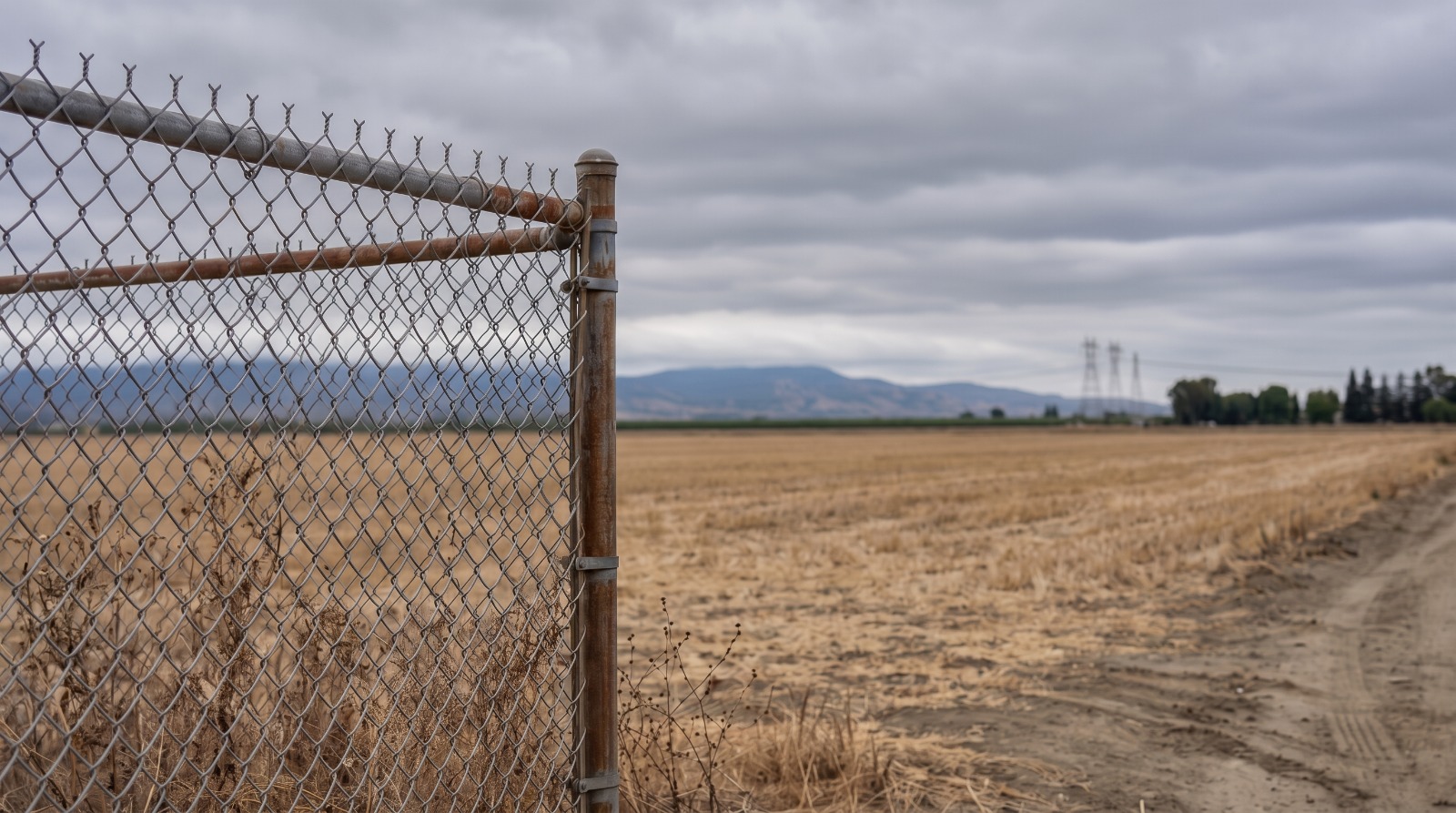
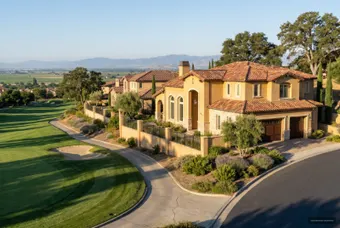
AI-rendered view of vacant land near Highway 152 and Camino Arroyo in Gilroy, where a second data center was proposed before the city's pause Photo: Houseberry
Gilroy's City Council voted unanimously on Oct. 19 to keep its ban on new data centers in place until Sept. 3, 2027, San Jose Spotlight reported. Amazon's data center on 56 acres at 8050 Camino Arroyo keeps building. A second proposal, at Highway 152 and Camino Arroyo about a mile southeast, stays frozen at the pre-application stage.
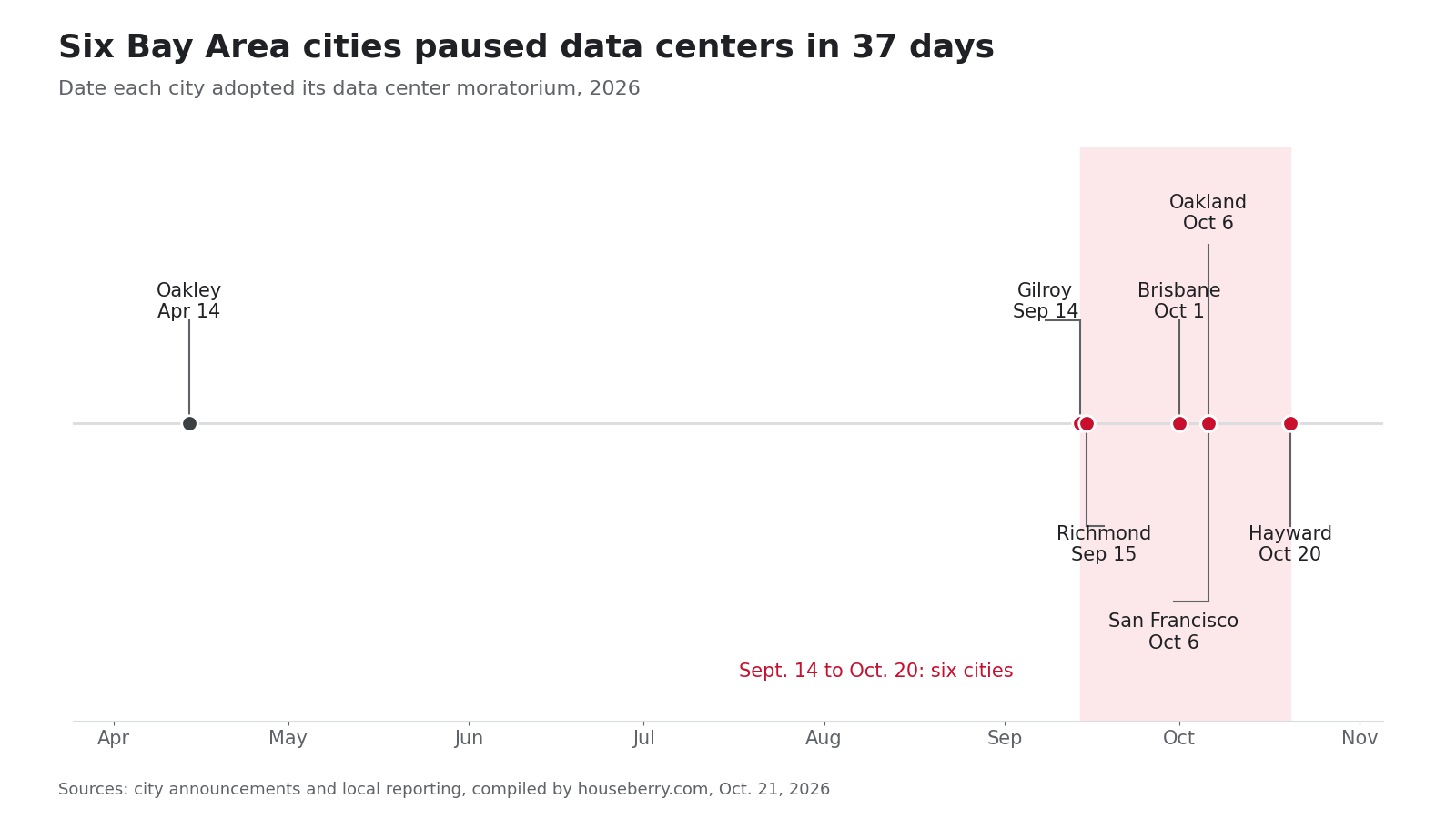
Gilroy is one of seven Bay Area cities that have adopted a data center pause in 2026, by our count. Six of them did it in the 37 days between Sept. 14 and Oct. 20. This post is the running list, with dates, votes and what each one actually stops, and we will keep it current.
The nearest homes to Gilroy's two sites are west of Highway 101. In Las Animas, about 0.9 miles from the Amazon site, Houseberry's price history put the median home at about $1.01 million in August 2026.
The tracker, as of Oct. 21
| City or county | Adopted | Runs until | Vote | What it stops |
|---|---|---|---|---|
| Oakley | April 14, 2026, extended May 12 | April 14, 2027 | 5-0 both times | Any data center land use application |
| Gilroy | Sept. 14, 2026, extended Oct. 19 | Sept. 3, 2027 | Unanimous both times | New data centers citywide. Amazon's Camino Arroyo build is exempt |
| Richmond | Sept. 15, 2026, extended Oct. 20 | About 22 more months | 6-1 on the first vote | Approvals and permits. Applications can still be filed |
| Brisbane | Oct. 1, 2026 | About mid-November | Unanimous | New data centers. None are proposed |
| San Francisco | Oct. 6, 2026, signed Oct. 16 | 45 days, extendable | Unanimous | New data centers and expansions of existing ones |
| Oakland | Oct. 6, 2026 | About Nov. 20 | 7-0 | Data center land use approvals |
| Hayward | Oct. 20, 2026 | 45 days, extendable | Not yet posted | New data centers citywide |
Just outside the region, San Joaquin County adopted a 45-day pause for its unincorporated land on Oct. 6. Brentwood is studying rules that could include a ban.
The dates come from each city's announcements and local reporting, listed in the sources below. Hayward's approval was reported by NBC Bay Area on Oct. 21, and the city had not posted the vote count when we checked.
How a California pause works
A city adopts the pause as an urgency ordinance under Government Code section 65858. It needs a four-fifths vote and lasts 45 days. After a public hearing, the council can extend it once for 10 months and 15 days and once more for a year, for two years total. Richmond used a different path in the same law, a single extension of 22 months and 15 days.
The catch is the finding. The council has to declare a "current and immediate threat to the public health, safety, or welfare." In August a judge tentatively ruled that Imperial County had not shown one for its data center pause, KPBS reported. The ruling was not final, but it is the legal soft spot every city on this list shares.
Oakland's vote shows how tight the math can be. With eight council seats, four-fifths is seven votes, and the pause passed 7-0 with one member absent. We covered that night in our Oakland post.
Why so many, so fast
Power is the short answer. PG&E's pipeline of proposed data center load reached 12.7 gigawatts at the end of June, up from 5.1 gigawatts in March, according to Insurance Journal. In Santa Clara, where the city runs its own utility, data centers use about 54 percent of the city's electricity, and Silicon Valley Power stopped taking new data center hookup requests in 2023, KQED reported.
Then come the neighbor issues. Backup diesel generators. Water for cooling. A constant fan hum, which is why San Jose holds commercial noise to 55 decibels at a property line shared with homes, a rule we explained in our San Jose noise post.
Gilroy had a simpler problem. The city does not define a data center as a land use at all. The Amazon project was approved by the community development director with no council vote, and the pause buys time to write zoning, noise, water and generator standards.
Where the Gilroy sites sit
All five Gilroy neighborhoods closest to the two sites are on the far side of Highway 101, with outlets, the Kaiser campus and big-box retail in between. Las Animas is closest at 0.9 miles. Harvest Park, 1.2 miles north of the Amazon site, had a typical home price of about $1.02 million in September 2026 in Houseberry's data. Downtown Gilroy, a mile southwest, was about $925,000.
Those neighborhoods score between 2.1 and 3.5 out of 5 overall on Houseberry's Gilroy rankings. Our September look at the Amazon site has the distances for every one.
Our view
A pause that ends in written rules is good government. Gilroy, Oakland and San Francisco all started this year with no clear standard for a building that can draw as much power as a small city, and 45 days to write one is not enough. Ten months is.
The risk is the pause that never ends. Monterey Park, in Los Angeles County, turned its moratorium into a permanent ban by ballot in June. A ban does not make the demand go away. It moves the load, the generators and the tax revenue to the next city down the road. We would rather see Gilroy finish its standards before Sept. 3 and let the Highway 152 project apply under them.
Who is not pausing
Santa Clara, home to nearly 60 data centers, debated a moratorium this month and instead told staff to tighten its air and water rules, KQED reported. San Jose is drafting standards that would cap generator testing at 25 hours a year and widen the notice radius to 1,500 feet, and city officials said a moratorium is not under consideration. Fremont allows data centers in industrial zones and has none proposed, the city says.
San Mateo County's study is aimed at North Fair Oaks, where server farms are allowed in industrial zones without a use permit today. We mapped the blocks it would touch in our San Mateo County post.
If you live near one of these sites, the next dates that matter are Oakland's about Nov. 20, when its 45 days run out, and Pittsburg's first vote. Before then, you can see how your neighborhood scores against the rest of the South County on Houseberry's Silicon Valley rankings, or find your block on the Houseberry map.
Sources
- San Jose Spotlight, "Gilroy extends moratorium on data center projects," Oct. 20, 2026
- Gilroy Dispatch, original Gilroy moratorium, Sept. 15, 2026
- Contra Costa News, Oakley moratorium and extension, April 15 and May 16, 2026, and Richmond moratorium, Sept. 16, 2026
- City of Richmond, Data Center Moratorium and Study page
- City of Brisbane news release, Oct. 16, 2026
- Mission Local, Oct. 6, 2026, and SF Standard, Oct. 16, 2026, on San Francisco
- KTVU, Oakland moratorium, Oct. 6, 2026
- NBC Bay Area, East Bay data center pauses, Oct. 21, 2026
- Local News Matters, Pittsburg and San Mateo County, Oct. 21, 2026
- KQED on Santa Clara, Oct. 8, 2026, and San Jose, Oct. 16, 2026
- KPBS on Imperial County, Aug. 28, 2026, and Planetizen on Monterey Park, June 7, 2026
- Cox Castle summary of the Sept. 21, 2026 data center bills
- California Government Code section 65858
- Houseberry neighborhood scores and price history, October 2026
The Houseberry Research Team is Houseberry's reporting team: Bay Area real estate analysts, data specialists and longtime local market watchers. Every day we check the public record: building permits, city council and planning agendas, county recorder filings, state housing bills, police incident data and school results. Then we tie each story to what it means for specific neighborhoods, using Houseberry's own neighborhood data on prices, appreciation, safety, schools and amenities. Questions or corrections: Contact us.
Map of Gilroy Neighborhoods
Loading map...
View Full Map
Top Neighborhoods in Gilroy, CA



All information provided on this website including but not limited to - school ratings, safety, amenities, user opinions, and property data - is for general informational purposes only. We do not guarantee its reliability, accuracy, or completeness. Users should independently verify information and consult appropriate professionals as needed. By using this website, you agree Houseberry is not responsible for actions, decisions, or consequences arising from reliance on the information provided
houseberry.com - CA DRE# 01847391
 Bay East ©2025. CCAR ©2025. bridgeMLS ©2025. Information Deemed Reliable But Not Guaranteed. This information is being provided by the Bay East MLS, or CCAR MLS, or bridgeMLS. The listings presented here may or may not be listed by the Broker/Agent operating this website. This information is intended for the personal use of consumers and may not be used for any purpose other than to identify prospective properties consumers may be interested in purchasing. Data last updated at October 22, 2026 12:00 AM