Gilroy Amazon Data Center: 56 Acres Off Camino Arroyo
Amazon's Gilroy data center covers 56 acres at 8050 Camino Arroyo and was approved by a staff signature, not a council vote. Here is the site, the process, the Map Act fight, and which Gilroy neighborhoods actually sit closest to it.
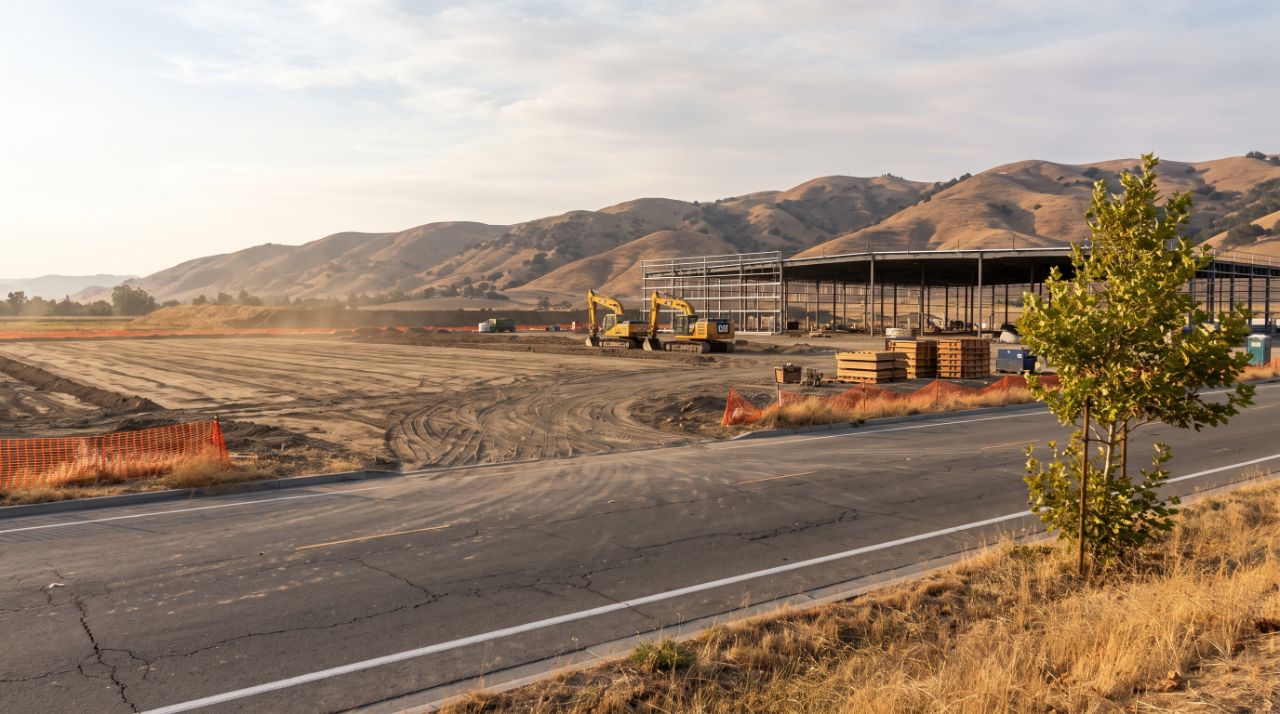
Graded construction site off Camino Arroyo in east Gilroy where Amazon's data center is being built. Photo: Houseberry
Assessor's parcel 841-69-044 is 56 acres of flat former farm ground on the east side of US 101, and Amazon Data Services bought it in 2020 for $31.28 million. What is going up on it is the Gilroy data center: two single-story data halls and a small security building, about 438,500 square feet in all, with each hall wired for up to 49 megawatts from PG&E. Gilroy's community development director approved the whole thing on July 3, 2025. The City Council never voted. That last sentence is why a good part of town is furious a year later.
One signature, one appeal, and no public hearing
The approval path here was legal, documented, and almost invisible. Community Development Director Sharon Goei signed off on July 3, 2025, after a draft environmental impact report released August 12, 2024 and a final EIR certified May 9, 2025. An appeal landed on July 21 and was withdrawn on August 18.
Then the permits. Grading on December 11, 2025, and the building permit on March 19, 2026. The city's own project page lists two impacts the EIR flagged as significant and unavoidable: the loss of prime farmland, and traffic that blows past Gilroy's vehicle-miles-traveled threshold.
Worth sitting with that second one. A building most people picture as empty racks humming in the dark still failed a driving test.
Why did Gilroy find out when the dirt started moving?
Because nothing in the process required telling anyone. Mayor Bozzo has said plainly that the city could not legally halt a permitted use on land zoned general industrial since 1981. By the time excavators showed up in December 2025, most residents had no idea what was coming.
The council's answer arrived on August 17, 2026, in a 6-1 vote rewriting the Architectural and Site Review process. Non-residential projects over 15,000 square feet now require a developer-hosted community meeting, mailed notice to owners and residents within 1,000 feet, newspaper notice, and documented outreach. Commercial and industrial projects that need an EIR now go to the planning commission.
Here is the part nobody said out loud. Draw a 1,000-foot ring around 8050 Camino Arroyo and it lands on outlet parking, Kaiser's campus, and six lanes of Highway 101. The mailed-notice rule, applied to this exact site, would have reached almost no Gilroy homeowner. The clause that would have changed this outcome is the last one, because this project had a full EIR and still never saw a dais.
The Map Act complaint, and what it could actually undo
The legal challenge is narrow and aimed at a five-year-old map, not the building. Gilroy resident Georgine Scott-Codiga, working through a group called Americans for Transparency, filed a complaint with the Santa Clara County Recorder arguing that a July 2020 lot line adjustment on the 66-acre Southpoint Business Park property amounted to an illegal subdivision. The 56-acre lot that came out of it is the one Amazon bought.
The city's position is arithmetic. Four lots existed before the adjustment and four after, with one relocated from the south end of the property to the north. City Attorney Andy Faber wrote that boundary lines moved without increasing the parcel count, so no hearing applied. City Administrator Matt Morley put it less formally to San José Spotlight: you can move lots around as long as the math works and you end up with the same number of lots. Scott-Codiga counters that the newly assigned APNs prove new parcels were created, and she has notified the district attorney and the state attorney general.
Being straight about the stakes: even a ruling in her favor is a finding about a 2020 map. It would not unbuild a data center holding a valid building permit since March. The realistic prize is precedent, not demolition.
Which Gilroy neighborhoods actually sit near Camino Arroyo
None of them abut it, and that single fact drives most of what follows. The parcel's neighbors are retail, a hospital campus and a freeway, so the nearest homes are a highway crossing away, not a fence line away.
We measured straight-line distance from the parcel to the center of each ranked Gilroy neighborhood on our Gilroy rankings. Five land inside a mile and a half, and the four closest all score at or below the citywide 2.7.
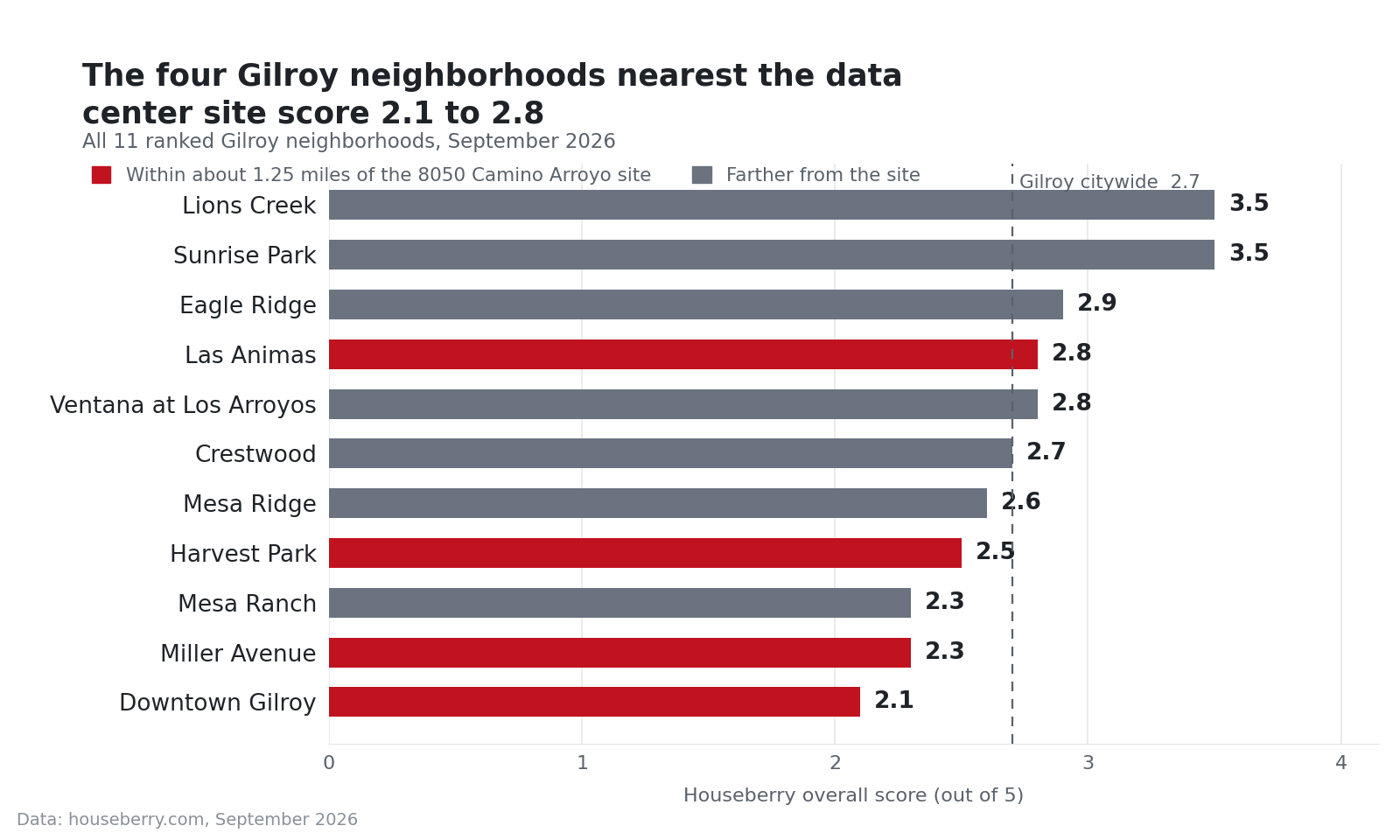
Prices below come from each neighborhood's own 12-month history, not the ranking snapshot.
| Neighborhood | Approx. distance from the site | Overall score | Median sale price |
|---|---|---|---|
| Las Animas | 0.9 mi northwest | 2.8 / 5 | $1.01M (Aug 2026) |
| Downtown Gilroy | 1.0 mi southwest | 2.1 / 5 | $935K (Jul 2026) |
| Miller Avenue | 1.1 mi west | 2.3 / 5 | $1.00M (Jul 2026) |
| Harvest Park | 1.2 mi north | 2.5 / 5 | $1.04M (Aug 2026) |
| Sunrise Park | 1.4 mi northwest | 3.5 / 5 | $1.27M (Aug 2026) |
Downtown Gilroy, the blocks along Monterey Street between Carmel and East 10th, is the closest thing to a walkable address in this city and scores 2.1 overall, dragged down by a 1.7 safety mark. Las Animas, the north-central pocket running east to Monterey Road, is the nearest neighborhood to the site and the best-scoring of the four at 2.8. Jump another quarter mile to Sunrise Park and the score leaps to 3.5 on a 4.4 safety rating, which tells you the gradient in Gilroy runs northwest, not toward or away from Camino Arroyo.
What does $1.16 million buy in Gilroy right now?
Less neighborhood than the same money buys one town north, and that gap is the real South County story. Gilroy's citywide median was about $1.16 million in August 2026, per our Gilroy city page. Its overall score is 2.7, last among the 18 Santa Clara County cities we score.
Run it against the neighbors. Morgan Hill sits at 3.3, San Jose 3.3, Campbell 3.5, Los Gatos 4.0 and Saratoga 4.1, an average of about 3.6 against Gilroy's 2.7. Morgan Hill's median was roughly $1.14 million, which is to say the price discount has mostly closed while the score gap has not. Buyers used to come south for cheaper. Now they come south for a bigger lot.
Does the data center move any of this? We went through what host towns report in our piece on whether data centers hurt home values, and adjacency does nearly all the work. A building across a freeway from the nearest bedroom is a different proposition from one across a street, the distinction we walked through in the 55-decibel rule for San Jose data centers. Here, the geography favors the project.
The honest downside is water and farmland, not property values. Phase 1 is projected to draw about 23 acre-feet of potable water a year until a recycled water connection arrives, anticipated by 2030, after which the city expects roughly 2 acre-feet. That is the number residents should hold the city to.
What lands on the council's desk next
No hearing date is set as of September 12, 2026. When the council passed the outreach rules in August it also directed staff to return with objective development standards governing the size, intensity and operational characteristics of projects like this one. That unscheduled item is the one to watch.
Morgan Hill did not wait. On August 26, 2026 its council unanimously adopted a 45-day moratorium on new data centers and battery storage, citing what happened next door. Gilroy has discussed one without adopting it, and our Oakland write-up covers what that tool does and does not freeze. Meanwhile the project is forecast to send about $40 million to Gilroy's general fund over its first decade, near $6 million a year once both phases run in 2037.
Gilroy is going to keep getting big industrial proposals, because it has the land and the freeway and the zoning, and we would rather see that land carrying homes like the Hecker Pass builder's remedy project than warehouses. If you are shopping South County, check the neighborhood before the listing, then check what is zoned across the nearest arterial. The surprise in Gilroy was never the building. It was that the map had already decided.
Sources
San José Spotlight, Amazon data center project in Gilroy upsets locals, September 9, 2026
City of Gilroy, Gilroy Data Center (by Amazon Web Services) project page
CEQAnet, Gilroy Data Center, SCH Number 2022110127
Gilroy Dispatch, City of Gilroy refutes accusation of Map Act violation at data center site
Gilroy Dispatch, Gilroy Council votes for more outreach on new projects
Morgan Hill Times, Morgan Hill declares moratorium on data centers, battery storage sites
Data Center Dynamics, Amazon Data Services gains approval for data center on 56 acres in Gilroy
Houseberry, Gilroy neighborhood rankings and city data, September 2026
Map of Gilroy Neighborhoods
Loading map...
View Full Map
Top Neighborhoods in Gilroy, CA



All information provided on this website including but not limited to - school ratings, safety, amenities, user opinions, and property data - is for general informational purposes only. We do not guarantee its reliability, accuracy, or completeness. Users should independently verify information and consult appropriate professionals as needed. By using this website, you agree Houseberry is not responsible for actions, decisions, or consequences arising from reliance on the information provided
houseberry.com - CA DRE# 01847391
 Bay East ©2025. CCAR ©2025. bridgeMLS ©2025. Information Deemed Reliable But Not Guaranteed. This information is being provided by the Bay East MLS, or CCAR MLS, or bridgeMLS. The listings presented here may or may not be listed by the Broker/Agent operating this website. This information is intended for the personal use of consumers and may not be used for any purpose other than to identify prospective properties consumers may be interested in purchasing. Data last updated at September 13, 2026 12:00 AM